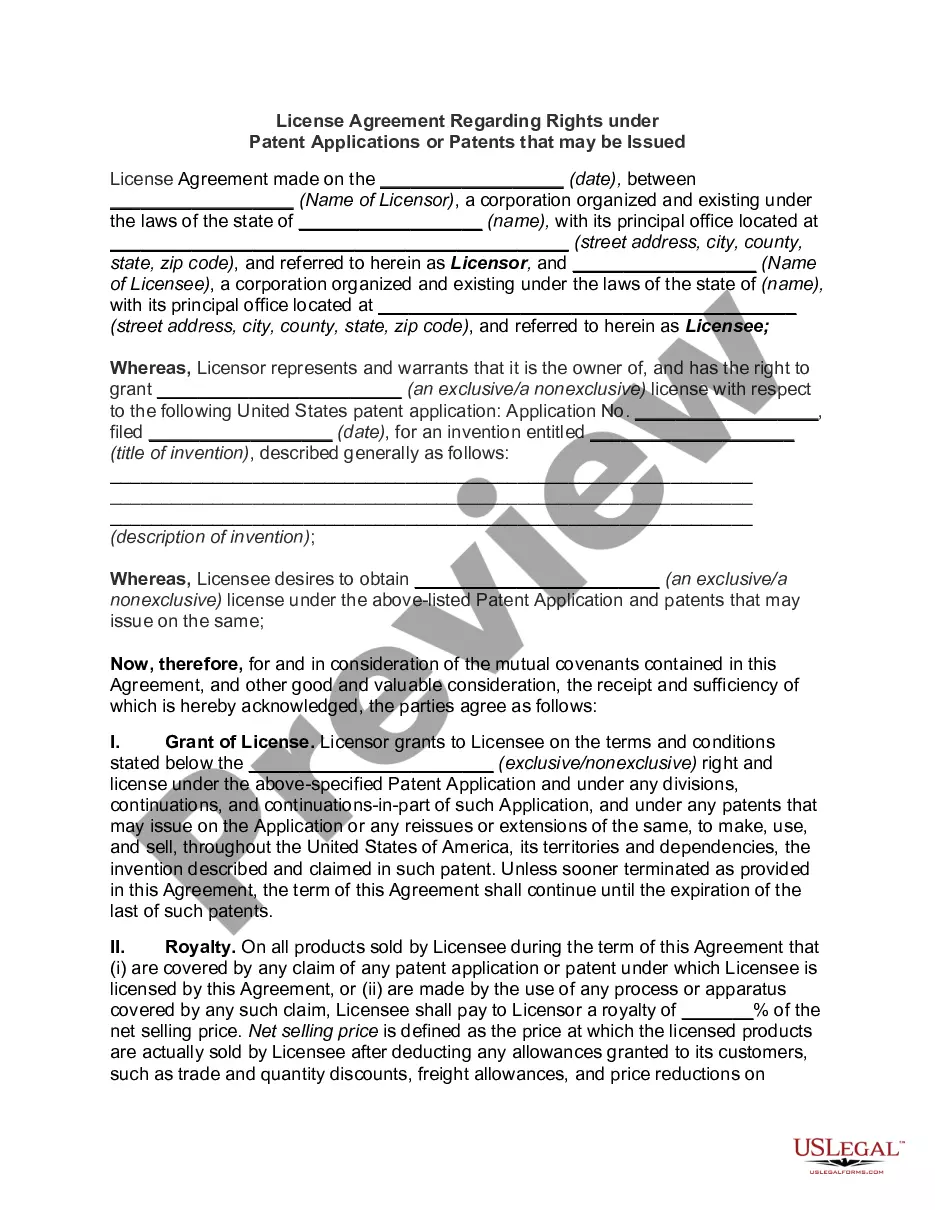
License Agreement Regarding Rights Under Patent Applications or Patents That May Be Issued
Overview of this form
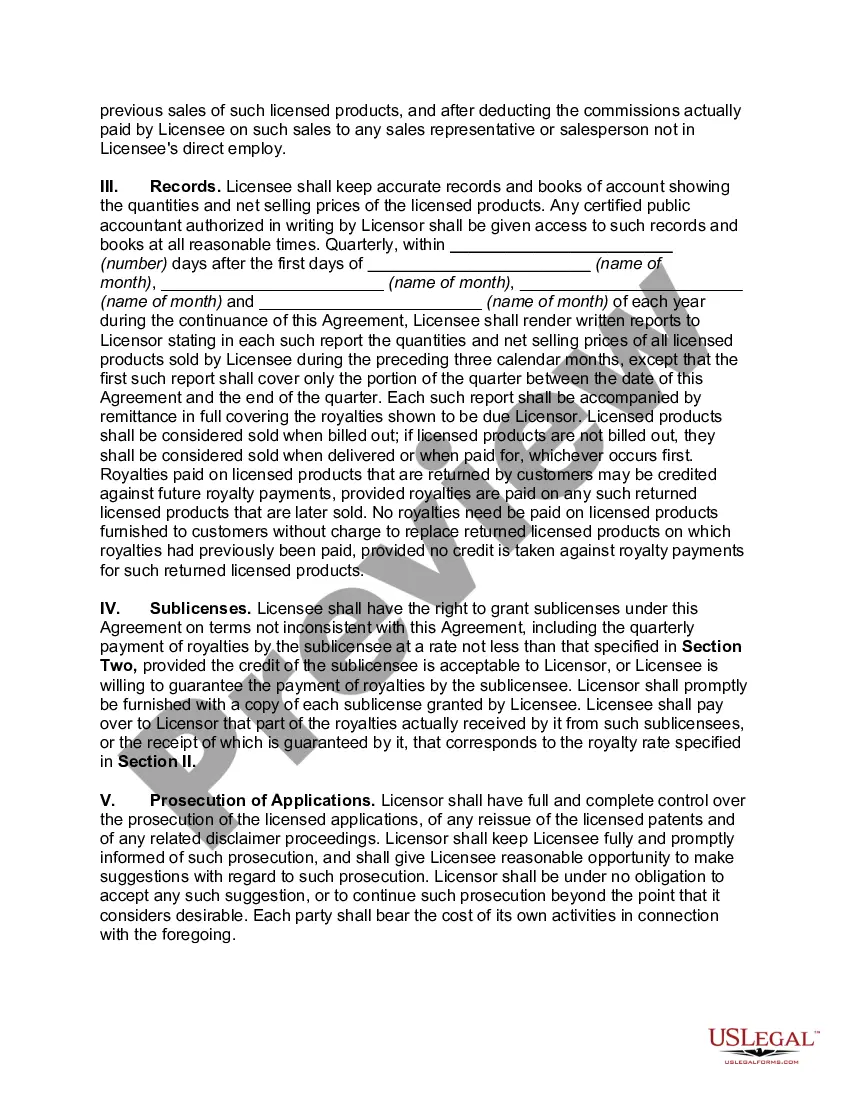
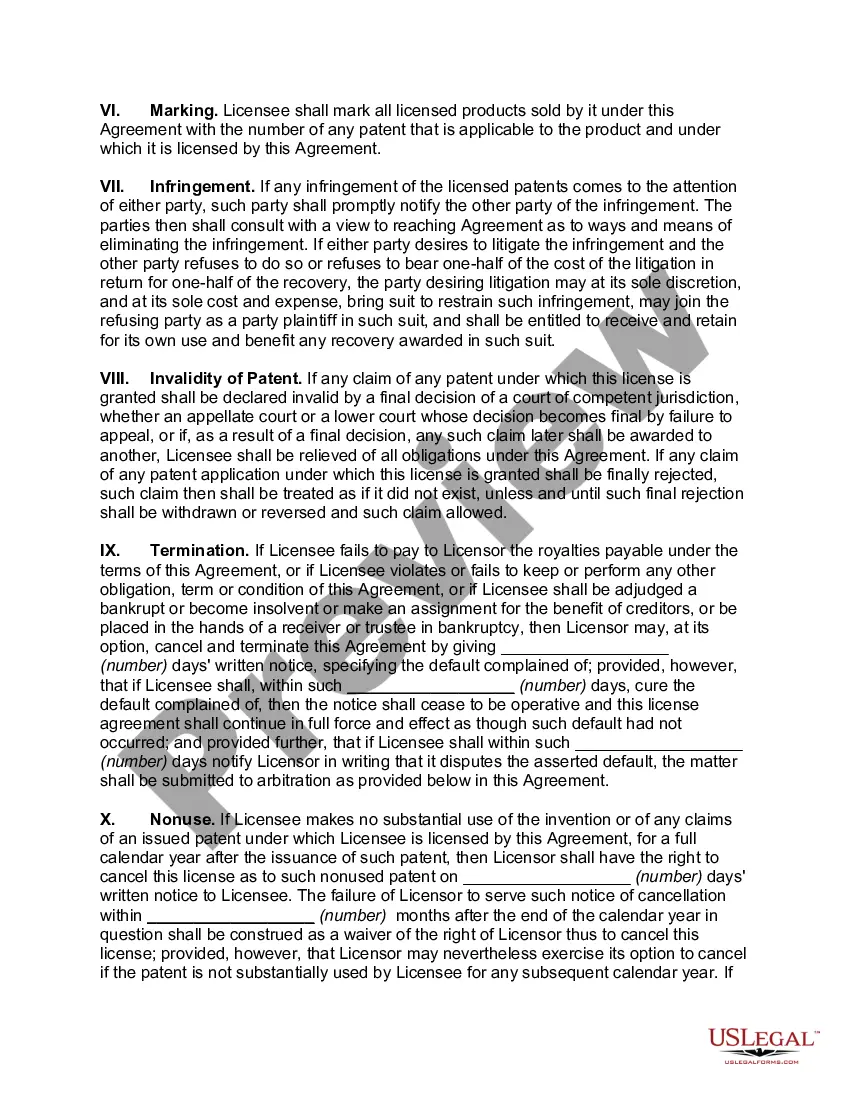
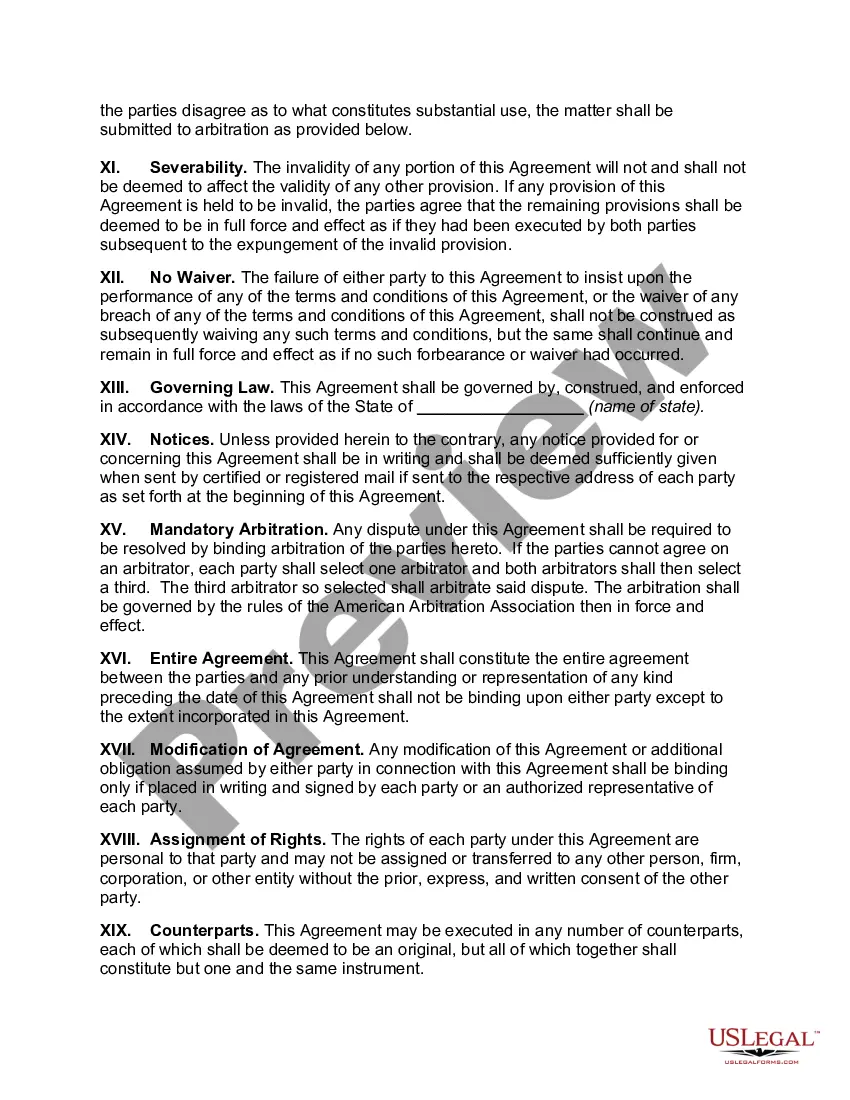
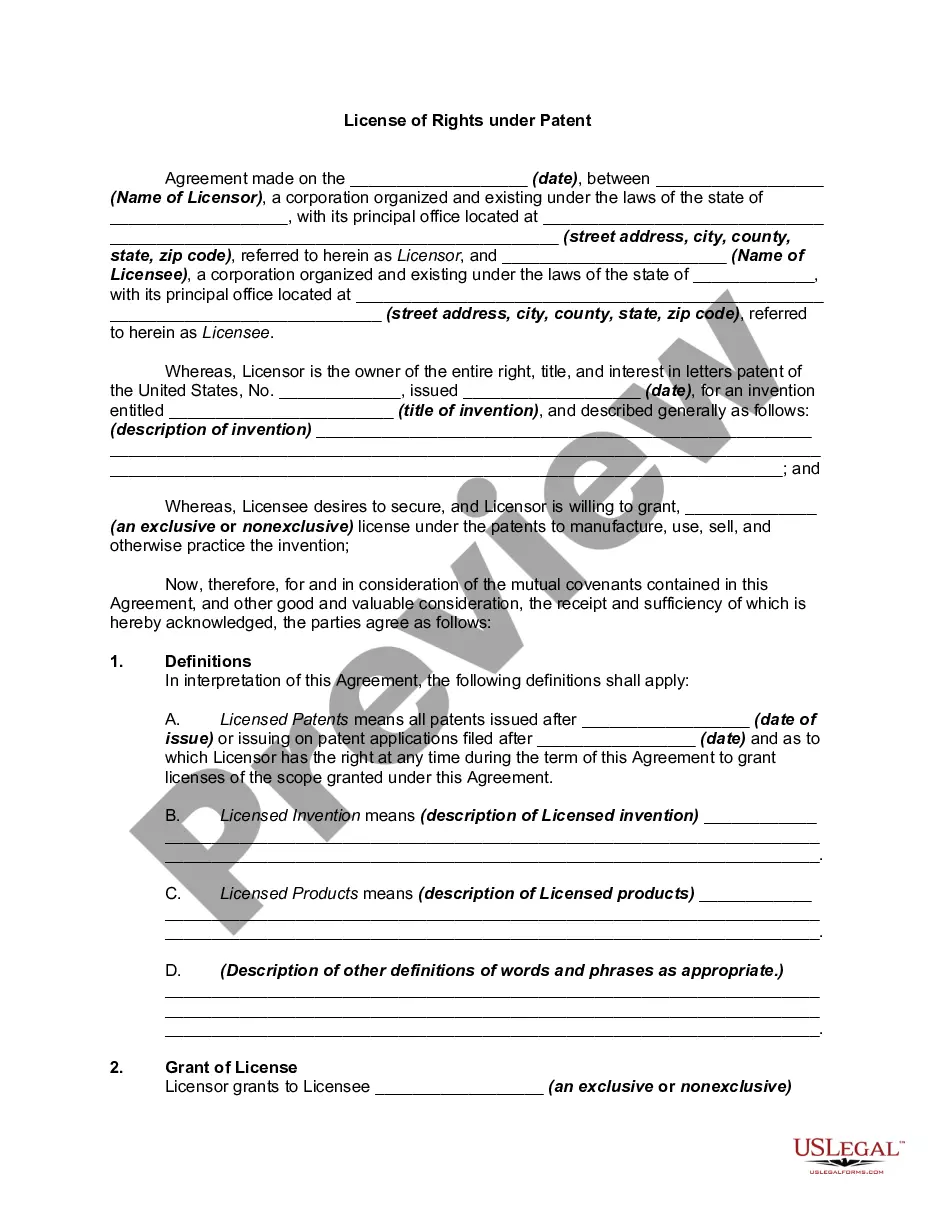
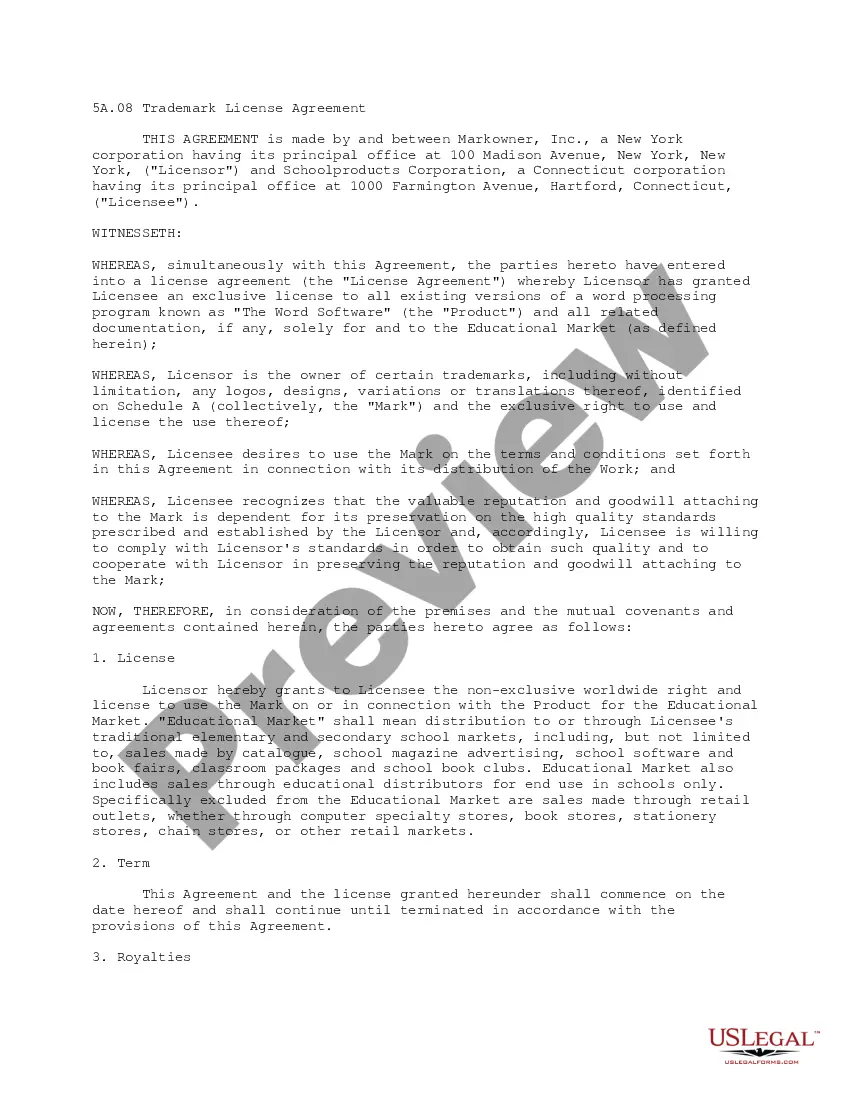
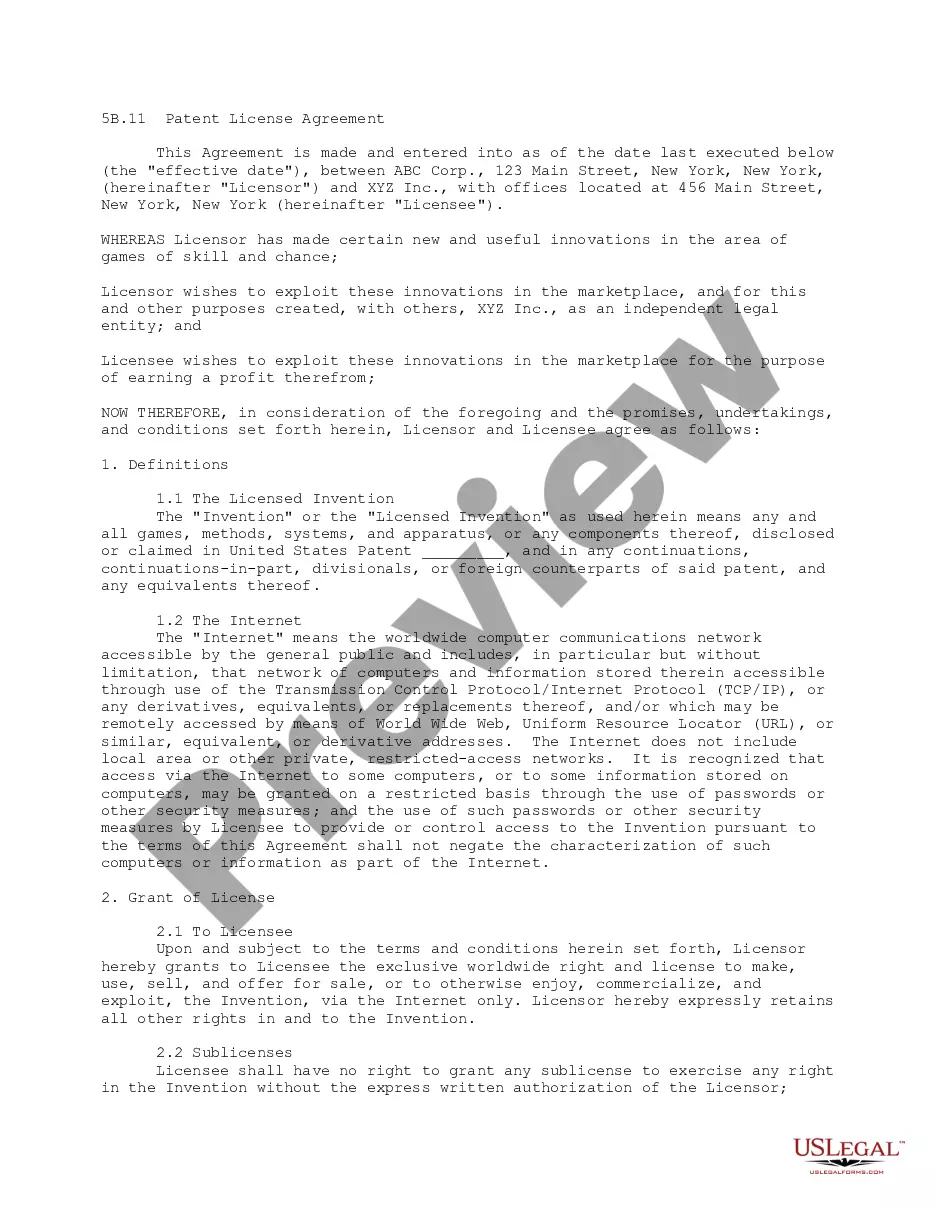
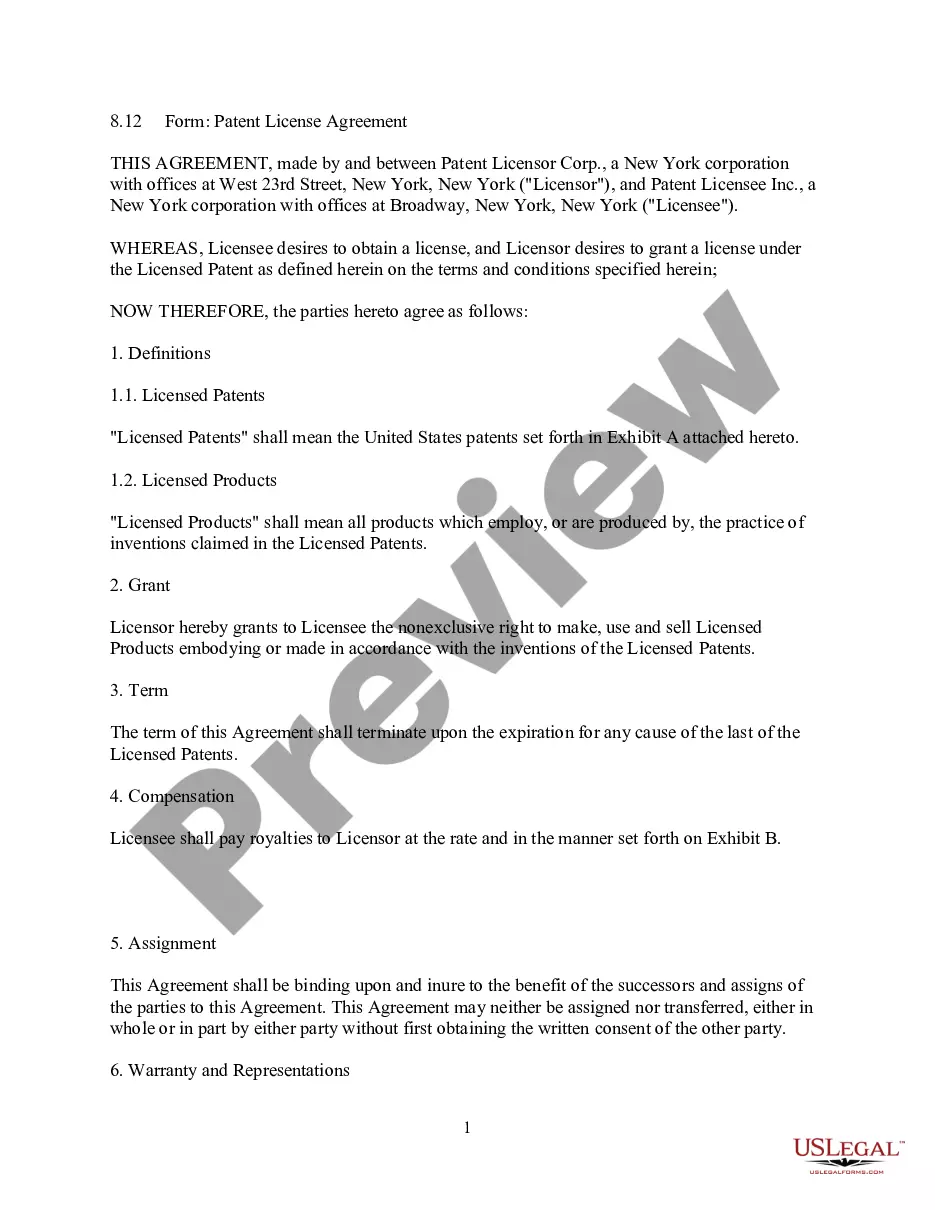
This License Agreement Regarding Rights Under Patent Applications or Patents That May Be Issued is a legal document that establishes the terms under which a Licensor grants a Licensee the rights to use, sell, or market inventions covered by specific patent applications or patents. This agreement outlines the licensing arrangement, rights granted, royalties, and other obligations of both parties. It is essential for businesses seeking to protect their intellectual property while allowing others to utilize their inventions under specific terms.
Main sections of this form
- Parties Involved: Identifies the Licensor and Licensee, including their addresses and corporate structure.
- Grant of License: Specifies whether the license is exclusive or nonexclusive, and outlines the rights granted for the patent application.
- Royalty Structure: Details the royalties that Licensee must pay to Licensor based on net selling price of products covered by the license.
- Record Keeping: Requires Licensee to maintain accurate records and provide periodic sales reports to Licensor.
- Termination Clauses: Outlines circumstances under which the agreement may be terminated by Licensor or Licensee.
- Dispute Resolution: Includes a mandatory arbitration clause for resolving disputes under the agreement.
When to use this form
This form should be used when a business, referred to as the Licensor, wishes to provide another party, the Licensee, with the right to use its patented invention or patent application. It is suitable when the Licensor wants to monetize their intellectual property while maintaining ownership, typically involving a payment of royalties in return for usage rights. This form can be relevant in various industries, particularly those involving technology, pharmaceuticals, or other innovations seeking to leverage patented inventions.
Intended users of this form
- Businesses or individuals who own patents or pending patent applications and want to license their inventions.
- Companies seeking permission to use patented technology or innovations from another entity.
- Legal professionals facilitating licensing agreements between parties involved in intellectual property transactions.
- Entrepreneurs or startups that aim to utilize patented technologies to enhance their product offerings without infringing on the original patents.
Instructions for completing this form
- Identify the parties involved by filling in the names and addresses of the Licensor and Licensee.
- Specify the type of license being granted (exclusive or nonexclusive) and provide details on the patent application, including the application number and title of the invention.
- Outline the royalty percentage and define net selling price concerning the licensed products.
- Include the duration of the agreement and the terms surrounding termination and nonuse.
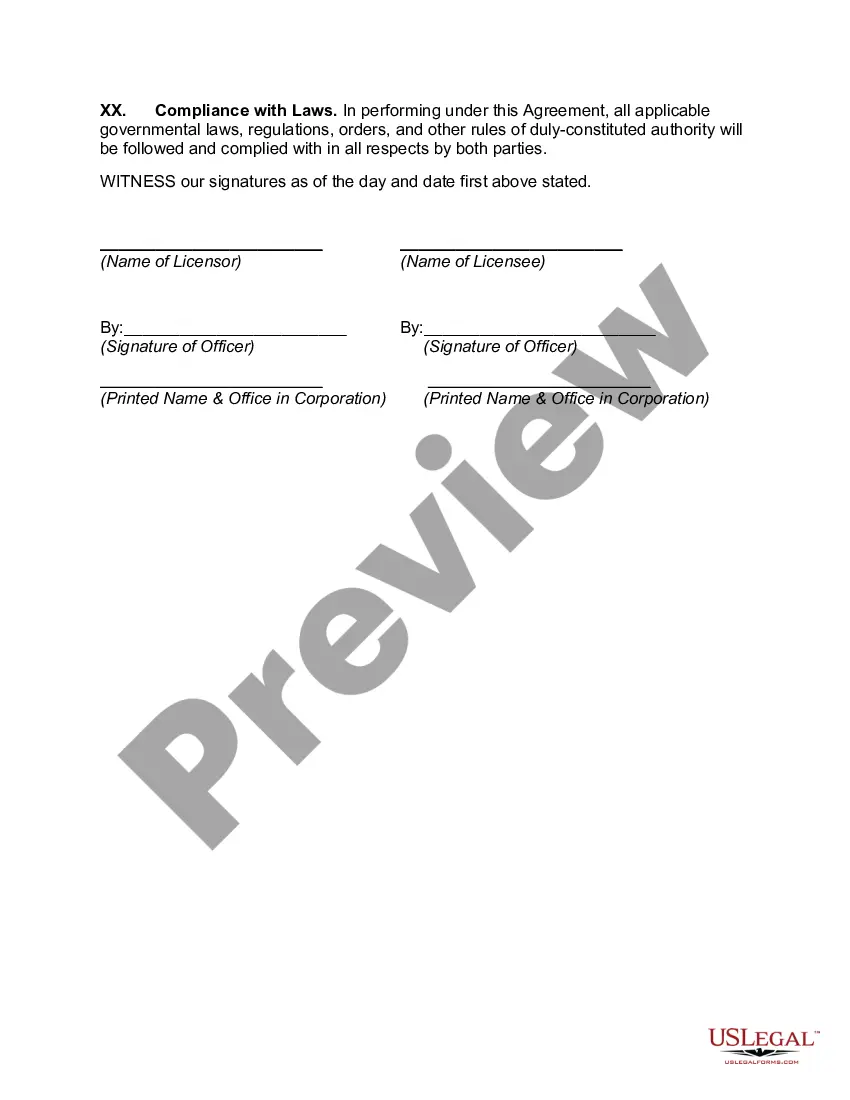
- Sign the agreement in the presence of an authorized representative from both parties.
Notarization guidance
This form does not typically require notarization to be legally valid. However, some jurisdictions or document types may still require it. US Legal Forms provides secure online notarization powered by Notarize, available 24/7 for added convenience.
Get your form ready online
Our built-in tools help you complete, sign, share, and store your documents in one place.
Make edits, fill in missing information, and update formatting in US Legal Forms—just like you would in MS Word.
Download a copy, print it, send it by email, or mail it via USPS—whatever works best for your next step.
Sign and collect signatures with our SignNow integration. Send to multiple recipients, set reminders, and more. Go Premium to unlock E-Sign.
If this form requires notarization, complete it online through a secure video call—no need to meet a notary in person or wait for an appointment.
We protect your documents and personal data by following strict security and privacy standards.

Make edits, fill in missing information, and update formatting in US Legal Forms—just like you would in MS Word.

Download a copy, print it, send it by email, or mail it via USPS—whatever works best for your next step.

Sign and collect signatures with our SignNow integration. Send to multiple recipients, set reminders, and more. Go Premium to unlock E-Sign.

If this form requires notarization, complete it online through a secure video call—no need to meet a notary in person or wait for an appointment.

We protect your documents and personal data by following strict security and privacy standards.
Mistakes to watch out for
- Failing to accurately define the royalty terms, leading to disputes over payments.
- Neglecting to identify all parties involved, which can lead to contractual issues.
- Not specifying the patent details clearly, resulting in ambiguity about what is licensed.
- Ignoring state-specific legal requirements that could affect the enforceability of the agreement.
- Overlooking the need for signatures from authorized representatives of both parties.
Why complete this form online
- Convenient access to a legally vetted document that saves time compared to drafting from scratch.
- Easy customization for specific legal situations, ensuring all necessary fields are filled out accurately.
- Online availability allows for quick downloading and printing.
- Access to guidance and support throughout the process, from filling out the form to understanding legal implications.
- Peace of mind knowing the form complies with current legal standards.
Looking for another form?
Form popularity
FAQ
Owning a patent or pending patent application is usually a condition for licensing.In order to obtain a patent for your invention, the invention must constitute patentable subject matter and be novel, non-obvious and useful.
A patent owner can give away or transfer his interests in a patent to a third person. The licensor gives away his rights on the invented patented intellectual property for a period of time over a mutual agreement. During such a period, the licensee can extract benefits and have rights in the interest of the patent.
A patent can only be applied for by the legal owner of the invention ('patent applicant'). The inventor is the legal owner of the invention unless this has been assigned to another party under a contract or by applicable law (see below). What benefits do inventors get from moral rights?
An example of a licensing agreement is a contract between the copyright holders of software and another company, allowing the latter to use the computer software for their daily business operations.
Licensing a patent simply means that the patent owner grants permission to another individual/organization to make, use, sell etc. his/her patented invention.Unlike selling or transferring a patent to another party, the licensor continue to have property rights over the patented invention.
A patent owner has the right to decide who may or may not use the patented invention for the period in which the invention is protected. In other words, patent protection means that the invention cannot be commercially made, used, distributed, imported, or sold by others without the patent owner's consent.
Patent Licensing is an act of or a process of granting, to a third party, permissions to extricate benefits by selling and using the licensed product. The patent owner gives license to a third person to use, sell and extract benefits from his patented invention, for an amount already decided as royalty.
What is Patent Licensing? When a patent is licensed, an agreement is made between the patent owner (or the licensor) and the person or company that wants to use and benefit from the patent (the licensee). It permits the licensee to make or sell the product, design, or technology in the patent.
A license agreement is a business contract shared between two parties. A licensor, who owns the product or brand; and the licensee, who purchases the license with the intent to work with the existing product or brand. Simply put, it is a contract that allows one company to use another company's intellectual property.