Sample Letter to Client regarding Refund of Balance of Retainer
What is this form?
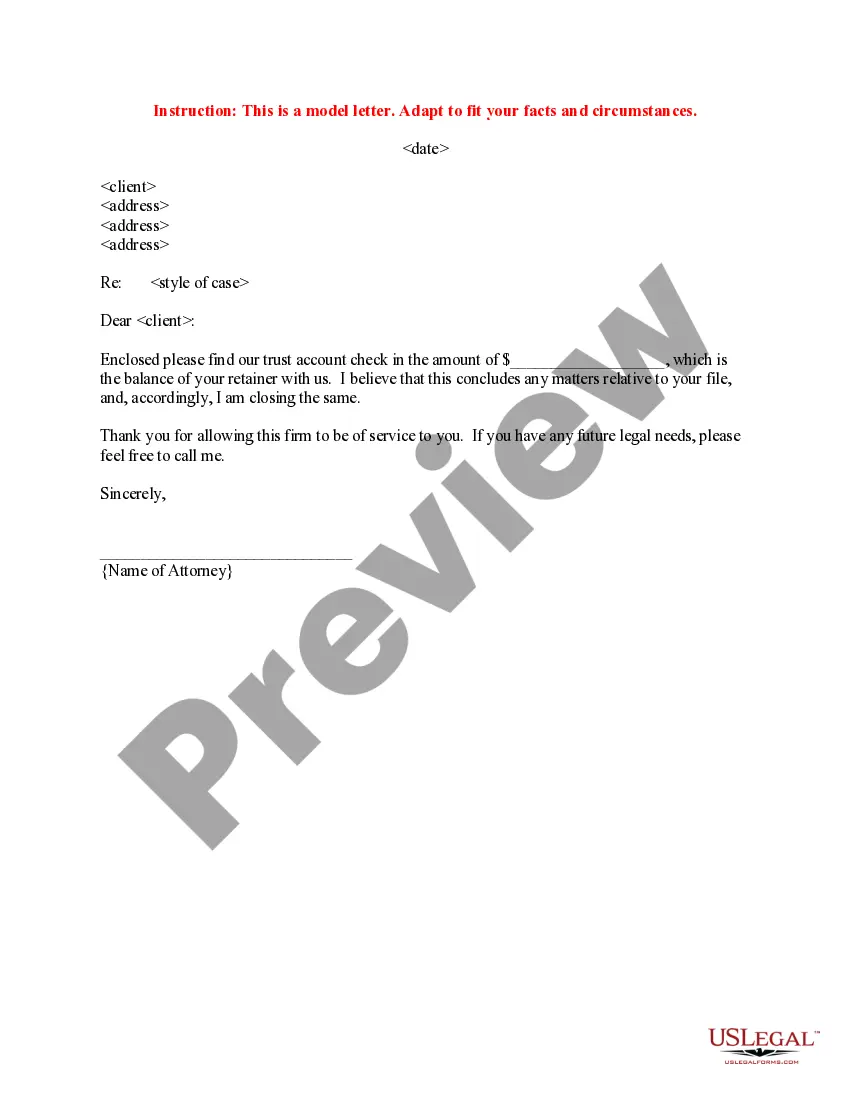
This Sample Letter to Client regarding Refund of Balance of Retainer is a professional communication tool used by attorneys to inform clients of the refund of any remaining balance on their retainer fee. This form ensures that the client is formally notified about the closure of their legal matter and the return of funds, distinguishing it from other client communication templates that may not specify financial matters or formal closure of a case.
Key components of this form
- Date of the letter
- Client's name and address
- Amount of the refund
- Statement regarding the closure of the client's file
- Option for future legal assistance
- Attorney's signature and name


When to use this form
This form should be used when an attorney needs to notify a client of the refund of their retainer balance after the conclusion of legal services. It is applicable in situations such as finalizing a case, transitioning to a different legal representation, or when a client decides to discontinue services before the retainer is fully utilized.
Intended users of this form
- Attorneys closing a client's case
- Legal professionals handling retainer agreements
- Firms managing client funds
Instructions for completing this form
- Enter the date at the top of the letter.
- Fill in the client's name and complete address.
- Specify the amount being refunded to the client.
- Include a closing statement that indicates the file will be closed.
- Make a note inviting the client to reach out for future legal needs.
- Sign the letter with the attorney's name.
Notarization guidance
Notarization is generally not required for this form. However, certain states or situations might demand it. You can complete notarization online through US Legal Forms, powered by Notarize, using a verified video call available anytime.
Get your form ready online
Our built-in tools help you complete, sign, share, and store your documents in one place.
Make edits, fill in missing information, and update formatting in US Legal Forms—just like you would in MS Word.
Download a copy, print it, send it by email, or mail it via USPS—whatever works best for your next step.
Sign and collect signatures with our SignNow integration. Send to multiple recipients, set reminders, and more. Go Premium to unlock E-Sign.
If this form requires notarization, complete it online through a secure video call—no need to meet a notary in person or wait for an appointment.
We protect your documents and personal data by following strict security and privacy standards.

Make edits, fill in missing information, and update formatting in US Legal Forms—just like you would in MS Word.

Download a copy, print it, send it by email, or mail it via USPS—whatever works best for your next step.

Sign and collect signatures with our SignNow integration. Send to multiple recipients, set reminders, and more. Go Premium to unlock E-Sign.

If this form requires notarization, complete it online through a secure video call—no need to meet a notary in person or wait for an appointment.

We protect your documents and personal data by following strict security and privacy standards.
Mistakes to watch out for
- Forgetting to input the client's correct address.
- Not specifying the exact refund amount.
- Omitting the date of the letter.
- Failing to sign the letter.
- Neglecting to advise the client on future services.
Advantages of online completion
- Easy access to editable templates tailored to legal requirements.
- Time-saving as forms are readily downloadable and printable.
- Ensures professionalism and accuracy in legal communications.
- Convenient for managing client relations efficiently.
What to keep in mind
- The Sample Letter to Client regarding Refund of Balance of Retainer is essential for formal legal communication about retainer refunds.
- The letter outline facilitates professionalism in concluding client cases.
- Proper completion of the letter can prevent misunderstandings and establish trust between the attorney and client.
Looking for another form?
Form popularity
FAQ
The Sample Letter to Client regarding Refund of Balance of Retainer is a formal attorney–client notice used to inform a client that any unused retainer funds will be refunded after legal services end. It should be used when finalizing a case or changing representation. The letter includes the date, client name/address, refund amount, a file-closure statement, an option for future legal services, and the attorney's signature.
This form is used to notify a client of a refund amount, not to request it. The letter should clearly present the refund amount and reference the closure of the file. It includes the date, the client’s name and address, the refund amount, a file-closure statement, an option for future legal services, and the attorney’s signature.
On this form, the language should be professional and concise, noting the refund amount and that the file is closed, with the date included, and the client’s name and address. It should also offer options for future legal services and include the attorney's signature.
To draft a polite refund notice using this form, maintain a respectful tone, clearly state the refund amount, confirm the file closure, provide an option for future legal services, include the date and attorney’s signature, and note the client’s address for records.
Use this Sample Letter to Client regarding Refund of Balance of Retainer as the formal template. It guides including the date, client name/address, refund amount, a file-closure statement, an option for future legal services, and the attorney’s signature to ensure proper closure.
It is tailored for legal retainer refunds and case closures, including a file-closure statement and an explicit option for future legal services, plus the attorney’s signature; these elements distinguish it from generic refund letters.