Issuer - Underwriter - Oriented Sample Stored Value Product Agreement and Disclosures
What is this form?
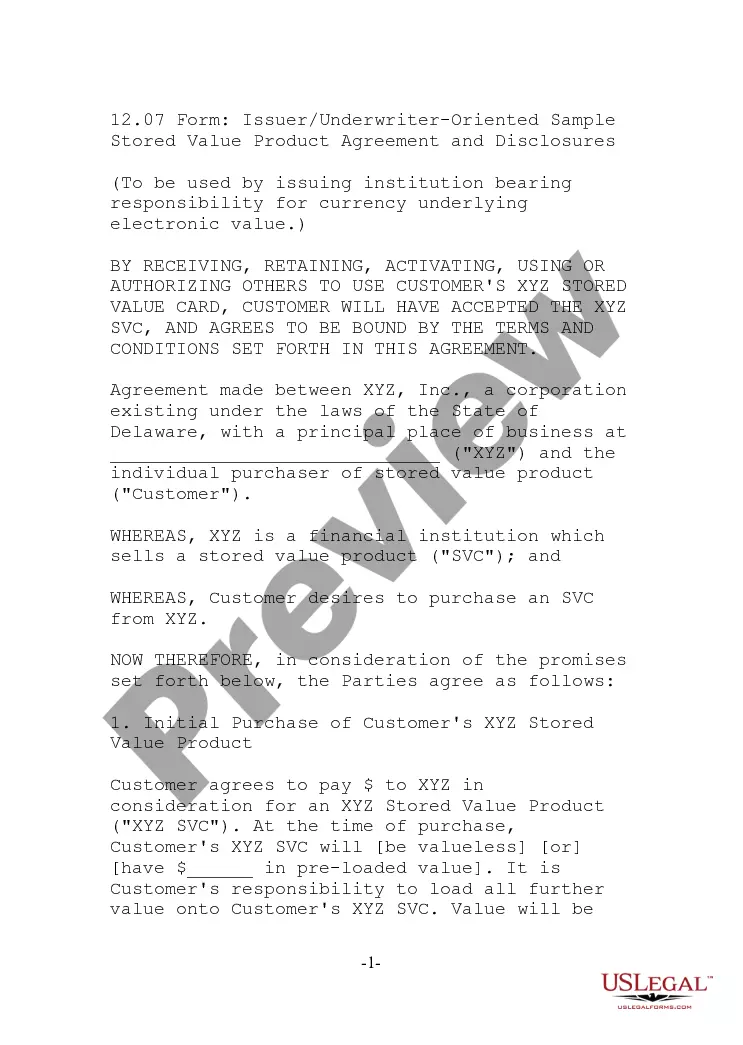
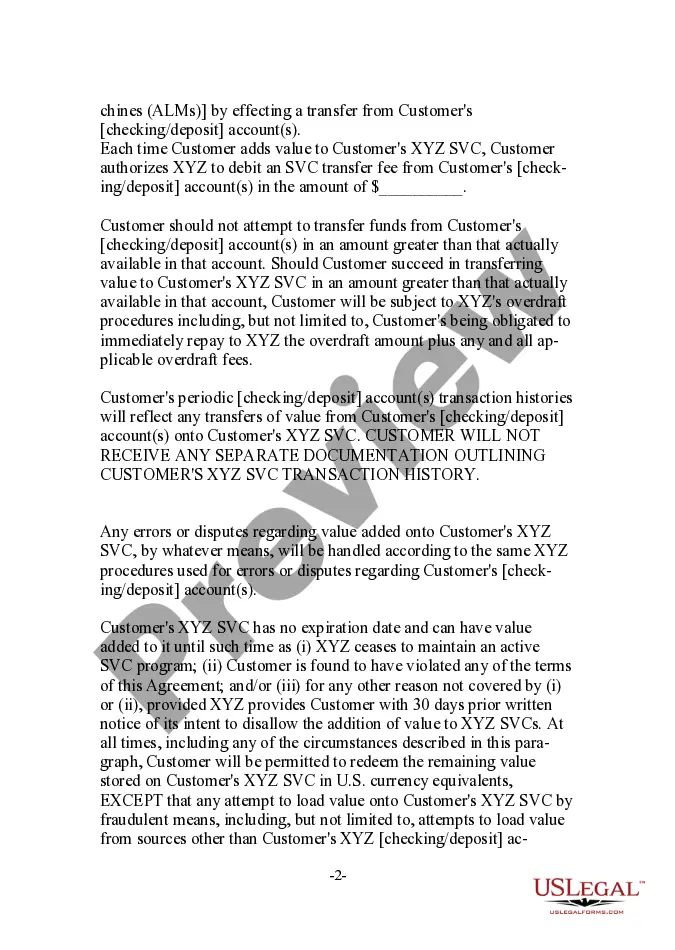
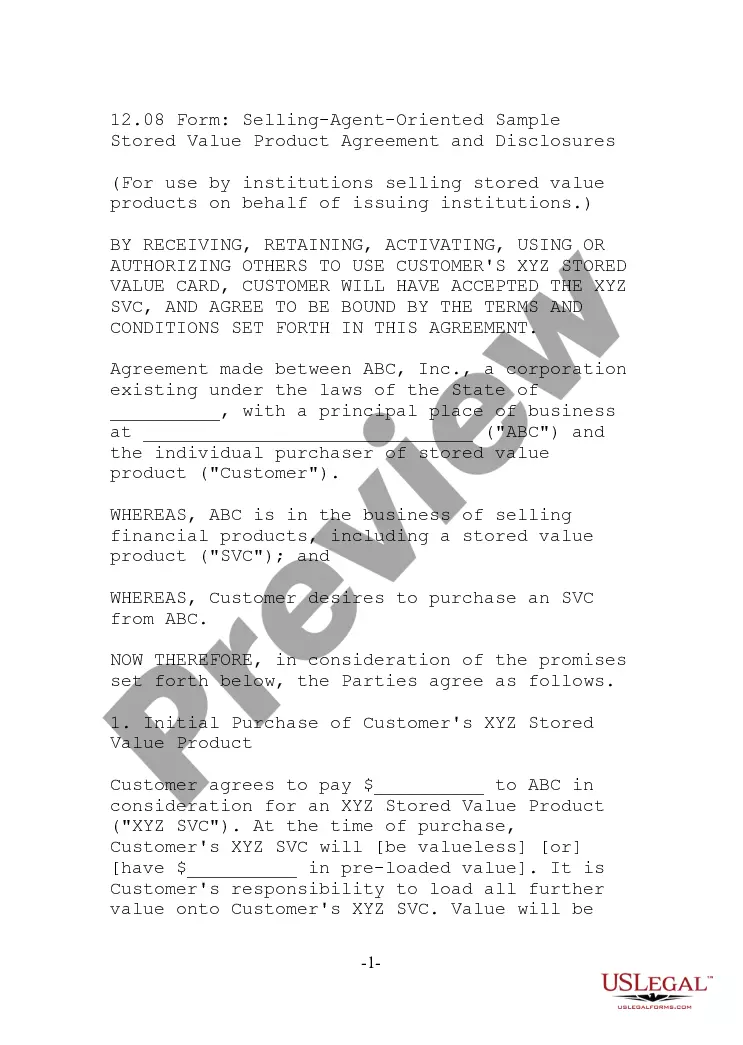
This Issuer - Underwriter - Oriented Sample Stored Value Product Agreement and Disclosures is a legal document used to outline the terms and conditions associated with a stored value product (SVC). This agreement is essential for businesses or individuals who are involved in issuing or using stored value products, ensuring clarity regarding usage, liabilities, and rights. The form sets the framework for transactions involving electronic value and distinguishes itself from other financial agreements by focusing specifically on stored value transactions.
Key parts of this document
- Initial purchase details for the stored value product, including pre-loaded value.
- Procedures for loading additional value onto the stored value card.
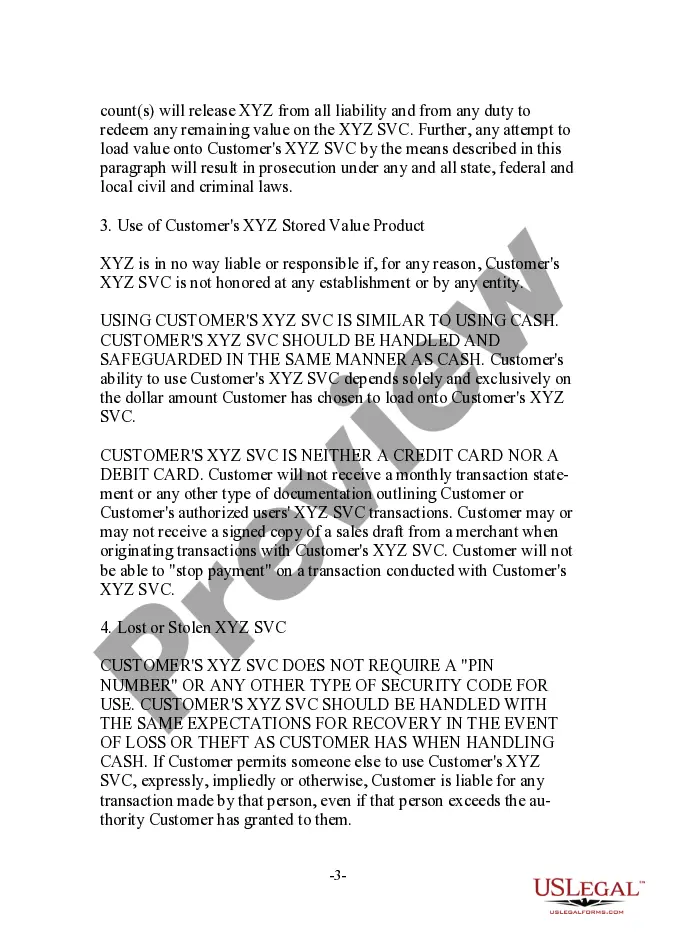
- Specifications for the use of the stored value card, including its treatment akin to cash.
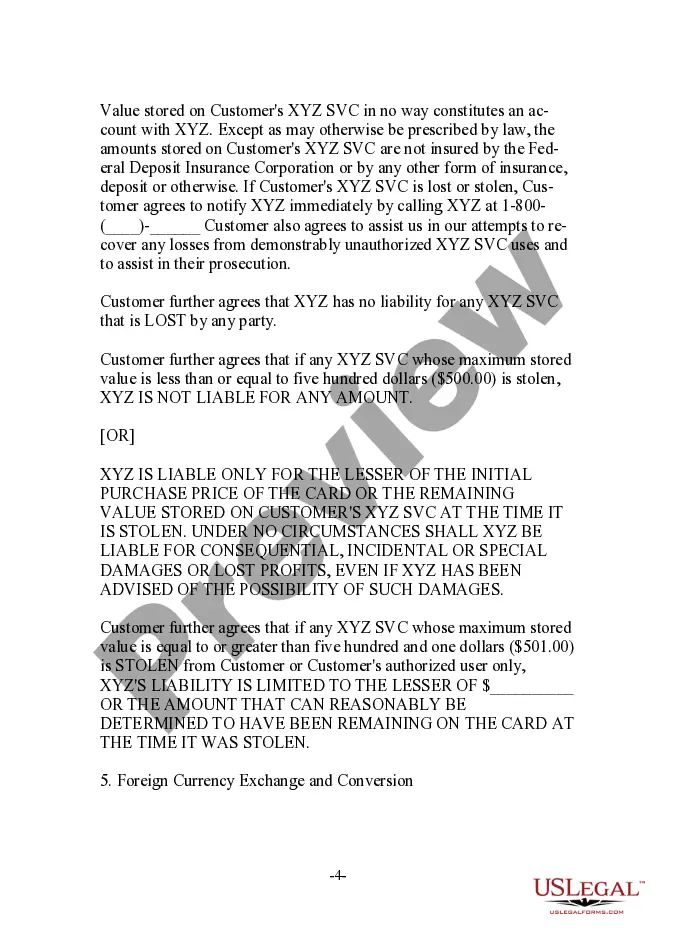
- Provisions regarding loss or theft of the stored value card.
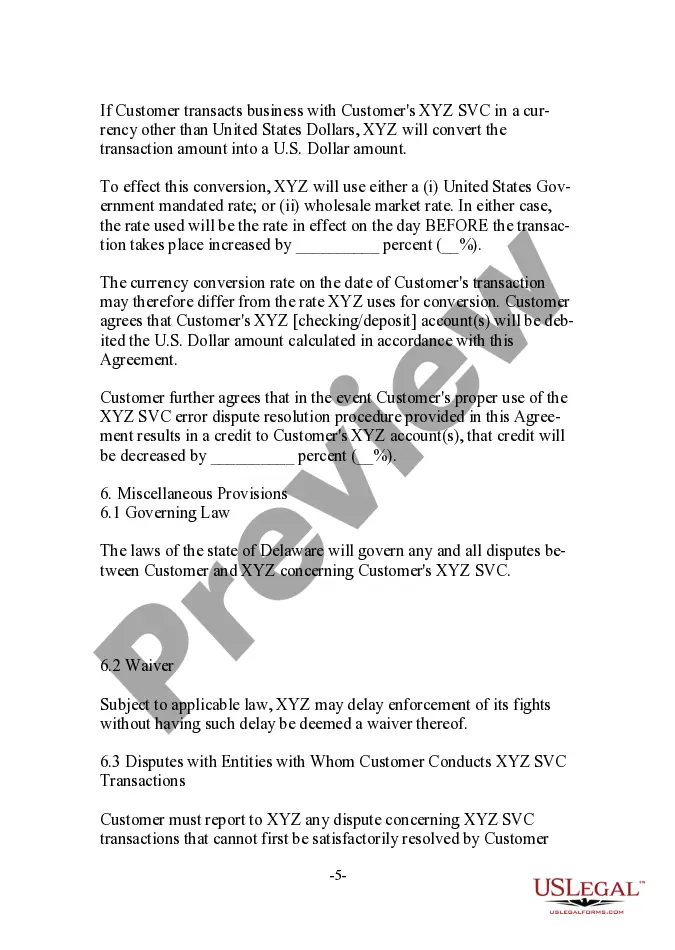
- Terms for foreign currency exchange and conversion during transactions.
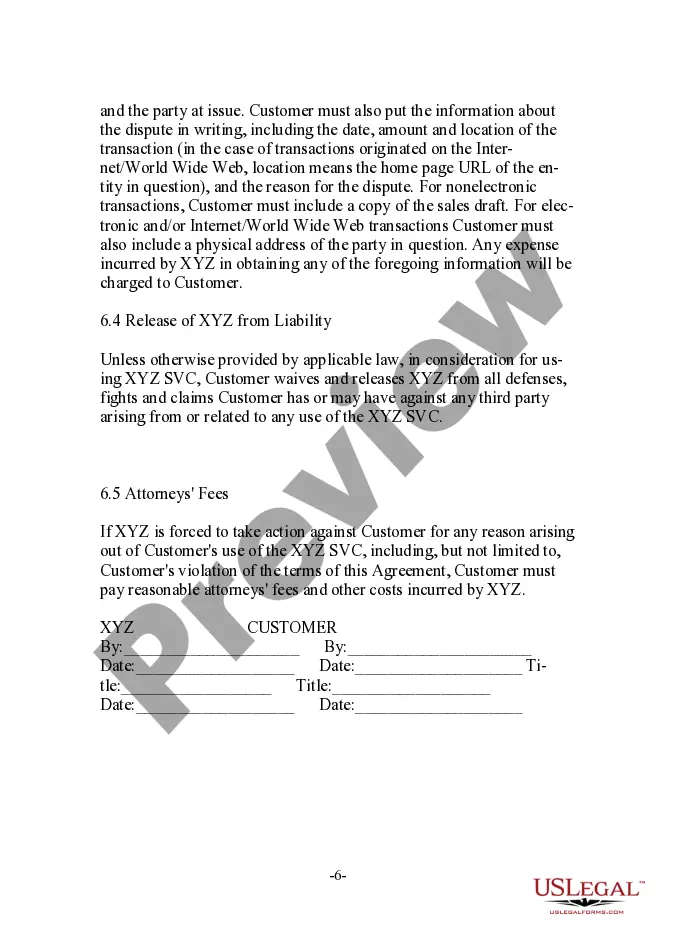
- Governing law and dispute resolution processes.
When to use this document
This form is used when an individual or business sells or purchases a stored value card. It is applicable in situations where the card will be used as a method for making purchases, transferring funds, or as a prepaid financial tool. Additionally, it is essential for clarifying responsibilities related to the management and security of the stored value card, especially in cases of loss or theft.
Who this form is for
- Businesses issuing stored value cards to customers.
- Individual contractors providing stored value services.
- Financial institutions involved in the sale of stored value products.
- Consumers looking to understand their rights and obligations when using a stored value card.
Completing this form step by step
- Identify the parties involved: Fill in the names and addresses of both the issuer (XYZ, Inc.) and the customer.
- Specify the initial purchase amount of the stored value product.
- Detail the loading procedures for transferring additional value from the customerâs checking or deposit accounts.
- Outline terms regarding loss or theft of the stored value card, ensuring customer awareness of their liabilities.
- Include any necessary exchange rate details if the stored value product will be used internationally.
Is notarization required?
This form does not typically require notarization to be legally valid. However, some jurisdictions or document types may still require it. US Legal Forms provides secure online notarization powered by Notarize, available 24/7 for added convenience.
Get your form ready online
Our built-in tools help you complete, sign, share, and store your documents in one place.
Make edits, fill in missing information, and update formatting in US Legal Forms—just like you would in MS Word.
Download a copy, print it, send it by email, or mail it via USPS—whatever works best for your next step.
Sign and collect signatures with our SignNow integration. Send to multiple recipients, set reminders, and more. Go Premium to unlock E-Sign.
If this form requires notarization, complete it online through a secure video call—no need to meet a notary in person or wait for an appointment.
We protect your documents and personal data by following strict security and privacy standards.

Make edits, fill in missing information, and update formatting in US Legal Forms—just like you would in MS Word.

Download a copy, print it, send it by email, or mail it via USPS—whatever works best for your next step.

Sign and collect signatures with our SignNow integration. Send to multiple recipients, set reminders, and more. Go Premium to unlock E-Sign.

If this form requires notarization, complete it online through a secure video call—no need to meet a notary in person or wait for an appointment.

We protect your documents and personal data by following strict security and privacy standards.
Avoid these common issues
- Failing to specify the value loaded onto the card at the time of purchase.
- Not clarifying the procedures for loading additional value correctly.
- Overlooking terms related to loss or theft, which may result in unexpected liabilities.
- Inaccurate reporting of disputes, which can hinder resolution efforts.
Benefits of completing this form online
- Fast and convenient access to essential legal documentation.
- Editability allows users to customize the form to fit their specific needs.
- Reliability through attorney-drafted language ensures legal solidity.
- Immediate download makes it easy to implement quickly.
Legal use & context
- The agreement serves to protect both the issuer and the user by clearly outlining rights and obligations.
- Ensures compliance with applicable financial regulations regarding stored value products.
- Helps prevent legal disputes by establishing agreed-upon protocols for transactions and liabilities.
Main things to remember
- This agreement is essential for those dealing with stored value products.
- Clarifies user responsibilities, especially regarding lost or stolen cards.
- Facilitates the proper use and understanding of stored value transactions.
Looking for another form?

Form popularity
FAQ
The term best efforts refers to an agreement made by a service provider to do whatever it takes to fulfill the requirements of a contract. In finance, an underwriter makes a best efforts or good faith promise to the issuer to sell as much of their securities offering as possible.
Definition: Underwriting is one of the most important functions in the financial world wherein an individual or an institution undertakes the risk associated with a venture, an investment, or a loan in lieu of a premium. Underwriters are found in banking, insurance, and stock markets.
Underwriters commission is calculated at 5% of the shares offered and underwritten. R120 was received along with matching application forms. Underwriters commission is calculated at 5% of the shares offered and underwritten.
Usually, there are two types of securities underwriters Institutional underwriters, which are specialized financial institutions, and Non-Institutional underwriters, which are mainly brokers.
Underwriting commission is the compensation that an underwriter receives for placing a new issue with investors. It is the fee which an investment banker charges for underwriting a security issue.Underwriting commission is also called a concession.
Quote quickly. Decline even quicker. Return phone calls with answers. I get back to the customer within a few hours, and certainly no longer than 24 hours. Be a step ahead. Share information. Understand the client. If I can't help, I know who can. Never get a follow-up.
Firm Underwriting. Firm underwriting is an underwriting agreement in which underwriter takes up a certain number of securities of firm himself. Sub-Underwriting. Joint Underwriting. Syndicate Underwriting. Complete Underwriting. Partial Underwriting.
An underwriter is a financial expert who takes a look at your finances and assesses how much risk a lender will take on if they decide to give you a loan. More specifically, underwriters evaluate your credit history, assets, the size of the loan you request and how well they anticipate that you can pay back your loan.
As outlined above, there are basically three different types of underwriting: loans, insurance, and securities.