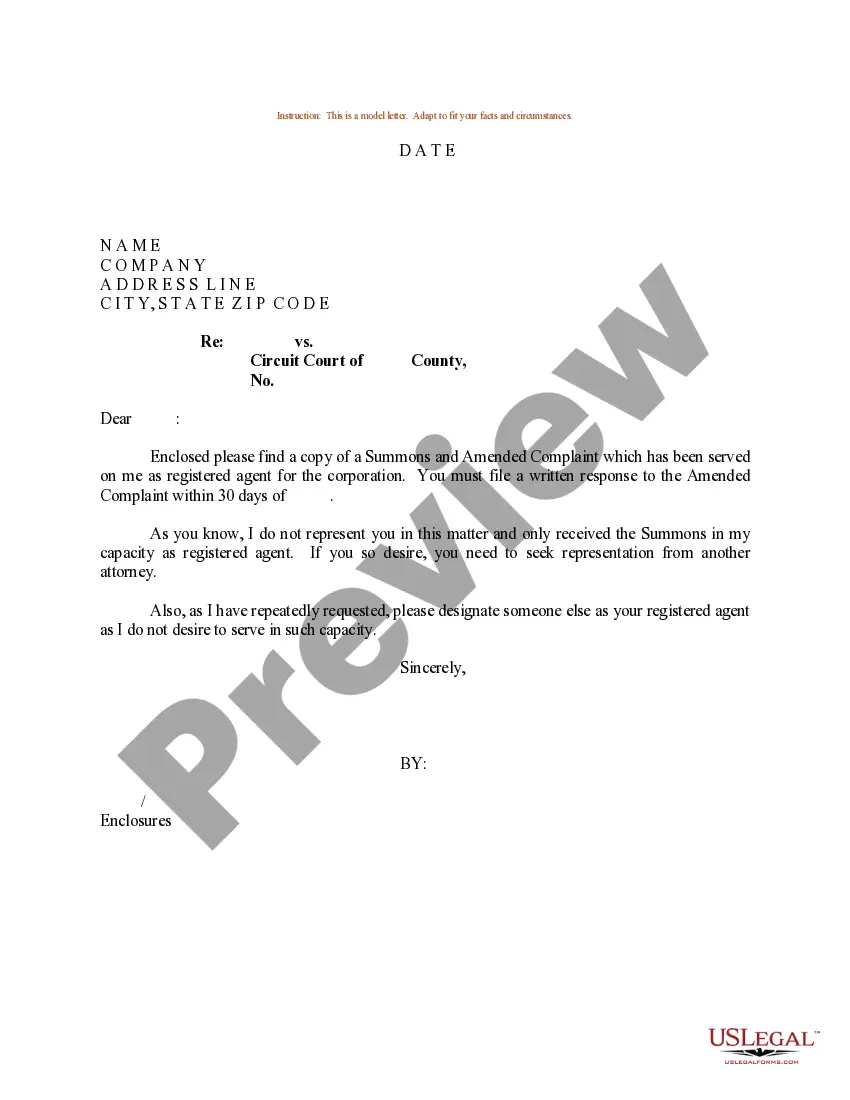
Sample Letter regarding Summons and Amended Complaint
What this document covers
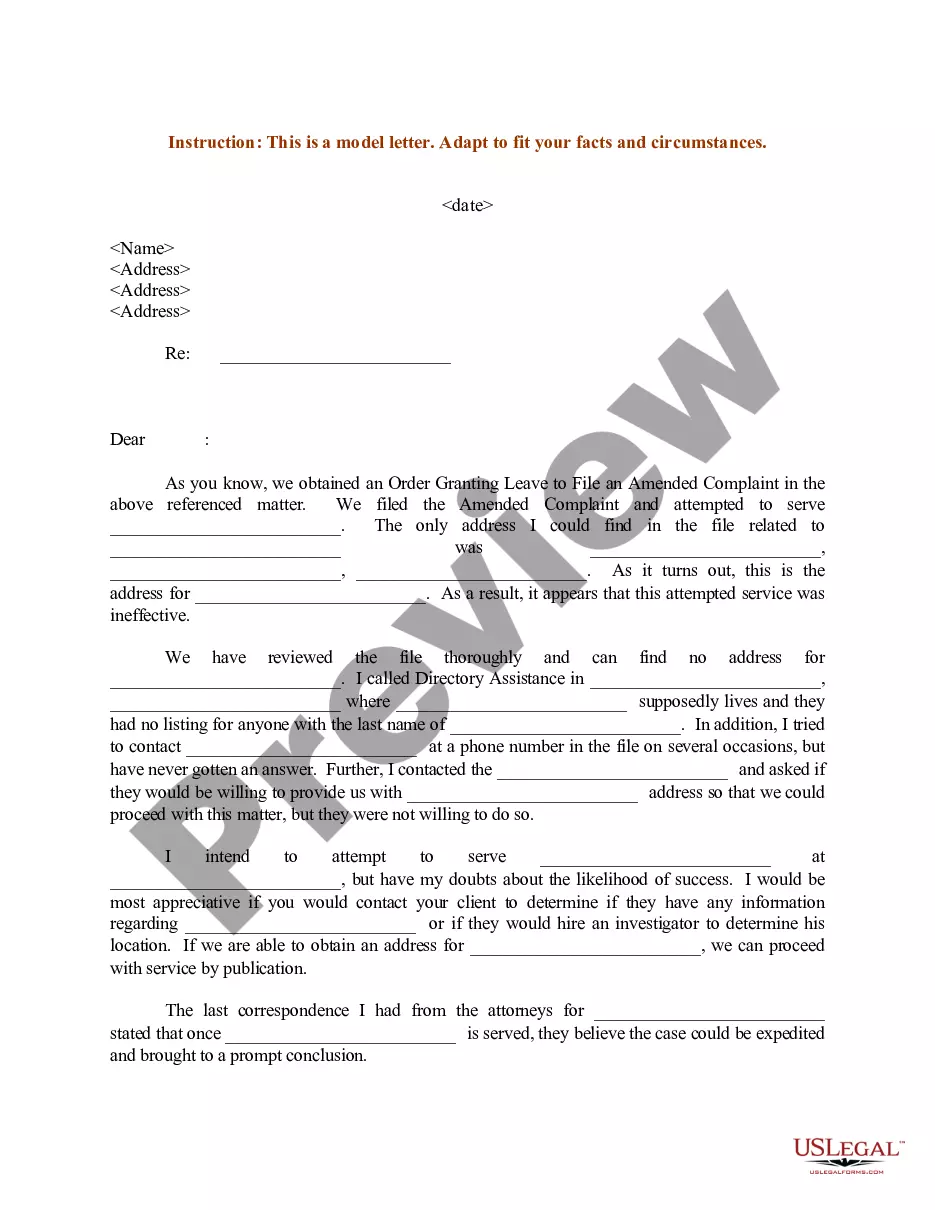
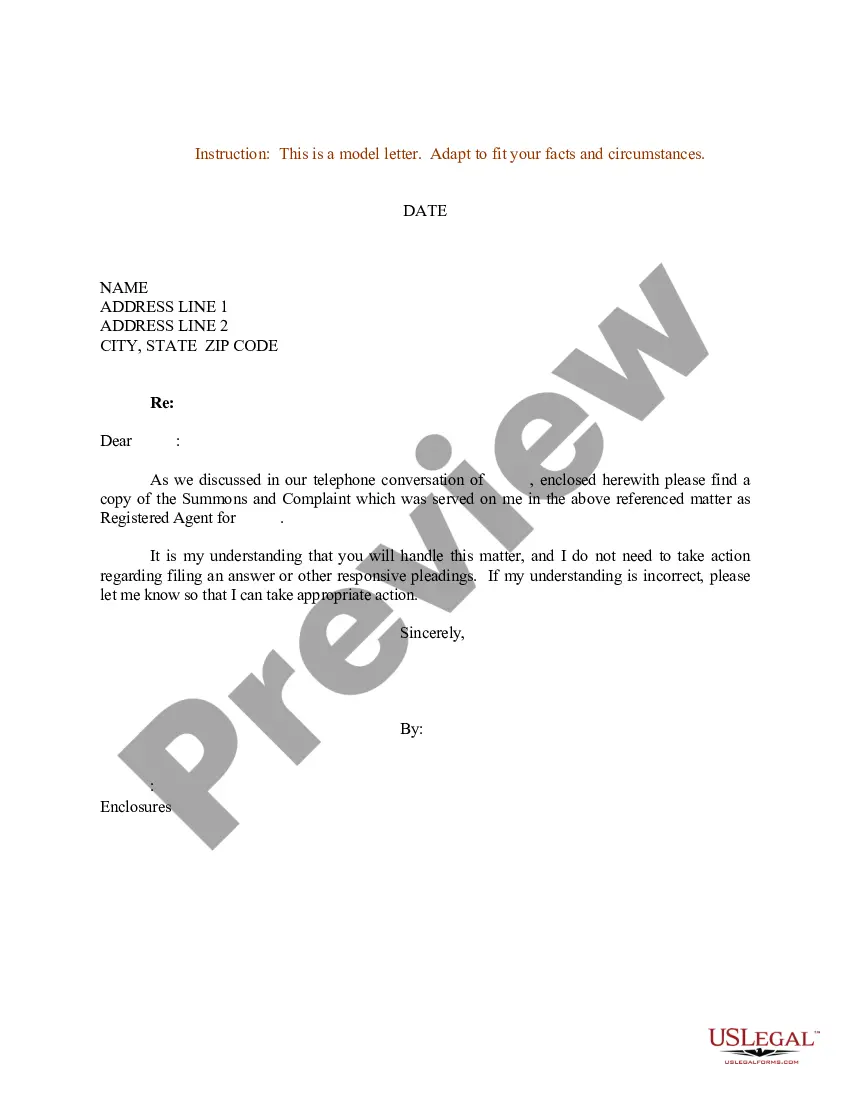
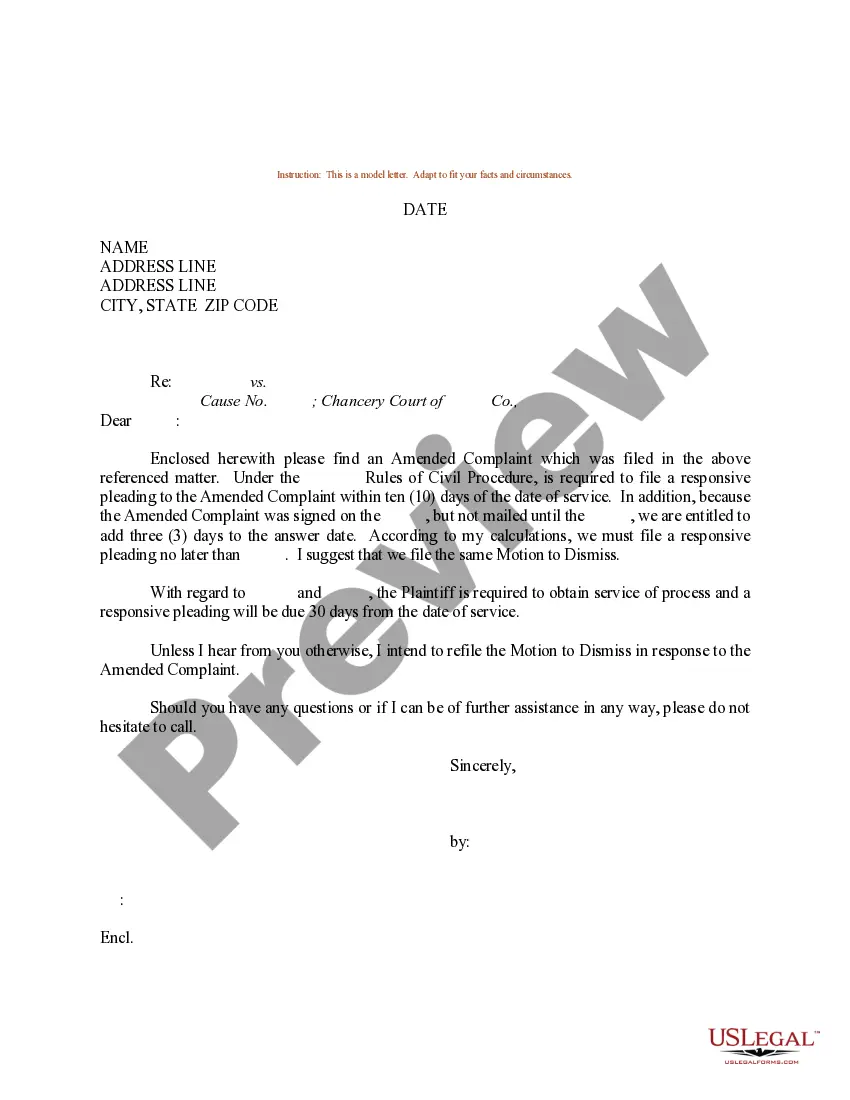
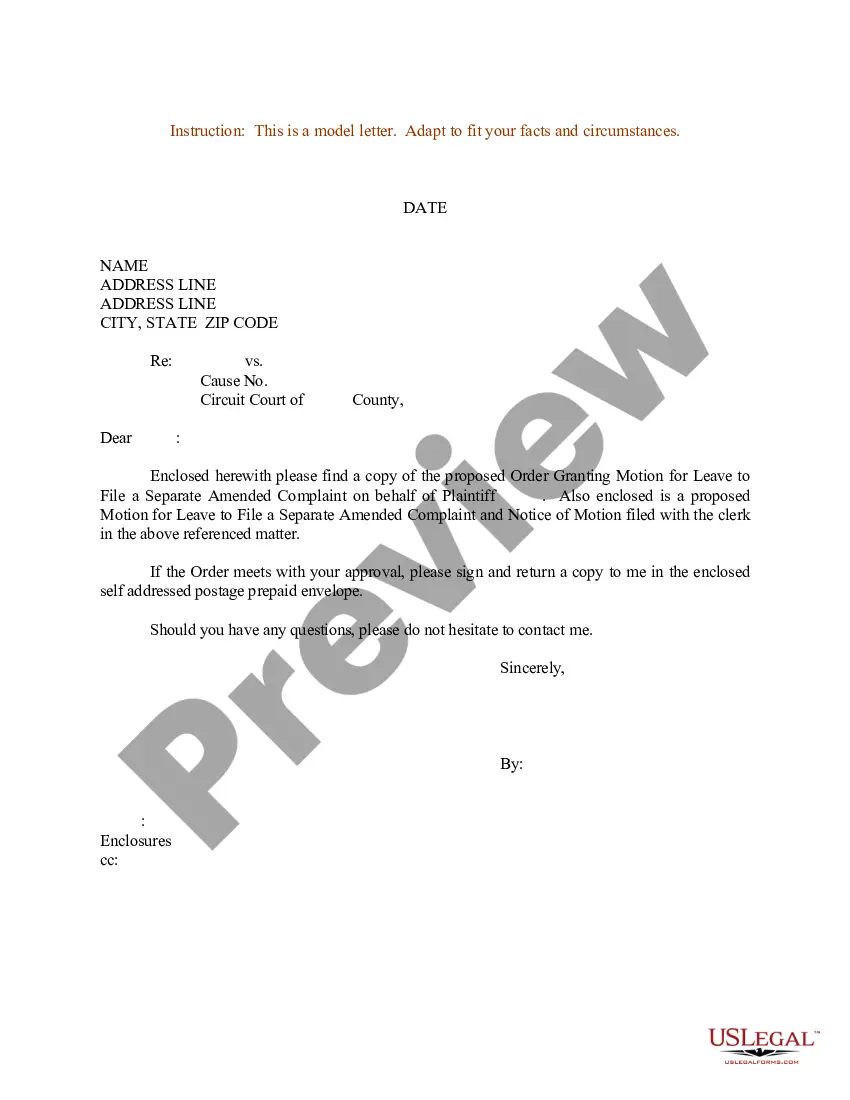
The Sample Letter regarding Summons and Amended Complaint is a template designed to assist individuals or entities in drafting a formal correspondence related to a legal summon and any amended complaints that may arise. This form stands out as a structured guide to effectively communicate legal information, unlike generic letters that may lack the needed legal specificity.
What’s included in this form
- Date of the correspondence
- Name of the recipient or entity
- Address of the recipient
- Subject line indicating relevance to summons and complaints
- Body content explaining the context and details of the summons
When this form is needed
This form is useful in scenarios where a party must formally respond to a summons or address an amended complaint in a legal case. It can be utilized by individuals or businesses who are involved in litigation and need to submit a written statement regarding changes to the initial complaint or provide additional information relevant to the case.
Who should use this form
- Individuals receiving a summons in a civil case
- Businesses involved in litigation
- Lawyers preparing communication for clients
How to complete this form
- Identify the date on which the letter is created.
- Enter the name and complete address of the recipient.
- Clearly state the subject of the letter relating to the summons and any amendments.
- Frame the body of the letter to highlight relevant details about the summons or complaint.
- Sign the letter to authenticate the correspondence.
Does this document require notarization?
This form does not typically require notarization unless specified by local law. Ensure to consult local regulations for any additional requirements that may apply to your situation.
Get your form ready online
Our built-in tools help you complete, sign, share, and store your documents in one place.
Make edits, fill in missing information, and update formatting in US Legal Forms—just like you would in MS Word.
Download a copy, print it, send it by email, or mail it via USPS—whatever works best for your next step.
Sign and collect signatures with our SignNow integration. Send to multiple recipients, set reminders, and more. Go Premium to unlock E-Sign.
If this form requires notarization, complete it online through a secure video call—no need to meet a notary in person or wait for an appointment.
We protect your documents and personal data by following strict security and privacy standards.

Make edits, fill in missing information, and update formatting in US Legal Forms—just like you would in MS Word.

Download a copy, print it, send it by email, or mail it via USPS—whatever works best for your next step.

Sign and collect signatures with our SignNow integration. Send to multiple recipients, set reminders, and more. Go Premium to unlock E-Sign.

If this form requires notarization, complete it online through a secure video call—no need to meet a notary in person or wait for an appointment.

We protect your documents and personal data by following strict security and privacy standards.
Common mistakes
- Incomplete addressing of the recipientâs information.
- Failure to provide accurate dates relevant to the case.
- Not including a clear subject line for the letter.
Why use this form online
- Easy access to a professionally drafted template.
- Editable format that allows for personal customization.
- Time efficiency in preparing necessary legal documents.
Looking for another form?

Form popularity
FAQ
Read the summons and make sure you know the date you must answer by. Read the complaint carefully. Write your answer. Sign and date the answer. Make copies for the plaintiff and yourself. Mail a copy to the plaintiff. File your answer with the court by the date on the summons.
Citations If an amendment adds a new party defendant, an amended or new summons naming that party as a defendant must be issued and served upon the new defendant, since no jurisdiction would be obtained by serving him with a copy of the summons that does not name him.
A Statement of Claim may be amended once without permission of the Court, within 28 days after the original Statement of Claim was filed, but for any subsequent amendments, a Notice of Motion to Amend must be filed and granted before the amendment can take place.
Provide the name of the court at the top of the Answer. You can find the information on the summons. List the name of the plaintiff on the left side. Write the case number on the right side of the Answer. Address the Judge and discuss your side of the case. Ask the judge to dismiss the case.
Since the parties are the same, you do not need an amended summons. Same for doe defendants once you ascertain their names. If your amended complaint has new names in the caption, then you want an amended summons, too.
Amended complaint. n. what results when the party suing (plaintiff or petitioner) changes the complaint he/she has filed. It must be in writing, and can be done before the complaint is served on any defendant, by agreement between the parties (usually their lawyers), or upon order of the court.
The court should freely give leave when justice so requires. (3) Time to Respond. Unless the court orders otherwise, any required response to an amended pleading must be made within the time remaining to respond to the original pleading or within 14 days after service of the amended pleading, whichever is later.
App. 352 251 P. 959, holds that when the original summons has been returned and filed, the clerk of the court has the power and the duty to issue an amended summons on the filing of an amended complaint which names a new party defendant.