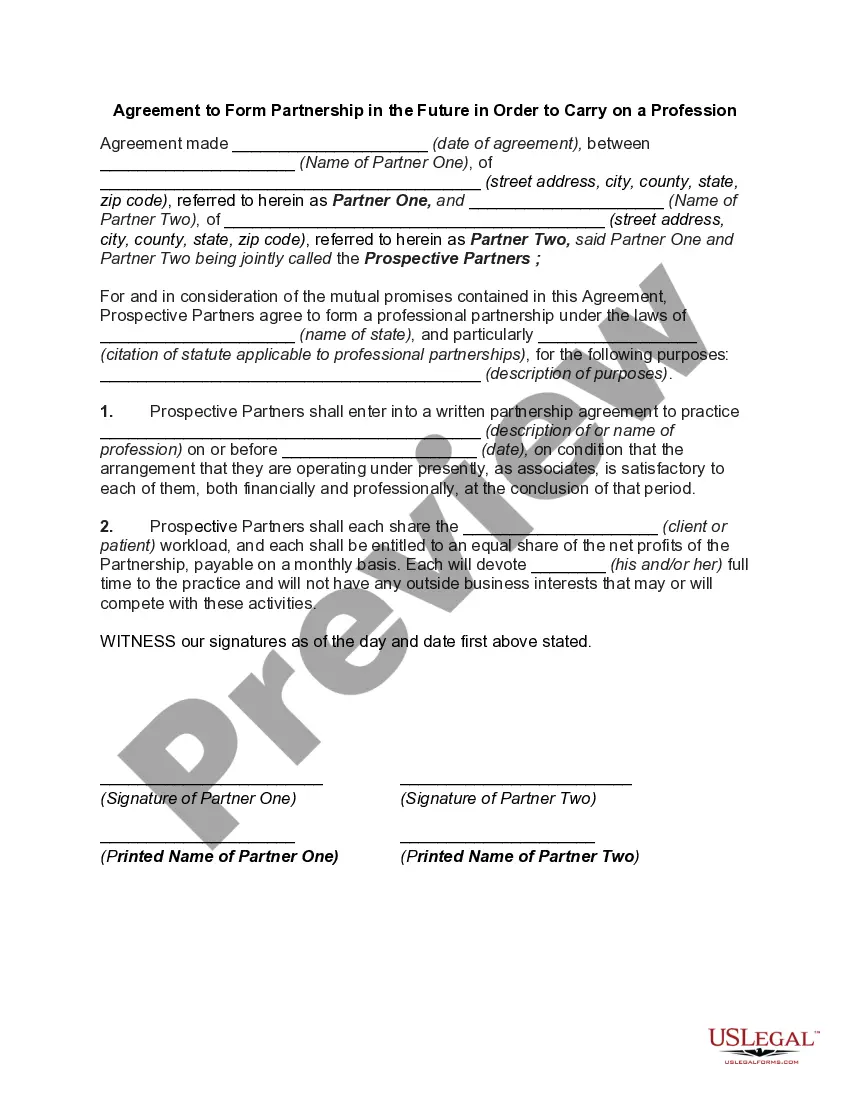
Agreement to Form Partnership in the Future in Order to Carry on a Profession
Overview of this form
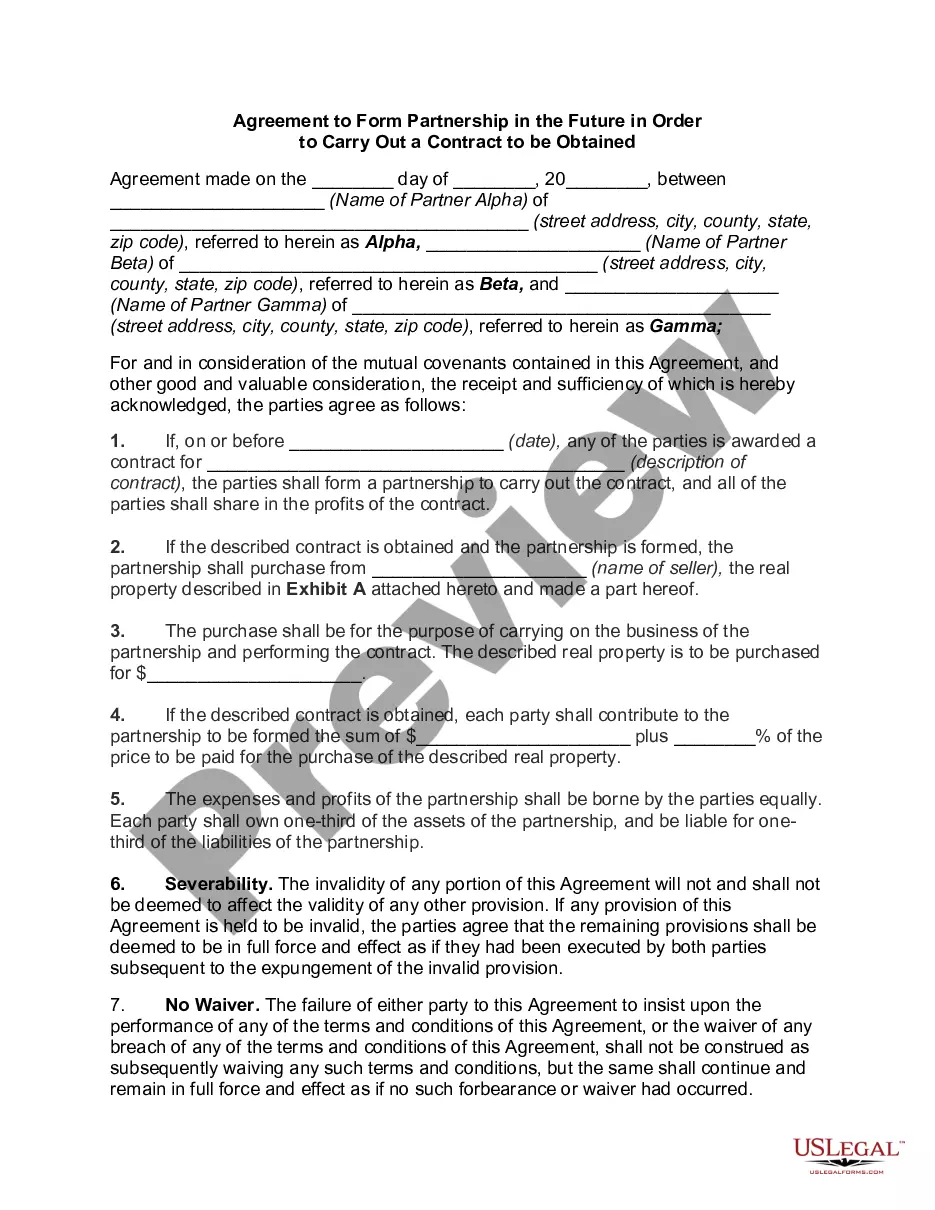
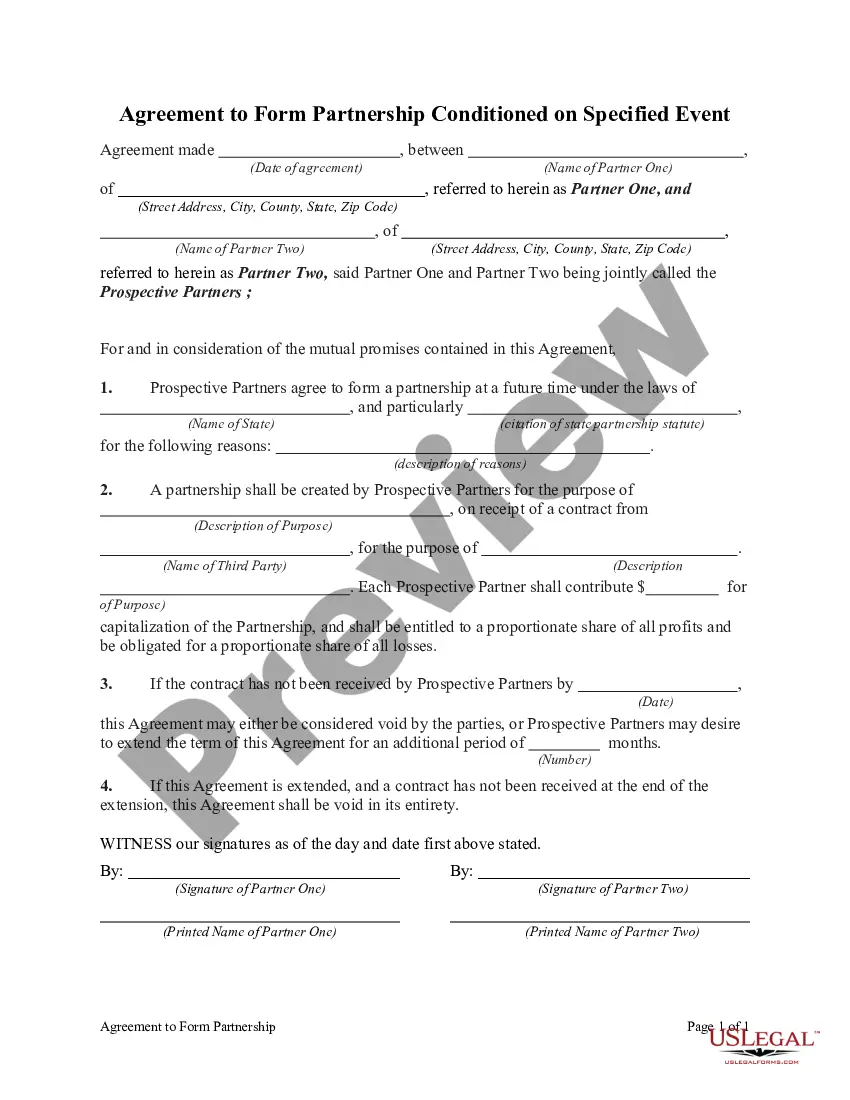
This Agreement to Form Partnership in the Future is a legal document outlining the intent of two individuals to establish a partnership for a specific professional purpose at a later date. Unlike other partnership agreements, this form is specifically designed to set the groundwork for future collaboration, ensuring both parties agree on essential terms before formally entering into a partnership.
Form components explained
- Date of the agreement.
- Names and addresses of the prospective partners.
- Purpose of forming the partnership.
- Timeline for entering into a formal partnership agreement.
- Details on workload and profit sharing.
- Signatures of both partners and their printed names.
When to use this form
This form is ideal for individuals who are in discussions about embarking on a shared professional endeavor but want to outline their intentions before establishing a legal partnership. It is useful for those who are currently working together as associates and wish to formalize their relationship in the future, ensuring clarity on responsibilities and profit-sharing from the outset.
Who this form is for
- Professionals planning to start a business together.
- Individuals working jointly in a professional capacity who want to formalize their intentions.
- Partners in fields that require a legal partnership framework.
How to prepare this document
- Fill in the date of the agreement.
- Enter the full names and addresses of both partners.
- Specify the purpose for forming the partnership.
- Indicate the timeline for establishing the formal partnership agreement.
- Detail how workload and profits will be shared.
- Both partners should sign and print their names at the bottom.
Is notarization required?
This form does not typically require notarization unless specified by local law. Users should verify local regulations to ensure compliance with partnership formation requirements.
Get your form ready online
Our built-in tools help you complete, sign, share, and store your documents in one place.
Make edits, fill in missing information, and update formatting in US Legal Forms—just like you would in MS Word.
Download a copy, print it, send it by email, or mail it via USPS—whatever works best for your next step.
Sign and collect signatures with our SignNow integration. Send to multiple recipients, set reminders, and more. Go Premium to unlock E-Sign.
If this form requires notarization, complete it online through a secure video call—no need to meet a notary in person or wait for an appointment.
We protect your documents and personal data by following strict security and privacy standards.

Make edits, fill in missing information, and update formatting in US Legal Forms—just like you would in MS Word.

Download a copy, print it, send it by email, or mail it via USPS—whatever works best for your next step.

Sign and collect signatures with our SignNow integration. Send to multiple recipients, set reminders, and more. Go Premium to unlock E-Sign.

If this form requires notarization, complete it online through a secure video call—no need to meet a notary in person or wait for an appointment.

We protect your documents and personal data by following strict security and privacy standards.
Avoid these common issues
- Failing to specify the purpose of the partnership clearly.
- Omitting dates or deadlines for formal agreement.
- Not including all partner names and addresses.
- Inadequately defining profit-sharing arrangements.
- Forget to sign the agreement.
Benefits of using this form online
- Convenient access to a professionally drafted legal document.
- Easy to edit and customize to fit specific needs.
- Reliable format designed by licensed attorneys.
What to keep in mind
- An Agreement to Form Partnership in the Future lays groundwork for a future professional partnership.
- It is essential to accurately specify the terms of the agreement, including workload and profit sharing.
- This form should be completed with attention to local state laws regarding partnership agreements.
Looking for another form?

Form popularity
FAQ
Create a preliminary plan for an alliance. This plan should detail how the alliance will benefit both companies. Approach the key decision maker. Build a relationship with your contact first. Present your idea. Listen and adapt your proposal as necessary.
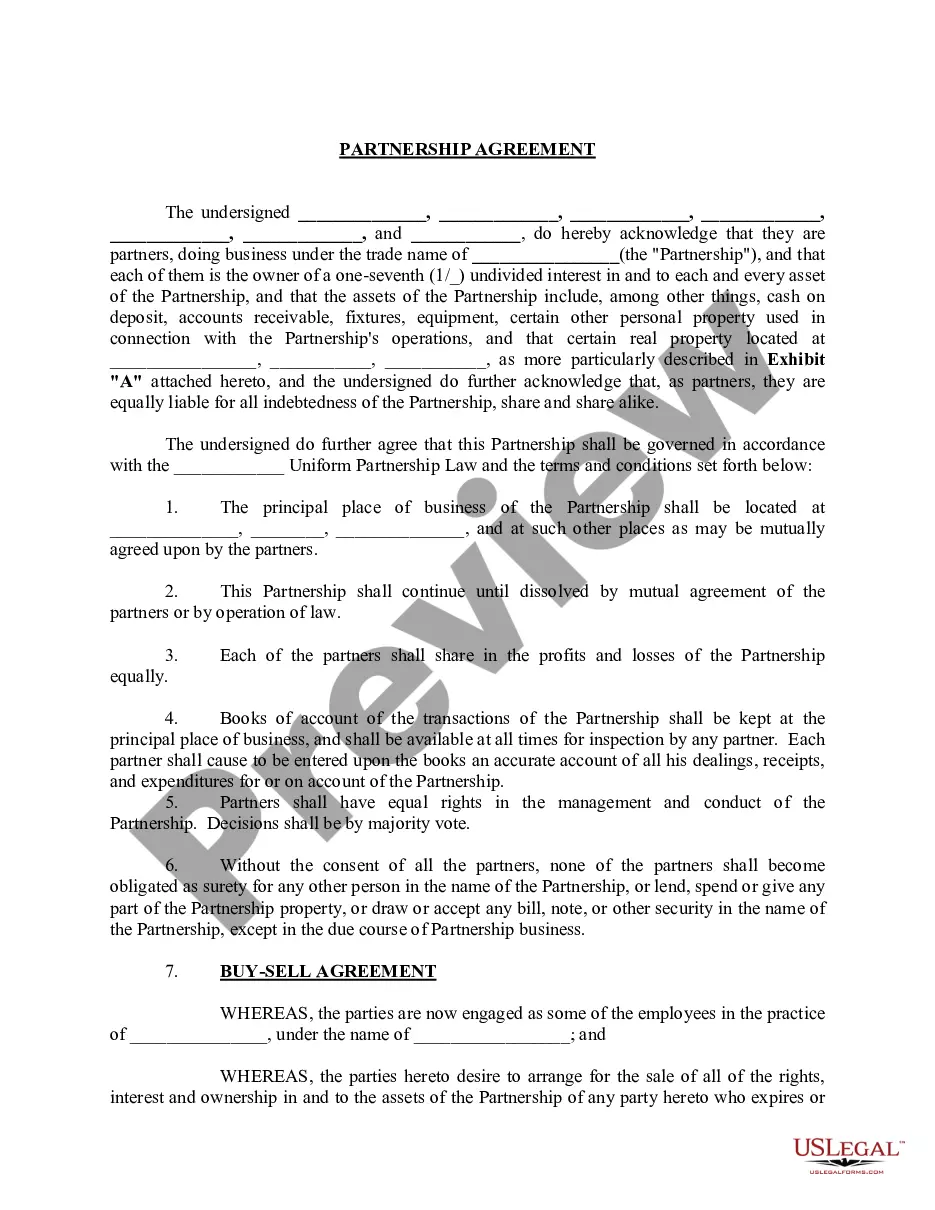
Although each partnership agreement differs based on business objectives, certain terms should be detailed in the document, including percentage of ownership, division of profit and loss, length of the partnership, decision making and resolving disputes, partner authority, and withdrawal or death of a partner.
Share the same values. Choose a partner with complementary skills. Have a track record together. Clearly define each partner's role and responsibilities. Select the right business structure. Put it in writing. Be honest with each other.
Although there's no requirement for a written partnership agreement, often it's a very good idea to have such a document to prevent internal squabbling (about profits, direction of the company, etc.) and give the partnership solid direction. Limited liability partnerships do have a writing requirement.
Name of your partnership. Contributions to the partnership and percentage of ownership. Division of profits, losses and draws. Partners' authority. Withdrawal or death of a partner.
You must register your partnership for Self Assessment with HM Revenue and Customs ( HMRC ) if you're the 'nominated partner'. This means you're responsible for sending the partnership tax return. The other partners need to register separately.
Forming a PartnershipPartnerships exist between two or more people who want to go into business together. In most states, creating a legally binding partnership requires nothing more than a verbal agreement and a handshake.
Name of the partnership. Contributions to the partnership. Allocation of profits, losses, and draws. Partners' authority. Partnership decision-making. Management duties. Admitting new partners. Withdrawal or death of a partner.