Agreed Judgment of Forfeiture
About this form
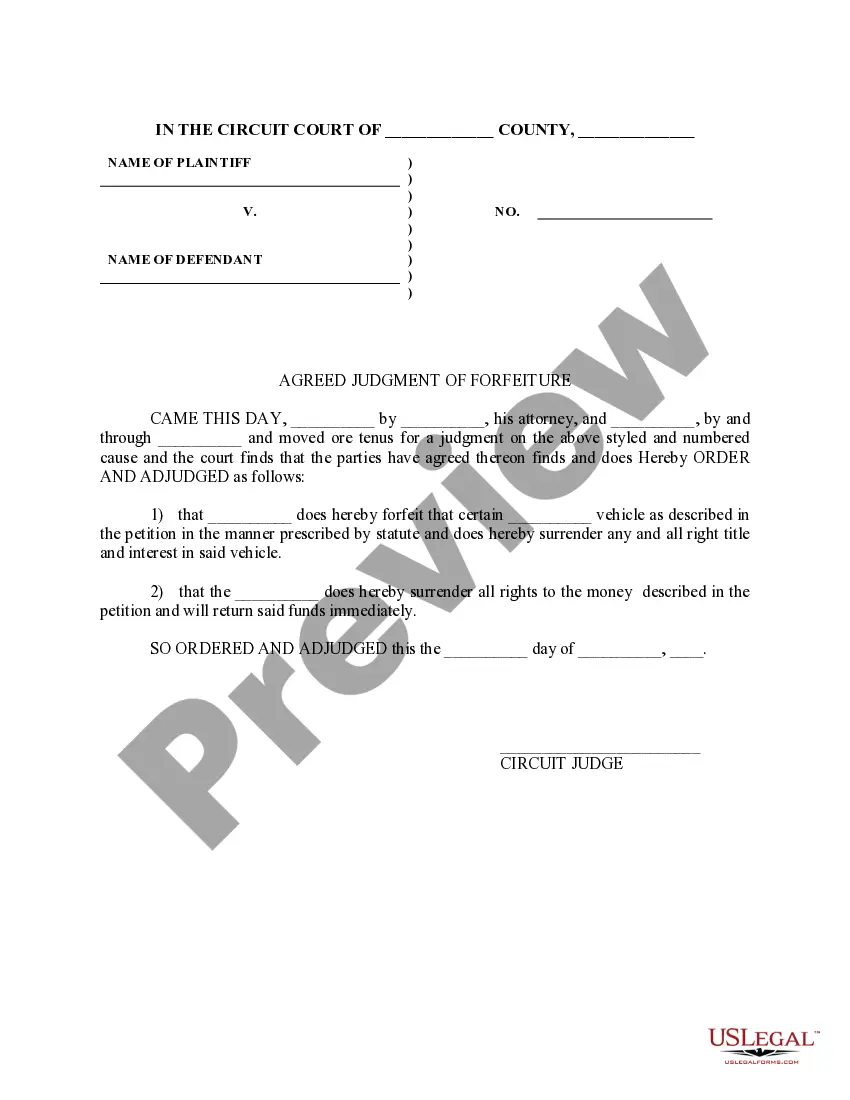
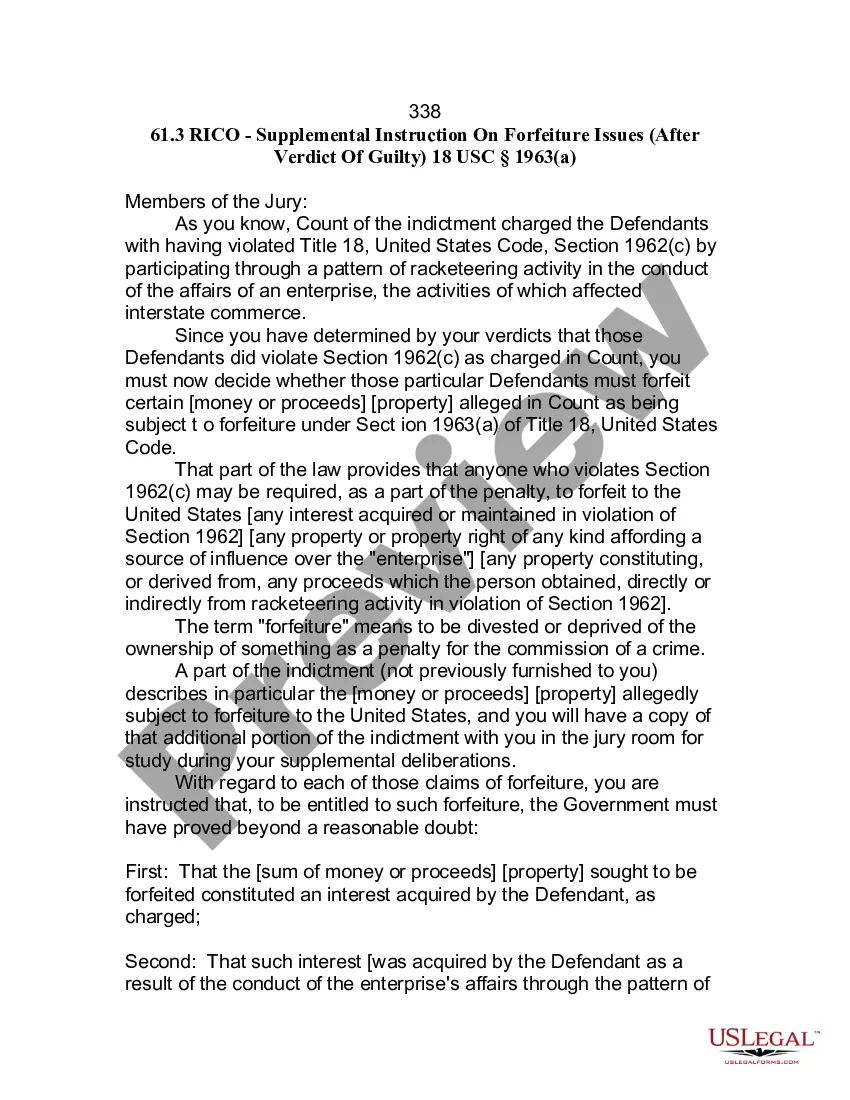
The Agreed Judgment of Forfeiture is a legal document used to formally agree to the forfeiture of a vehicle when payments have not been made. This form establishes that the vehicle is surrendered by the debtor and outlines the return of any funds improperly held by the creditor. It differs from other forms by serving as a mutual agreement, eliminating potential disputes in the forfeiture process.
Main sections of this form
- Identification of the vehicle being forfeited.
- Declaration of forfeiture by the debtor.
- Agreement on the return of any improperly held funds to the debtor.
- Signature and acknowledgment of the circuit judge.
When to use this form
This form is utilized when a debtor has failed to make payments on a vehicle, and both partiesâdebtor and creditorâagree to finalize the forfeiture. It is relevant in situations where amicable negotiations have occurred and both parties want to formalize the agreement in a legally binding manner.
Who can use this document
- Debtors who have defaulted on vehicle payments.
- Creditors looking to recover the vehicle through forfeiture.
- Legal representatives acting on behalf of either party in the forfeiture process.
Instructions for completing this form
- Identify the parties involved, including the creditor and debtor.
- Describe the vehicle that is being forfeited, including make, model, and identification number.
- Specify any improperly held funds to be returned to the debtor.
- Fill in the date of the agreement and the signature of the circuit judge.
Does this document require notarization?
This form does not typically require notarization unless specified by local law. It is advisable to check state-specific regulations to ensure compliance.
Get your form ready online
Our built-in tools help you complete, sign, share, and store your documents in one place.
Make edits, fill in missing information, and update formatting in US Legal Forms—just like you would in MS Word.
Download a copy, print it, send it by email, or mail it via USPS—whatever works best for your next step.
Sign and collect signatures with our SignNow integration. Send to multiple recipients, set reminders, and more. Go Premium to unlock E-Sign.
If this form requires notarization, complete it online through a secure video call—no need to meet a notary in person or wait for an appointment.
We protect your documents and personal data by following strict security and privacy standards.

Make edits, fill in missing information, and update formatting in US Legal Forms—just like you would in MS Word.

Download a copy, print it, send it by email, or mail it via USPS—whatever works best for your next step.

Sign and collect signatures with our SignNow integration. Send to multiple recipients, set reminders, and more. Go Premium to unlock E-Sign.

If this form requires notarization, complete it online through a secure video call—no need to meet a notary in person or wait for an appointment.

We protect your documents and personal data by following strict security and privacy standards.
Avoid these common issues
- Failing to accurately identify the vehicle can lead to legal disputes.
- Not specifying the correct amount of funds to be returned.
- Omitting signatures from both parties and the circuit judge.
Advantages of online completion
- Convenience of instant access and downloading at any time.
- Editability allows users to customize the form for specific circumstances.
- Reliability, as it is drafted by licensed attorneys to ensure legal compliance.
Main things to remember
- The Agreed Judgment of Forfeiture serves to formalize the forfeiture of a vehicle due to non-payment.
- It ensures an agreement for the return of any improperly held funds back to the debtor.
- Completion of this form requires specific details regarding the parties and the vehicle involved.
- It's essential to comply with state-specific requirements and include necessary signatures for legal validity.
Looking for another form?
Form popularity
FAQ
Forfeiture. A foreclosure action extinguishes any claim the mortgagor may have to the real property securing a defaulted loan, whereas a forfeiture refers generally to the loss of a right to something as a result of nonperformance of an obligation or condition.
Forfeiture, under the terms of a contract, refers to the requirement by the defaulting party to give up ownership of an asset, or cash flows from an asset, as compensation for the resulting losses to the other party.The process of forfeiture often involves proceedings in a court of law.
Forfeiture is a means for a landlord to terminate a lease, in the event of some default by the tenant.
Invariably, a lease will contain a provision that in the event the rent is not paid, or some other covenant is breached, then the lease can be brought to an end by the landlord. The impact of this on the lease is that legally it no longer exists.
If no third party files a timely petition, the preliminary order becomes the final order of forfeiture if the court finds that the defendant (or any combination of defendants convicted in the case) had an interest in the property that is forfeitable under the applicable statute.
Bail bond forfeiture results when a court appearance is missed, and the company or person who put up the bond is required to pay the defendant's outstanding bail amount.A forfeited bond becomes the property of the jurisdiction overseeing the case, and it cannot be refunded.
The term money judgment is used to describe a particular kind of directly forfeitable property. It is a short-hand way of describing the defendant's continuing obligation to forfeit the money derived from or used to commit his criminal offense whether he has retained the actual dollars in his possession or not.
It is an in personam (against the person) action and requires that the government indict (charge) the property used or derived from the crime along with the defendant. If the jury finds the property forfeitable, the court issues an order of forfeiture.
Forfeiture refers to a loss of any property, money, or assets without consideration or compensation in return. A forfeiture generally occurs due to default in complying with repayment obligations under a contract. It can also be used as a penalty for an illegal way of conducting business.