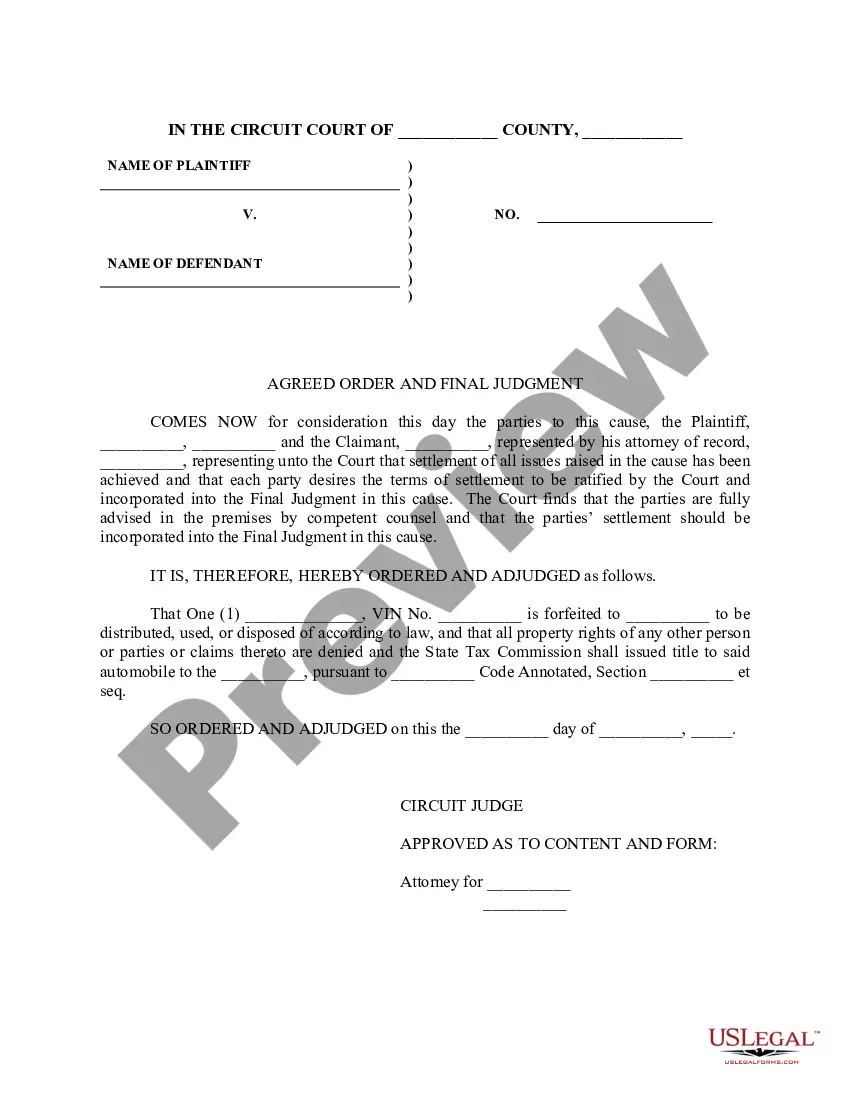
Agreed Order and Final Judgment - Awarding Forfeiture
Overview of this form
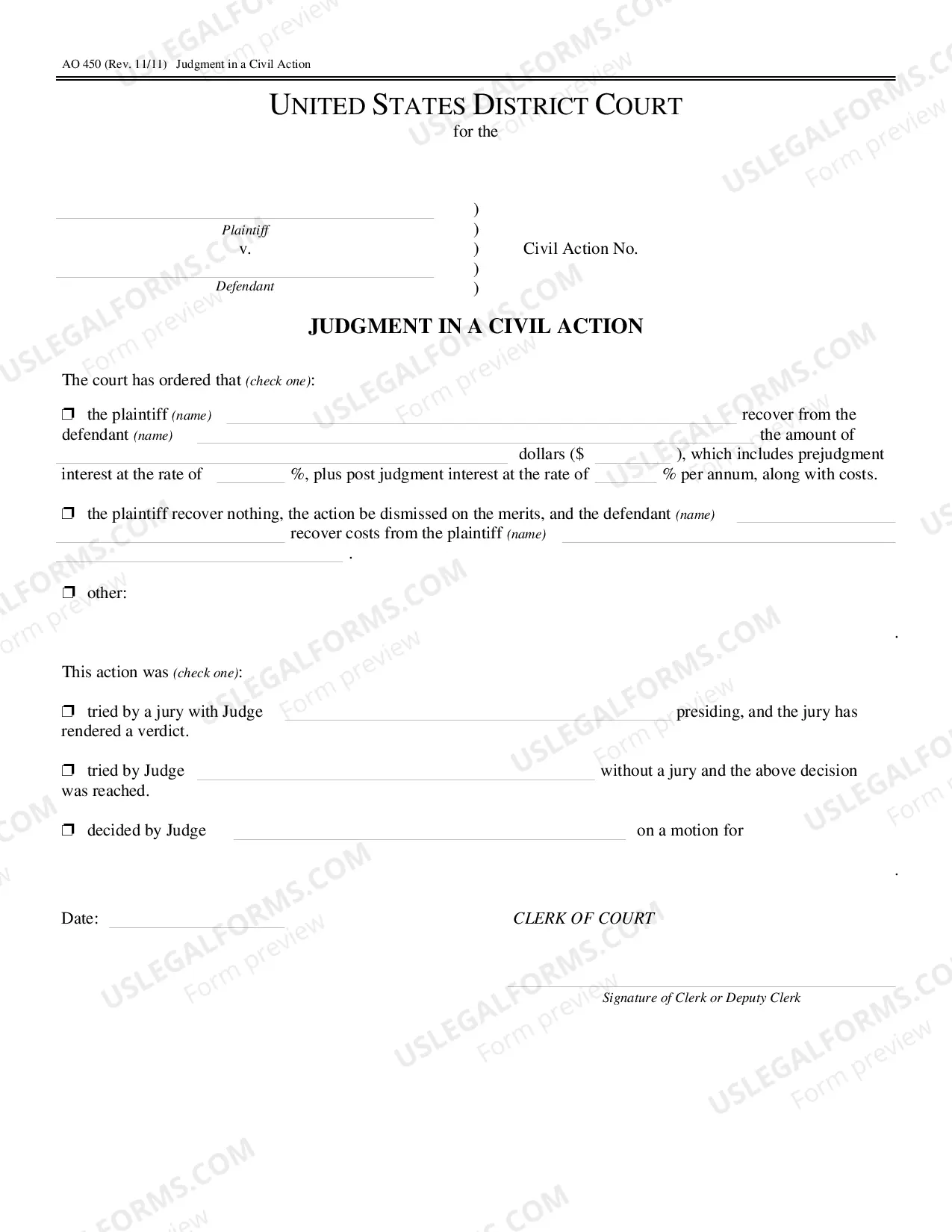
The Agreed Order and Final Judgment - Awarding Forfeiture is a legal document used by authorities to formally record the agreement regarding property forfeiture. This form is specifically applicable in cases where a perpetrator consents to the forfeiture of property associated with drug or other criminal activities. It differs from other forfeiture forms by capturing both the legal order and the agreement between the involved parties, making it enforceable in court.
Key parts of this document
- Identification of the forfeited property, including an official description and vehicle identification number (VIN).
- Details of the party to whom the property is forfeited.
- Legal references to the relevant code enacted for the forfeiture.
- Signatures of the circuit judge and representing attorney, confirming the agreement and judgment.
- Date of judgment and order issuance.
When to use this document
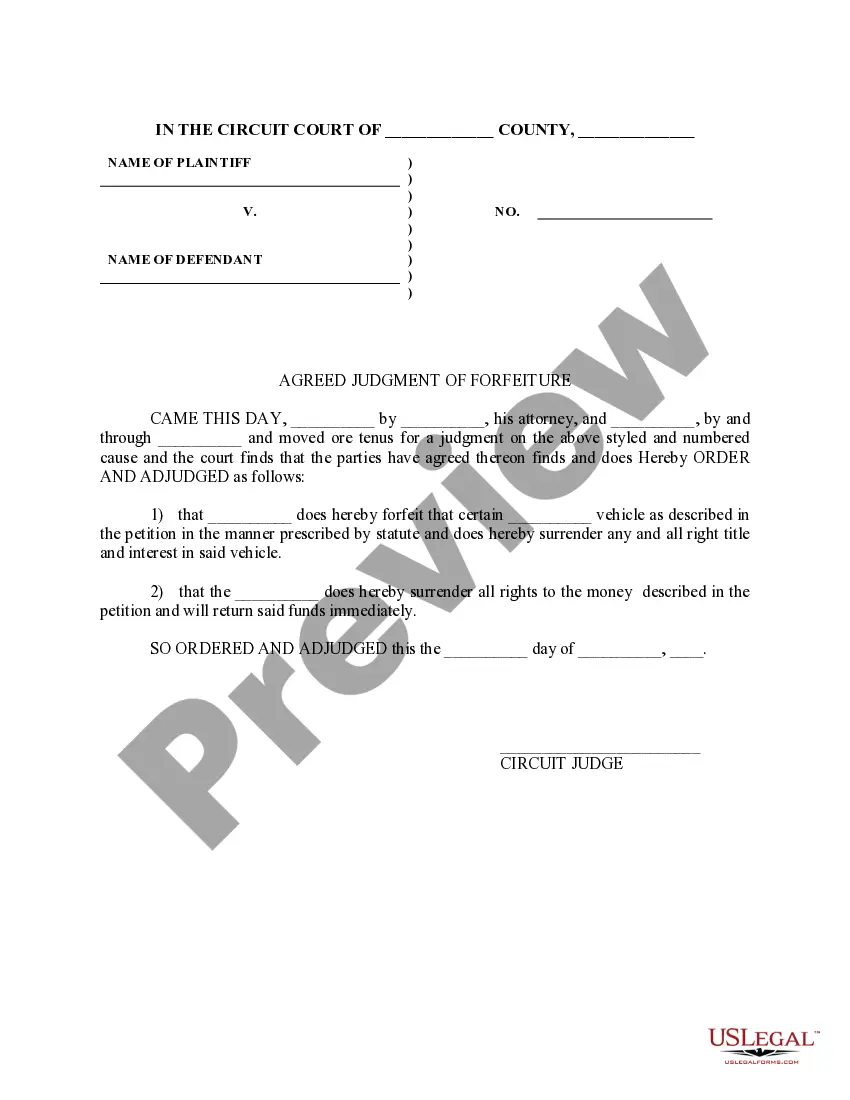
This form is essential when law enforcement authorities seek to seize property linked to criminal activities, and the involved party agrees to the forfeiture. It can be used in various scenarios, such as resolving drug-related offenses or other illegal activities where property is subject to forfeiture by consent. This agreement formalizes the transfer of ownership and ensures compliance with legal requirements.
Who should use this form
This form is intended for:
- Law enforcement agencies or authorities involved in property seizure due to criminal activities.
- Individuals or entities subject to forfeiture who voluntarily agree to the terms.
- Attorneys representing either party in the forfeiture proceedings.
Instructions for completing this form
- Identify the property being forfeited, including any relevant details such as the VIN.
- Specify the recipient of the forfeited property.
- Enter the appropriate legal code reference to support the forfeiture.
- Fill in the date on which the order is issued.
- Gather required signatures from the circuit judge and the attorney for the involved parties.
Does this form need to be notarized?
This form usually doesn’t need to be notarized. However, local laws or specific transactions may require it. Our online notarization service, powered by Notarize, lets you complete it remotely through a secure video session, available 24/7.
Get your form ready online
Our built-in tools help you complete, sign, share, and store your documents in one place.
Make edits, fill in missing information, and update formatting in US Legal Forms—just like you would in MS Word.
Download a copy, print it, send it by email, or mail it via USPS—whatever works best for your next step.
Sign and collect signatures with our SignNow integration. Send to multiple recipients, set reminders, and more. Go Premium to unlock E-Sign.
If this form requires notarization, complete it online through a secure video call—no need to meet a notary in person or wait for an appointment.
We protect your documents and personal data by following strict security and privacy standards.

Make edits, fill in missing information, and update formatting in US Legal Forms—just like you would in MS Word.

Download a copy, print it, send it by email, or mail it via USPS—whatever works best for your next step.

Sign and collect signatures with our SignNow integration. Send to multiple recipients, set reminders, and more. Go Premium to unlock E-Sign.

If this form requires notarization, complete it online through a secure video call—no need to meet a notary in person or wait for an appointment.

We protect your documents and personal data by following strict security and privacy standards.
Avoid these common issues
- Failing to provide a complete and accurate description of the forfeited property.
- Leaving out required signatures, particularly from the circuit judge or attorney.
- Not referencing the correct legal code related to forfeiture.
- Inconsistency in the information provided between the agreement and other legal documents.
Advantages of online completion
- Convenience of downloading and printing the form at any time.
- Editable fields for customization according to unique case details.
- Access to forms created by licensed attorneys for accuracy and compliance.
- Immediate access prevents delays in legal proceedings.
Legal use & context
- This form represents an agreement between the involved parties and the state authorities regarding property forfeiture.
- It serves as a legal final judgment that can be enforced by the courts.
- Compliance with both state and federal laws governing forfeiture is essential for validity.
Summary of main points
- The Agreed Order and Final Judgment - Awarding Forfeiture is essential for legally transferring property linked to criminal activities.
- Proper completion and submission of this form can expedite the forfeiture process.
- Ensure all signatures and information are filled accurately to avoid legal complications.
Looking for another form?

Form popularity
FAQ
An order or judgment of the Court that finally disposes of the rights of the parties. A final order usually, but not always, is one which ends litigation.Typically, judicial review or an appeal is only permissible as against a final order.
Once the remainder of the case is voluntarily dismissed, however, the dismissal order becomes a final judgment that can be appealed.
Often they are filed for due to urgent matters that need addressing before the court brings the case to a close. Interim orders (also known as Temporary Orders) are heard usually between 2-3 months after an Initiating Application is filed, and last until the Final Order is made, which is when the case is closed.
Interim Orders are temporary orders made by the court until Final Orders can be made. The nature of the family law system means that most parties will wait 12 months or longer for a Final Hearing. Therefore, parties often require parenting orders to be made prior to a Final Hearing.
Interim orders (also known as Temporary Orders) are heard usually between 2-3 months after an Initiating Application is filed, and last until the Final Order is made, which is when the case is closed.
The last decision from a court that resolves all issues in dispute and settles the parties' rights with respect to those issues. A final judgment leaves nothing except decisions on how to enforce the judgment, whether to award costs, and whether to file an appeal.
In a recent judgment, the Bombay High Court ruled that while entertaining the Regular Civil Appeal, if the First Appellate Court passes interim order under Order 39 Rules 1 and 2 of the CPC, it cannot be challenged further by taking help of sub-rule (r) of Rule 1 of Order 43.
In the US legal system, a final order is an order by a court disposing of all the issues in a case and resulting in a decision for one of the parties.When the judge has reached a decision in case and entered judgment, the order is final for procedural purposes, but may not be the last order entered by the court.