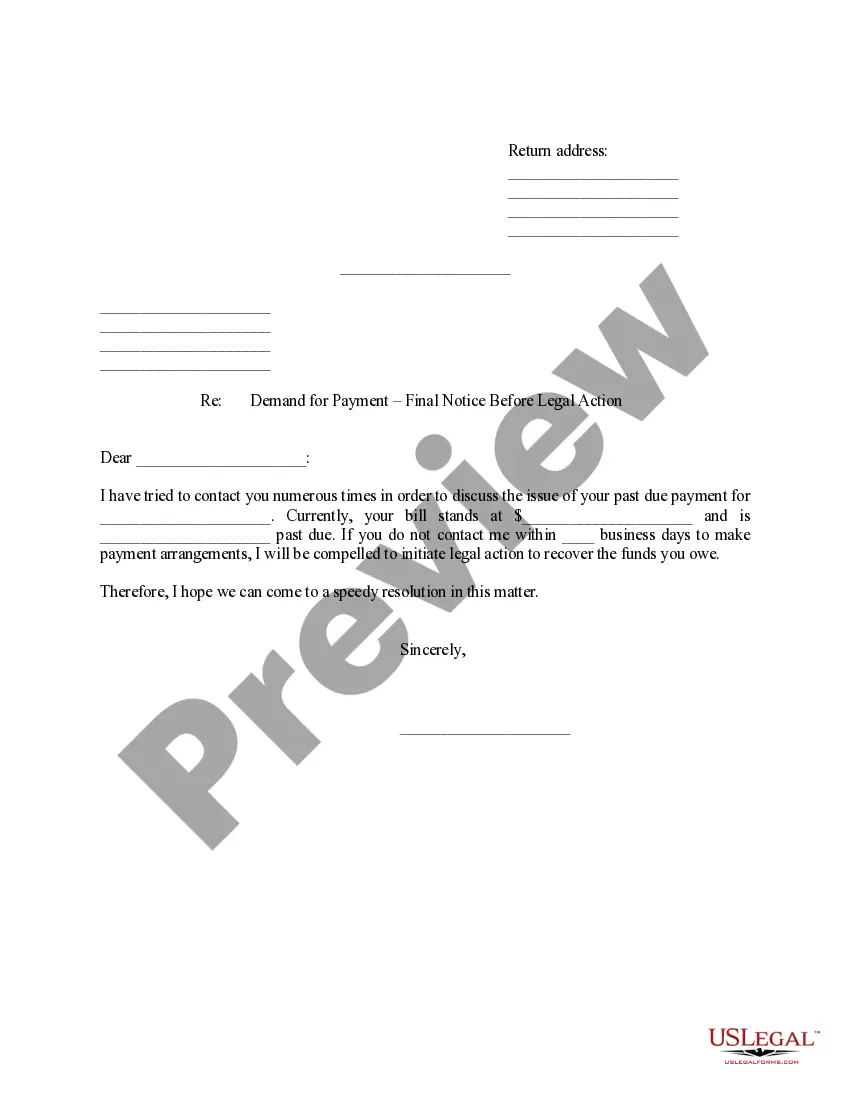
Sample Letter for Demand for Payment - Final Notice Before Legal Action
What is this form?
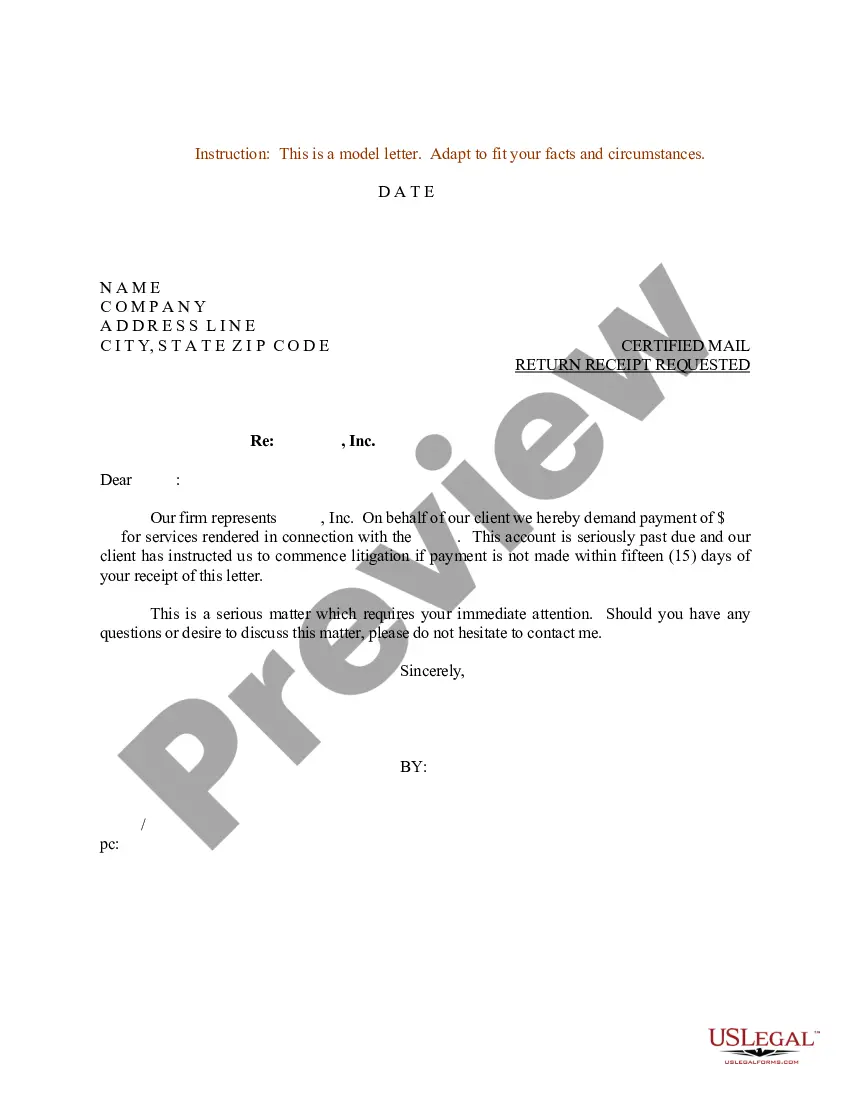
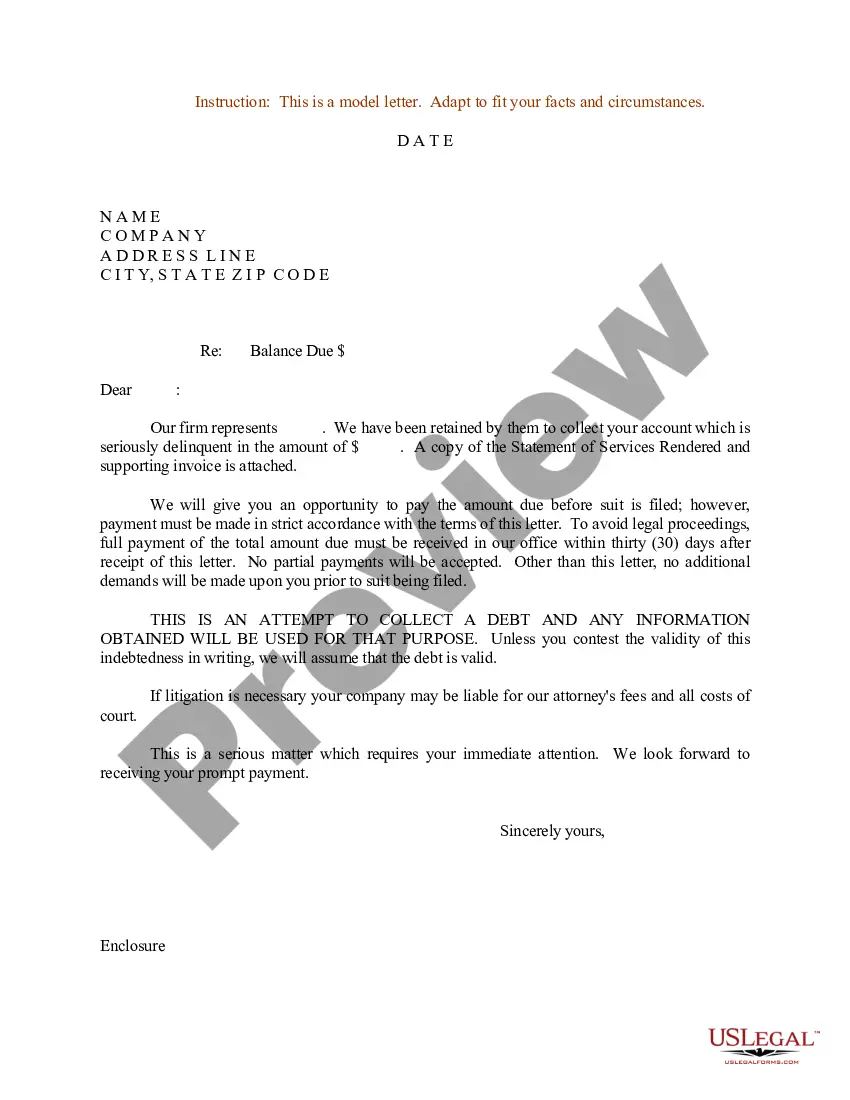
This Sample Letter for Demand for Payment, also known as a final notice before legal action, is a template designed to formally request payment from a debtor. It serves as a last effort to collect a debt before legal proceedings may begin. Unlike informal reminders or requests, this letter clearly communicates the seriousness of the situation and the impending consequences if payment is not made, providing a professional and structured approach to debt collection.
Key parts of this document
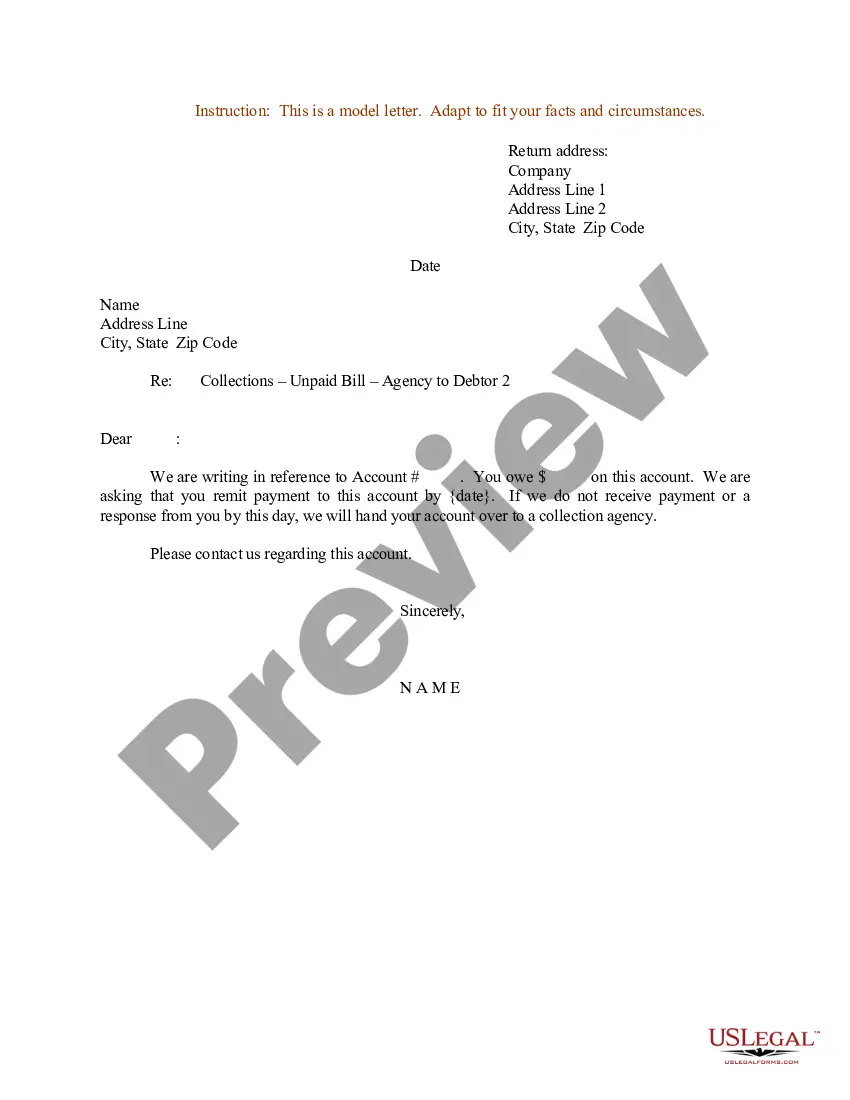
- Return address section for the sender's details.
- Date field to indicate when the letter is sent.
- Recipient's address, including company name and location.
- Subject line specifying demand for payment.
- Body with a clear request for payment and an emphasis on resolution.
- Closing section with a signature line for the sender's name.
Situations where this form applies
This form should be used when a debtor has not responded to previous payment requests. It is appropriate in situations where you need to escalate the urgency of the request, indicating that you are prepared to take legal action if necessary. Use this letter when you want to maintain a professional tone while conveying the seriousness of the debt issue.
Who should use this form
- Individuals or businesses seeking payment from clients or customers.
- Creditors who have exhausted informal collection attempts.
- Legal professionals assisting clients in debt collection matters.
Completing this form step by step
- Enter your full name and address in the return address section.
- Fill in the date when the letter is being sent.
- Provide the recipient's name and address accurately.
- Clearly state the subject of the letter as "Demand for Payment."
- Write a concise message outlining your request for payment and the possibility of further action.
- Sign the letter to validate your request.
Is notarization required?
Notarization is generally not required for this form. However, certain states or situations might demand it. You can complete notarization online through US Legal Forms, powered by Notarize, using a verified video call available anytime.
Get your form ready online
Our built-in tools help you complete, sign, share, and store your documents in one place.
Make edits, fill in missing information, and update formatting in US Legal Forms—just like you would in MS Word.
Download a copy, print it, send it by email, or mail it via USPS—whatever works best for your next step.
Sign and collect signatures with our SignNow integration. Send to multiple recipients, set reminders, and more. Go Premium to unlock E-Sign.
If this form requires notarization, complete it online through a secure video call—no need to meet a notary in person or wait for an appointment.
We protect your documents and personal data by following strict security and privacy standards.

Make edits, fill in missing information, and update formatting in US Legal Forms—just like you would in MS Word.

Download a copy, print it, send it by email, or mail it via USPS—whatever works best for your next step.

Sign and collect signatures with our SignNow integration. Send to multiple recipients, set reminders, and more. Go Premium to unlock E-Sign.

If this form requires notarization, complete it online through a secure video call—no need to meet a notary in person or wait for an appointment.

We protect your documents and personal data by following strict security and privacy standards.
Typical mistakes to avoid
- Failing to include all necessary addresses.
- Not specifying the amount owed clearly.
- Leaving out the date, which could affect the urgency of the demand.
- Not signing the letter, which may undermine its legitimacy.
Why use this form online
- Convenient access to a professionally drafted legal template.
- Editable Word format allows for customization to fit specific situations.
- Quick download process saves time compared to traditional methods.
- Provides a reliable framework for communicating serious financial requests.
Legal use & context
- This letter serves as a formal record of your demand for payment, which can be useful in legal proceedings.
- Sending a final notice demonstrates due diligence, which may be required before pursuing legal action.
- Receiving this letter may prompt the debtor to address the outstanding balance promptly.
Summary of main points
- This form serves as a final demand for payment, clearly stating the seriousness of the situation.
- It is crucial to include accurate recipient and sender details to ensure effective communication.
- Using this structured letter can help facilitate payment and avoid legal action.
Looking for another form?
Form popularity
FAQ
No, a demand letter is not necessary prior to filing a superior court limited/unlimited jurisdiction lawsuit in California.
Step 1 Enter the Header Information. Step 2 Enter the Amount Due. Step 3 Complete the Debtor's Details. Step 4 Enter the Payment Option. Step 5 Detail the Consequences and Sign.
Type your letter. Concisely review the main facts. Be polite. Write with your goal in mind. Ask for exactly what you want. Set a deadline. End the letter by stating you will promptly pursue legal remedies if the other party does not meet your demand. Make and keep copies.
Outline The Incident. You will need to start by outlining the details of the accident. Detail Your Injuries. Explain All Of Your Damages. Calculate Your Settlement Demand. Attach Relevant Documents. Get Help From An Attorney.
An attorney is usually not necessary at this point and you can write a demand letter on your own. To write one, gather necessary documents, draft your letter, and send the letter to your opposing party.
Your company name and address. recipient's name and address. today's date. a clear reference and/or any account reference numbers. the amount outstanding. original payment due date. a brief explanation that no payment has been received.
Establish facts. Don't assume everyone knows the facts. Refer to evidence. If there's evidence (like a contract), you don't need to include it, but you should refer to it. Make a demand. Be specific as to what you want. Set a deadline and establish method of payment. Offer a consequence.
When writing a final notice, keep in mind that it is a legal document. Always include the important details, such as the date and the name of the people or the party involved. Clarify the reasons as to why you are giving a final notice.
A Final Demand Letter is the final letter sent in attempt to collect a debt or repayment. The letter is sent prior to a collector or financial institution filing legal action against a debtor.