Surrogate or Surrogacy Agreement for Artificial Insemination between Husband, Wife, and Donor - Identity of Donor Known
What this document covers
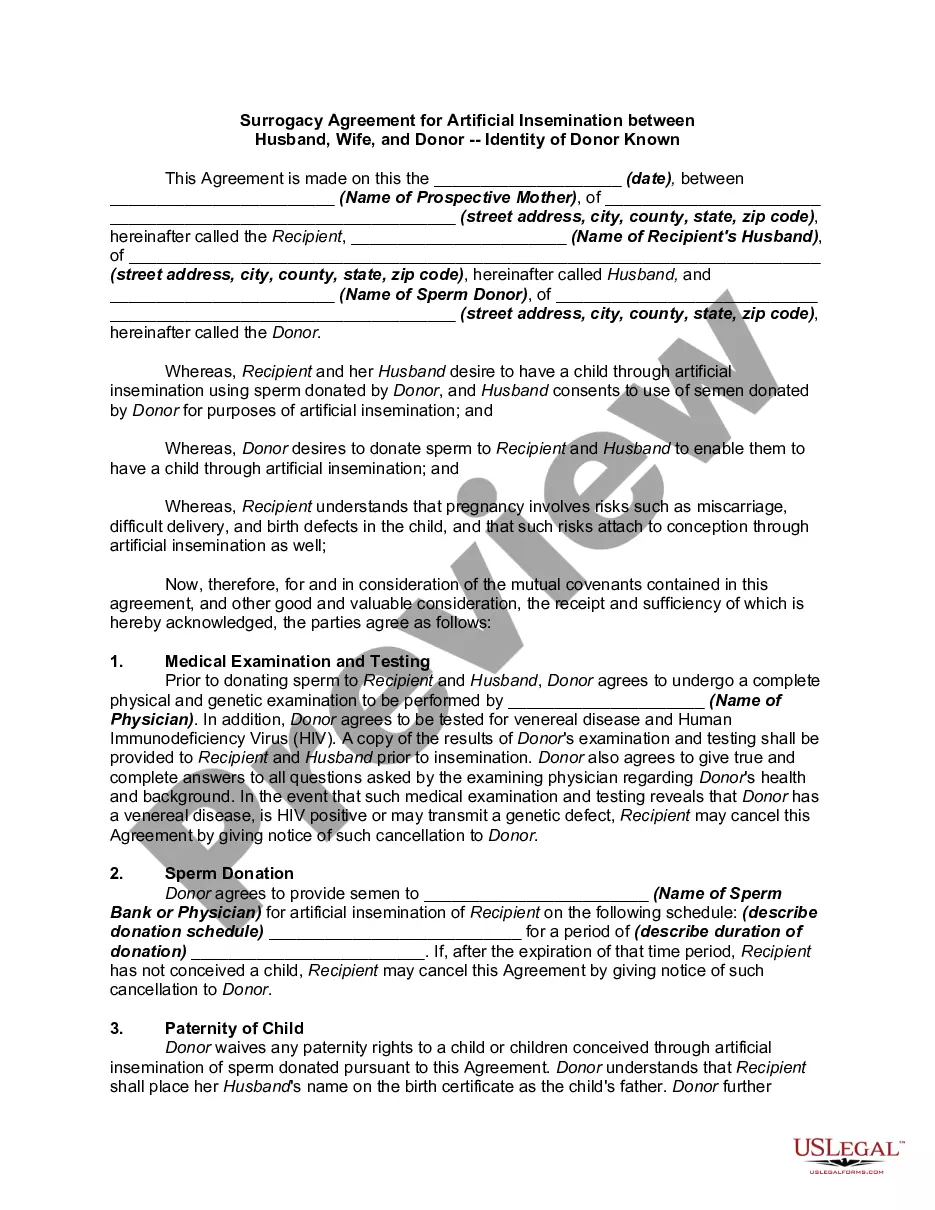
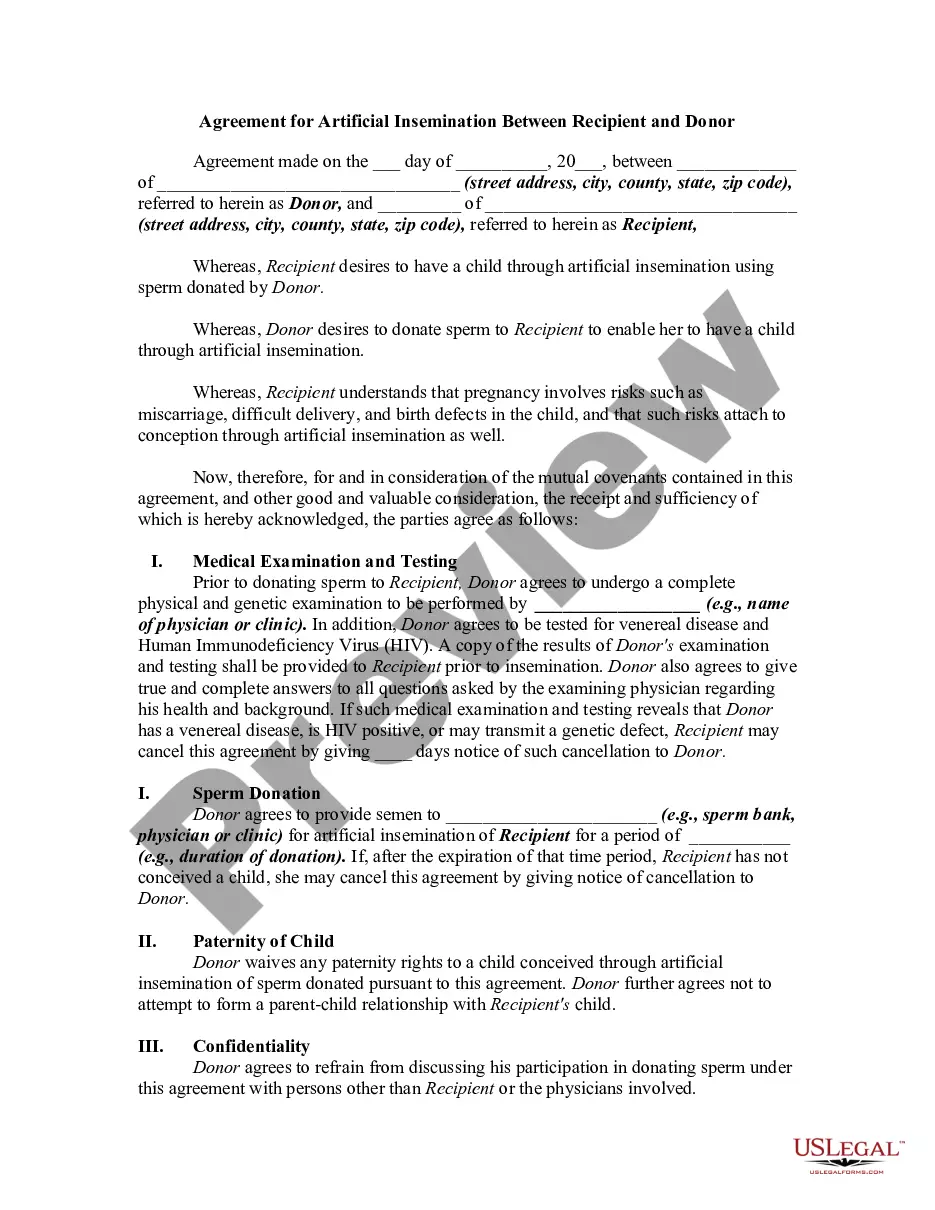
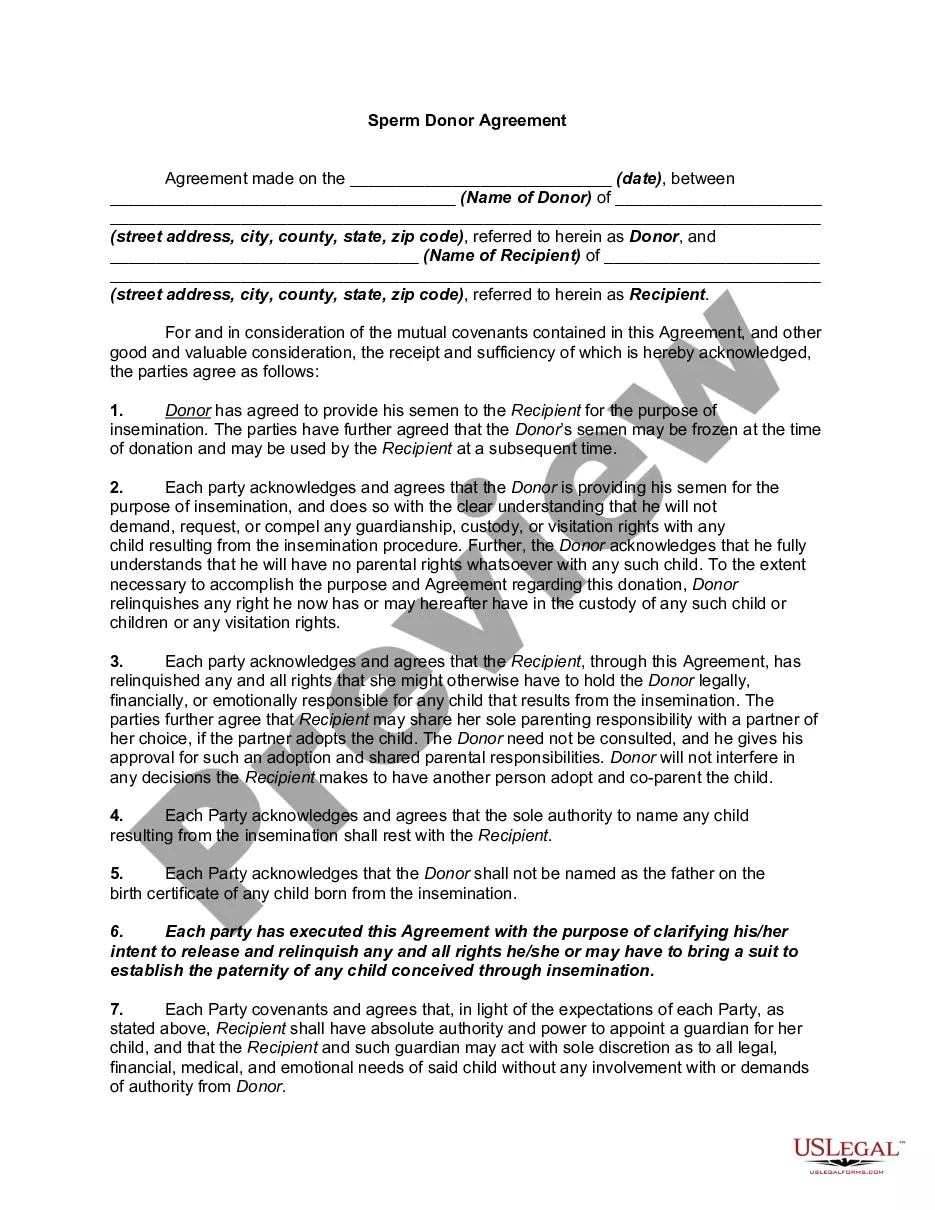
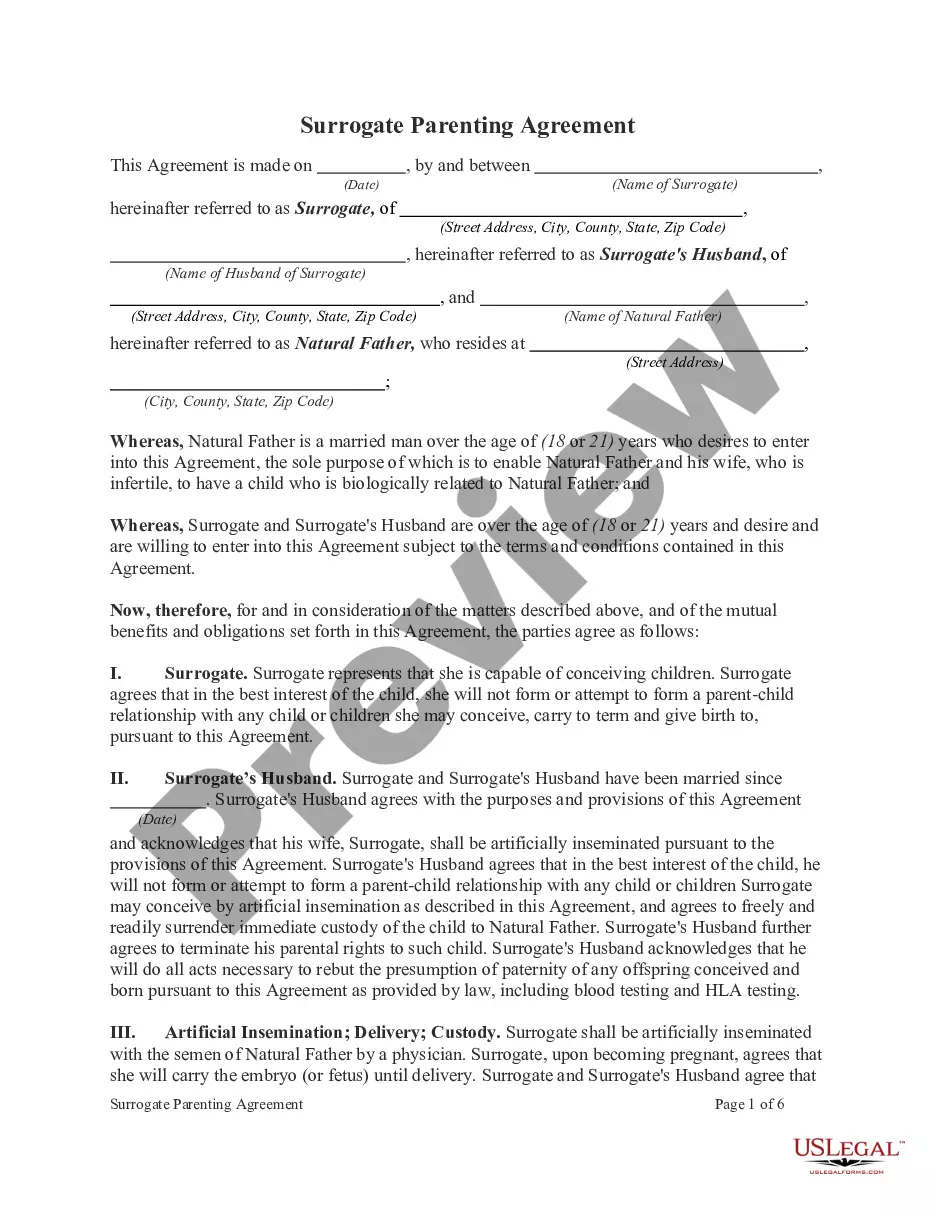
This Surrogate or Surrogacy Agreement for Artificial Insemination is a legal contract between a husband, wife, and a known sperm donor. Its primary purpose is to facilitate the artificial insemination process, where the husband and wife seek to have a child using the sperm donated by an identified donor. This agreement outlines the responsibilities, rights, and agreements made by all parties involved, differentiating it from other surrogacy arrangements. It is essential for ensuring clarity and legal protection for everyone involved in the surrogacy process.
Key components of this form
- Date of the agreement and identification of all parties involved.
- Provisions for medical examination and testing of the donor.
- Details about the sperm donation schedule and process.
- Waiver of paternity rights by the donor.
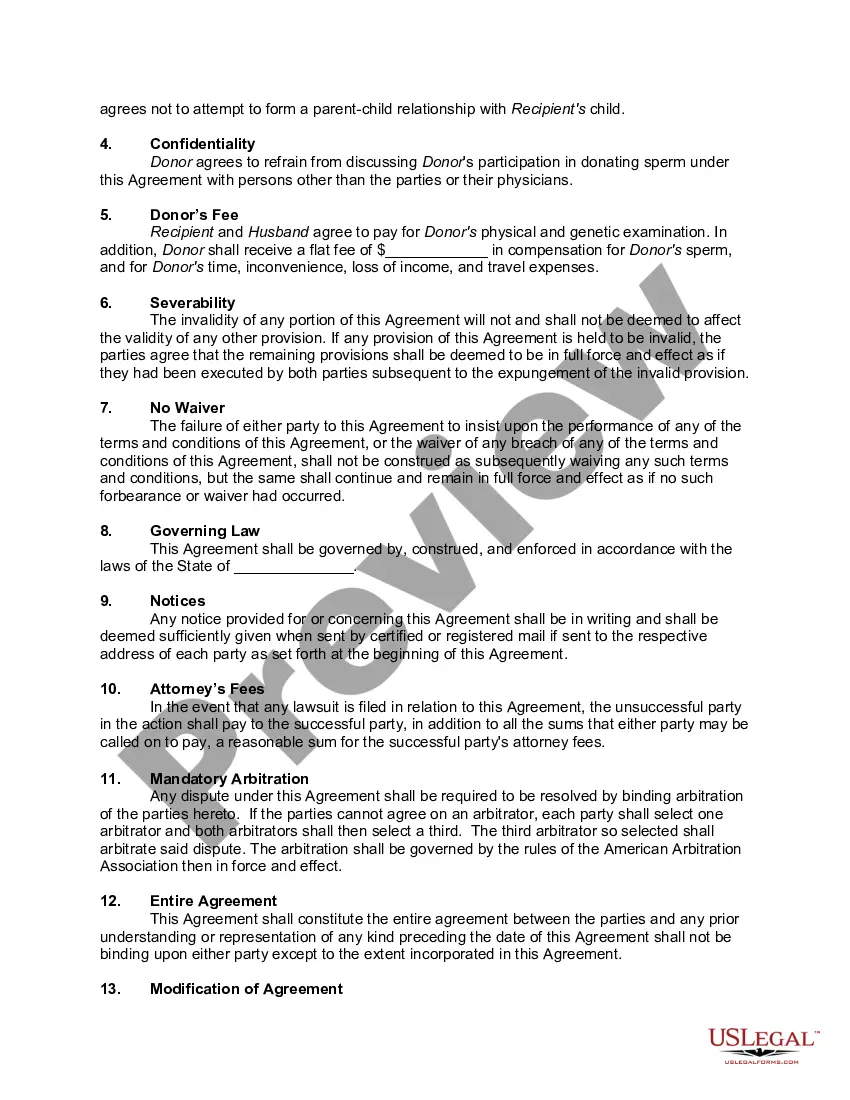
- Confidentiality clause regarding the donor's participation.
- Conditions regarding financial compensation for the donor.
- Termination and cancellation terms of the agreement.
- Governing law and dispute resolution through arbitration.
When this form is needed
This form should be used when a husband and wife wish to conceive a child through artificial insemination using sperm from a known donor. It is particularly applicable in cases where the couple has fertility issues and has chosen to seek assistance while keeping the identity of the donor transparent and known. The agreement safeguards the interests of all parties and formalizes the arrangement to prevent future disputes.
Who needs this form
- Intended parents (husband and wife) seeking to use a known donor's sperm for artificial insemination.
- A sperm donor who is willing to contribute sperm with a clear understanding of his rights and responsibilities.
- Legal professionals or advisors assisting couples with surrogacy agreements.
Completing this form step by step
- Identify all parties involved: the wife, husband, and sperm donor, providing their names and addresses.
- Specify the date of the agreement at the beginning of the document.
- Detail the medical examination and testing requirements for the donor.
- Outline the sperm donation schedule and duration.
- Include clauses about paternity rights, confidentiality, and compensation for the donor.
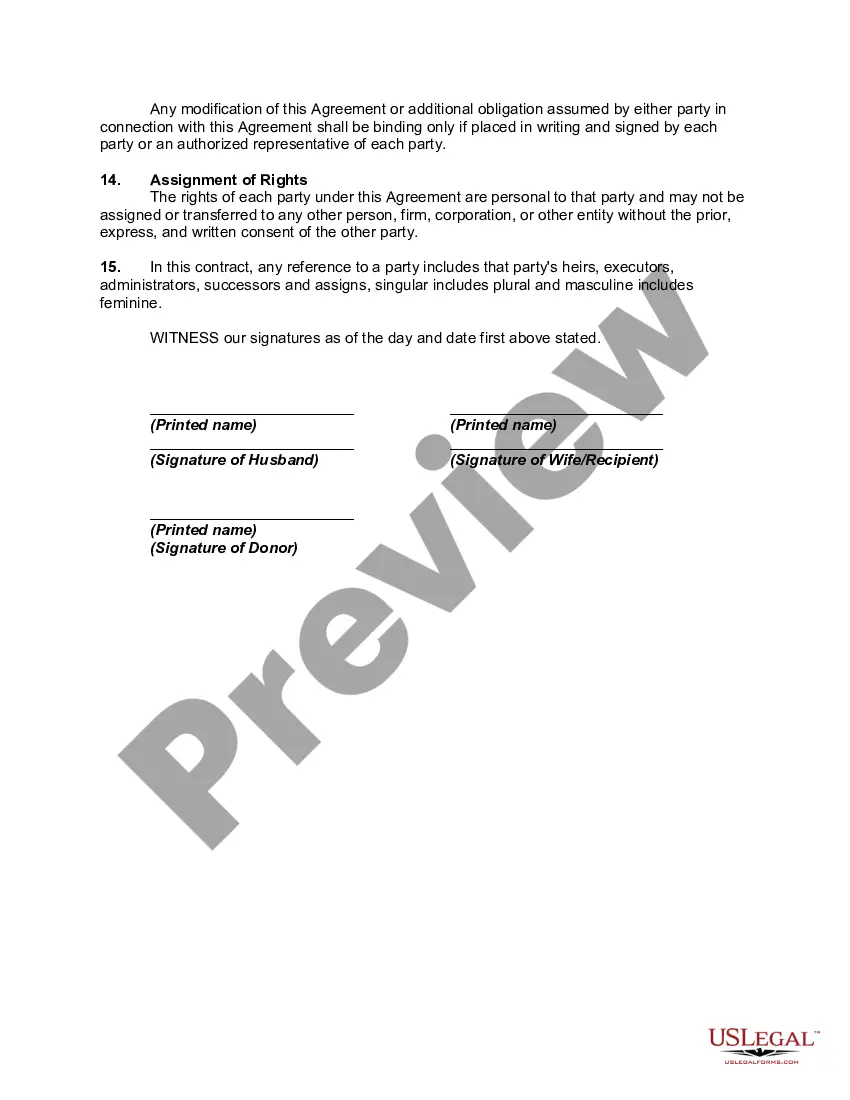
- Ensure all parties sign the agreement in the designated areas to formalize it.
Is notarization required?
This form usually doesn’t need to be notarized. However, local laws or specific transactions may require it. Our online notarization service, powered by Notarize, lets you complete it remotely through a secure video session, available 24/7.
Get your form ready online
Our built-in tools help you complete, sign, share, and store your documents in one place.
Make edits, fill in missing information, and update formatting in US Legal Forms—just like you would in MS Word.
Download a copy, print it, send it by email, or mail it via USPS—whatever works best for your next step.
Sign and collect signatures with our SignNow integration. Send to multiple recipients, set reminders, and more. Go Premium to unlock E-Sign.
If this form requires notarization, complete it online through a secure video call—no need to meet a notary in person or wait for an appointment.
We protect your documents and personal data by following strict security and privacy standards.

Make edits, fill in missing information, and update formatting in US Legal Forms—just like you would in MS Word.

Download a copy, print it, send it by email, or mail it via USPS—whatever works best for your next step.

Sign and collect signatures with our SignNow integration. Send to multiple recipients, set reminders, and more. Go Premium to unlock E-Sign.

If this form requires notarization, complete it online through a secure video call—no need to meet a notary in person or wait for an appointment.

We protect your documents and personal data by following strict security and privacy standards.
Common mistakes
- Failing to include a clear schedule for sperm donation.
- Not specifying the obligations of each party regarding medical testing.
- Leaving out the confidentiality clause, which is crucial for privacy.
- Not getting all parties to sign and date the agreement.
- Ignoring state-specific legal requirements that could affect the agreement's enforceability.
Advantages of online completion
- Convenience of downloading and completing the form at your own pace.
- Editability allows tailored specifications according to personal circumstances.
- Instant access to professionally drafted templates ensures reliability.
- Easy to save and share with legal professionals or advisors for review.
Legal use & context
- This agreement provides legal clarity regarding the rights and responsibilities of the parties involved in the surrogacy process.
- It helps prevent potential disputes related to paternity and parental rights.
- Consultation with legal counsel is advised to ensure compatibility with local laws.
Summary of main points
- A properly executed surrogate agreement is crucial for protecting the rights of all parties involved in artificial insemination.
- Details surrounding medical testing, paternity rights, and confidentiality must be clearly addressed.
- Customizations may be needed based on state-specific requirements, so consult with legal professionals if uncertain.
Looking for another form?
Form popularity
FAQ
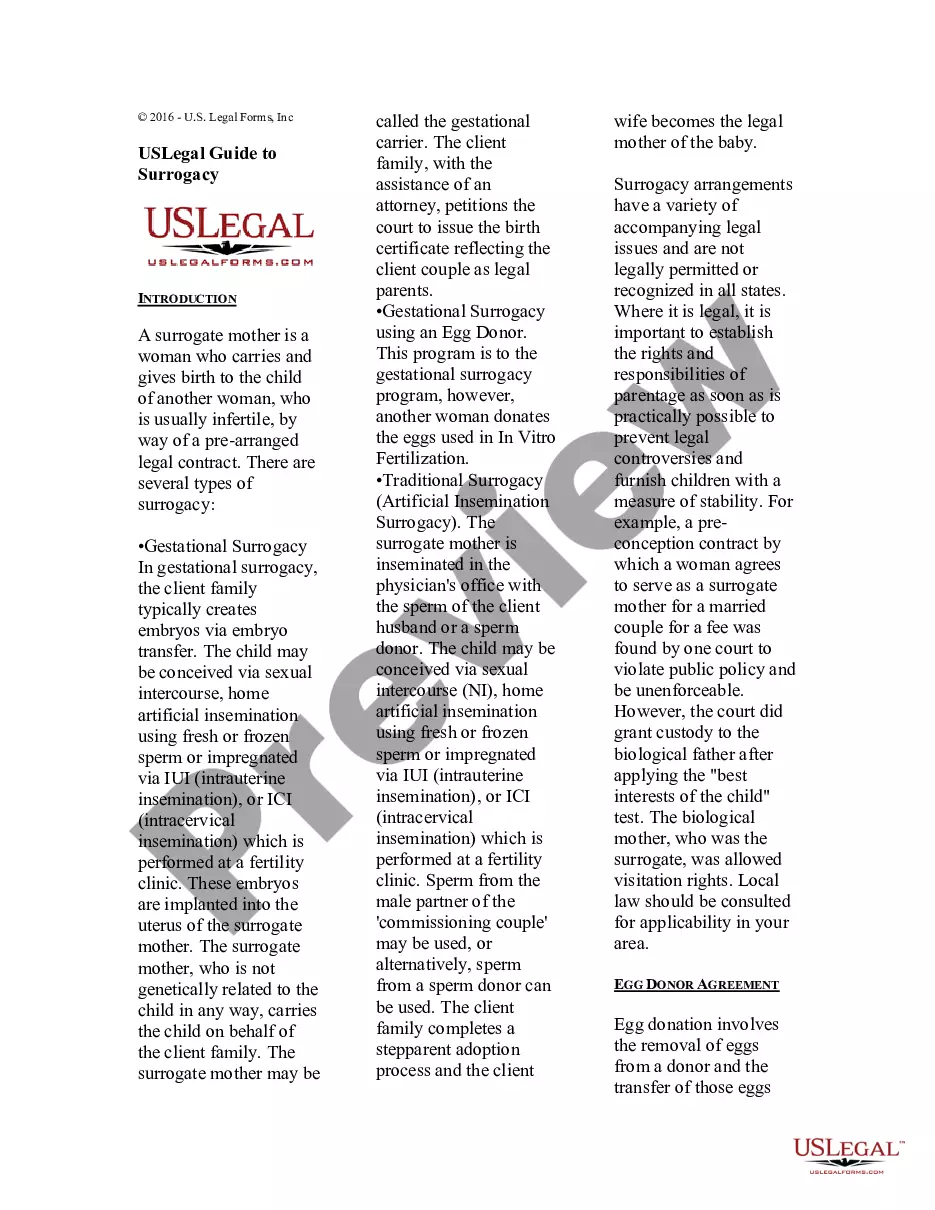
(SER-uh-gut PREG-nun-see) A type of pregnancy in which a woman carries and gives birth to a baby for a person who is not able to have children. In a surrogate pregnancy, eggs from the woman who will carry the baby or from an egg donor are fertilized with sperm from a sperm donor to make an embryo.
5. In 1922 Ilya Ivanovich Ivanov (Russia) developed the methods of artificial insemination as we know them today.
If your donor is donating to you via a private arrangement i.e. by home insemination it is illegal to pay him for the sale of sperm. Donors are allowed to receive a reasonable contribution towards costs such as travel expenses.
In California, a man is a sperm donor and not a father if the child is conceived through assisted reproduction (not sex) and either (a) the man provides his sperm to a physician or sperm bank rather than directly to his recipient(s), or (b) the donor and the recipient(s) have a written agreement in place, prior to
On the upside, being a sperm donor comes with virtually no medical risks and, in fact, delivers a medical benefit: the chance to be screened, free of charge, for STDs, sperm quality and quantity, genetic conditions (if you get that far) and more.
Yes, there are exceptions. States vary widely on their laws concerning sperm donation and legal parentage.This means that if a DNA test shows that the known donor is the father, then he will be considered the legal fathereven if his name is not on the birth certificate.
About two-thirds of states have adopted the Uniform Parentage Act (UPA), which gives protections to sperm donors in cases where a mother has sued them for child support.Since the donor is not the legal father, he is not legally bound to pay child support.
Yes! California law treats any person who provides sperm that is used for assisted reproduction as a sperm donor and not a parent if they are not married to the person giving birth.Otherwise, they may be inappropriately treated as a sperm donor without any parental rights.
Yes! California law treats any person who provides sperm that is used for assisted reproduction as a sperm donor and not a parent if they are not married to the person giving birth.Otherwise, they may be inappropriately treated as a sperm donor without any parental rights.