Sample Letter for Warning before Dismissal - Final
Overview of this form
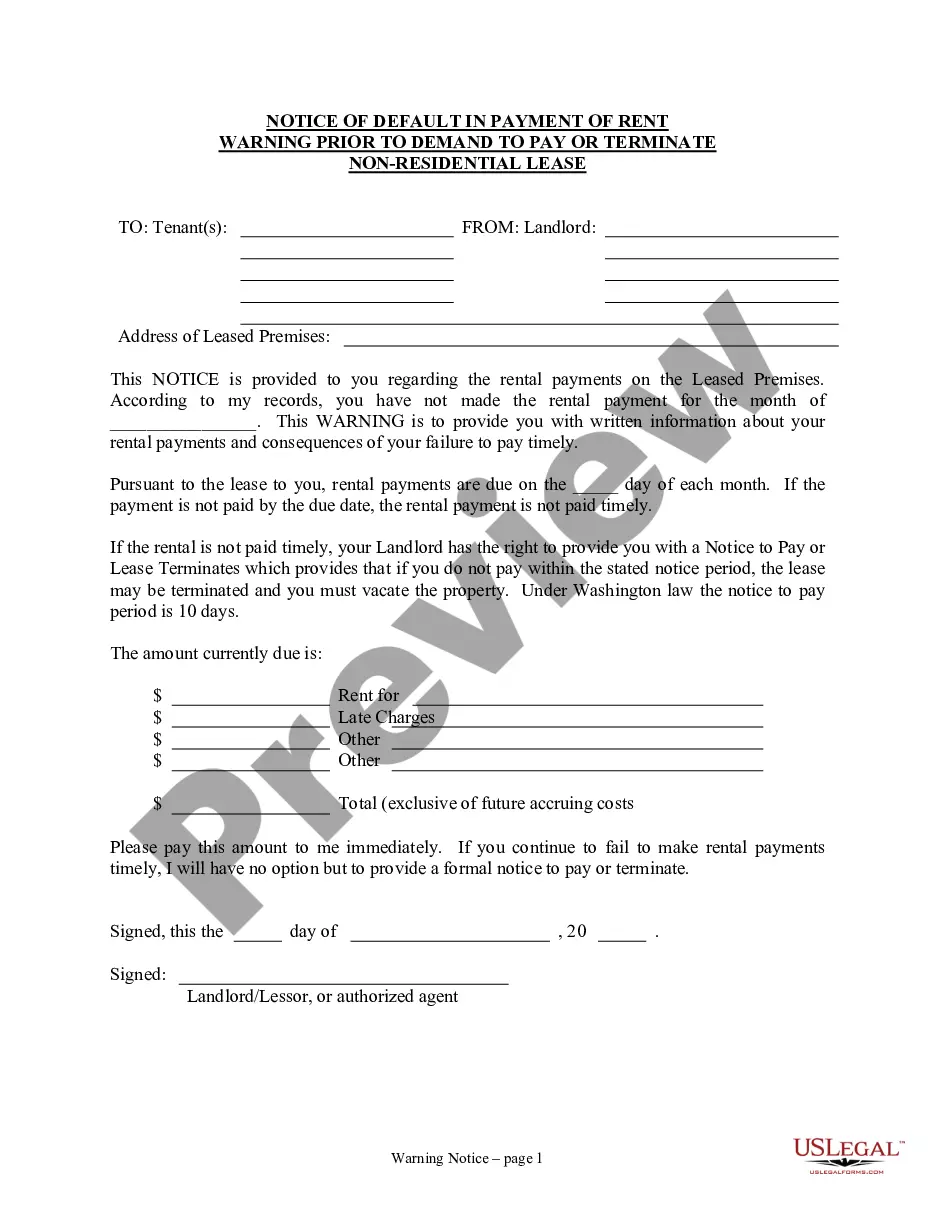
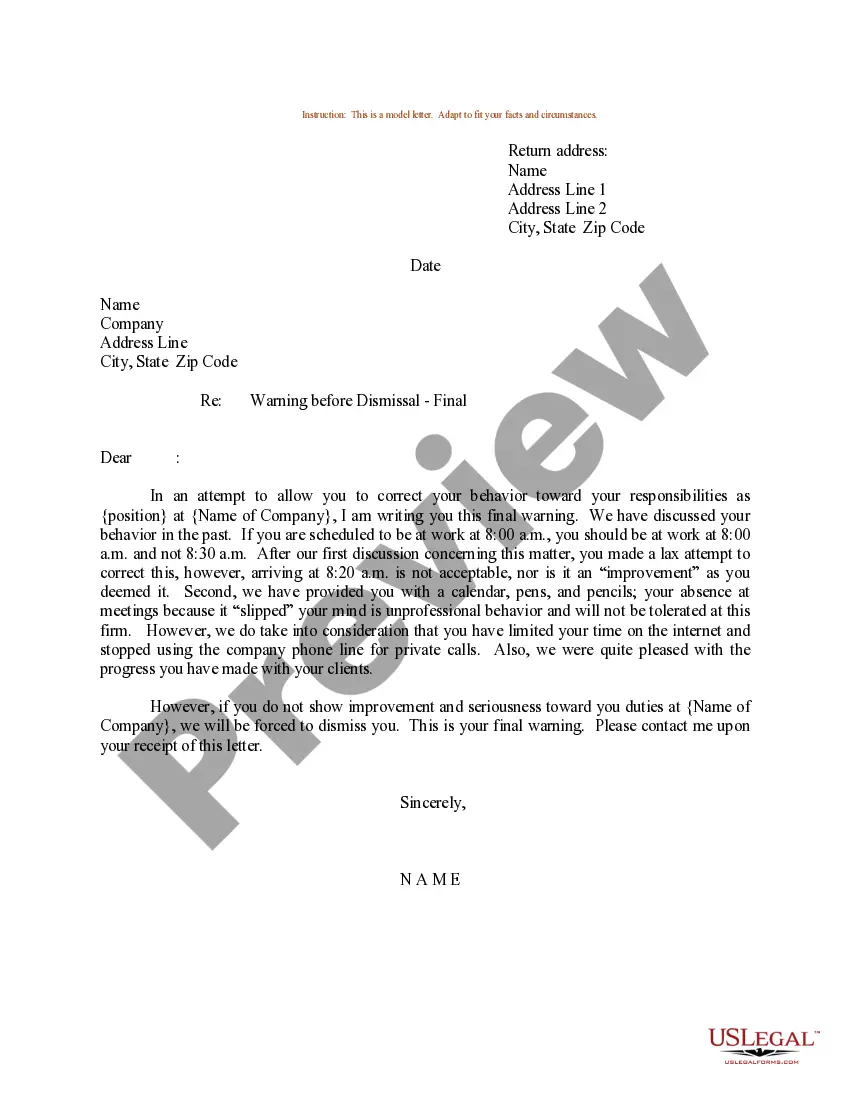
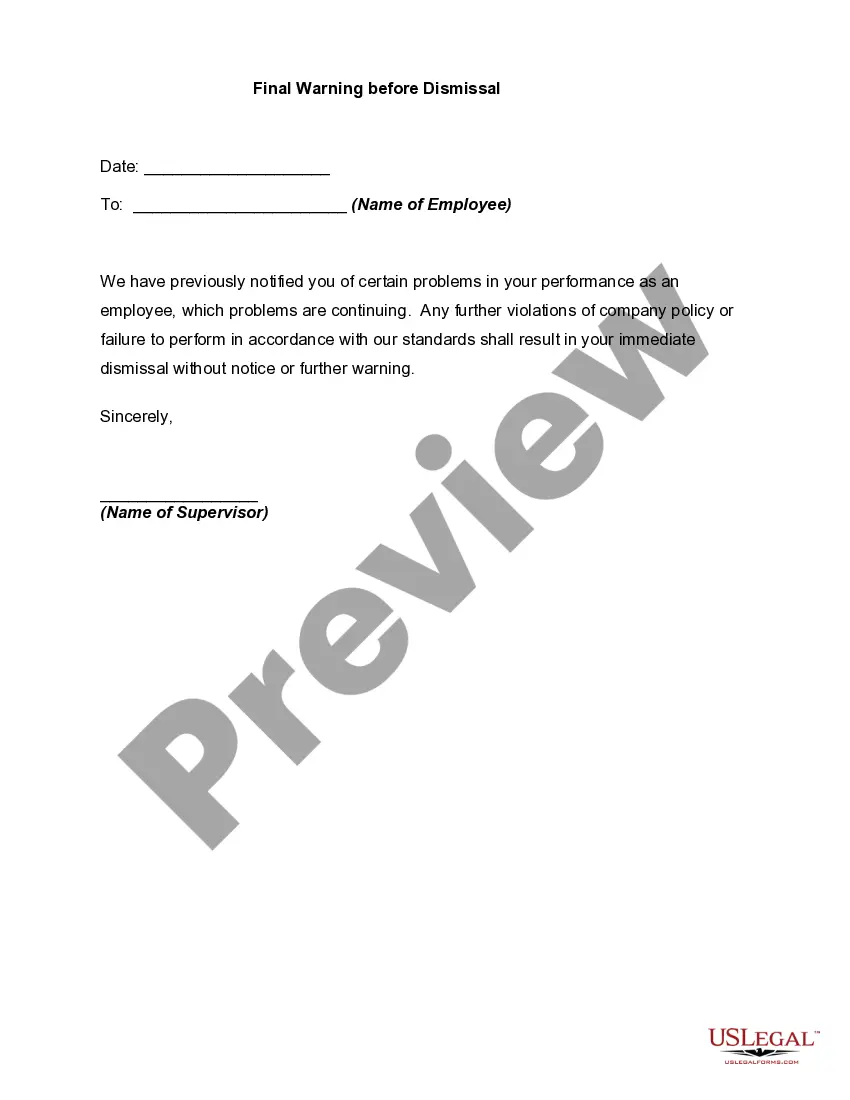
The Sample Letter for Warning before Dismissal - Final is a template designed to formally notify an employee of their unsatisfactory performance while providing a final warning. This letter is essential for employers who want to document their attempts to address performance issues and clearly outline the potential consequences, including the possibility of dismissal. Unlike other informal warnings, this letter is more structured and serves as a crucial step in the disciplinary process.
Key components of this form
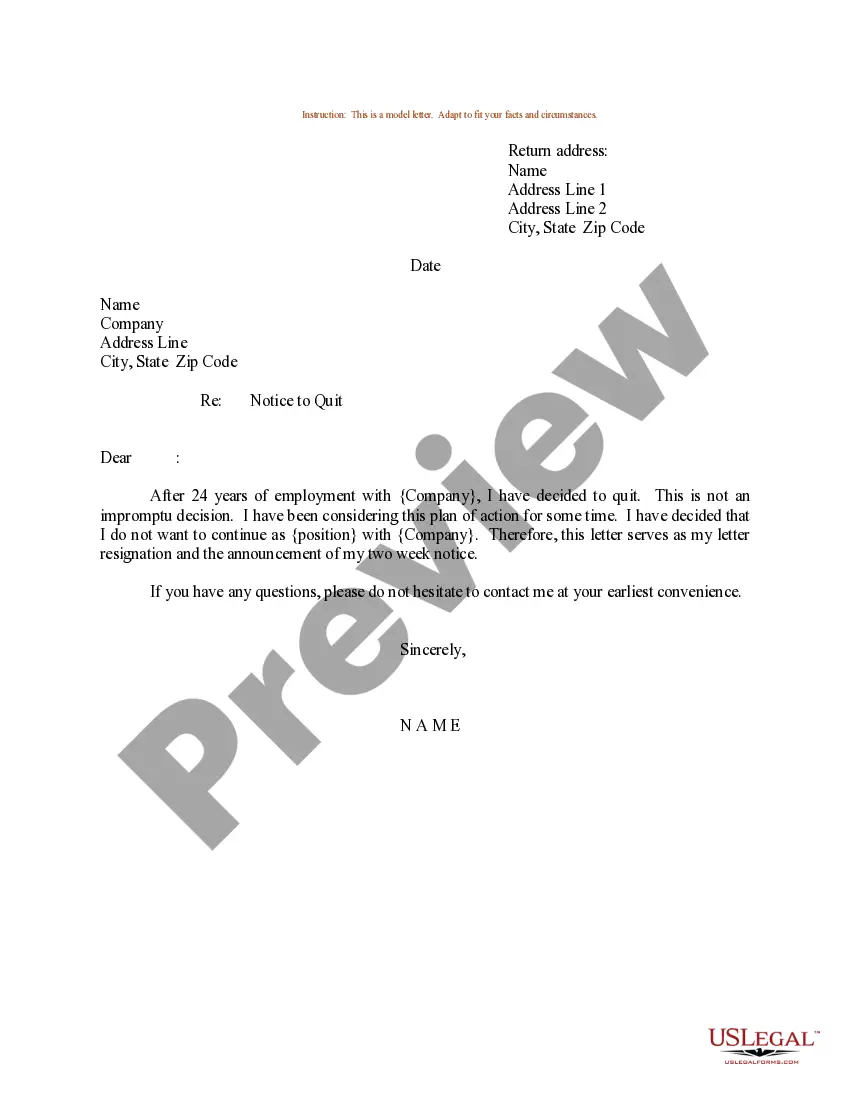
- Return address: Includes the employer's name and address.
- Date: The date when the letter is issued.
- Recipient's details: The name and address of the employee receiving the warning.
- Subject line: Clearly states the intent of the letter (final warning before dismissal).
- Warning statement: Explicitly mentions the seriousness of the employee's performance issues and the consequences if improvement is not shown.
- Call to action: Encourages the employee to contact the employer upon receipt of the letter.
- Signature line: Space for the employer's signature and printed name.
When to use this document
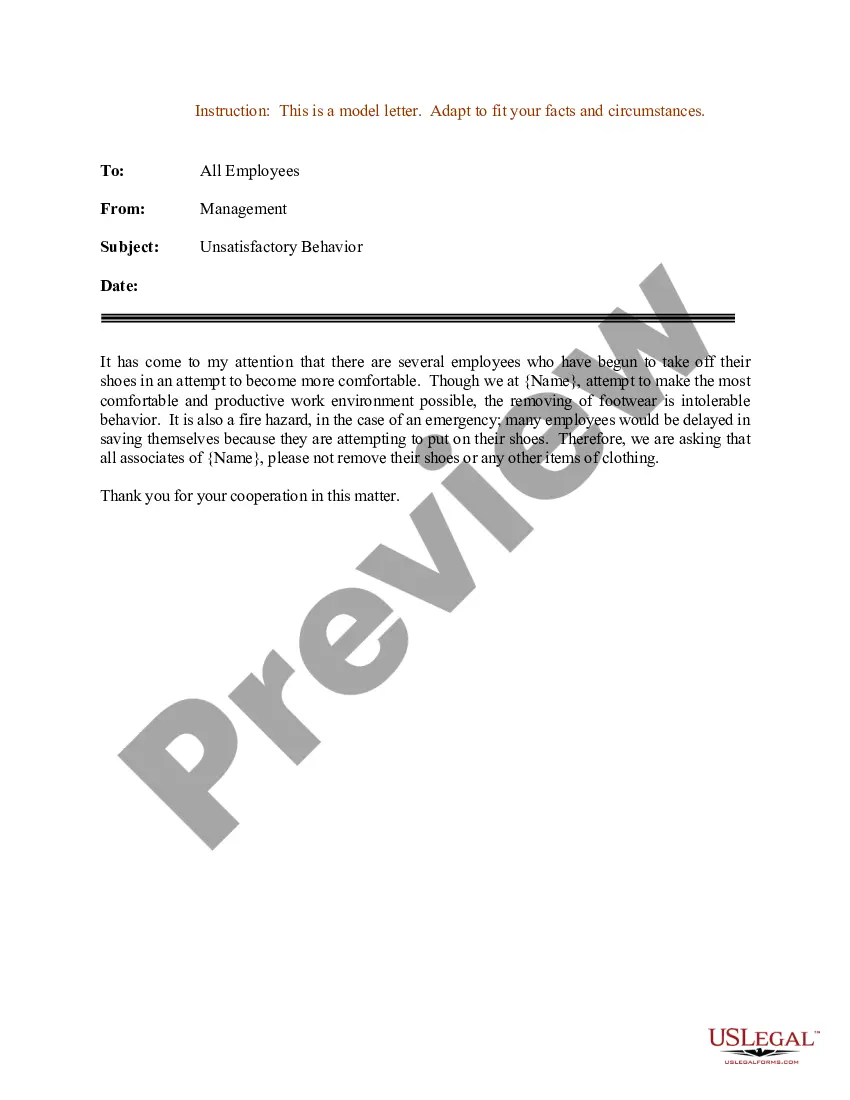
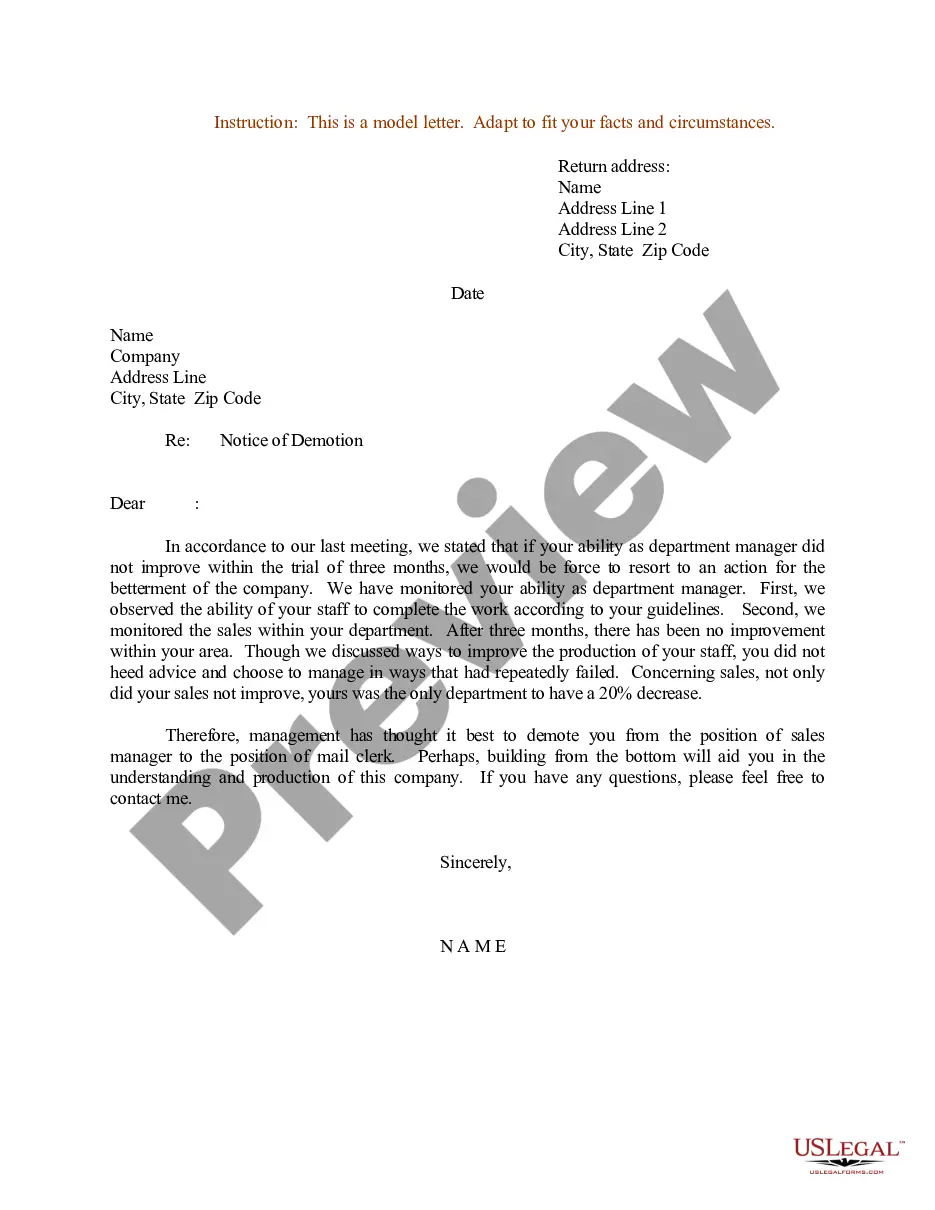
This form should be used when an employer has documented performance issues with an employee and has already provided previous warnings. It serves as a final attempt to communicate the seriousness of the situation before possible termination. Scenarios may include repeated tardiness, inadequate work quality, or failure to meet job responsibilities after prior discussions.
Who can use this document
This form is intended for:
- Employers and managers looking to address employee performance issues.
- Human resources professionals who are guiding disciplinary procedures.
- Business owners who manage their employee team's performance directly.
Instructions for completing this form
- Start by entering the return address at the top of the letter.
- Add the date when the letter is being issued.
- Fill in the recipient's details, including their name and address.
- Clearly state the subject as "Warning before Dismissal - Final."
- In the body of the letter, outline the specific performance issues and the urgency of the final warning.
- Encourage the employee to reach out to you regarding the letter.
- Sign the letter and print your name below the signature.
Is notarization required?
This form usually doesn’t need to be notarized. However, local laws or specific transactions may require it. Our online notarization service, powered by Notarize, lets you complete it remotely through a secure video session, available 24/7.
Get your form ready online
Our built-in tools help you complete, sign, share, and store your documents in one place.
Make edits, fill in missing information, and update formatting in US Legal Forms—just like you would in MS Word.
Download a copy, print it, send it by email, or mail it via USPS—whatever works best for your next step.
Sign and collect signatures with our SignNow integration. Send to multiple recipients, set reminders, and more. Go Premium to unlock E-Sign.
If this form requires notarization, complete it online through a secure video call—no need to meet a notary in person or wait for an appointment.
We protect your documents and personal data by following strict security and privacy standards.

Make edits, fill in missing information, and update formatting in US Legal Forms—just like you would in MS Word.

Download a copy, print it, send it by email, or mail it via USPS—whatever works best for your next step.

Sign and collect signatures with our SignNow integration. Send to multiple recipients, set reminders, and more. Go Premium to unlock E-Sign.

If this form requires notarization, complete it online through a secure video call—no need to meet a notary in person or wait for an appointment.

We protect your documents and personal data by following strict security and privacy standards.
Avoid these common issues
- Failing to provide previous documentation of performance issues.
- Omitting a clear deadline for expected improvement.
- Not personalizing the letter for the specific employee's situation.
- Using vague language that does not specify the issues being addressed.
Advantages of online completion
- Convenience: Download and complete the form at your convenience.
- Editability: Easily customize the letter to fit your specific needs.
- Reliability: Forms drafted by licensed attorneys ensure legal compliance.
Legal use & context
- Provides a formal record of employer efforts to rectify employee performance issues.
- Can protect the employer from potential wrongful termination claims by documenting the warning process.
Summary of main points
- The form is essential for documenting a final warning before employee dismissal.
- It is vital for employers to follow fair procedures to avoid legal issues.
- Proper use of this form can safeguard against wrongful termination claims and establish a clear communication trail.
Looking for another form?

Form popularity
FAQ
If an employee does not meet the requirements of their final written warning in the timeframe set, it could lead to dismissal. The employer should make this clear to the employee.
Step 1: Identify the problem and consider your options. Clearly identify the performance or conduct issue. Step 2: Meet with the employee. Step 3: Create your letter of final warning. Step 4: Provide the final warning letter to the employee.
If it's gross misconduct, the outcome is usually demotion, transfer to another part of the business, or dismissal. Some examples are violence, theft, and fraud. You might issue someone a final written warning for gross misconduct. When issuing any warning to one of your staff, you should tell them what the problem is.
If you receive a final written warning at work, it means your employer is taking serious disciplinary action against you regarding your performance, behaviour including absences.
Closing: Conclude your letter on a positive note, showing that you believe there is enough time for the employee to improve. For instance, specify that you believe that they are a 'valuable asset to the organisation'. Your name & signature: Since you will need a written copy, opt for a handwritten signature.
Typically, you give one verbal warning and two written warnings (one initial and one final) before dismissing them. However, in cases of severe or gross misconduct, you may dismiss the employee without prior warning.
Explain why certain actions are a concern or problem for the business. Let the employee know he or she is valued by the company, and that you would like to help resolve the issue. Ask for input. Ask the employee for ideas about how the situation or performance can be improved.
If an employee does not meet the requirements of their final written warning in the timeframe set, it could lead to dismissal. The employer should make this clear to the employee.
In cases of serious misconduct or poor performance, the employer does not have to give a first written warning and can instead go straight to a final written warning. For example, where the employee's actions have, or could, cause serious harm to the business.The employer should make this clear to the employee.