Competence - Unanimous Verdict
What is this form?
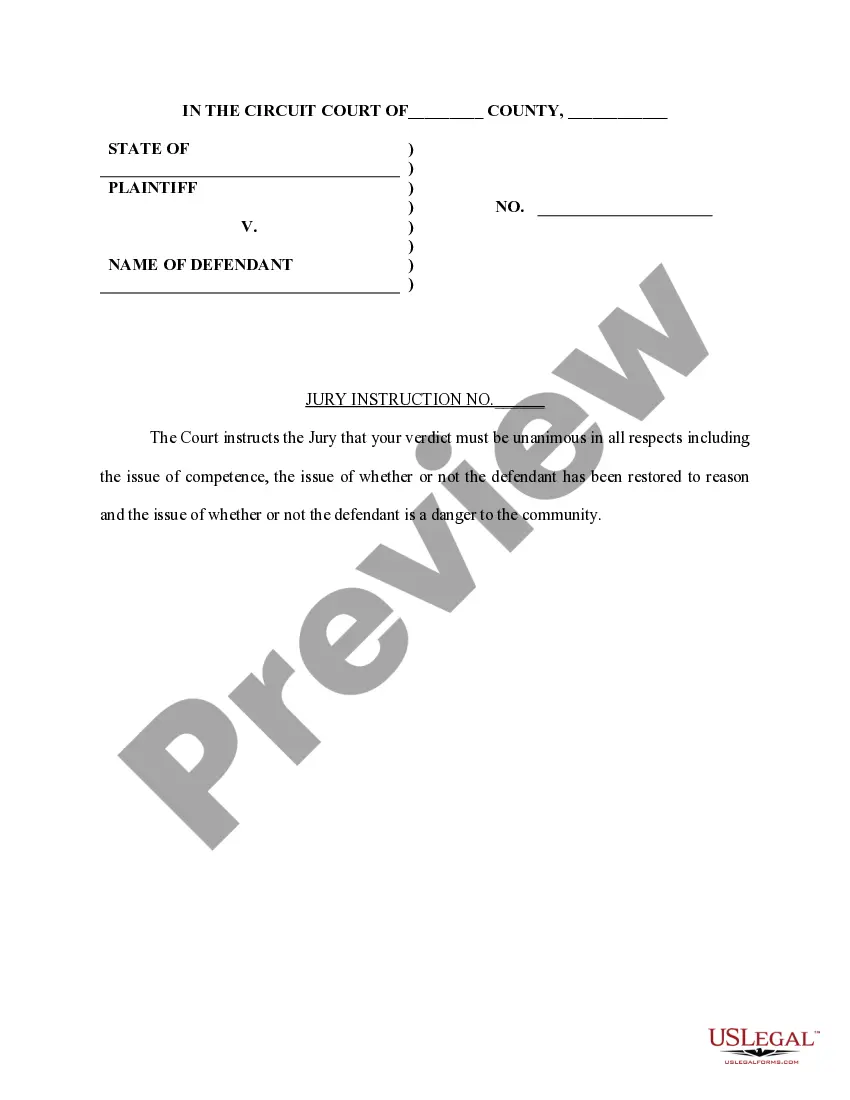
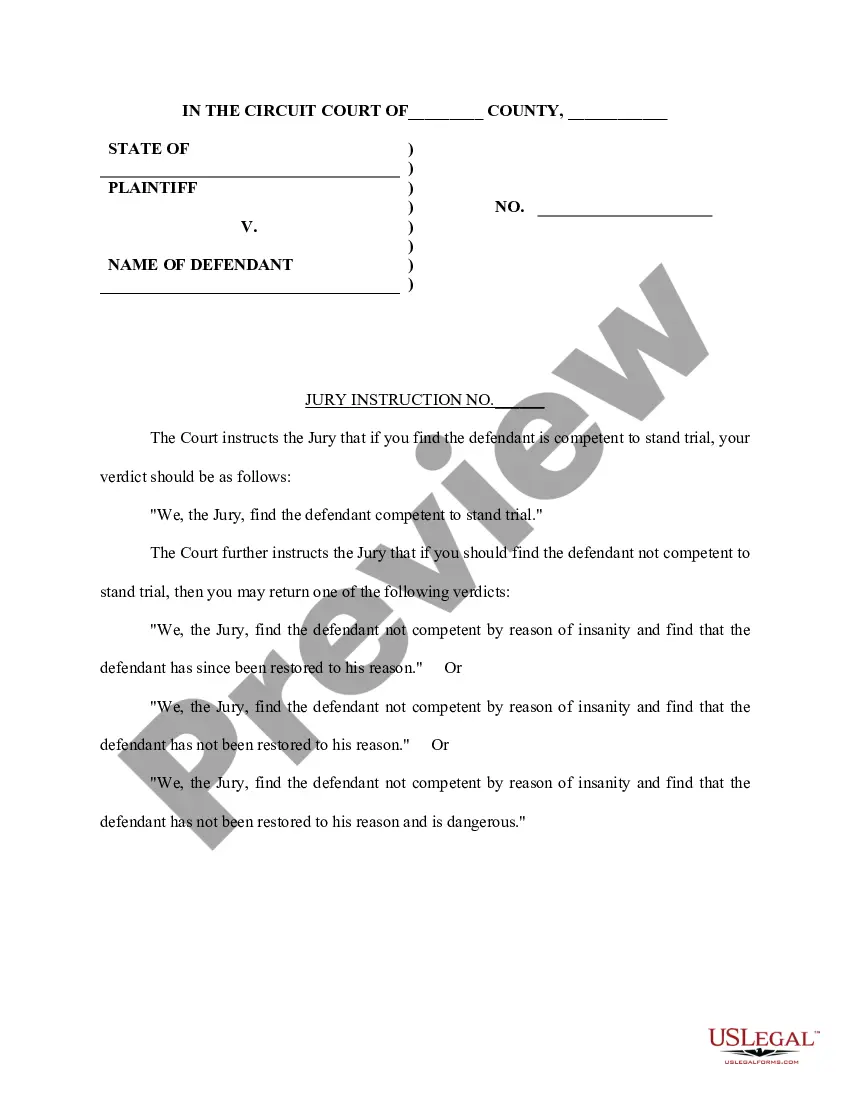
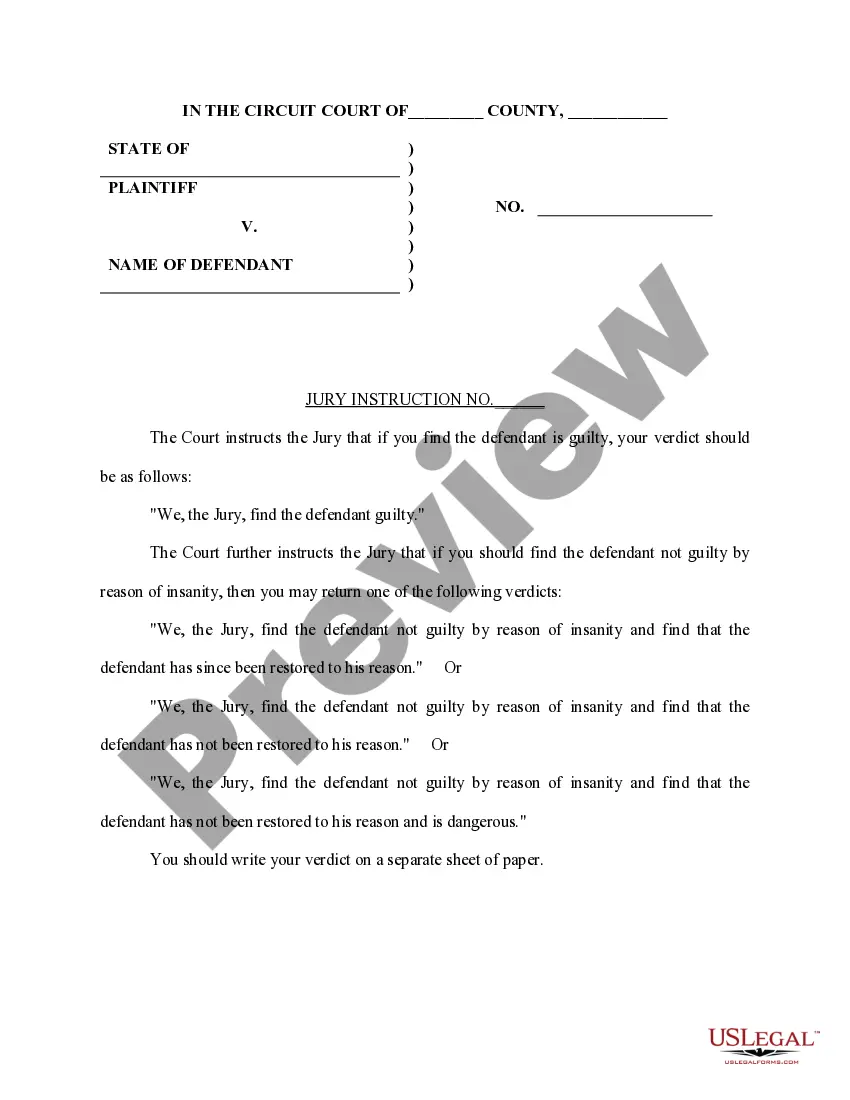
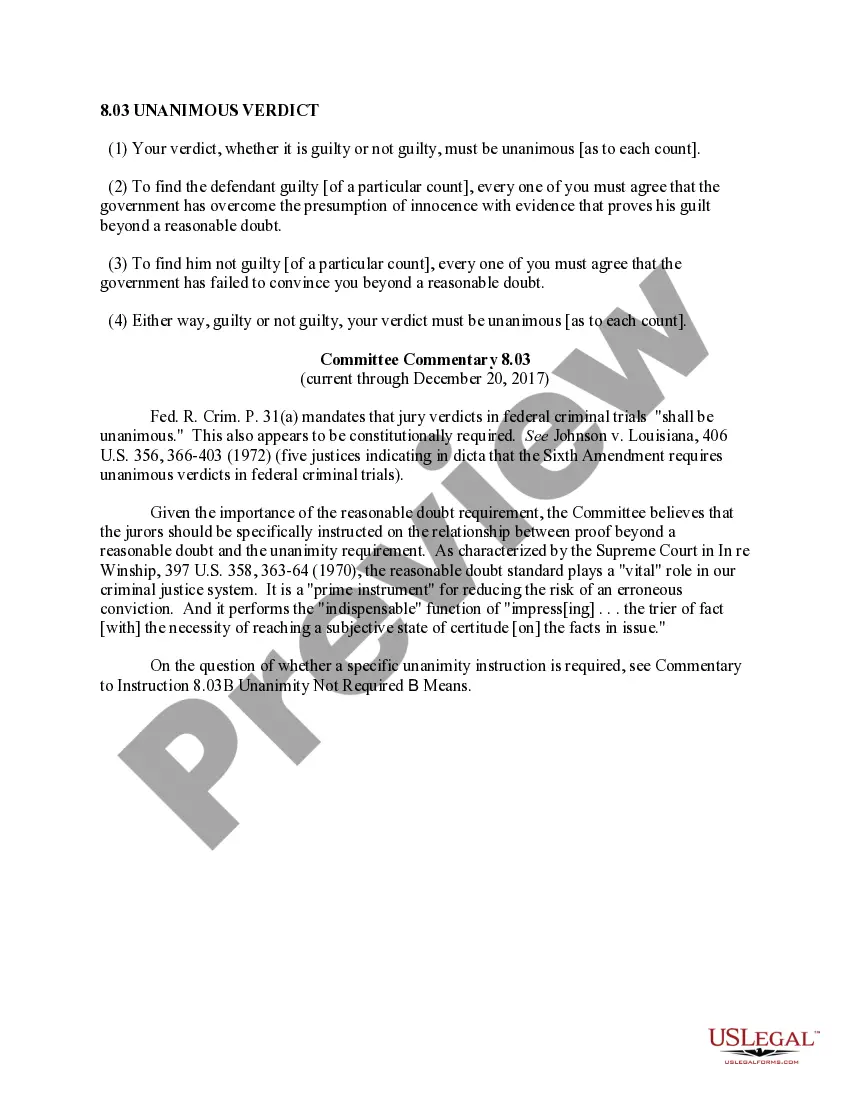
The Competence - Unanimous Verdict form is a sample jury instruction that directs the jury to reach a unanimous decision on the issue of a defendant's competence. This form specifies that all jury members must agree on whether the defendant has been restored to reason and whether the defendant poses a danger to the community. This form is crucial for ensuring fair trial outcomes in criminal cases involving competency evaluations.
Form components explained
- Unanimous verdict requirement: All jurors must agree on the verdict.
- Competence assessment: Addresses the issue of the defendant's mental state.
- Risk evaluation: Considers whether the defendant is a danger to the community.
When this form is needed
This form is used in criminal trials when assessing the competency of a defendant. It applies in situations where the defendant's mental state at the time of trial needs to be determined, particularly if there is concern about their ability to understand the proceedings or to assist in their defense. By ensuring a unanimous verdict, the jury can collectively assess the implications of the defendant's behavior and mental fitness.
Intended users of this form
- Jurors in a criminal trial assessing a defendant's competence.
- Judges providing instructions to the jury regarding their responsibilities.
- Attorneys representing defendants whose competency is in question.
How to complete this form
- Review the jury instruction and ensure all jurors understand the terms.
- Confirm that all jurors are present during deliberation to foster a unanimous decision.
- Discuss the defendant's competence and the implications of their mental state.
- Reach a final verdict that reflects the unanimous agreement of all jurors.
- Document the verdict according to court protocols.
Does this document require notarization?
This form does not typically require notarization to be legally valid. However, some jurisdictions or document types may still require it. US Legal Forms provides secure online notarization powered by Notarize, available 24/7 for added convenience.
Get your form ready online
Our built-in tools help you complete, sign, share, and store your documents in one place.
Make edits, fill in missing information, and update formatting in US Legal Forms—just like you would in MS Word.
Download a copy, print it, send it by email, or mail it via USPS—whatever works best for your next step.
Sign and collect signatures with our SignNow integration. Send to multiple recipients, set reminders, and more. Go Premium to unlock E-Sign.
If this form requires notarization, complete it online through a secure video call—no need to meet a notary in person or wait for an appointment.
We protect your documents and personal data by following strict security and privacy standards.

Make edits, fill in missing information, and update formatting in US Legal Forms—just like you would in MS Word.

Download a copy, print it, send it by email, or mail it via USPS—whatever works best for your next step.

Sign and collect signatures with our SignNow integration. Send to multiple recipients, set reminders, and more. Go Premium to unlock E-Sign.

If this form requires notarization, complete it online through a secure video call—no need to meet a notary in person or wait for an appointment.

We protect your documents and personal data by following strict security and privacy standards.
Mistakes to watch out for
- Assuming that a majority vote is sufficient; a unanimous verdict is required.
- Not discussing all aspects of the defendant's competence thoroughly.
- Failing to ensure that all jurors fully understand the legal terms related to competence.
Benefits of using this form online
- Convenience: Easily access and download the form from anywhere.
- Editability: Customize the form as needed before use.
- Reliability: Obtain a form created by licensed attorneys, ensuring it meets legal standards.
Looking for another form?



Form popularity
FAQ
All jurors should deliberate and vote on each issue to be decided in the case.In a civil case, the judge will tell you how many jurors must agree in order to reach a verdict. In a criminal case, the unanimous agreement of all 12 jurors is required.
A verdict of a jury that is reached by a majority. Majority verdicts can be taken in both criminal and civil cases. In criminal cases the verdict need not be unanimous if there are no fewer than 11 jurors and 10 of them agree on the verdict or if there are 10 jurors and 9 of them agree on the verdict.
When the jury struggles to all agree on the same verdict, the judge may decide that a verdict can be returned if a majority of the jury can reach an agreement. This is known as 'majority verdict' and normally means that the judge is content to receive a verdict if 10 or more of the 12 jurors are in agreement.
If the jury cannot agree on all counts as to any defendant, the jury may return a verdict on those counts on which it has agreed. . . . If the jury cannot agree on a verdict on one or more counts, the court may declare a mistrial on those counts. A hung jury does not imply either the defendant's guilt or innocence.
Overall, juries show a relatively high degree of competencejurors take their decision-making tasks seriously, understand the nature of the adversary process, attempt to make decisions that achieve many (sometimes conflicting) goals simultaneously, and perform at a level that is similar to that of judges.
The term that is given to the verdict where all of the jurors have agreed.
A unanimous verdict is a verdict agreed upon by the entire jury panel. The purpose of majority verdicts was to prevent lone rogue jurors to force a hung jury. Majority verdicts is only available if it is a state offence and not a Commonwealth offence.
Q - Do all the jury members have to agree on the verdict? A - In a criminal trial the jury verdict must be unanimous, that is all 12 jurors must agree.It is up to the Crown to decide whether to apply for a new trial. A jury that cannot agree on a verdict is called a 'hung' jury.
Louisiana, the Supreme Court held that defendants have a right to a unanimous verdict in both federal and state criminal trials. In other words, each and every member of a given jury must agree in order to acquit or convict the defendant.