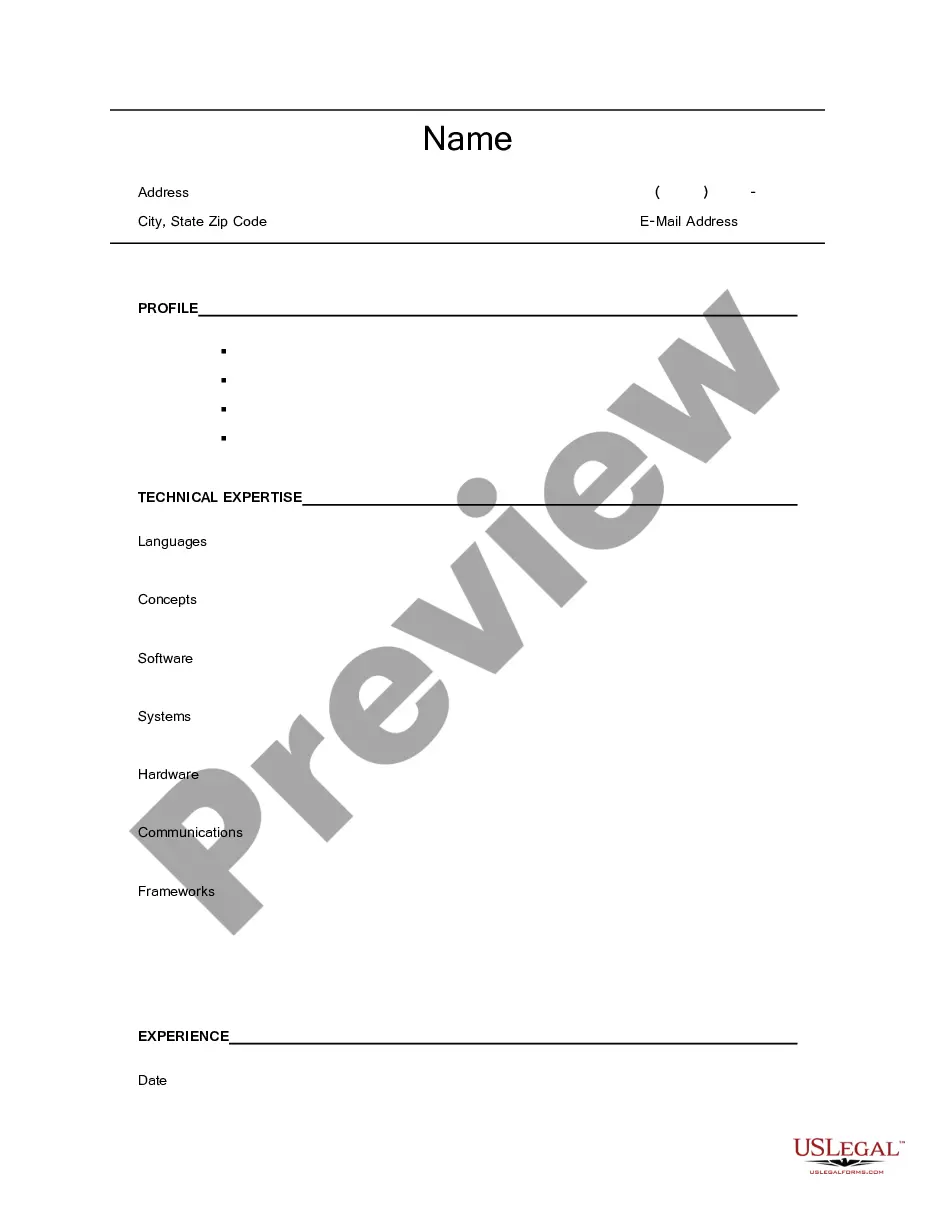
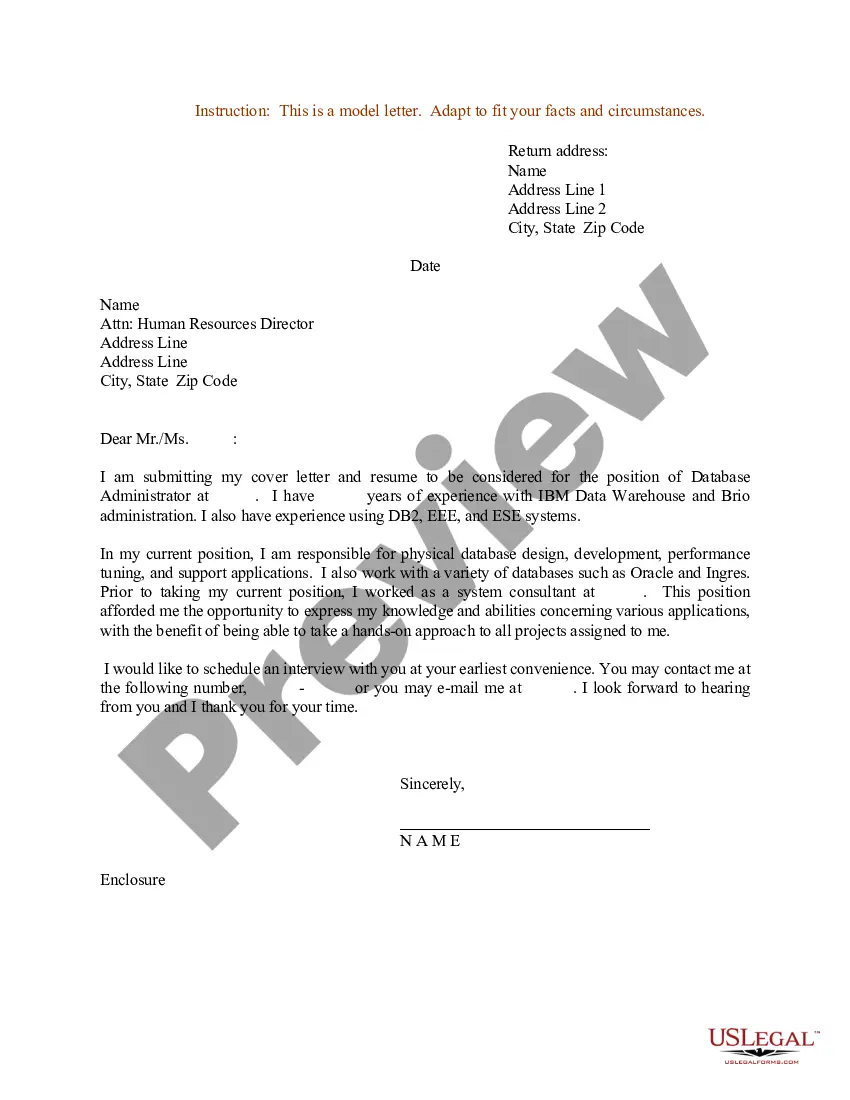
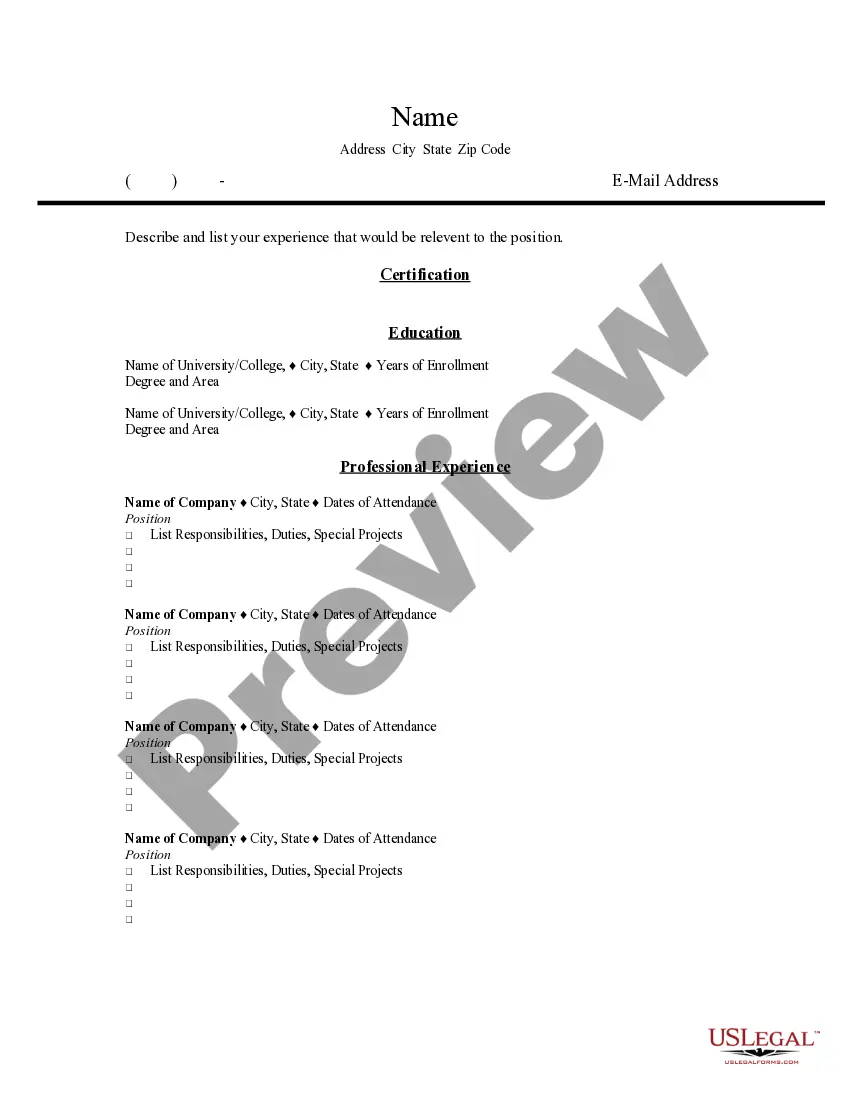
Texas Resume for Database Administrator
Description

Get your form ready online
Our built-in tools help you complete, sign, share, and store your documents in one place.
Make edits, fill in missing information, and update formatting in US Legal Forms—just like you would in MS Word.
Download a copy, print it, send it by email, or mail it via USPS—whatever works best for your next step.
Sign and collect signatures with our SignNow integration. Send to multiple recipients, set reminders, and more. Go Premium to unlock E-Sign.
If this form requires notarization, complete it online through a secure video call—no need to meet a notary in person or wait for an appointment.
We protect your documents and personal data by following strict security and privacy standards.

Make edits, fill in missing information, and update formatting in US Legal Forms—just like you would in MS Word.

Download a copy, print it, send it by email, or mail it via USPS—whatever works best for your next step.

Sign and collect signatures with our SignNow integration. Send to multiple recipients, set reminders, and more. Go Premium to unlock E-Sign.

If this form requires notarization, complete it online through a secure video call—no need to meet a notary in person or wait for an appointment.

We protect your documents and personal data by following strict security and privacy standards.
Looking for another form?



How to fill out Resume For Database Administrator?
Are you currently in a situation where you require documents for either business or personal reasons almost every day.
There are numerous legal document templates accessible online, but finding ones you can rely on is not easy.
US Legal Forms offers thousands of form templates, such as the Texas Resume for Database Administrator, that are designed to comply with federal and state standards.
Once you find the appropriate form, simply click Purchase now.
Select the pricing plan you prefer, complete the required information to create your account, and pay for your order using your PayPal or Visa or Mastercard.
- If you are already familiar with the US Legal Forms website and have an account, simply Log In.
- Then, you will be able to download the Texas Resume for Database Administrator template.
- If you do not have an account and wish to start using US Legal Forms, follow these steps.
- Find the form you need and ensure it is for your specific city/state.
- Use the Review button to evaluate the form.
- Read the description to confirm that you have chosen the correct form.
- If the form is not what you're looking for, utilize the Search field to locate the form that meets your needs.
Form popularity
FAQ
The five main functions of a Database Administrator (DBA) encompass performance monitoring, security management, backup and recovery, data modeling, and user management. Each function is integral to maintaining a healthy database environment. When you describe your DBA experience in your Texas Resume for Database Administrator, ensure you provide specific examples of how you have successfully executed these functions. This adds credibility to your application.
The five main functions of administration include planning, organizing, directing, coordinating, and controlling. These functions ensure that an organization runs smoothly and achieves its objectives. When detailing your administrative skills on your Texas Resume for Database Administrator, relate these functions to database management tasks. This connection can show employers your capability to manage both technical and administrative responsibilities effectively.
Two key skills for database administrators and IT systems analysts are data analysis and database design. Data analysis involves interpreting complex datasets to inform business decisions, while database design focuses on creating efficient database structures. Highlighting these skills in your Texas Resume for Database Administrator demonstrates your ability to optimize data usage and enhance organizational efficiency. This can attract employers looking for well-rounded candidates.
The five main functions of a database include data storage, data retrieval, data manipulation, data security, and data integrity. Each of these functions plays a vital role in how information is managed and accessed. When writing your Texas Resume for Database Administrator, consider mentioning your experience with these functions, especially if you've improved database performance or security. This showcases your ability to enhance overall database capabilities.
One key function of a Database Administrator is to ensure data security and compliance with regulations. This involves setting up access controls, monitoring database activities, and implementing encryption where necessary. When you outline this function in your Texas Resume for Database Administrator, emphasize your experience with security protocols and any relevant certifications. This can set you apart in a competitive job market.
Essential skills for a database administrator include proficiency in database management systems, strong analytical skills, and an understanding of data warehousing concepts. Knowledge of SQL and programming languages is also vital. Furthermore, a DBA should possess problem-solving abilities and effective communication skills to work with stakeholders. Highlight these skills in your Texas Resume for Database Administrator to make a strong impression on hiring managers.
The five main functions of a Database Administrator (DBA) include installation and configuration of database systems, monitoring and optimizing database performance, ensuring data integrity and security, performing backups and recovery, and managing user access. Each of these functions is crucial for maintaining a reliable database environment. When crafting your Texas Resume for Database Administrator, showcase your experience in these areas to attract potential employers. This demonstrates your comprehensive understanding of DBA responsibilities.
To effectively list your database skills on your Texas Resume for Database Administrator, include specific technologies and tools you have used, such as SQL, Oracle, or MySQL. Highlight your proficiency in data modeling, performance tuning, and backup and recovery processes. Additionally, consider organizing your skills into categories, like programming languages, database management systems, and analytical tools. This clear presentation helps potential employers quickly assess your qualifications.