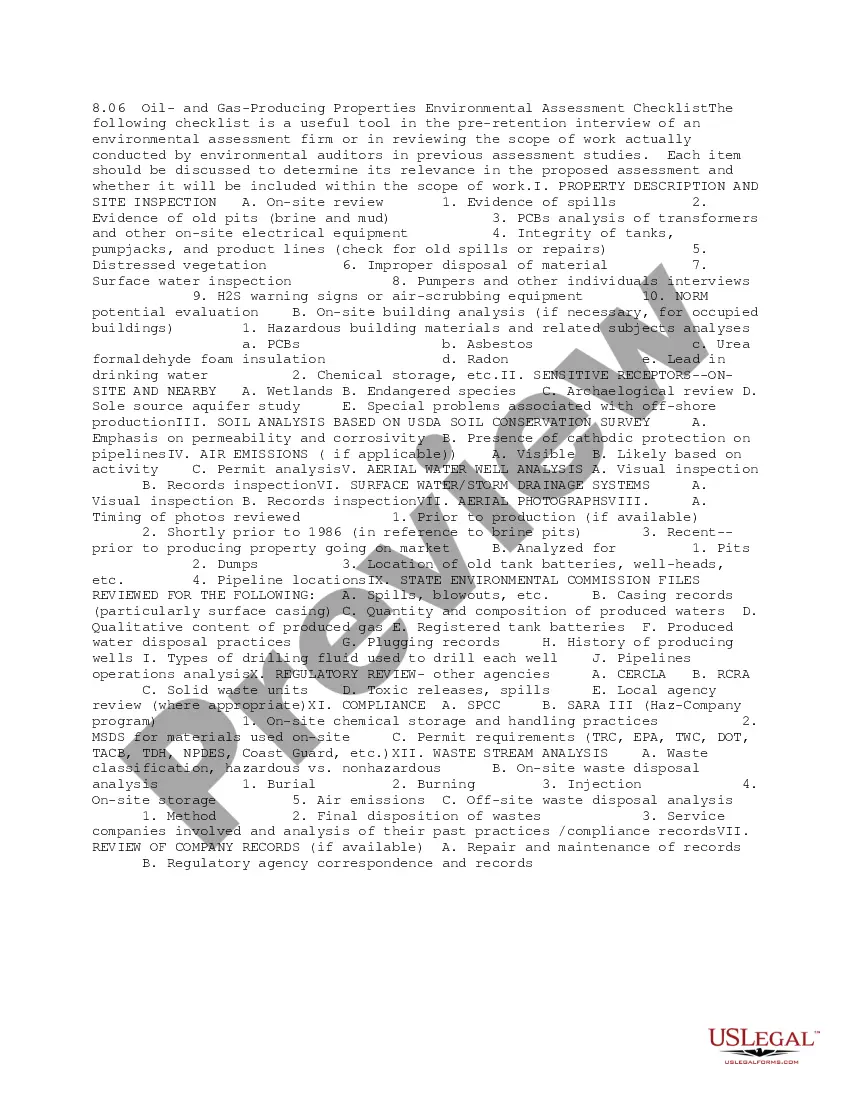
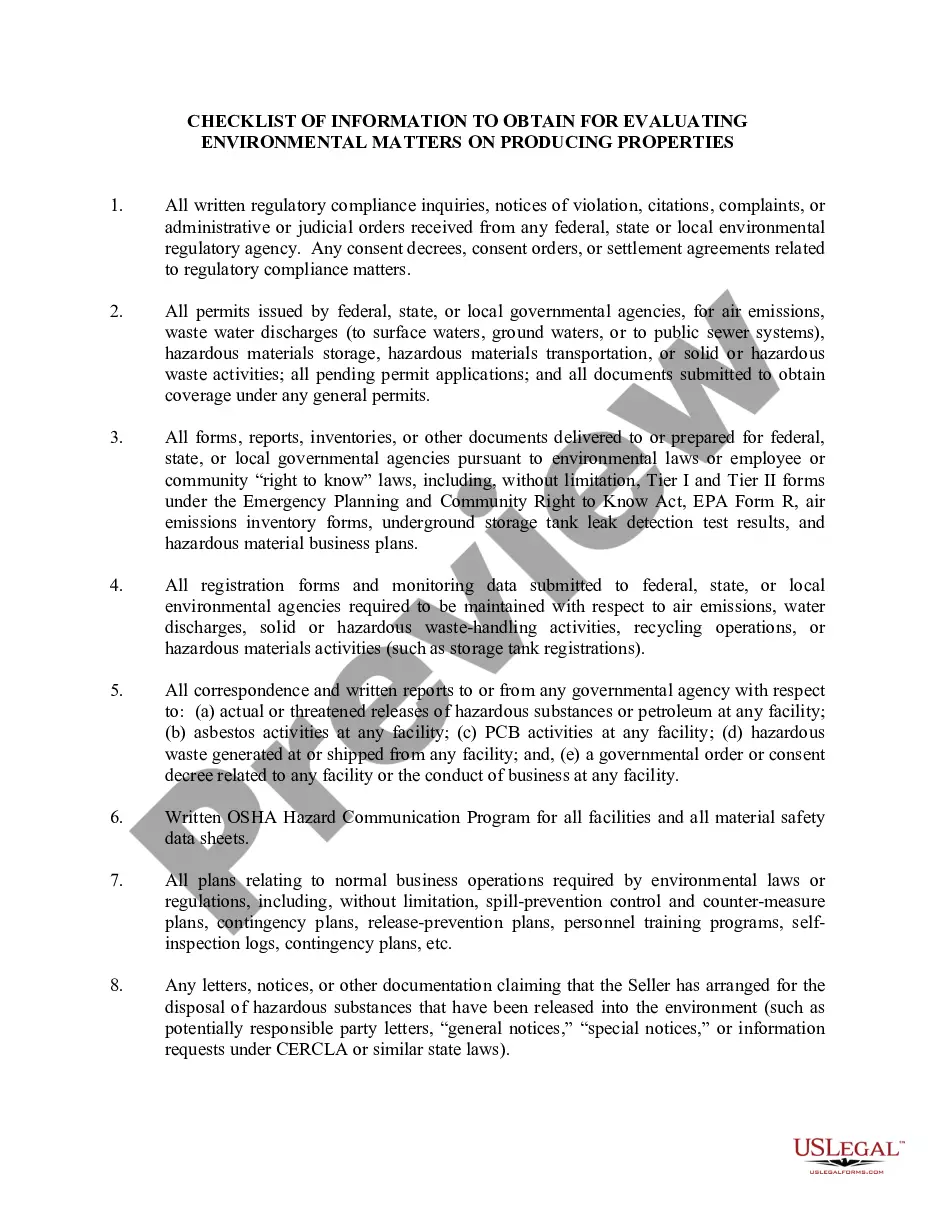
This due diligence checklist can be used in the pre-retention interview of an environmental assessment firm or in reviewing the scope of work conducted by environmental auditors in previous assessment studies.
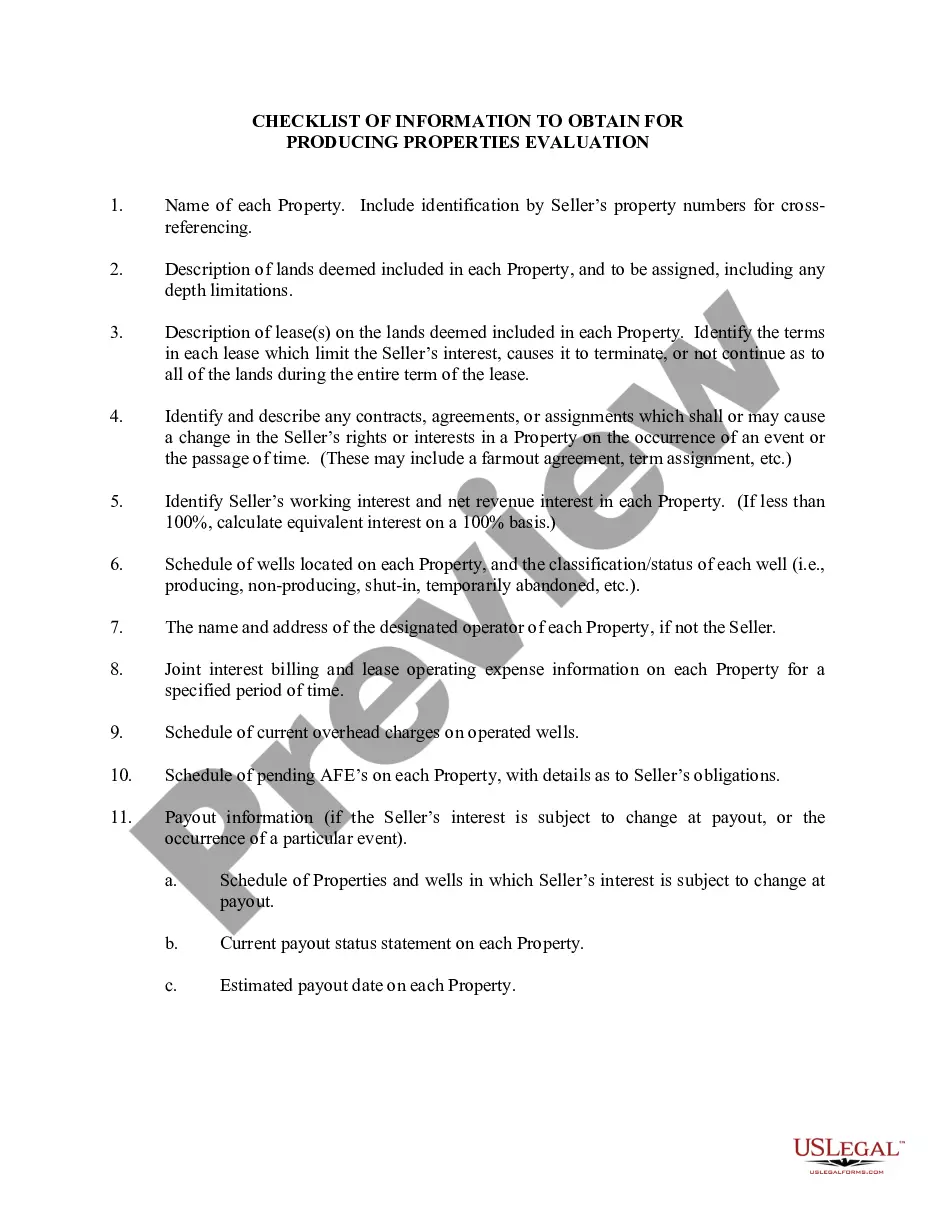
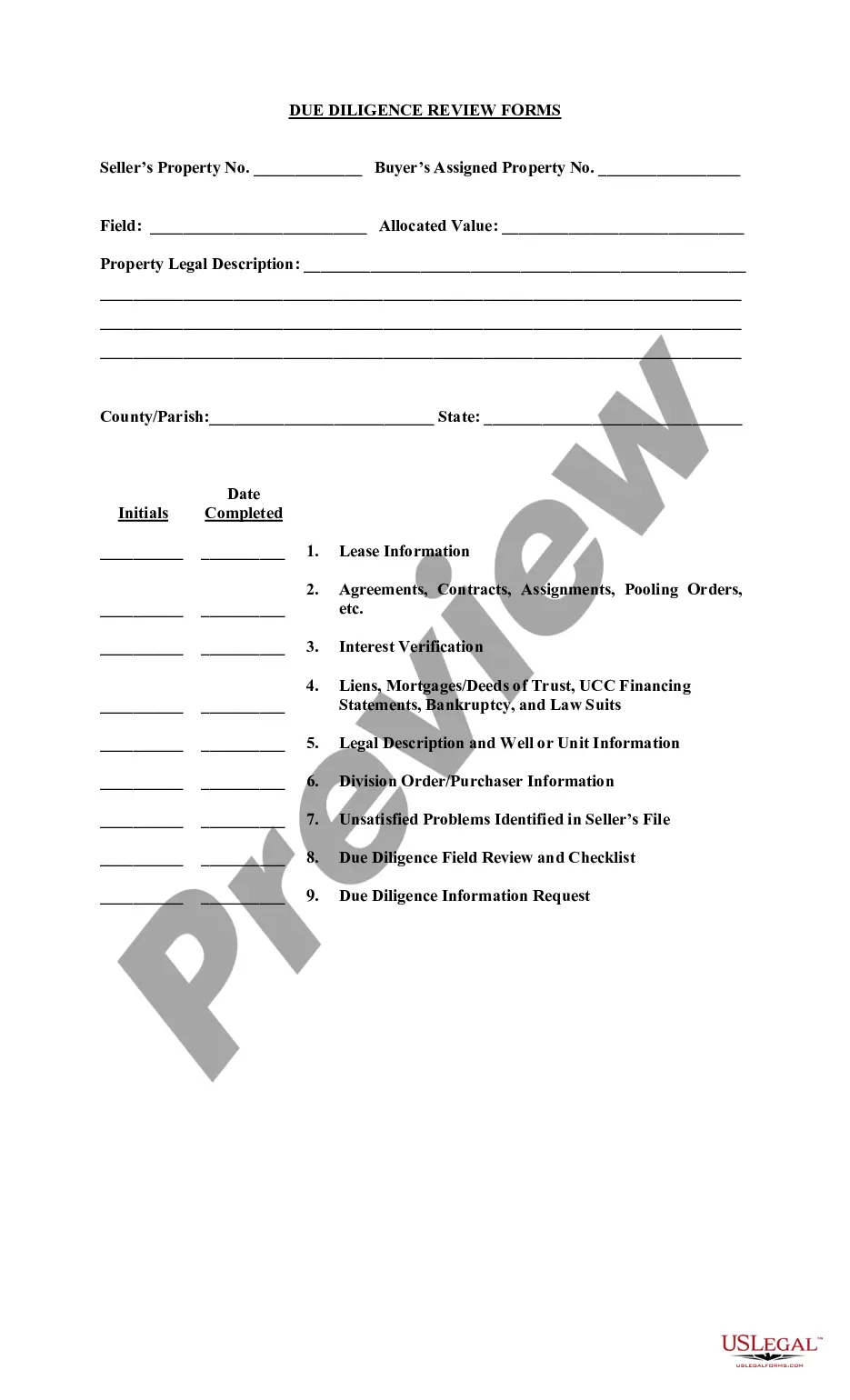
Texas Oil and Gas Producing Properties Environmental Assessment Checklist
Category:
State:
Multi-State
Control #:
US-DD0806
Format:
Word;
PDF;
Rich Text
Instant download
Description
Get your form ready online
Our built-in tools help you complete, sign, share, and store your documents in one place.
Built-in online Word editor
Make edits, fill in missing information, and update formatting in US Legal Forms—just like you would in MS Word.
Export easily
Download a copy, print it, send it by email, or mail it via USPS—whatever works best for your next step.
E-sign your document
Sign and collect signatures with our SignNow integration. Send to multiple recipients, set reminders, and more. Go Premium to unlock E-Sign.
Notarize online 24/7
If this form requires notarization, complete it online through a secure video call—no need to meet a notary in person or wait for an appointment.
Store your document securely
We protect your documents and personal data by following strict security and privacy standards.

Make edits, fill in missing information, and update formatting in US Legal Forms—just like you would in MS Word.

Download a copy, print it, send it by email, or mail it via USPS—whatever works best for your next step.

Sign and collect signatures with our SignNow integration. Send to multiple recipients, set reminders, and more. Go Premium to unlock E-Sign.

If this form requires notarization, complete it online through a secure video call—no need to meet a notary in person or wait for an appointment.

We protect your documents and personal data by following strict security and privacy standards.
Looking for another form?


How to fill out Oil And Gas Producing Properties Environmental Assessment Checklist?
Are you in a scenario where you will require documents for either commerce or particular activities nearly every day.
There are numerous legal document templates accessible online, but finding reliable forms isn't easy.
US Legal Forms provides thousands of template forms, including the Texas Oil and Gas Producing Properties Environmental Assessment Checklist, that are crafted to fulfill state and federal requirements.
Once you find the correct form, just click Purchase now.
Select the pricing plan you prefer, fill in the necessary details to create your account, and pay for the order using your PayPal or Visa or Mastercard.
- If you are already acquainted with the US Legal Forms site and have an account, simply Log In.
- After that, you can download the Texas Oil and Gas Producing Properties Environmental Assessment Checklist template.
- If you do not have an account and wish to start using US Legal Forms, follow these steps.
- Obtain the form you need and ensure it is for your correct city/region.
- Utilize the Preview button to review the form.
- Check the summary to confirm that you have chosen the correct form.
- If the form isn't what you're looking for, use the Search field to locate the form that fits your requirements.
Form popularity
FAQ
Looking up mineral rights ownership in Texas involves checking county clerk records, as these documents provide essential information on ownership transfers. Local appraisal districts may also maintain online records that detail property ownership, including mineral rights. To simplify this process, consider referring to the Texas Oil and Gas Producing Properties Environmental Assessment Checklist, which can guide you through understanding mineral rights in relation to environmental assessments.
To find API numbers for wells in Texas, you can start by visiting the Railroad Commission of Texas website. They provide online databases that allow you to search for oil and gas well information using various criteria, including location and operator. Additionally, utilizing the Texas Oil and Gas Producing Properties Environmental Assessment Checklist can help ensure you gather all relevant details related to specific properties.
Rule 37 pertains specifically to drilling site spacing and well density, aiming to balance production efficiency and resource conservation. It ensures that wells are not located too close to one another, which can lead to waste and decreased productivity. For operators and landowners, understanding Rule 37 is crucial, and the Texas Oil and Gas Producing Properties Environmental Assessment Checklist can help you comply with this guideline. This checklist ensures you meet all spacing requirements effectively.
The depth needed to drill for oil in Texas varies widely by region and geological conditions, often ranging from a few hundred feet to several thousand feet. Factors such as the type of oil reservoir and the technology used play significant roles in determining drilling depth. Utilizing resources like the Texas Oil and Gas Producing Properties Environmental Assessment Checklist can provide valuable information about drilling expectations in your area. This checklist helps you understand the variables that influence drilling depth.
The value of mineral rights per acre in Texas varies significantly depending on location, production potential, and market conditions. In some regions, mineral rights can be worth thousands of dollars per acre, while others may offer little value. Researching specific areas and using the Texas Oil and Gas Producing Properties Environmental Assessment Checklist can help you assess your mineral rights' worth accurately. This checklist assists in determining factors that influence value in your region.
Rule 37 in Texas refers to a regulation that governs the spacing and density of wells in oil and gas drilling. This rule aims to prevent waste and protect correlative rights among mineral owners. Understanding Rule 37 is essential for anyone involved in oil and gas production, and the Texas Oil and Gas Producing Properties Environmental Assessment Checklist provides insights into compliance with this important regulation. By following the checklist, you can ensure your operations conform to established oil drilling standards.
Determining whether you own mineral rights in Texas requires examining your property deed. Mineral rights can be sold or leased separately from the surface rights, so it's crucial to review any agreements or documentation. If you are unsure, consulting legal experts or using the Texas Oil and Gas Producing Properties Environmental Assessment Checklist can clarify your ownership status. This checklist will guide you through necessary assessments to confirm your mineral rights.
Oil and gas production in Texas is primarily regulated by the Railroad Commission of Texas (RRC). The RRC ensures compliance with state laws and protects public safety and the environment. Their oversight includes granting permits, monitoring operations, and enforcing regulations. Utilizing the Texas Oil and Gas Producing Properties Environmental Assessment Checklist can help you understand these regulations better.