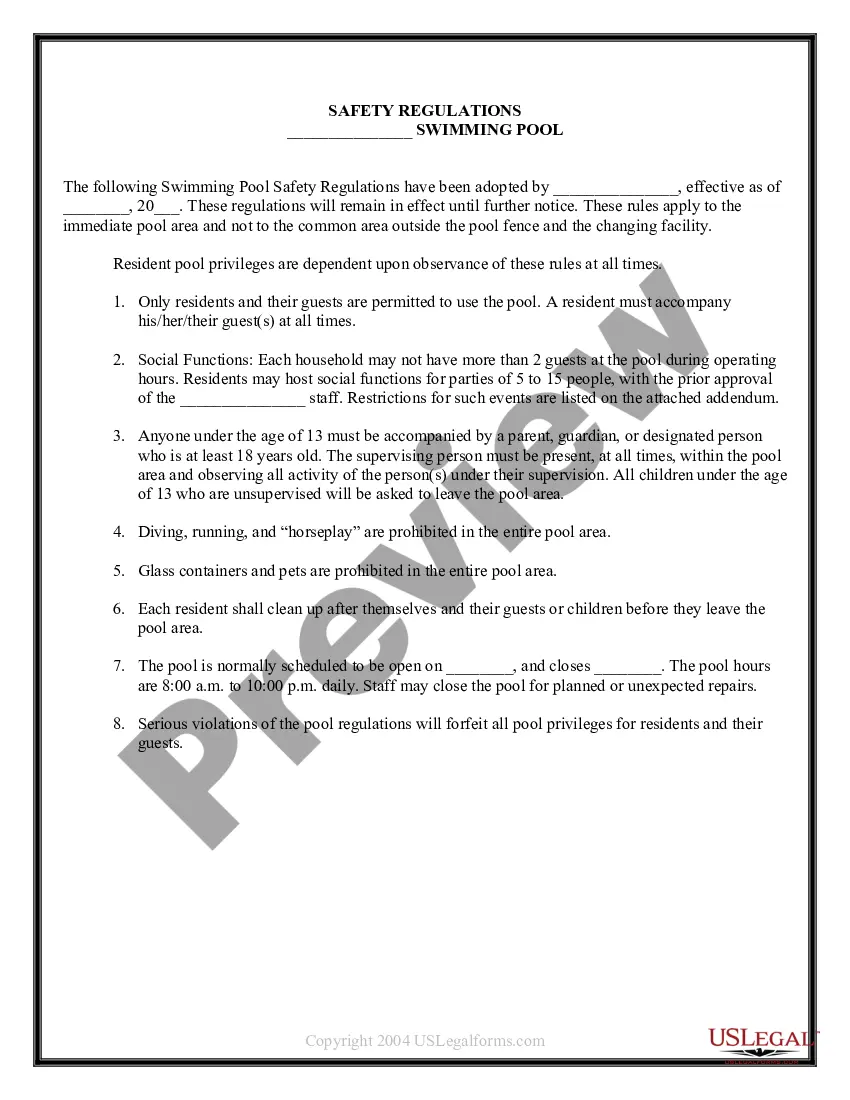
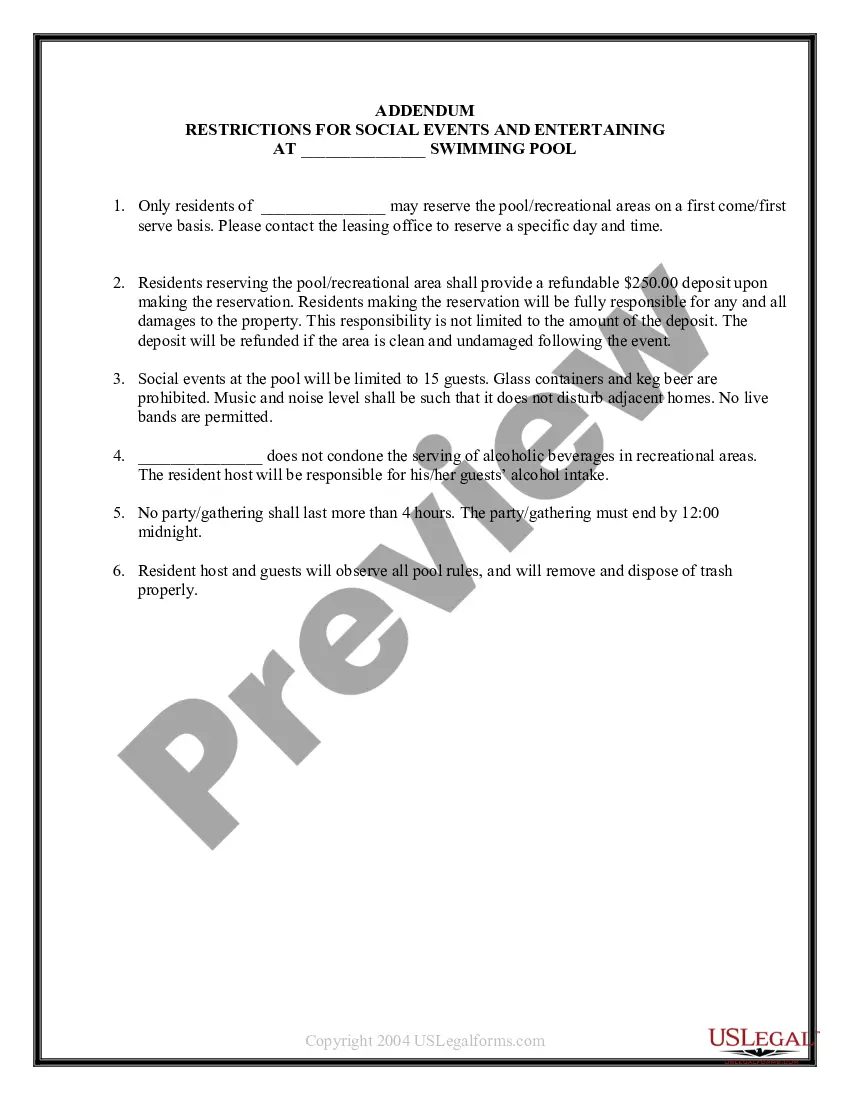
Apartment policy concerning the use of the complex swimming pool.
Texas Apartment Complex Swimming Pool Policy
Category:
State:
Multi-State
Control #:
US-898LT
Format:
Word;
Rich Text
Instant download
Description
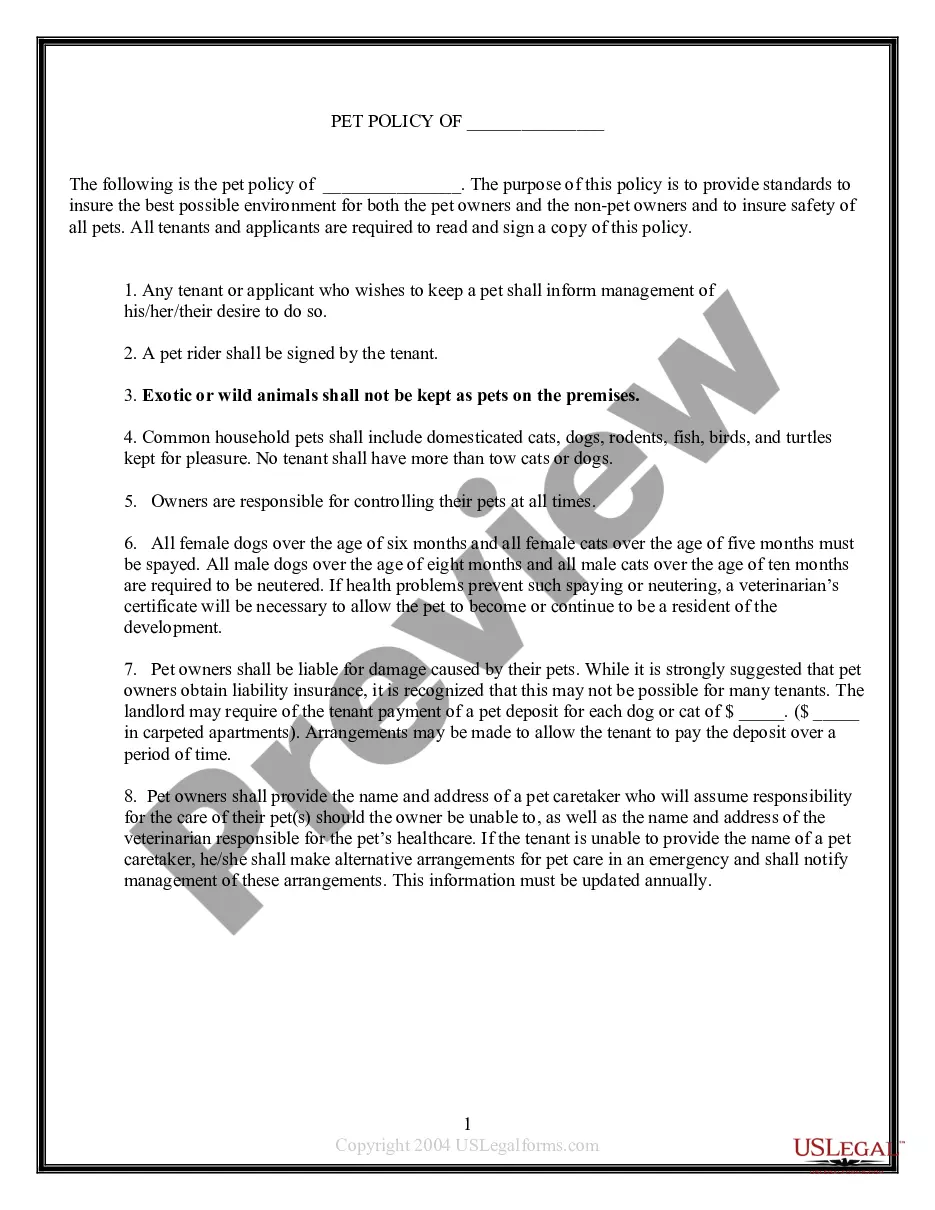
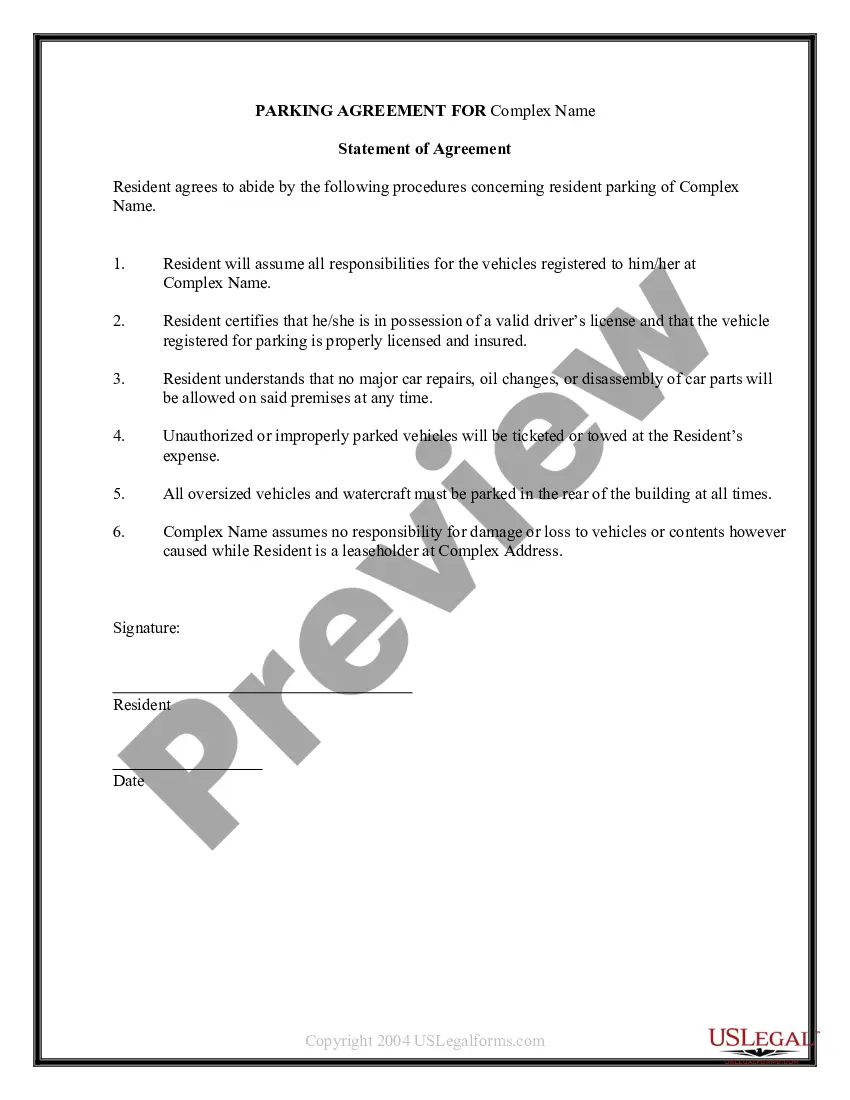
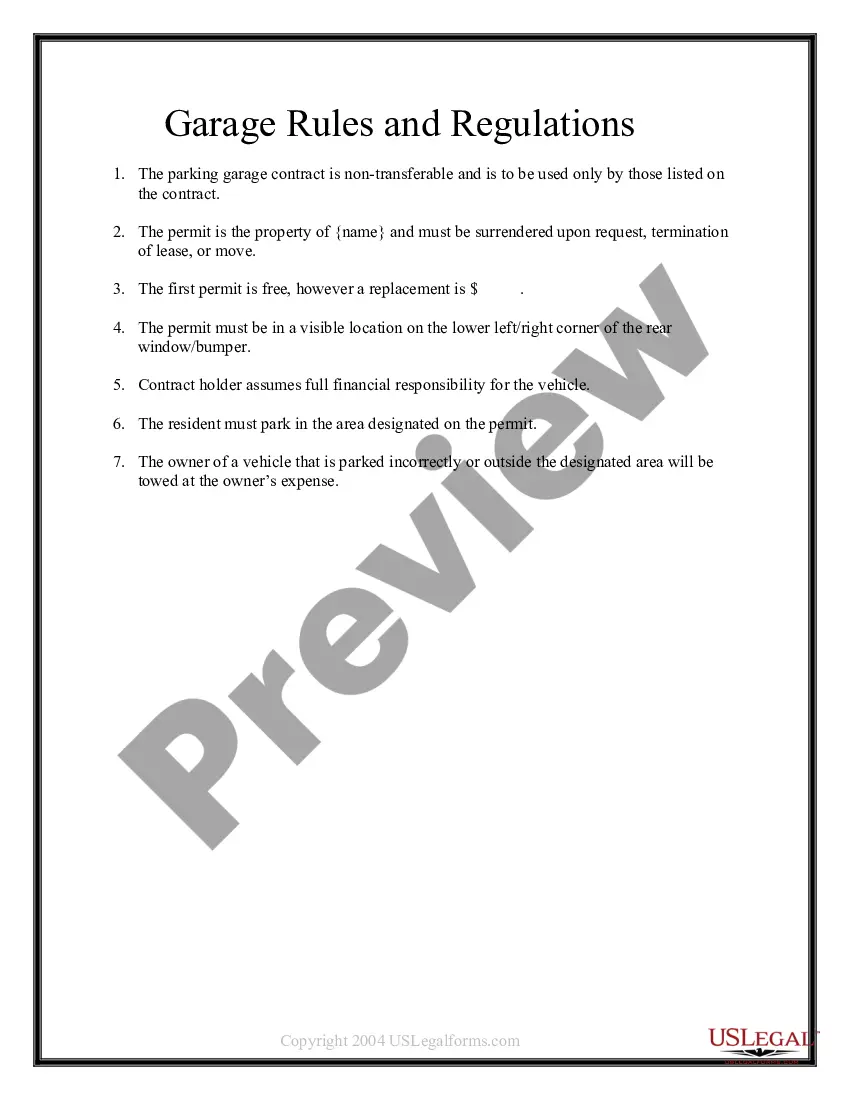
Get your form ready online
Our built-in tools help you complete, sign, share, and store your documents in one place.
Built-in online Word editor
Make edits, fill in missing information, and update formatting in US Legal Forms—just like you would in MS Word.
Export easily
Download a copy, print it, send it by email, or mail it via USPS—whatever works best for your next step.
E-sign your document
Sign and collect signatures with our SignNow integration. Send to multiple recipients, set reminders, and more. Go Premium to unlock E-Sign.
Notarize online 24/7
If this form requires notarization, complete it online through a secure video call—no need to meet a notary in person or wait for an appointment.
Store your document securely
We protect your documents and personal data by following strict security and privacy standards.

Make edits, fill in missing information, and update formatting in US Legal Forms—just like you would in MS Word.

Download a copy, print it, send it by email, or mail it via USPS—whatever works best for your next step.

Sign and collect signatures with our SignNow integration. Send to multiple recipients, set reminders, and more. Go Premium to unlock E-Sign.

If this form requires notarization, complete it online through a secure video call—no need to meet a notary in person or wait for an appointment.

We protect your documents and personal data by following strict security and privacy standards.
Looking for another form?
How to fill out Apartment Complex Swimming Pool Policy?
You can dedicate multiple hours online searching for the legal document template that meets the federal and state requirements you need.
US Legal Forms offers thousands of legal templates that have been reviewed by experts.
You can download or print the Texas Apartment Complex Swimming Pool Policy from our services.
If available, utilize the Preview option to view the document template as well.
- If you already possess a US Legal Forms account, you can Log In and click on the Download button.
- After that, you can fill out, modify, print, or sign the Texas Apartment Complex Swimming Pool Policy.
- Every legal document template you obtain is yours permanently.
- To acquire another copy of any purchased form, go to the My documents tab and click the appropriate option.
- If you are using the US Legal Forms website for the first time, follow the simple instructions below.
- First, ensure you have selected the correct document template for your area/city of choice.
- Examine the form outline to confirm you have chosen the correct form.
Form popularity
FAQ
Visibility and potential effect on home values Also, an HOA may deny the installation of an above-ground pool because it is visible through the backyard fencing. Plus, some homeowner associations see these pools as cheap and are worried that they may hurt home valuesa major concern for everyone.
The Department of State Health Services Environmental Health Program, Local Health Departments, Local Code Enforcement Offices and other governmental jurisdictions help to provide safety and sanitation of public swimming pools and spas in the state of Texas.
A class A pool is one that is intended for and properly certified for competitive aquatic use. However, the pool is not limited to competitive events and may be used for recreational purposes.
Most (but not all) HOA pools are considered private. Even if your pool is considered public, you only need to make ADA-compliant changes if they are readily achievable. Speak to your association's attorney to find out what your HOA may need to do.
Typically, a pool fence is required if the body of water is at least 18 inches deep. If there is a deck around the above ground pool, that may affect the requirements in some states, so you need to check your local laws. But, many do stick with the four feet pool fence rule.
Fencing In almost all cases, public-use pools are required to have some kind of fencing around the pool. States, cities, and counties usually specify exactly what is required of these fences in terms of material, spacing, gates, locks, and more.
(C) Class C pool--Any pool operated for and in conjunction with: (i) lodging such as hotels, motels, apartments, condominiums, or mobile home parks; (ii) property owner associations, private organizations, or clubs; or.
Class B. Class B pools are most commonly referred to 'Public Pools. These are any pool intended for public recreational use. If you are working at a local town pool, you likely will be operating a class B swimming facility.
Among other things, Texas law requires pool owners to have a fence surrounding the pool or yard that is at least 48 inches high with no gaps between the pickets or the ground and bottom of the fence that are more than 4 inches wide. Chain-link fences or slats that can be climbed by children are prohibited.