Tennessee Marital Domestic Separation and Property Settlement Agreement Minor Children Parties May have Joint Property or Debts where Divorce Action Filed
About this form
The Marital Domestic Separation and Property Settlement Agreement is a legal document designed for spouses with minor children who are in the process of divorce. This form outlines arrangements regarding asset distribution, debt obligations, child custody, visitation rights, and child support payments. Unlike general separation agreements, this form specifically addresses the needs of parties with children and joint obligations, ensuring all essential matters are settled while a divorce action is pending.
What’s included in this form
- Separation provisions outlining living arrangements and personal freedoms.
- Financial disclosures to ensure transparency regarding assets and liabilities.
- Details on the division of marital assets and debts.
- Child custody arrangements, including primary custody and visitation rights.
- Child support obligations, including payment amounts and schedules.
- Alimony provisions, specifying any spousal support arrangements.


When this form is needed
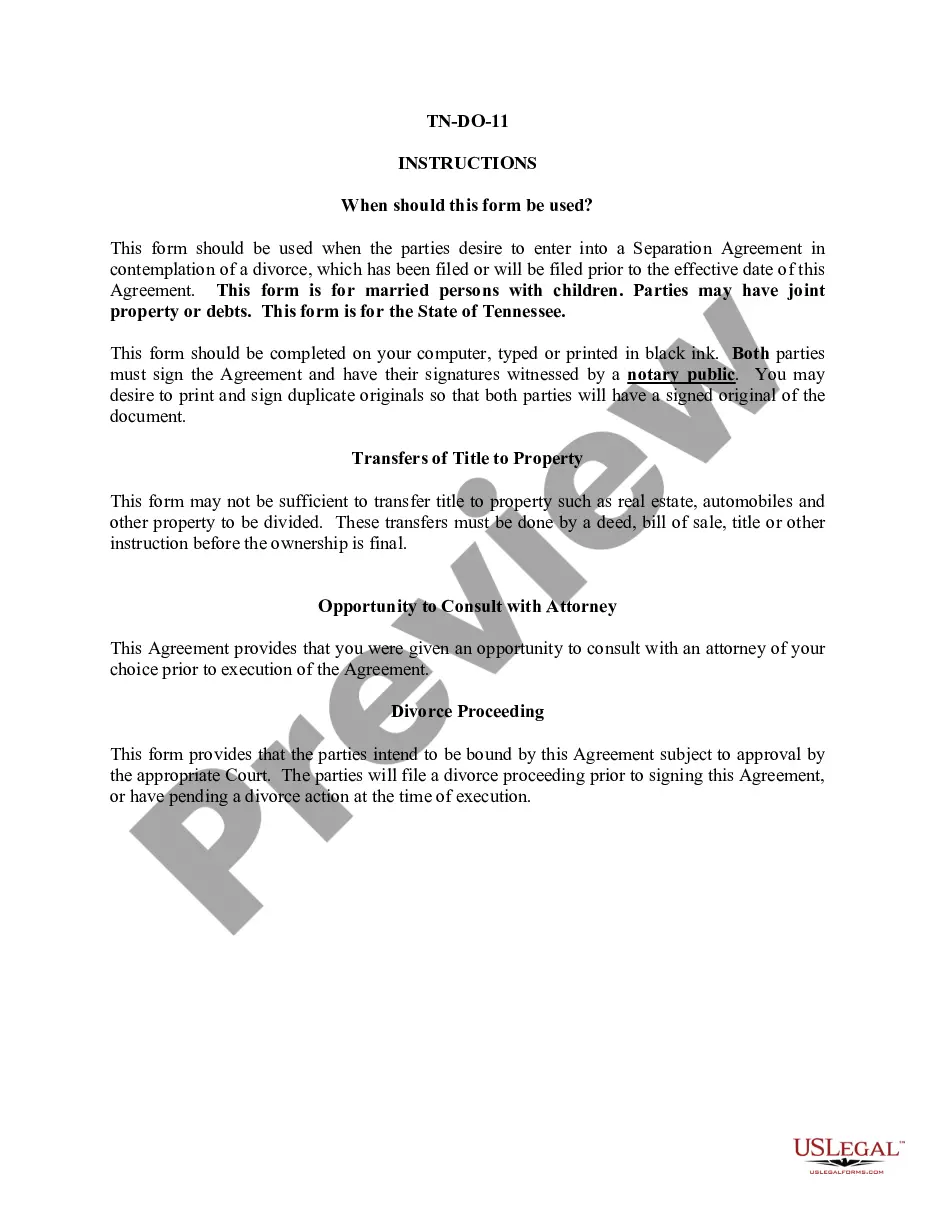
This form should be utilized when married couples with minor children are contemplating divorce and need to formalize their separation agreement. It is especially applicable when they have joint property or debts and wish to settle all relevant issues before the divorce is finalized.
Who this form is for
- Married couples seeking legal separation prior to divorce.
- Parents with minor children needing to clarify custody and support terms.
- Spouses who share ownership of property or debts that must be divided.
- Individuals wanting to ensure legal compliance and protect their rights during a divorce process.
Steps to complete this form
- Identify the parties involved by entering their full legal names and marriage date.
- Describe the joint property and debts clearly, including any necessary valuations.
- Specify terms related to child custody, including who will have primary responsibility and the visitation schedule.
- Outline the child support amount and duration, as well as any spousal support conditions.
- Ensure both parties sign the agreement in the presence of a notary public for validation.
Does this form need to be notarized?
Yes, this form must be notarized to be legally valid. The integrated online notarization services provided by US Legal Forms allow for secure video sessions, available 24/7, ensuring convenience and compliance without the need for in-person visits.
Get your form ready online
Our built-in tools help you complete, sign, share, and store your documents in one place.
Make edits, fill in missing information, and update formatting in US Legal Forms—just like you would in MS Word.
Download a copy, print it, send it by email, or mail it via USPS—whatever works best for your next step.
Sign and collect signatures with our SignNow integration. Send to multiple recipients, set reminders, and more. Go Premium to unlock E-Sign.
If this form requires notarization, complete it online through a secure video call—no need to meet a notary in person or wait for an appointment.
We protect your documents and personal data by following strict security and privacy standards.

Make edits, fill in missing information, and update formatting in US Legal Forms—just like you would in MS Word.

Download a copy, print it, send it by email, or mail it via USPS—whatever works best for your next step.

Sign and collect signatures with our SignNow integration. Send to multiple recipients, set reminders, and more. Go Premium to unlock E-Sign.

If this form requires notarization, complete it online through a secure video call—no need to meet a notary in person or wait for an appointment.

We protect your documents and personal data by following strict security and privacy standards.
Common mistakes
- Failing to provide complete financial disclosures, which can lead to legal disputes later.
- Not specifying the visitation schedule or child support terms clearly.
- Neglecting to sign the document in the presence of a notary, making it unenforceable.
Benefits of completing this form online
- Convenience of downloading the form at any time, from anywhere.
- Editability allows customization to fit specific needs and circumstances.
- Reliability by utilizing templates drafted by licensed attorneys, ensuring legal compliance.
Summary of main points
- This form is essential for couples with minor children undergoing separation before divorce.
- It addresses the division of assets and debts, ensuring a fair settlement.
- Legal consultation prior to completing this form is highly advisable.
Looking for another form?
Form popularity
FAQ
Equitable distribution, also known as equitable division or division of property, takes into account a variety of factors when dividing assets and debts, including how long the parties were married, their needs, and the financial contribution each party made during the marriage.
Generally, in community property states, money earned by either spouse during marriage and all property bought with those earnings are considered community property that is owned equally by husband and wife.For example, property inherited by just one spouse belongs to that spouse alone.
Under the divorce rules in California, spouses can divide assets by assigning certain items to each spouse, by allowing one spouse to buy out the other's share of an asset, or by selling assets and dividing the proceeds. They can also agree to hold property together even after the divorce.
Put together all of your financial records for the past three years. Make copies of your bank, investment and retirement accounts. Set up an offshore trust and international LLC. Set up an international bank account in the name of the LLC. Establish credit in your own name.
California is a community property state, not an equitable distribution state. This means that any assets or property gained during the course of a marriage belong equally to both spouses and, therefore, the property must be equally divided between the two spouse by the court in a divorce.
If both parties want to keep the marital home, or they individually cannot afford the home by themselves, the home can be sold. The proceeds from the sale will be split based on the agreement the parties have reached in their divorce settlement, or the manner ordered by the court.
In most divorces, the marital home is a couple's biggest asset. It's also the center of family life and often serves as an anchor for families with minor children. If a judge determines that the marital home is one spouse's separate property, the solution is simple: the spouse who owns it, gets it.
Tennessee is not a community property state, like California or New York. Tennessee is an equitable division state.Generally speaking, the property that each partner brings into the marriage or receives by gift, bequest or devise during marriage is called separate property (not community property).
Equitable Distribution is a three step process conducted by the court when spouses are unable to divide property on their own.