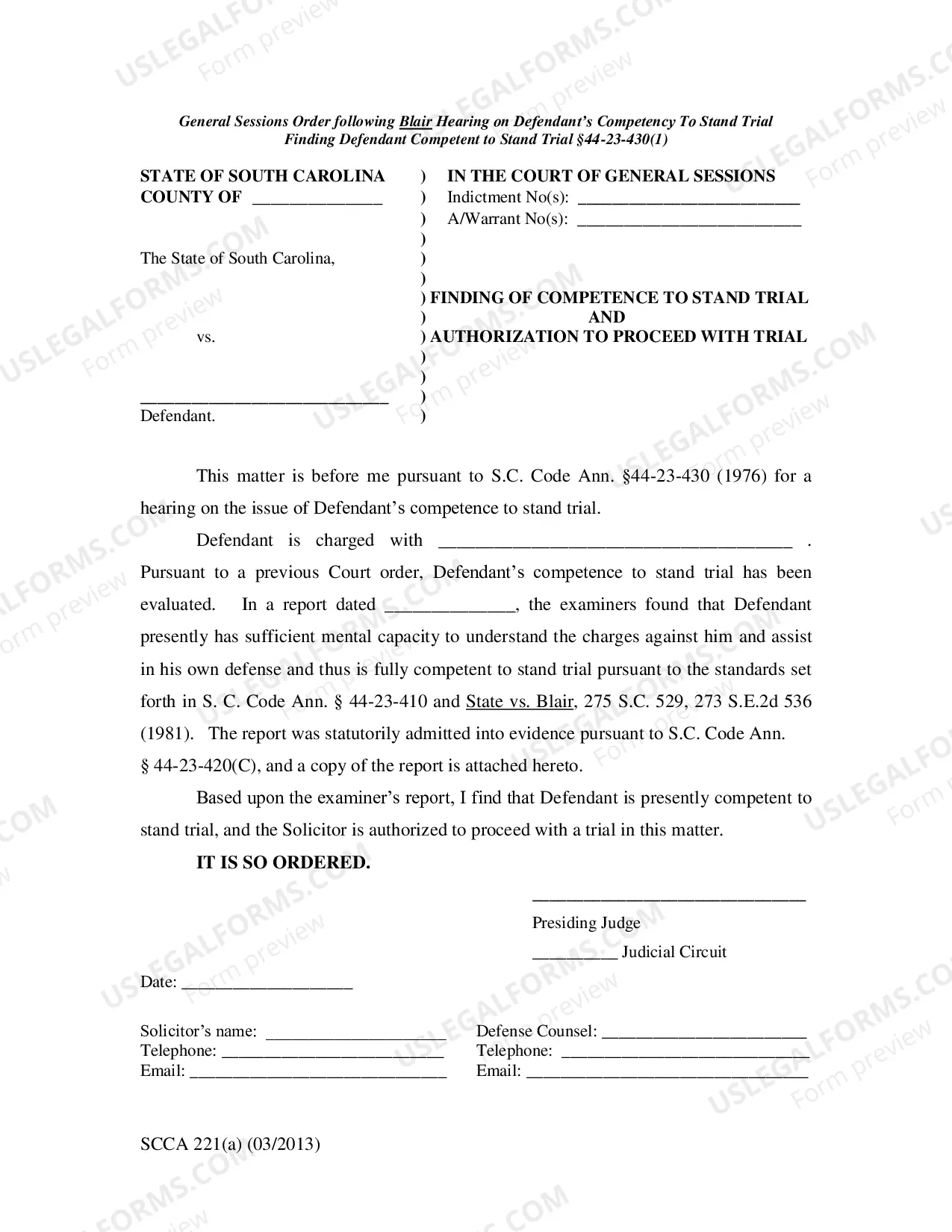
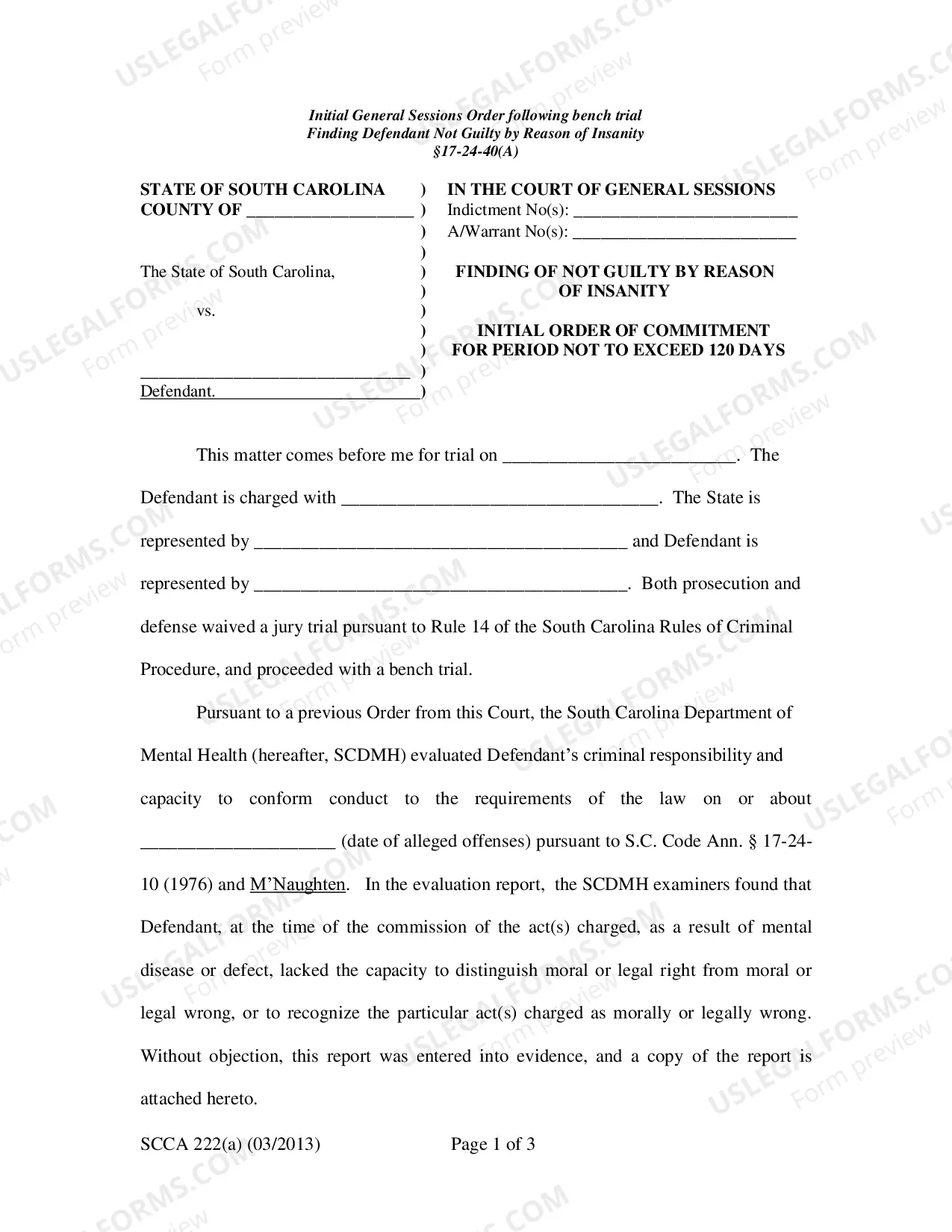
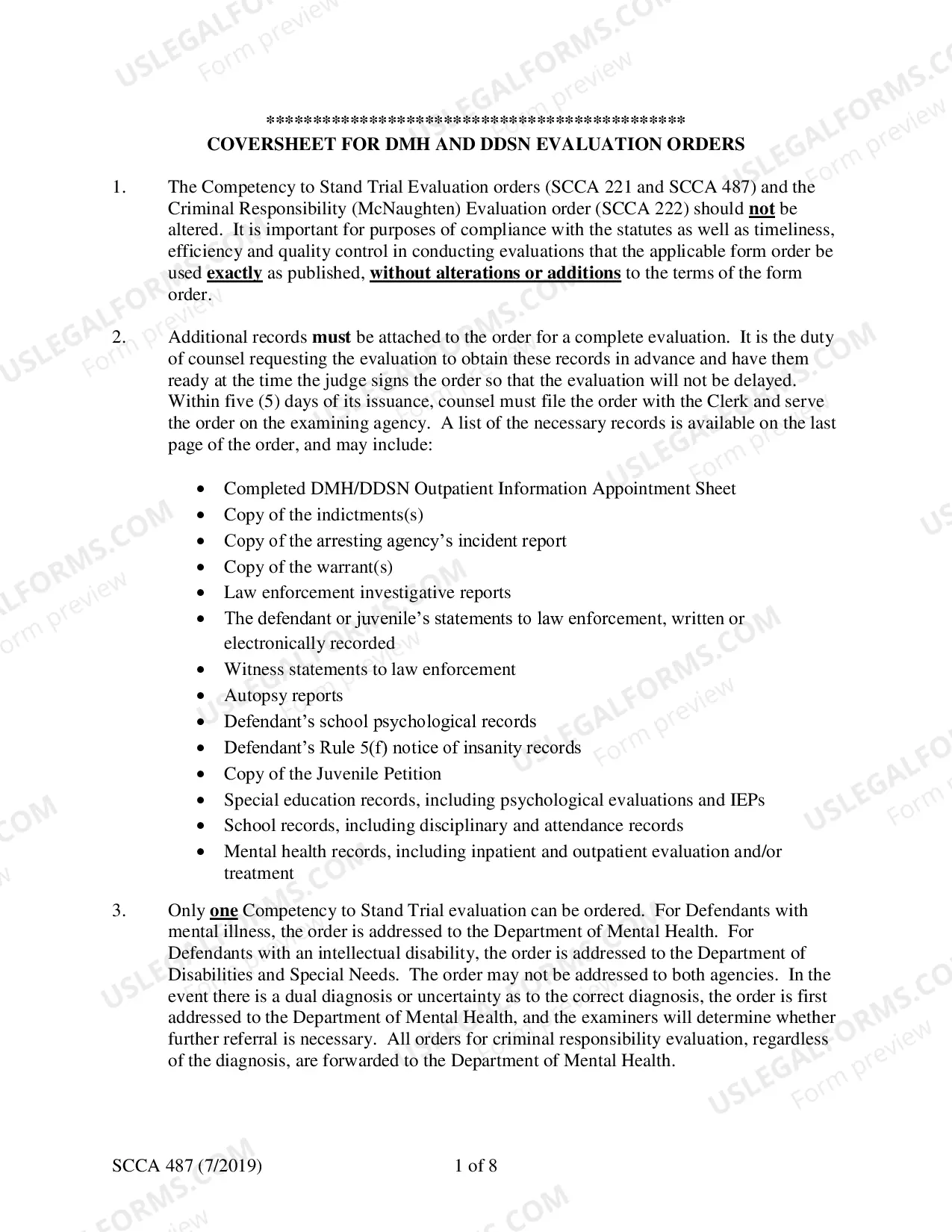
South Carolina Competency-Defendant Found Competent
Description
Get your form ready online
Our built-in tools help you complete, sign, share, and store your documents in one place.
Make edits, fill in missing information, and update formatting in US Legal Forms—just like you would in MS Word.
Download a copy, print it, send it by email, or mail it via USPS—whatever works best for your next step.
Sign and collect signatures with our SignNow integration. Send to multiple recipients, set reminders, and more. Go Premium to unlock E-Sign.
If this form requires notarization, complete it online through a secure video call—no need to meet a notary in person or wait for an appointment.
We protect your documents and personal data by following strict security and privacy standards.

Make edits, fill in missing information, and update formatting in US Legal Forms—just like you would in MS Word.

Download a copy, print it, send it by email, or mail it via USPS—whatever works best for your next step.

Sign and collect signatures with our SignNow integration. Send to multiple recipients, set reminders, and more. Go Premium to unlock E-Sign.

If this form requires notarization, complete it online through a secure video call—no need to meet a notary in person or wait for an appointment.

We protect your documents and personal data by following strict security and privacy standards.
Looking for another form?


How to fill out South Carolina Competency-Defendant Found Competent?
Preparing official paperwork can be a real burden unless you have ready-to-use fillable templates. With the US Legal Forms online library of formal documentation, you can be confident in the blanks you obtain, as all of them comply with federal and state regulations and are verified by our specialists. So if you need to fill out South Carolina Competency-Defendant Found Competent, our service is the best place to download it.
Obtaining your South Carolina Competency-Defendant Found Competent from our service is as simple as ABC. Previously authorized users with a valid subscription need only log in and click the Download button once they find the correct template. Later, if they need to, users can get the same blank from the My Forms tab of their profile. However, even if you are new to our service, registering with a valid subscription will take only a few minutes. Here’s a quick guide for you:
- Document compliance verification. You should carefully examine the content of the form you want and ensure whether it satisfies your needs and meets your state law requirements. Previewing your document and looking through its general description will help you do just that.
- Alternative search (optional). If there are any inconsistencies, browse the library using the Search tab above until you find an appropriate template, and click Buy Now once you see the one you need.
- Account creation and form purchase. Sign up for an account with US Legal Forms. After account verification, log in and select your preferred subscription plan. Make a payment to proceed (PayPal and credit card options are available).
- Template download and further usage. Choose the file format for your South Carolina Competency-Defendant Found Competent and click Download to save it on your device. Print it to fill out your paperwork manually, or use a multi-featured online editor to prepare an electronic copy faster and more efficiently.
Haven’t you tried US Legal Forms yet? Sign up for our service today to obtain any formal document quickly and easily whenever you need to, and keep your paperwork in order!
Form popularity
FAQ
Their results indicated that approximately 81 percent of individuals across studies and diagnostic categories were eventually restored, usually within 90?120 days.
What Happens to a Defendant Who Is Found to Be Incompetent and Not Restorable? This type of finding indicates that neither in-patient nor outpatient treatment will help the defendant understand the charges against her. Under these circumstances, the defendant cannot be prosecuted for her crimes.
The defendant's competence is determined at a court hearing called a ?competency hearing.? 3 A trial court judge makes an adjudication on the issue of competency with the help of a psychiatric or psychological report. The goal of the hearing is to determine if the defendant is incompetent rather than competent.
Defense attorneys have concerns regarding their client's competency in about 8% to 15% of felony prosecutions, and it is estimated that about 20% to 30% of evaluated defendants are found incompetent to stand trial.
(5) ?Incompetent? or ?incompetency? means mentally incompetent to stand trial. A person is mentally incompetent to stand trial if he or she is unable to understand the character and consequences of the proceedings against him or her or is unable properly to assist in his or her defense.
If the defendant is found incompetent, community mental health program director is ordered by a court to evaluate the best place to restore competency. Generally, those accused of misdemeanors are handled in an outpatient setting or released.
In determining whether the defendant is competent to stand trial, the court must determine "whether the defendant has sufficient present ability to consult with his lawyer with a reasonable degree of rational understanding -- and whether he has a rational as well as factual understanding of the proceedings against
A lack of competency forms a roadblock to a trial and conviction regardless of how strong the prosecution's evidence may be. It does not prevent the police from making an arrest or the prosecution from filing charges, but the proceedings cannot go further until and unless the defendant is found to be competent.