South Carolina ROBBERY WITHIN THE SPECIAL TERRITORIAL JURISDICTION
Overview of this form
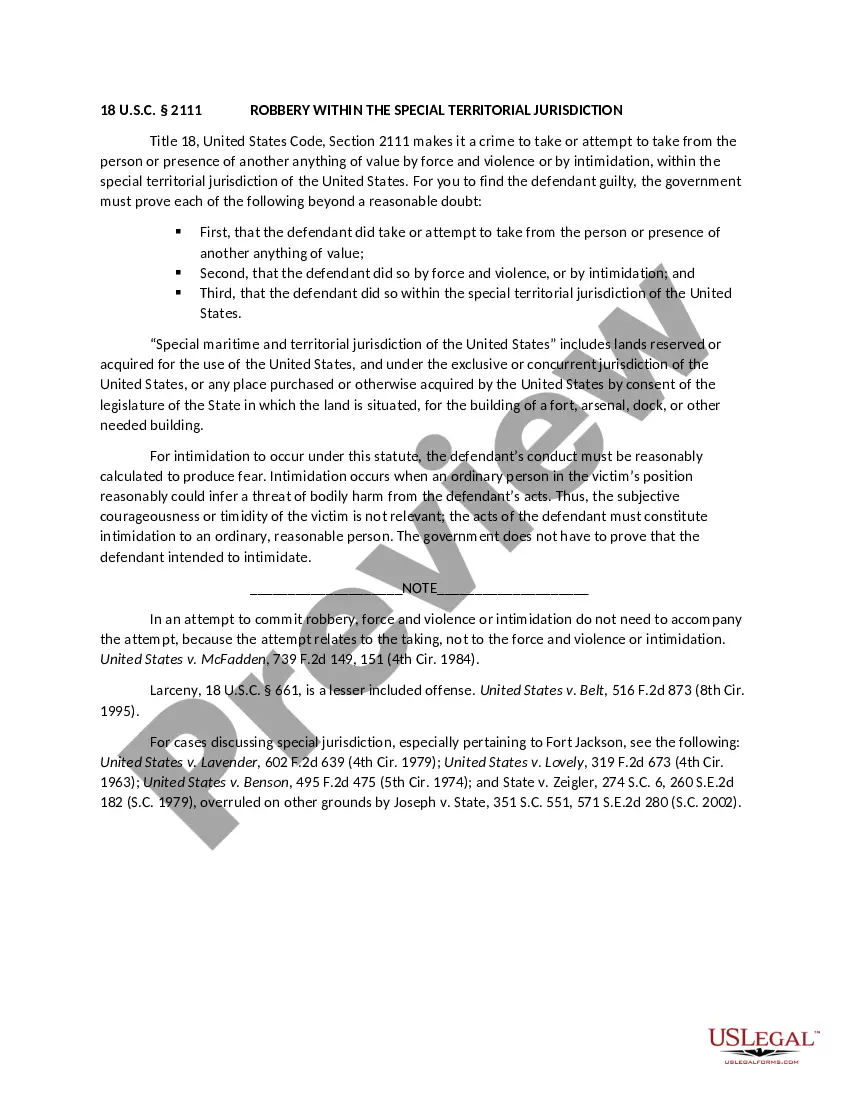
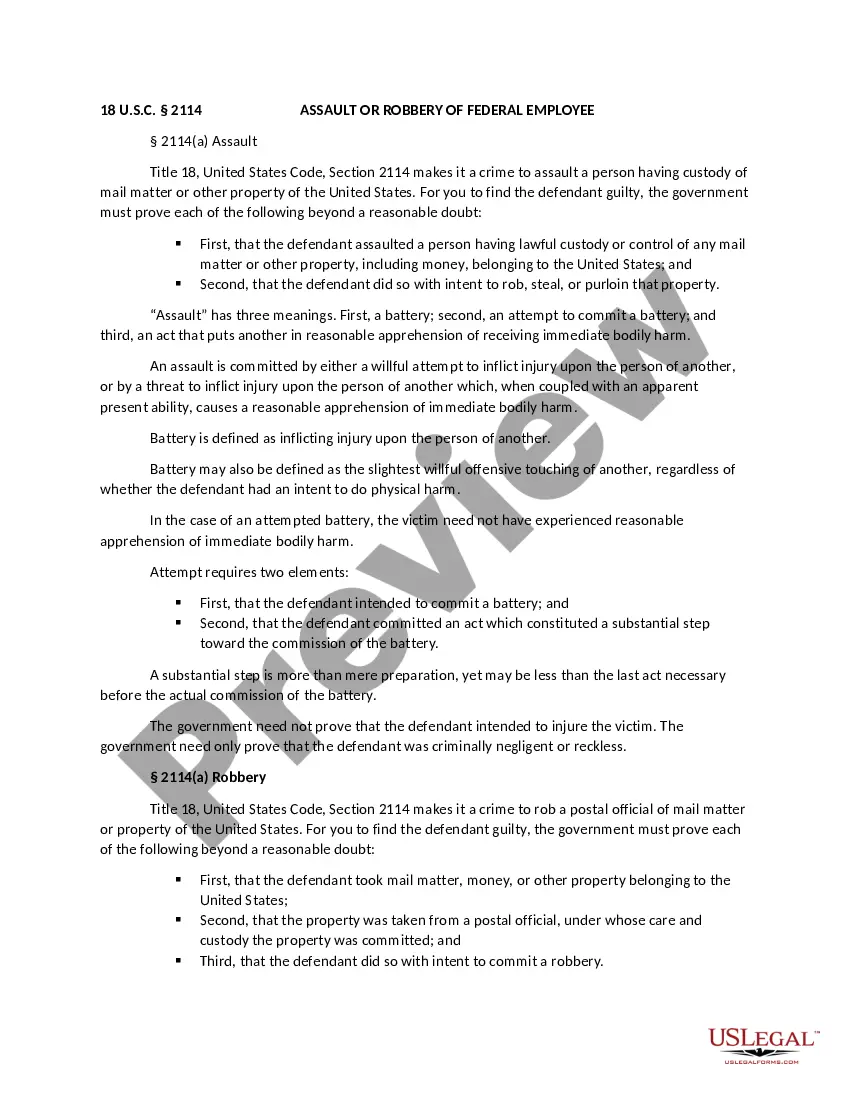
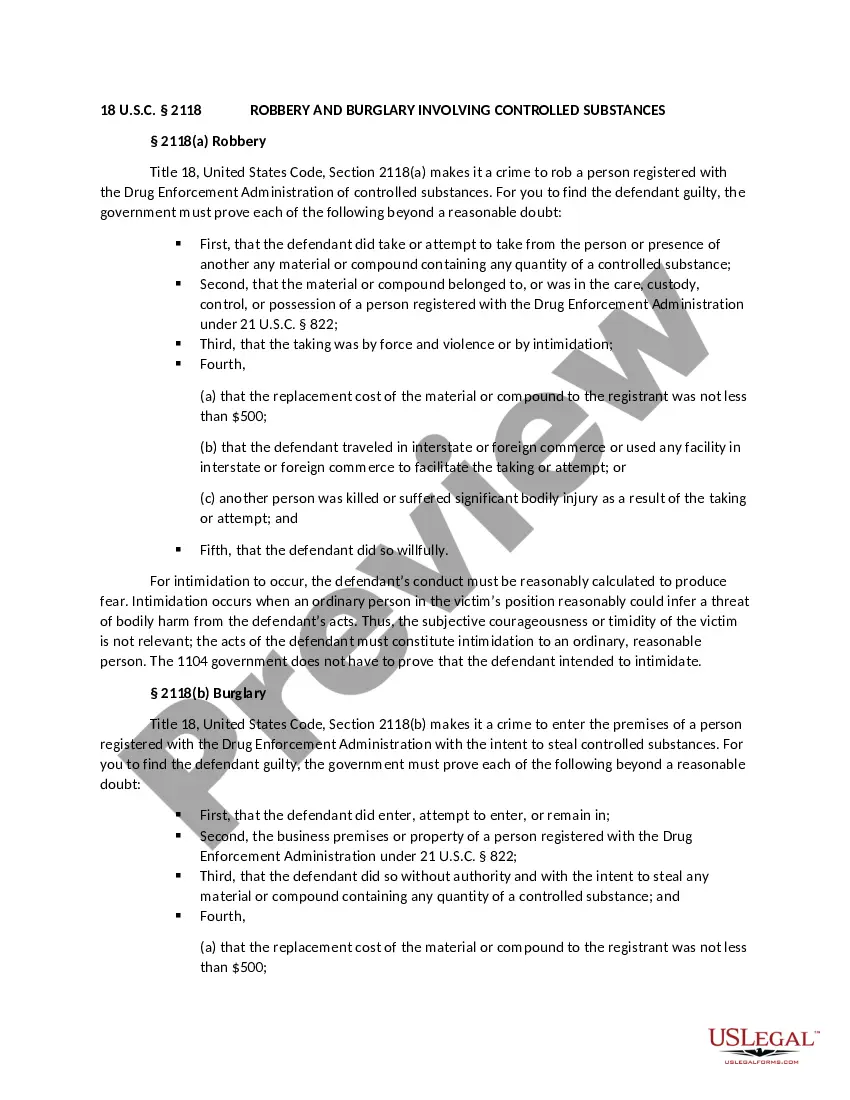
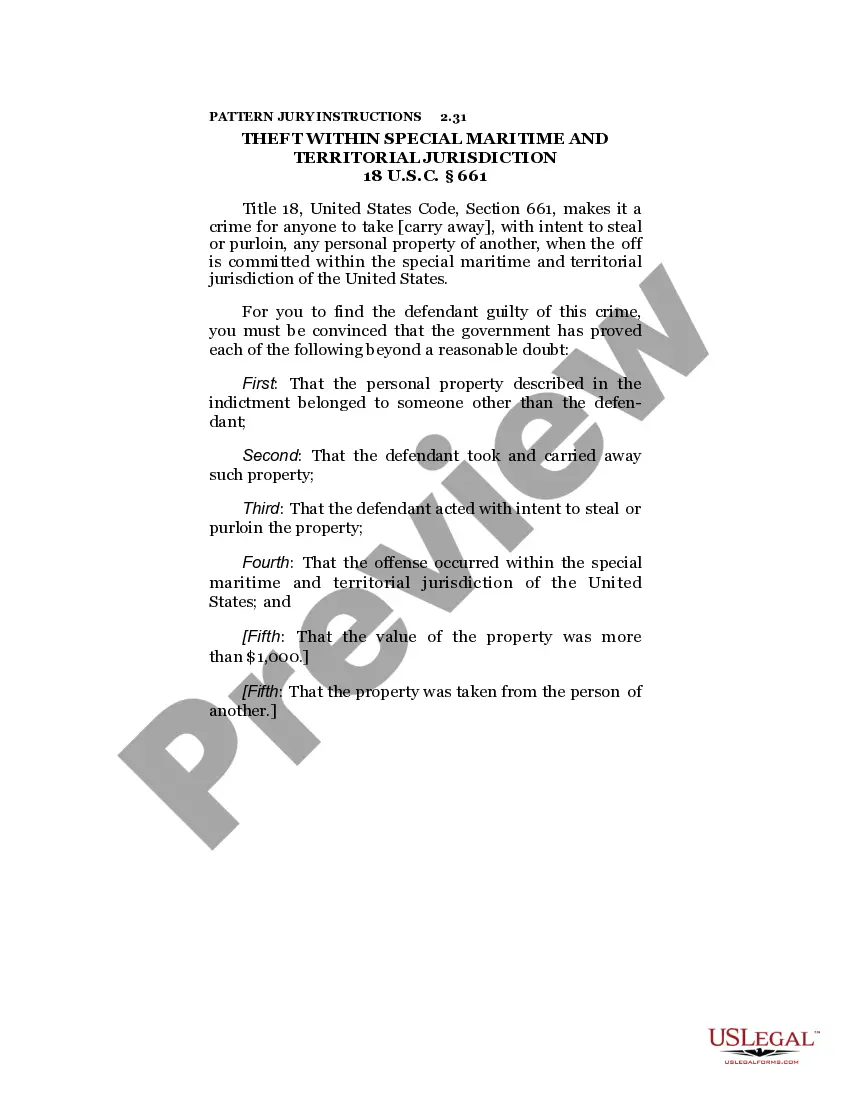
The Robbery Within the Special Territorial Jurisdiction form contains official pattern jury instructions used in federal criminal cases regarding robbery. This form outlines specific legal requirements for proving robbery under Title 18, United States Code, Section 2111, differentiating it from other criminal instructions by focusing on crimes occurring within the special territorial jurisdiction of the United States, such as military bases and federal properties.
Form components explained
- Definition of robbery under federal law.
- Criteria for proving the act of taking or attempting to take property.
- Explanation of force and violence, or intimidation as means to commit robbery.
- Clarification of special territorial jurisdiction where the crime can occur.
- References to relevant case law regarding intimidation and attempts.
When to use this document
This form is utilized in federal criminal court cases to instruct juries on the relevant laws when deliberating a case involving robbery within areas under federal jurisdiction. It is needed during trials to ensure that jurors have a clear understanding of the legal thresholds that must be met to establish a defendant's guilt.
Who should use this form
- Federal prosecutors preparing for a robbery trial.
- Defense attorneys representing clients accused of robbery.
- Judges instructing juries in federal criminal cases.
- Any legal professional involved in federal criminal law.
Completing this form step by step
- Read the instructions provided thoroughly to understand the legal components of robbery.
- Gather evidence and documentation pertinent to the case to support the charges of robbery.
- Ensure that all legal definitions and criteria are explicitly stated for jurors.
- Include relevant case law citations to reinforce arguments regarding intimidation and jurisdiction.
- Submit the form to the court before trial proceedings commence to ensure proper jury instructions.
Does this document require notarization?
This form does not typically require notarization to be legally valid. However, some jurisdictions or document types may still require it. US Legal Forms provides secure online notarization powered by Notarize, available 24/7 for added convenience.
Get your form ready online
Our built-in tools help you complete, sign, share, and store your documents in one place.
Make edits, fill in missing information, and update formatting in US Legal Forms—just like you would in MS Word.
Download a copy, print it, send it by email, or mail it via USPS—whatever works best for your next step.
Sign and collect signatures with our SignNow integration. Send to multiple recipients, set reminders, and more. Go Premium to unlock E-Sign.
If this form requires notarization, complete it online through a secure video call—no need to meet a notary in person or wait for an appointment.
We protect your documents and personal data by following strict security and privacy standards.

Make edits, fill in missing information, and update formatting in US Legal Forms—just like you would in MS Word.

Download a copy, print it, send it by email, or mail it via USPS—whatever works best for your next step.

Sign and collect signatures with our SignNow integration. Send to multiple recipients, set reminders, and more. Go Premium to unlock E-Sign.

If this form requires notarization, complete it online through a secure video call—no need to meet a notary in person or wait for an appointment.

We protect your documents and personal data by following strict security and privacy standards.
Avoid these common issues
- Failing to define intimidation adequately in the jury instructions.
- Not highlighting the special territorial jurisdiction clearly enough.
- Omitting relevant case law references that support the definitions provided.
- Not reviewing the form for applicability to the specific case facts.
Legal use & context
This form is pivotal in federal criminal trials, providing jurors with a clear framework for understanding robbery under federal law. It helps prevent inconsistencies in jury deliberations and ensures that the legal standards are upheld in cases of robbery within federal jurisdiction.
Main things to remember
- The form outlines essential jury instructions specific to robbery cases in federal territories.
- Understanding and clear definition of intimidation is vital for prosecution.
- Legal precedents enhance the instructions and aid in juror comprehension.
- Proper use ensures adherence to federal legal standards during jury trials.
Looking for another form?
Form popularity
FAQ
South Carolina Code Annotated 16-17-530: Public Disorderly Conduct (Misdemeanor) Under South Carolina Code Annotated 16-17-530, the crime of public disorderly conduct is defined as behavior that is outside the bounds of behavior expected of citizens in public areas.
If the defendant defaults on his bond by failing to appear at trial after proper notice or otherwise violates the terms or conditions of his release, there is a "forfeiture" and the bond may be estreated in circuit court by the solicitor for general sessions offenses. §17-15-170, State v.
CHAPTER 15 - BAIL AND RECOGNIZANCES. SECTION 17-15-55. Reconsideration by circuit court of bond set by summary court; subsequent violent offenders. (A)(1) The circuit courts, at their discretion, may review and reconsider bond for general sessions offenses set by summary court judges.
Common law robbery is a felony in South Carolina. Section 16-11-325 of the South Carolina Code states that strong-arm robbery is punishable by up to 15 years in a state prison, and anyone facing these charges should enlist the assistance of an experienced attorney.
Under South Carolina Code Annotated 16-17-530, the crime of public disorderly conduct is defined as behavior that is outside the bounds of behavior expected of citizens in public areas.
(A) A person charged with a noncapital offense triable in either the magistrates, county or circuit court, shall, at his appearance before any of such courts, be ordered released pending trial on his own recognizance without surety in an amount specified by the court, unless the court determines in its discretion that
An appearance bond is valid for a period of three years from the date the bond is executed for a charge triable in circuit court and eighteen months from the date the bond is executed for a charge triable in magistrates or municipal court.