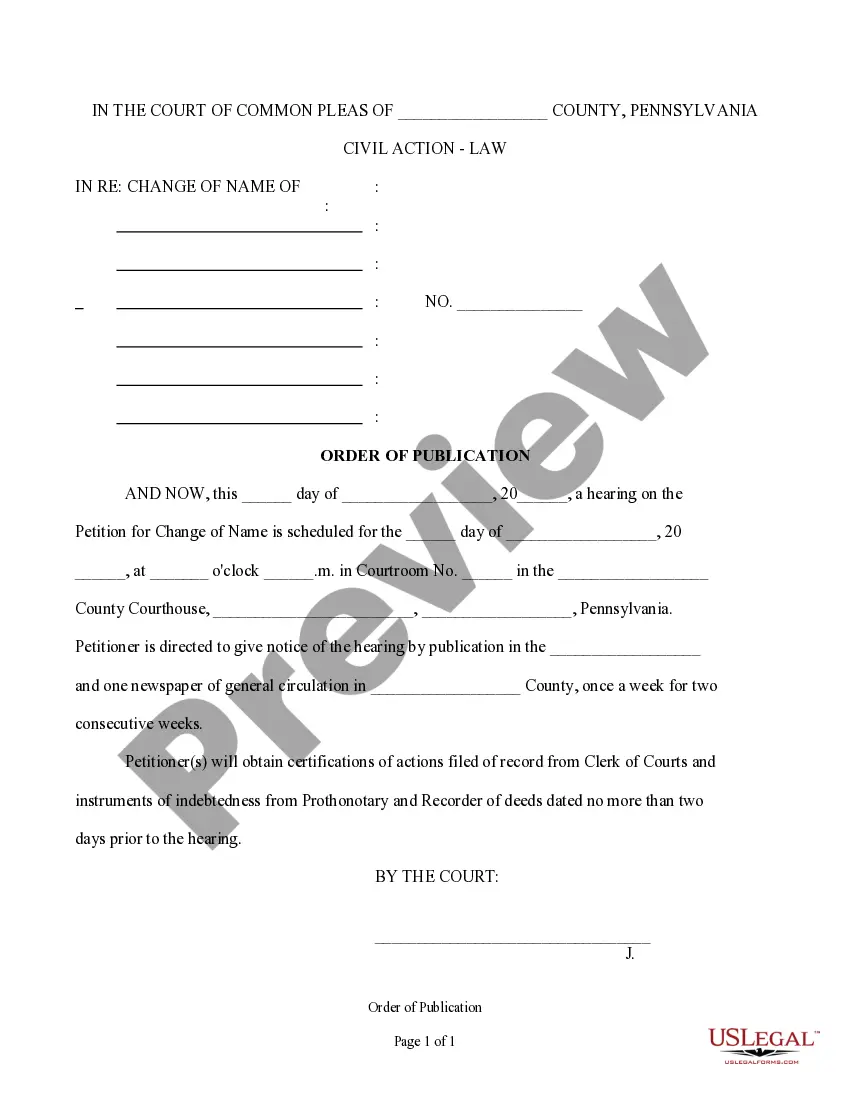
Pennsylvania Order for Publication - Family Name Change
What this document covers
The Order for Publication - Family Name Change is a legal document that officially orders the publication of a name change petition in a local newspaper. This form serves to notify the public of the upcoming hearing regarding a requested change of name, making it distinct from other forms related to name changes that may not require public notice. Using this form helps ensure compliance with court requirements for public awareness.
Key components of this form
- Date and time of the hearing.
- Courtroom number and location details.
- Required newspaper(s) for publication notice.
- Certification requirements from Clerk of Courts and Prothonotary.
When this form is needed
This form is used when an individual is seeking a formal change of their family name and must notify the public through publication ahead of a court hearing. It is particularly necessary in cases where legal requirements dictate that notice must be given to ensure transparency and an opportunity for objections.
Intended users of this form
- Individuals or families seeking a legal name change.
- Petitioners who have filed a name change petition in court.
- Anyone required to notify the public of a name change hearing as per local law.
Completing this form step by step
- Fill in the date and time of the hearing.
- Specify the courtroom number and courthouse details.
- Identify the newspaper(s) for the publication notice.
- Note any required certifications from the relevant county offices.
Is notarization required?
This form does not typically require notarization unless specified by local law. However, obtaining the proper certifications from local offices is essential to validate the publication notice.
Get your form ready online
Our built-in tools help you complete, sign, share, and store your documents in one place.
Make edits, fill in missing information, and update formatting in US Legal Forms—just like you would in MS Word.
Download a copy, print it, send it by email, or mail it via USPS—whatever works best for your next step.
Sign and collect signatures with our SignNow integration. Send to multiple recipients, set reminders, and more. Go Premium to unlock E-Sign.
If this form requires notarization, complete it online through a secure video call—no need to meet a notary in person or wait for an appointment.
We protect your documents and personal data by following strict security and privacy standards.

Make edits, fill in missing information, and update formatting in US Legal Forms—just like you would in MS Word.

Download a copy, print it, send it by email, or mail it via USPS—whatever works best for your next step.

Sign and collect signatures with our SignNow integration. Send to multiple recipients, set reminders, and more. Go Premium to unlock E-Sign.

If this form requires notarization, complete it online through a secure video call—no need to meet a notary in person or wait for an appointment.

We protect your documents and personal data by following strict security and privacy standards.
Typical mistakes to avoid
- Failing to include specific details about the hearing date and location.
- Not properly identifying the newspapers for publication, leading to invalid notices.
- Neglecting to obtain the necessary certifications prior to the hearing.
Benefits of completing this form online
- Convenient access to legally vetted templates, ensuring compliance.
- Editable forms allow for quick modifications based on individual needs.
- Reliable guidance throughout the completion process to minimize errors.
Looking for another form?
Form popularity
FAQ
Attach a copy of the child's birth certificate and official fingerprints to the Petition; publish notice of the name change; and. give notice to the other parent.
There is no cost. It is free to change the last name of a child during the course of a Family Court proceeding. There is, however, a $65 fee for filing for a name change in Civil Court and a $210 fee for Supreme Court.
The notice must be published in one issue of the Gazette and in one issue of a newspaper circulating in the district in which he or she is resident. Applicants must seek an exemption from the Director if they wish to be exempt from publication.
There is a small fee for the forms and filing. The fee varies from $5.00 to $8.00. A name change is not so simple when an adult wishes to have his/her given name or surname changed for a reason other than divorce.
If you have sole parental responsibility, you will be able to change your child's name without anyone else's consent or a Court approval. You will still need to seek legal advice from a solicitor to make a formal deed to change their name.
Attach a copy of the child's birth certificate and official fingerprints to the Petition; publish notice of the name change; and. give notice to the other parent.
There is a small fee for the forms and filing. The fee varies from $5.00 to $8.00. A name change is not so simple when an adult wishes to have his/her given name or surname changed for a reason other than divorce.
If there is only one (1) parent petitioning for the name change of their child, they must get the other parent's consent. The same goes for if none of the parents are filing the petition. Have the parent(s) fill out the Consent Form and sign it in front of a notary public.
Marriage or Divorce Sometimes, when parents divorce, if one parent is awarded the majority of custody, they may choose to change the child's last name.This could be the last name of one of the parents, a hyphenated last name, or even a name that represents the combining of the two last names.