South Carolina AIDING AND ABETTING
What is this form?
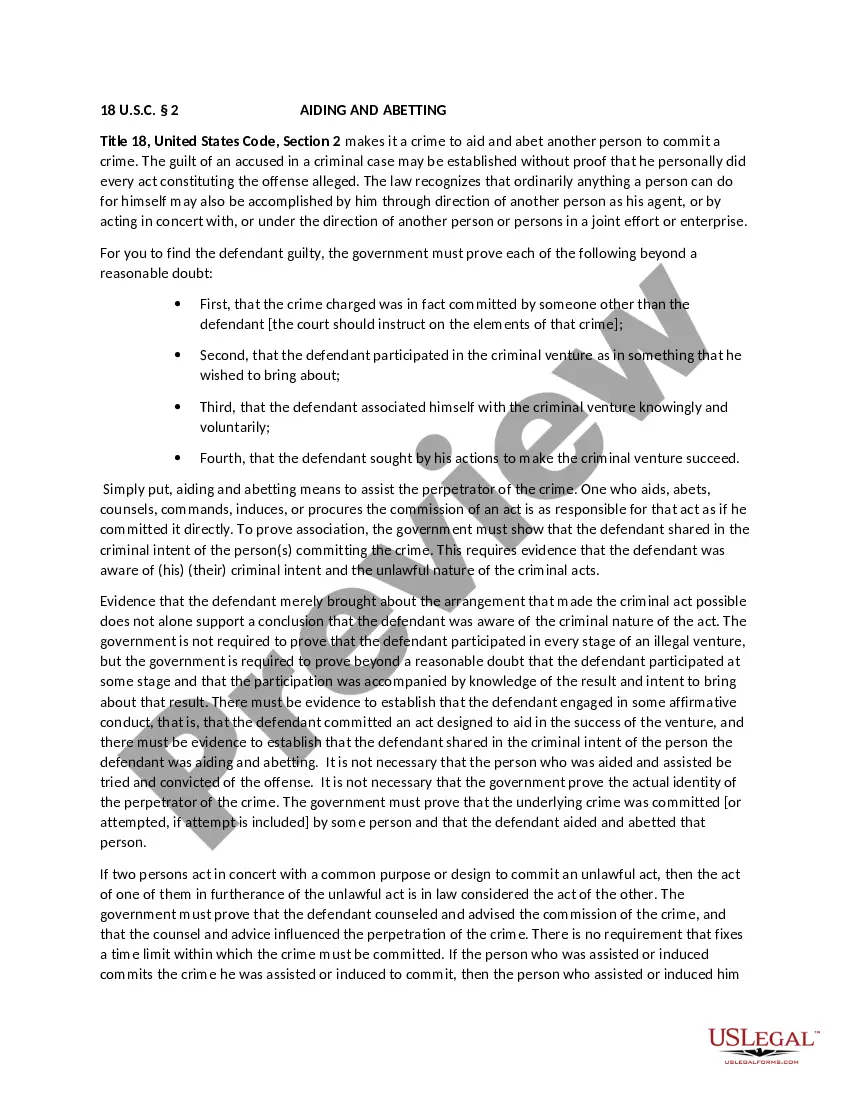
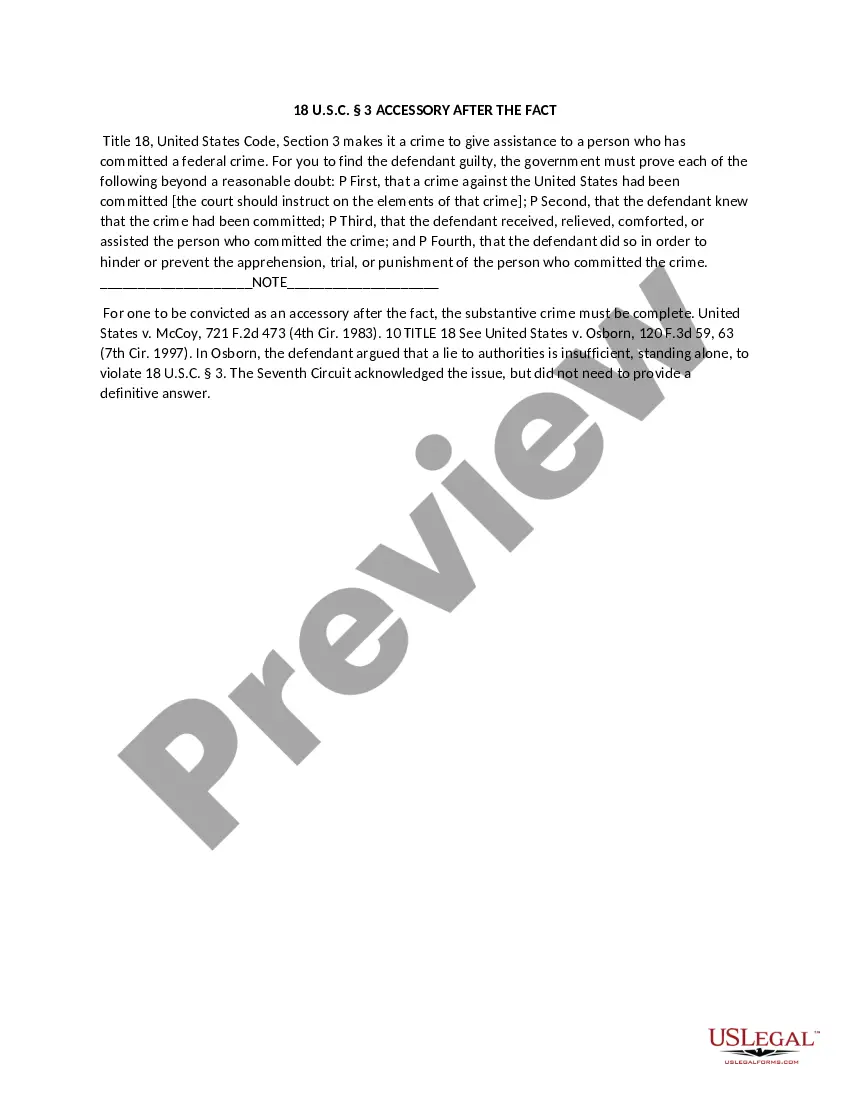
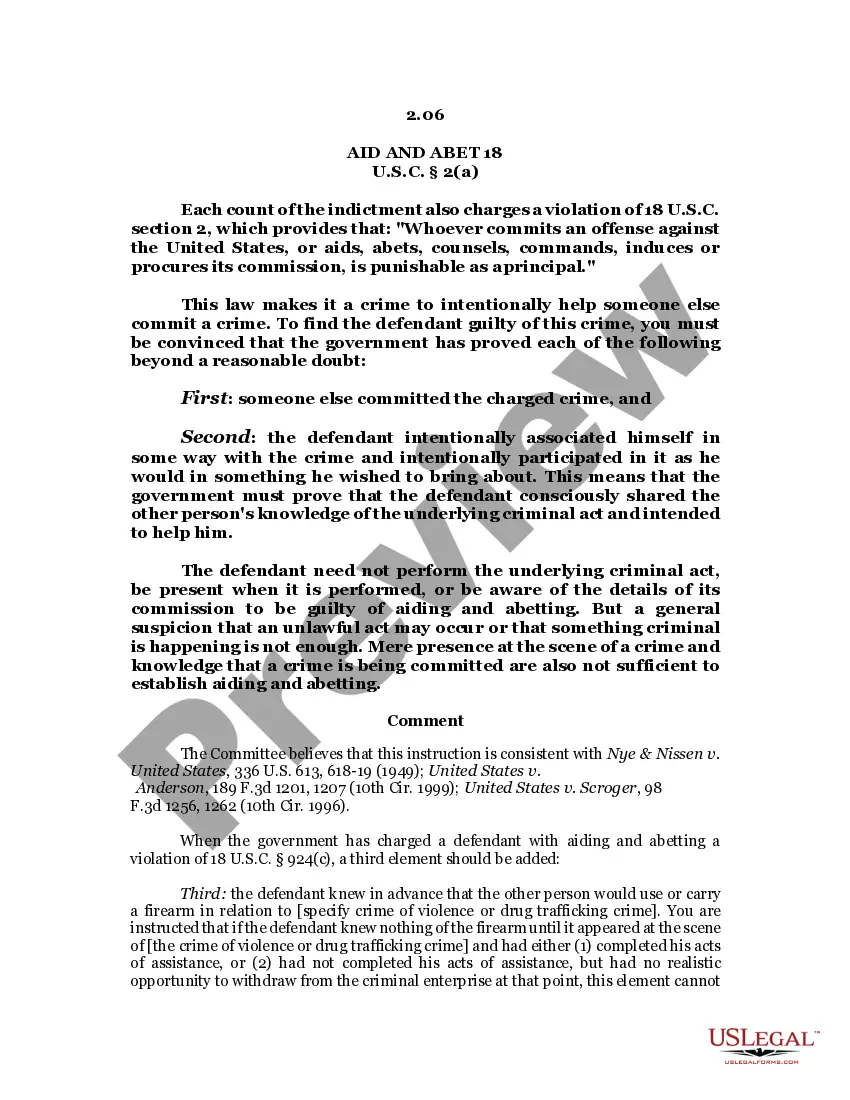
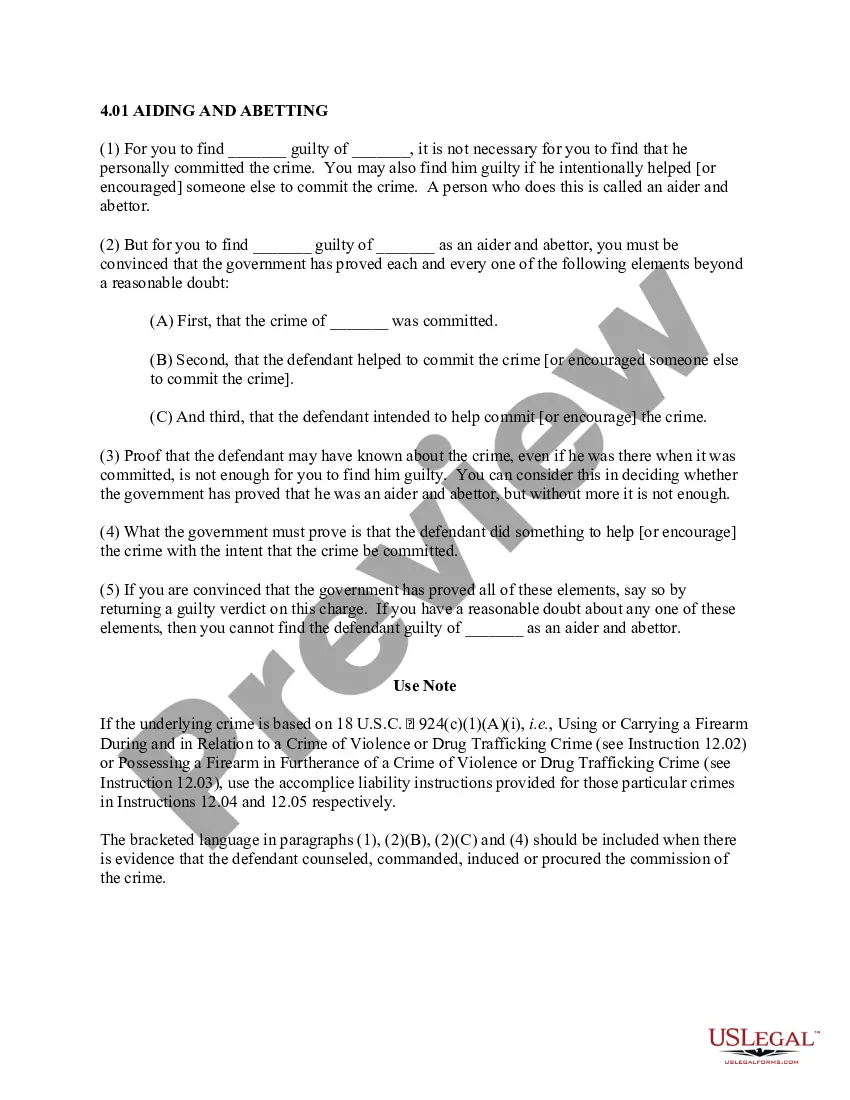
The Aiding and Abetting form provides the official pattern jury instructions related to the crime of aiding and abetting in criminal cases within the Federal District Court of South Carolina. This form is essential for understanding how individuals can be held legally responsible for assisting others in committing crimes. It clarifies the legal principles surrounding participation in a crime, distinguishing it from other criminal charges where direct involvement is required.
Main sections of this form
- Definition of aiding and abetting, including the scope of participation in criminal activities.
- Criteria for establishing guilt without direct involvement in the criminal act.
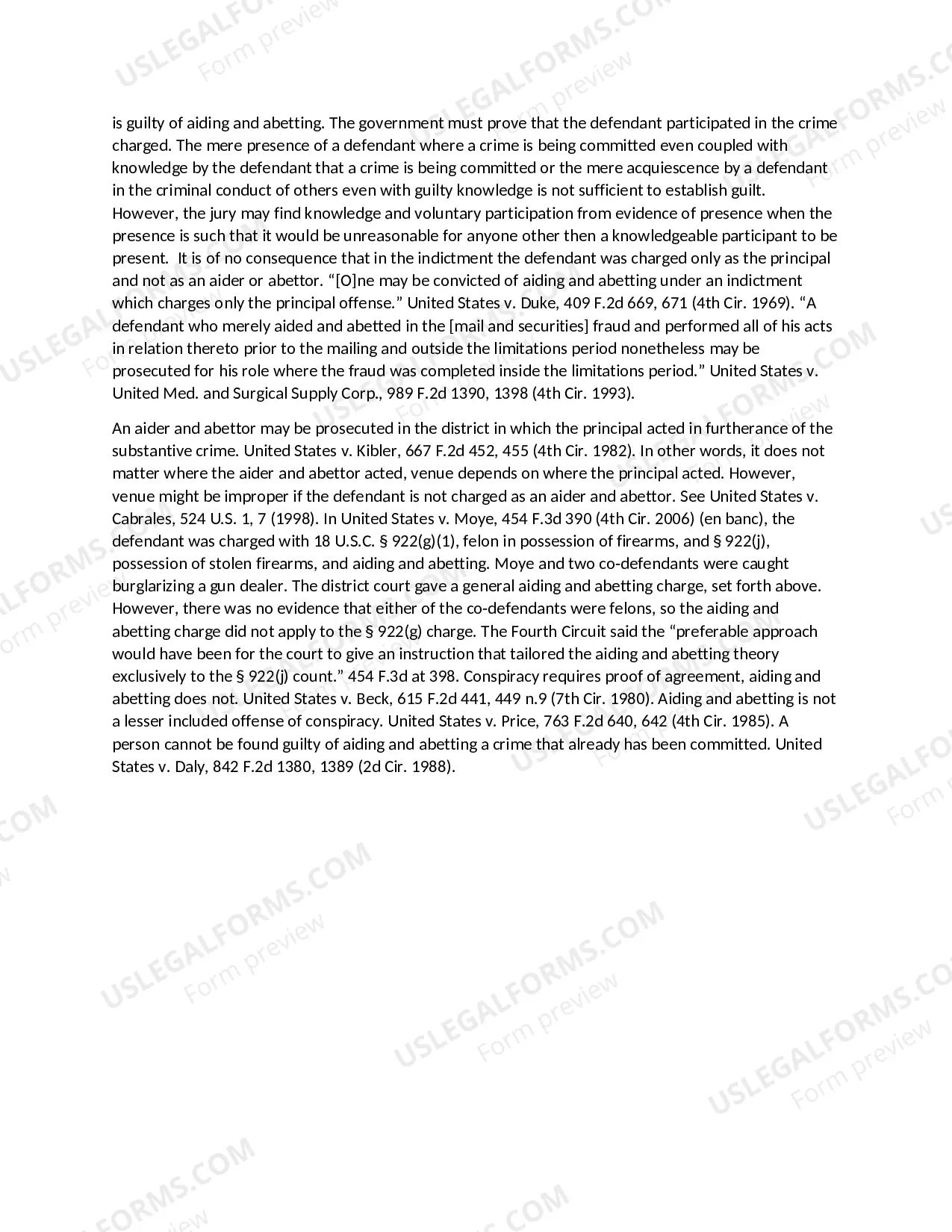
- Proof requirements for the prosecution, including shared criminal intent and affirmative conduct.
- Explanation of how venue applies in aiding and abetting cases.
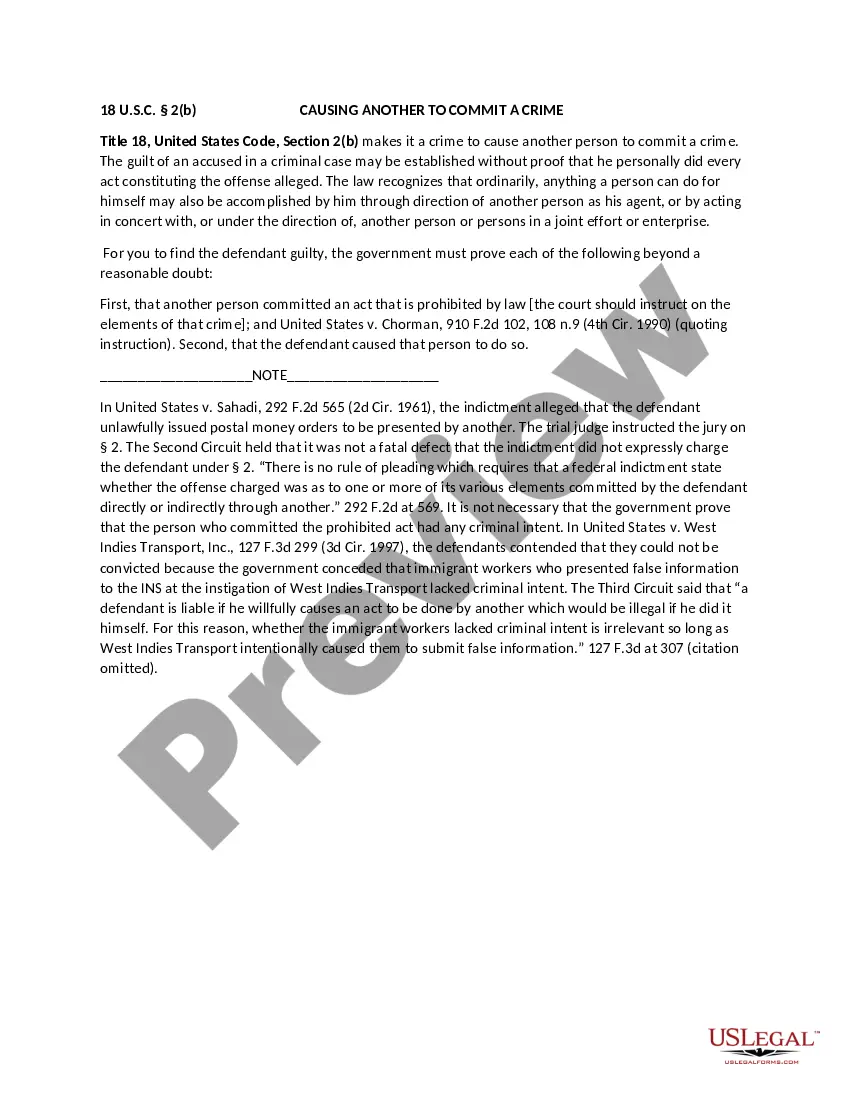
- Legal precedents and examples to illustrate the application of the law.
When this form is needed
This form should be used in cases where an individual is accused of helping another person commit a crime. This includes situations where someone may have provided support, advice, or resources that contributed to the criminal activity, even if they were not physically present during the commission of the crime.
Who this form is for
This form is intended for:
- Legal professionals preparing jury instructions for cases involving aiding and abetting.
- Defendants accused of participation in a crime without direct involvement.
- Prosecutors seeking to establish elements of the crime in court.
- Students or researchers studying criminal law and jury instructions.
Steps to complete this form
- Review the definitions of aiding and abetting to understand its implications.
- Assess the elements of the underlying crime, ensuring clarity on what was committed.
- Gather evidence of the defendant's knowledge and intent related to the criminal act.
- Outline the defendant's actions that demonstrate participation in the venture.
- Consult relevant legal precedents to strengthen the application of this form in specific cases.
Does this form need to be notarized?
In most cases, this form does not require notarization. However, some jurisdictions or signing circumstances might. US Legal Forms offers online notarization powered by Notarize, accessible 24/7 for a quick, remote process.
Get your form ready online
Our built-in tools help you complete, sign, share, and store your documents in one place.
Make edits, fill in missing information, and update formatting in US Legal Forms—just like you would in MS Word.
Download a copy, print it, send it by email, or mail it via USPS—whatever works best for your next step.
Sign and collect signatures with our SignNow integration. Send to multiple recipients, set reminders, and more. Go Premium to unlock E-Sign.
If this form requires notarization, complete it online through a secure video call—no need to meet a notary in person or wait for an appointment.
We protect your documents and personal data by following strict security and privacy standards.

Make edits, fill in missing information, and update formatting in US Legal Forms—just like you would in MS Word.

Download a copy, print it, send it by email, or mail it via USPS—whatever works best for your next step.

Sign and collect signatures with our SignNow integration. Send to multiple recipients, set reminders, and more. Go Premium to unlock E-Sign.

If this form requires notarization, complete it online through a secure video call—no need to meet a notary in person or wait for an appointment.

We protect your documents and personal data by following strict security and privacy standards.
Avoid these common issues
- Failing to prove shared intent between the aider and the principal perpetrator.
- Assuming mere presence at the crime scene equates to aiding and abetting.
- Neglecting to establish that the underlying crime was committed or attempted.
- Overlooking the need for affirmative conduct that proves participation.
Why complete this form online
- Convenient access to the form for immediate download and use.
- Ability to edit the form digitally for customization before submission.
- Reliable source as the form is drafted by licensed attorneys ensuring accuracy.
Legal use & context
- The principle of aiding and abetting applies in both federal and state courts.
- Understanding the nuances of this form can help in preparing effective defense or prosecution strategies.
- This form is applicable when there is a clear connection between the aiding party and the crime committed.
Summary of main points
- Aiding and abetting involves assisting another in committing a crime.
- Proof of knowledge and intent is critical for establishing guilt.
- The form is significant for legal counsel, defendants, and prosecutors in judicial proceedings.
Looking for another form?
Form popularity
FAQ
It is unlawful for any person to assist, instruct, aid or abet, or attempt to assist, instruct, aid or abet any other person in obtaining any cable television service without payment of the lawful charge therefor. HISTORY: 1984 Act No. 407. Disclaimer: These codes may not be the most recent version.
(1) "Physical abuse" means inflicting physical injury upon a child or encouraging or facilitating the infliction of physical injury upon a child by any person including, but not limited to, a person responsible for the child's welfare, as defined in Section 63-7-20.
Pursuant to South Carolina Code Annotated 16-3-300(B)(1), the crime of assault and battery of a high and aggravated nature occurs when the Defendant unlawfully injures another individual resulting in: (1) great bodily injury to the other person OR (2) the act is accomplished by methods that are likely to cause death or
SECTION 16-11-311. Burglary; first degree. (3) the entering or remaining occurs in the nighttime. (B) Burglary in the first degree is a felony punishable by life imprisonment.
A person who is convicted under an aiding and abetting theory faces the same penalties as the principal perpetrator. In a robbery case, like the example above, the aider and abettor will typically face anywhere from three to nine years in state prison, plus an additional 10 years for the gun enhancement.
SECTION 16-13-10. Forgery. (4) willingly act or assist in any of the premises, with an intention to defraud any person.
Unannotated. SECTION 16-1-10. Categorization of felonies and misdemeanors; exemptions. (C) All offenses with a term of imprisonment of less than one year are misdemeanors and exempt from the classification system.
SECTION 16-3-10. "Murder" defined. "Murder" is the killing of any person with malice aforethought, either express or implied.