Rhode Island Acknowledgment
Understanding this form
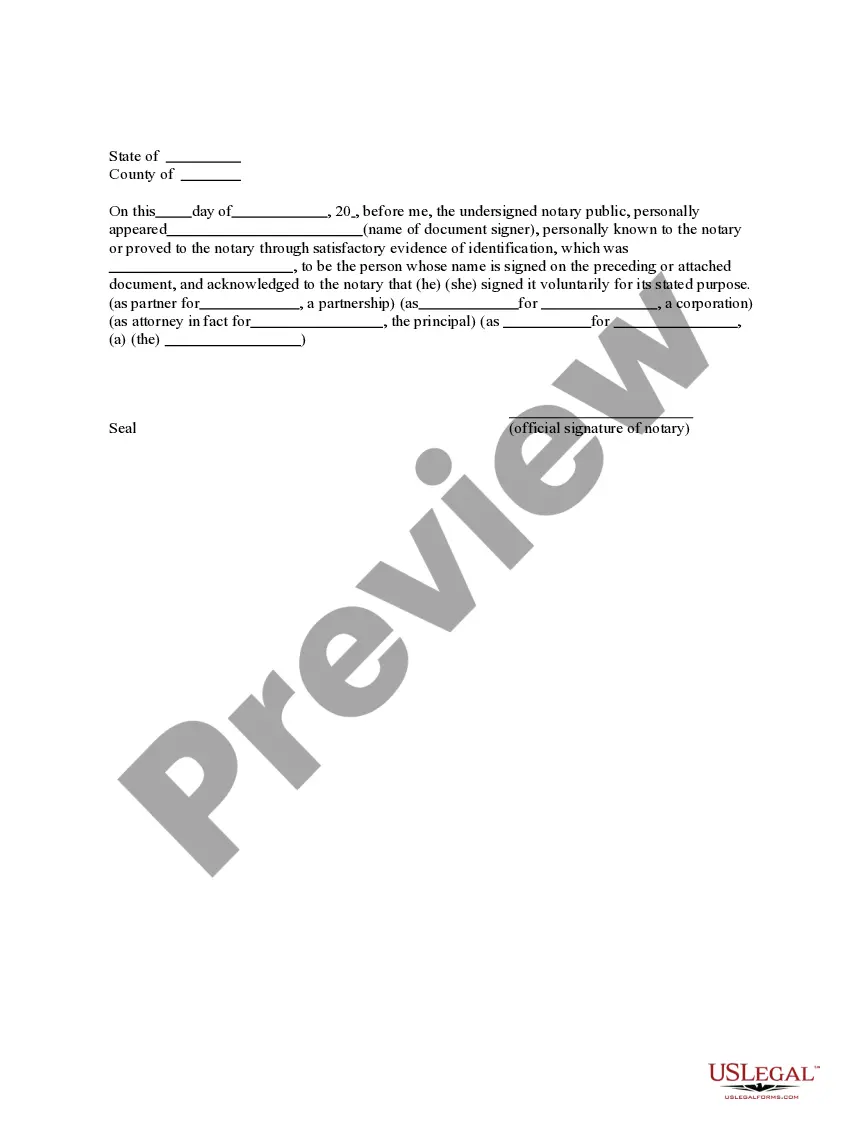
The Acknowledgment form certifies that a person has appeared before a notary public to affirm their signature on a document. This form is essential for validating the authenticity of signatures and ensuring that the signer acted voluntarily. Unlike other forms, the Acknowledgment explicitly includes the notary's confirmation, making it a key component in transactions requiring legal verification.
Key components of this form
- Date of acknowledgment.
- Name of the person signing the document.
- Notary public's signature and seal.
- Statement of voluntary signature from the signer.
- Identification verification section.

When to use this form
This form is used when a signer needs to validate their identity and confirm their signature on various legal documents, such as contracts, property deeds, or agreements. It is typically required in real estate transactions, business contracts, and other legal dealings where proof of signature is needed.
Who can use this document
- Individuals signing legal documents.
- Businesses entering contractual agreements.
- Real estate professionals involved in property transactions.
- Attorneys needing to validate client signatures.
Instructions for completing this form
- Enter the date of the acknowledgment.
- Provide the name of the signer as it appears on the document.
- Notary public should verify the identity of the signer.
- Fill out the statement confirming the voluntary signature.
- Complete the notary's section with signature and seal.
Notarization guidance
This form needs to be notarized to ensure legal validity. US Legal Forms provides secure online notarization powered by Notarize, allowing you to complete the process through a verified video call, available anytime.
Get your form ready online
Our built-in tools help you complete, sign, share, and store your documents in one place.
Make edits, fill in missing information, and update formatting in US Legal Forms—just like you would in MS Word.
Download a copy, print it, send it by email, or mail it via USPS—whatever works best for your next step.
Sign and collect signatures with our SignNow integration. Send to multiple recipients, set reminders, and more. Go Premium to unlock E-Sign.
If this form requires notarization, complete it online through a secure video call—no need to meet a notary in person or wait for an appointment.
We protect your documents and personal data by following strict security and privacy standards.

Make edits, fill in missing information, and update formatting in US Legal Forms—just like you would in MS Word.

Download a copy, print it, send it by email, or mail it via USPS—whatever works best for your next step.

Sign and collect signatures with our SignNow integration. Send to multiple recipients, set reminders, and more. Go Premium to unlock E-Sign.

If this form requires notarization, complete it online through a secure video call—no need to meet a notary in person or wait for an appointment.

We protect your documents and personal data by following strict security and privacy standards.
Typical mistakes to avoid
- Failing to include the date of acknowledgment.
- Not providing adequate identification for the signer.
- Leaving the notary signature or seal blank.
- Confusing the acknowledgment with a different legal form.
Advantages of online completion
- Convenient access to a legally vetted template.
- Editable for personal or business specific needs.
- Reliable online notarization options available 24/7.
- Reduced need for physical travel to a notary.
Looking for another form?
Form popularity
FAQ
Most notaries choose black ink for their inked seals. The only states with laws that require that their notaries use black ink for their seals are Florida, Oregon, Illinois, Delaware, Missouri, and Massachusetts.
They key difference is that for a signature witnessing, the signer must always sign the document in the Notary's presence.An acknowledgment, on the other hand, does not require the Notary to witness the signature in most states (one exception is Maryland).
A witness is brought in during the signing of a document to physically observe the parties sign it. Witnesses should be able to confirm the identity of both parties. They then sign the document as a witness to confirm that they saw each party sign.
A notary acknowledgement ensures that the signer of the document is indeed the person named in the document. The function of the notary in this case is to verify the identity of the signer. On the other hand, a notary is asked to perform a Jurat, when the signer takes an oath or makes an affirmation.
The purpose of an acknowledgment is for a signer, whose identity has been verified, to declare to a Notary or notarial officer that he or she has willingly signed a document.The signer may either sign the document before appearing before you, or in your presence.
An acknowledgment is a formal declaration before an authorized official such as a notary, by a person who has signed a document, that the document is his or her act. Acknowledgments are governed by the Uniform Acknowledgment Act. The person acknowledging the document must personally appear before the notary.
Notary Stamp/Seal It is required that all notaries public in Rhode Island have a notary stamp. The stamp shall be in round (circular) or rectangular form with an edge border surrounding the required elements of the stamp.
Unlike jurats, an acknowledgment does not need to be signed in the presence of a notary. However, the affiant does need to swear or affirm that they signed under their own free will.
The purpose of an acknowledgment is for a signer, whose identity has been verified, to declare to a Notary or notarial officer that he or she has willingly signed a document. Click to expand.The signer must declare (acknowledge) signing the document for its intended purpose.