Rhode Island Grant Deed from Individual to Individual
What this document covers
The Grant Deed from Individual to Individual is a legal document used to transfer property ownership from one individual (the Grantor) to another (the Grantee). This specific deed complies with all state statutory laws, ensuring that the transfer is legally recognized. Unlike a warranty deed, a grant deed implies that the grantor has not transferred the property to anyone else and that the property is free from undisclosed encumbrances, providing peace of mind to the grantee.
Main sections of this form
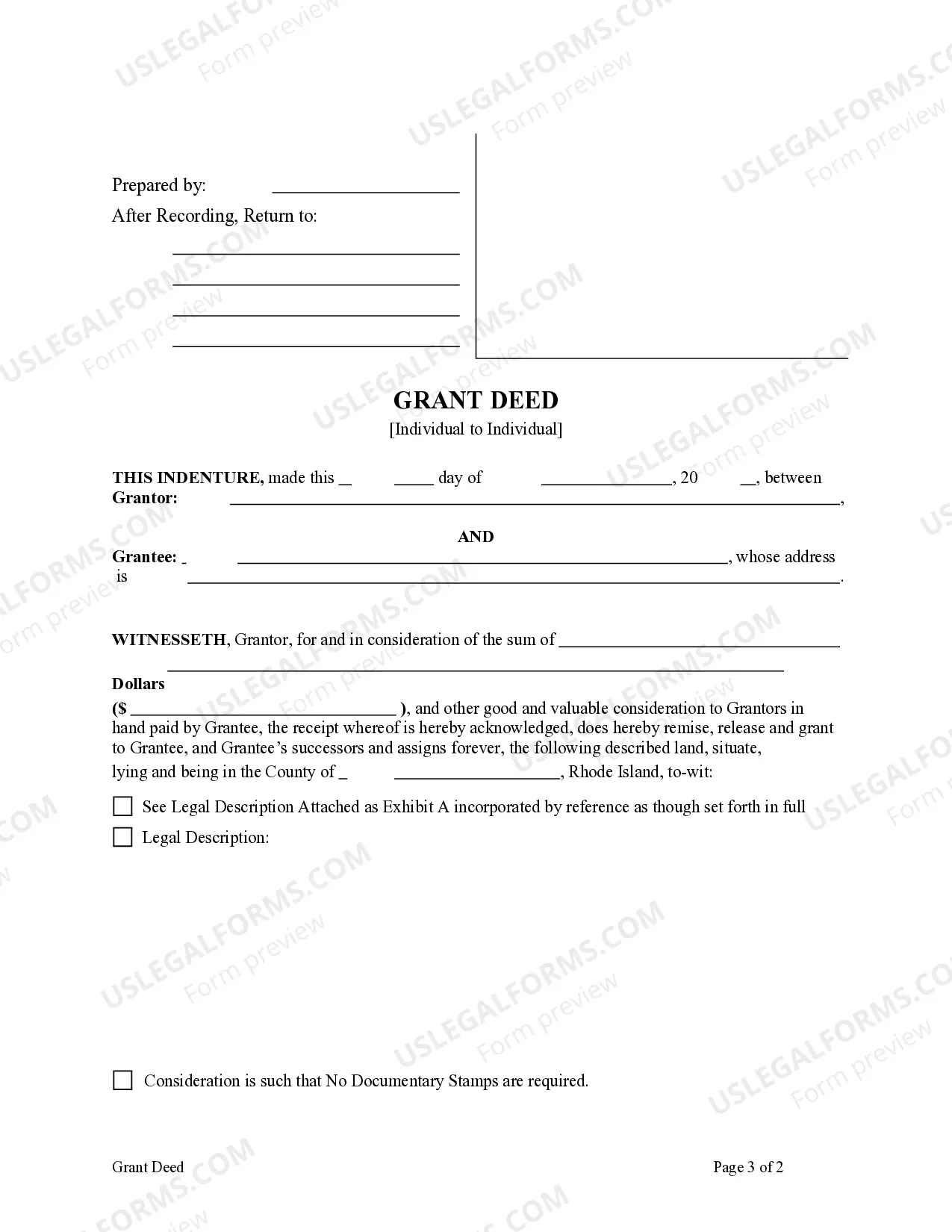
- Names and addresses of the Grantor and Grantee
- Legal description of the property being transferred
- Consideration clause indicating any payment or acknowledgment of transfer
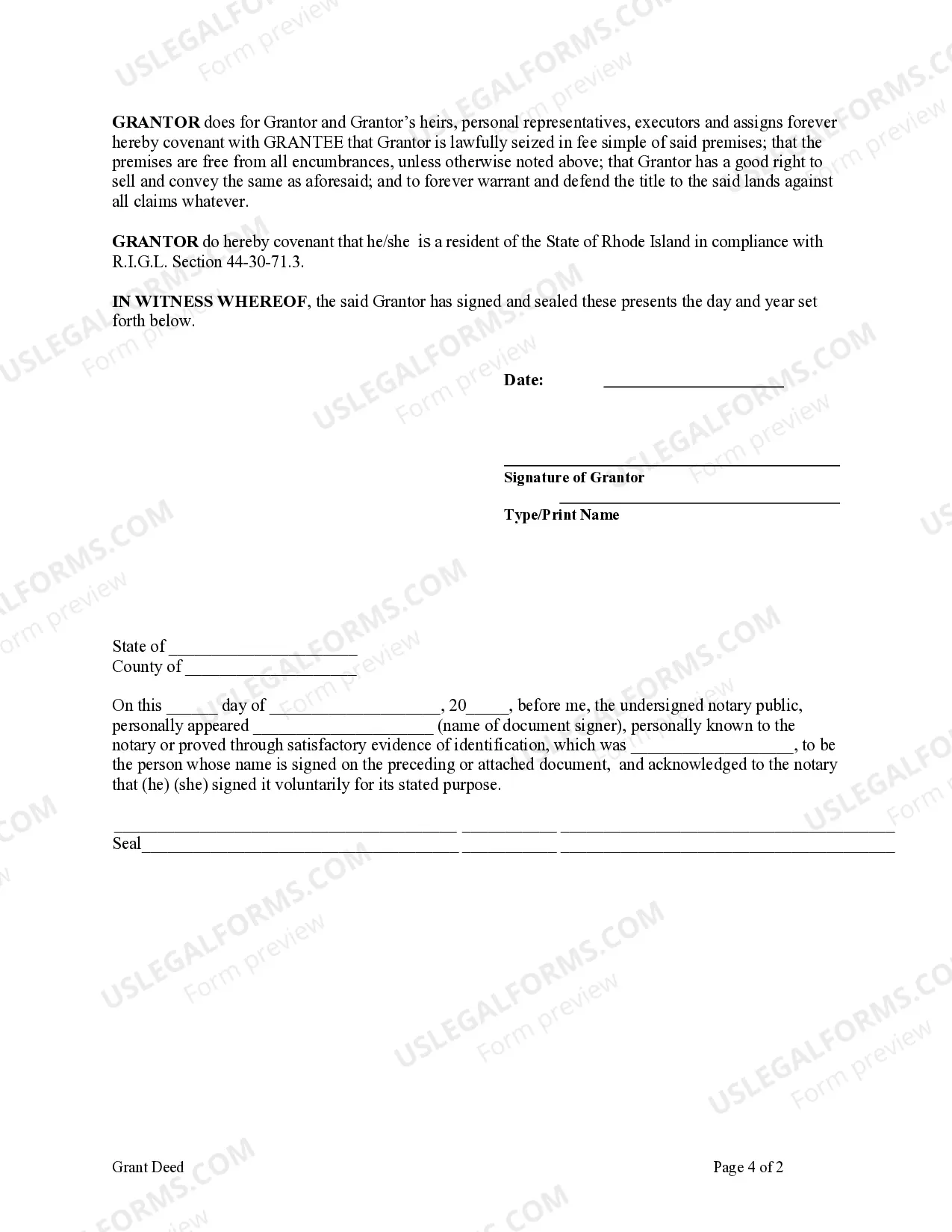
- Grantorâs covenant assuring the title is free from encumbrances
- Signature lines for the Grantor and notary acknowledgment





When to use this form
This form is typically used when an individual wishes to transfer ownership of real property to another individual. It is appropriate in scenarios such as selling a home, gifting property to a family member, or making a simple exchange of property without complex legal considerations. Using this grant deed makes the transfer clear and legally binding.
Who needs this form
- Individuals transferring ownership of real estate
- Property owners who wish to document a gift of property
- People involved in simple property exchanges
- Anyone needing a legally binding deed to record property transactions
How to complete this form
- Identify and enter the names and addresses of both the Grantor and the Grantee.
- Provide a complete legal description of the property being transferred.
- Include any consideration paid, if applicable, or indicate that no consideration is given.
- Have the Grantor sign and date the deed.
- Arrange for the deed to be notarized to ensure its legal validity.
Notarization requirements for this form
Yes, this form must be notarized to be legally valid. It is important to ensure that the Grantor signs the deed in the presence of a notary public, who will then certify the signature. US Legal Forms also offers integrated online notarization, providing 24/7 availability through secure video calls, ensuring that users can complete their forms without traveling.
Get your form ready online
Our built-in tools help you complete, sign, share, and store your documents in one place.
Make edits, fill in missing information, and update formatting in US Legal Forms—just like you would in MS Word.
Download a copy, print it, send it by email, or mail it via USPS—whatever works best for your next step.
Sign and collect signatures with our SignNow integration. Send to multiple recipients, set reminders, and more. Go Premium to unlock E-Sign.
If this form requires notarization, complete it online through a secure video call—no need to meet a notary in person or wait for an appointment.
We protect your documents and personal data by following strict security and privacy standards.

Make edits, fill in missing information, and update formatting in US Legal Forms—just like you would in MS Word.

Download a copy, print it, send it by email, or mail it via USPS—whatever works best for your next step.

Sign and collect signatures with our SignNow integration. Send to multiple recipients, set reminders, and more. Go Premium to unlock E-Sign.

If this form requires notarization, complete it online through a secure video call—no need to meet a notary in person or wait for an appointment.

We protect your documents and personal data by following strict security and privacy standards.
Avoid these common issues
- Failing to provide a complete legal description of the property.
- Not having the deed notarized if required by local laws.
- Leaving blank fields or not providing all necessary information.
- Not checking for existing liens or encumbrances on the property.
Why complete this form online
- Convenience of completing the document from home without needing to visit an attorney.
- Editability allows users to ensure all information is accurate before finalizing.
- Access to forms drafted by licensed attorneys, enhancing reliability.
Looking for another form?
Form popularity
FAQ
To transfer a property as a gift, you need to fill in a TR1 form and send it to the Land Registry, along with an AP1 form. If either side is not using a Solicitor or Conveyancer, an ID1 form will also be needed.
It will depend what state the property is in. For example, the minimum fee payable when changing the title to have someone removed from a property title in NSW is $133.48. This fee must be paid to the NSW Government Land & Property Information Department.
You must sign the grant deed if you are the seller. You also must have a public notary acknowledge or verify your signature on the grant deed. A grant deed is legally ineffective unless the grantor, meaning the person selling or transferring the property, signs the grant deed.
Retrieve your original deed. Get the appropriate deed form. Draft the deed. Sign the deed before a notary. Record the deed with the county recorder. Obtain the new original deed.
Contrary to normal expectations, the Deed DOES NOT have to be recorded to be effective or to show delivery, and because of that, the Deed DOES NOT have to be signed in front of a Notary Public. However, if you plan to record it, then it does have to be notarized as that is a County Recorder requirement.
The seller or the seller's broker will hire an attorney to prepare the real estate deed to ensure that all of the requirements in the creation of a valid deed are met before the seller conveys title to the property. All real estate deeds must be in writing.
A grant deed is the instrument used to transfer title to an interest in real property from one owner to someone else.A deed of trust is the security instrument given to a lender to secure a loan or other obligation. Bare naked title is deeded to the trustee, who holds the power of sale or the power to re-convey.
Although it's possible to change the names on title deeds yourself, we recommend that you seek professional help from a solicitor. The value of property is sufficiently high to make it worthwhile getting the transfer right.
All standard form deeds include the necessary legal language that actually transfers the property. The deed must be signed by the grantor or grantors if the property is owned by more than one person. The deed must be legally delivered to the grantee or to someone acting on the grantee's behalf.