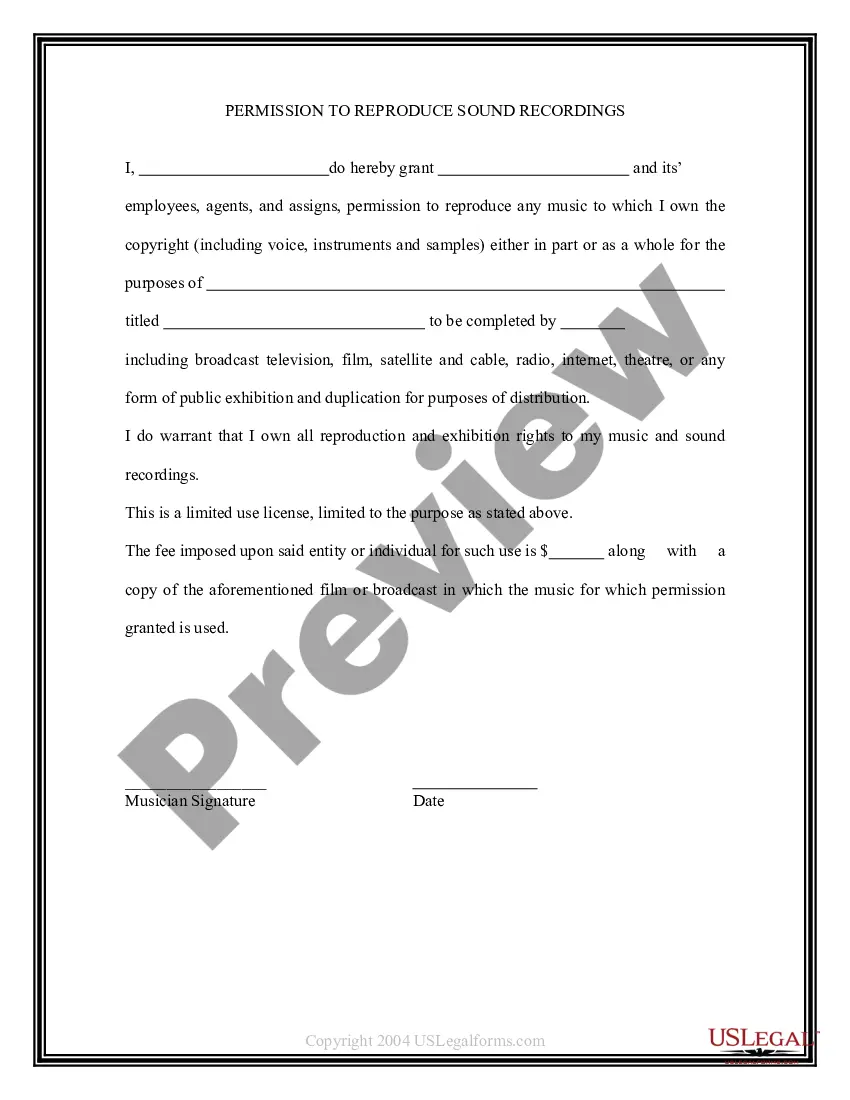
This is a form signed by a musician or owner of music granting permission to reproduce copyrighted music for use in a film, television, Internet, radio etc.
Puerto Rico Permission To Reproduce Sound Recordings
State:
Multi-State
Control #:
US-PRM-23
Format:
Word;
Rich Text
Instant download
Description

How to fill out Permission To Reproduce Sound Recordings?
Finding the appropriate official document template can be challenging.
Of course, there are numerous templates accessible online, but how can you find the official form you need.
Utilize the US Legal Forms website. This service provides a vast array of templates, such as the Puerto Rico Permission To Reproduce Sound Recordings, suitable for both business and personal purposes. All templates are reviewed by experts and comply with federal and state regulations.
Once you are confident the form is appropriate, choose the Buy now button to purchase the form. Select the payment plan you prefer and provide the necessary information. Create your account and pay for your order using your PayPal account or credit card. Choose the file format and download the official document template to your device. Complete, edit, print, and sign the downloaded Puerto Rico Permission To Reproduce Sound Recordings. US Legal Forms is the largest collection of official templates where you can find various document formats. Utilize the service to download professionally crafted documents that adhere to state requirements.
- If you are already registered, Log In to your account and click on the Obtain button to access the Puerto Rico Permission To Reproduce Sound Recordings.
- Use your account to browse the official templates you have previously acquired.
- Visit the My documents tab in your account to retrieve another copy of the document you need.
- If you are a new user of US Legal Forms, here are simple steps you can follow.
- First, make sure you have selected the correct form for your area/county. You can review the form using the Review button and read the form description to ensure it is suitable for your needs.
- If the form does not meet your requirements, utilize the Search section to find the appropriate form.
Form popularity
FAQ
Yes, Puerto Rico requires businesses to obtain a license to operate legally. This includes businesses that intend to reproduce sound recordings. To navigate the licensing process effectively, you might benefit from resources like USLegalForms, which can provide the necessary forms and guidance for securing your Puerto Rico Permission To Reproduce Sound Recordings.
In Puerto Rico, the noise ordinance typically regulates sound levels during specific hours to maintain community peace. Generally, the ordinance restricts loud noise from 10 PM to 7 AM on weekdays and from 10 PM to 8 AM on weekends. If you plan to reproduce sound recordings during these hours, you may need to consider obtaining a Puerto Rico Permission To Reproduce Sound Recordings to ensure compliance with local laws.
Yes, US patents are enforceable in Puerto Rico, as the territory follows federal patent law. This means that patent rights granted by the United States extend to Puerto Rico. However, understanding the specific nuances of patent enforcement in the territory can be complex. If you need assistance with patents or related legal matters, US Legal Forms can provide valuable tools to help you navigate these issues.
Law 75, also known as the Puerto Rico Dealers' Act, regulates the relationships between suppliers and dealers in the territory. This law is crucial for businesses involved in distribution, as it outlines the rights and obligations of both parties. Understanding Law 75 can greatly benefit those seeking to navigate the local market effectively. For detailed guidance, consider using platforms like US Legal Forms, which provide essential resources.
The recording law in Puerto Rico governs how sound recordings can be reproduced and distributed. To legally reproduce sound recordings, obtaining the Puerto Rico Permission To Reproduce Sound Recordings is essential. This permission helps protect the rights of artists and record labels. By ensuring compliance with these laws, you can avoid potential legal issues and safeguard your creative work.
Yes, a US patent applies in Puerto Rico just like it does in the 50 states. When you obtain a patent, it grants you exclusive rights to your invention throughout the entire United States, including Puerto Rico. This means you can protect your innovative ideas and prevent others from using them without your permission. For detailed guidance on patent applications and rights in Puerto Rico, uslegalforms offers comprehensive resources tailored to your needs.
In general, the individual who writes or records an original song owns the copyright in the musical work or sound recording. So if only one person is involved in the writing and recording process, then that person owns the resulting copyrights.
To register a claim to copyright in a sound recording, you must submit the following to the Copyright Office: (1) a completed application form; (2) a nonrefundable filing fee; and (3) the required deposit of your work.
To be eligible for copyright, a sound recording must be the original work of the author and show a minimal amount of creativity. You may also copyright a sound effect, called a sound mark by the Copyright Office. Think, for example, of NBC's three chimesthey are copyrighted.
In general, the individual who writes or records an original song owns the copyright in the musical work or sound recording. So if only one person is involved in the writing and recording process, then that person owns the resulting copyrights.