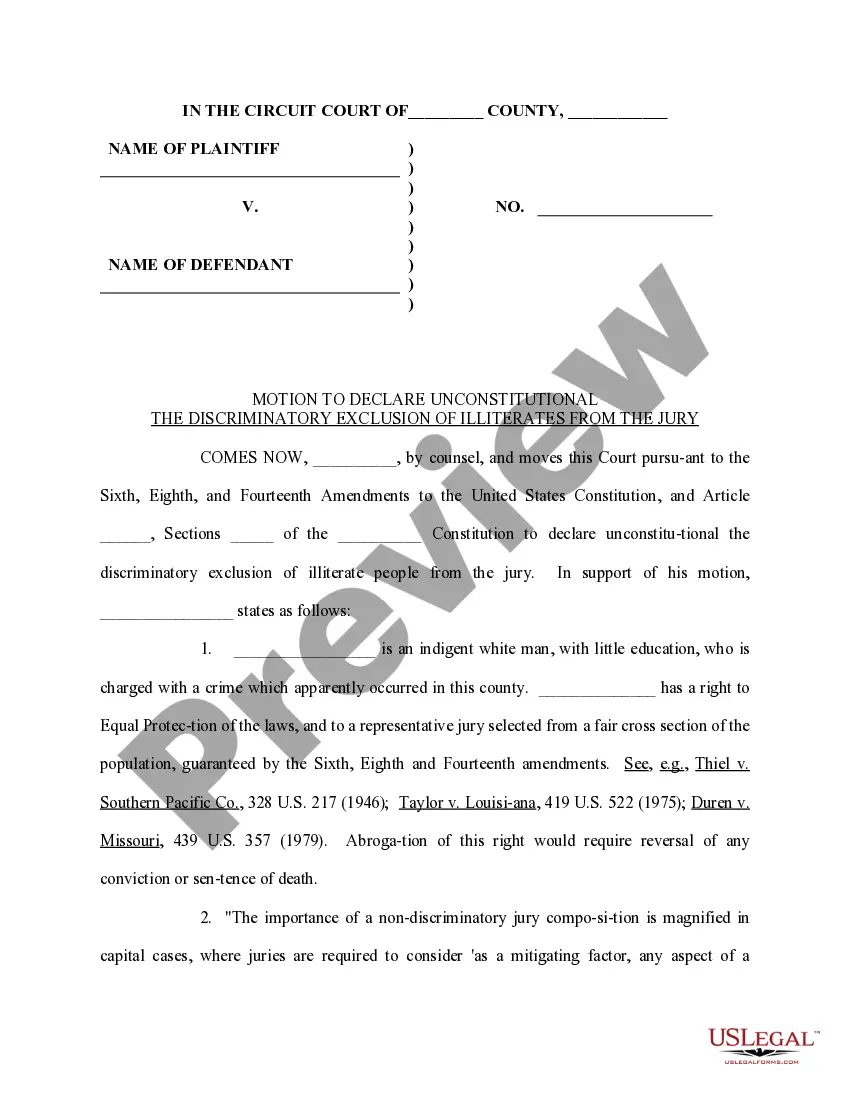
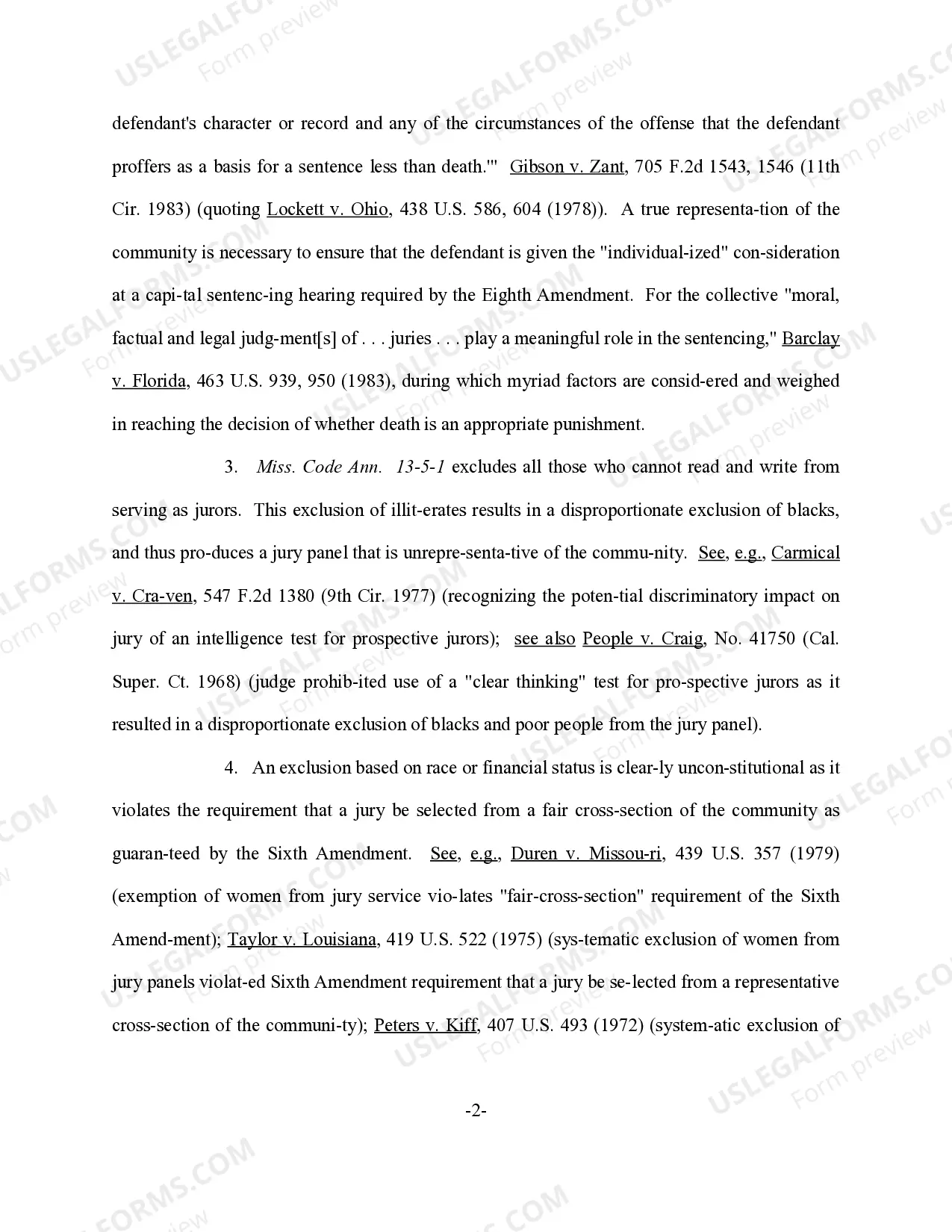
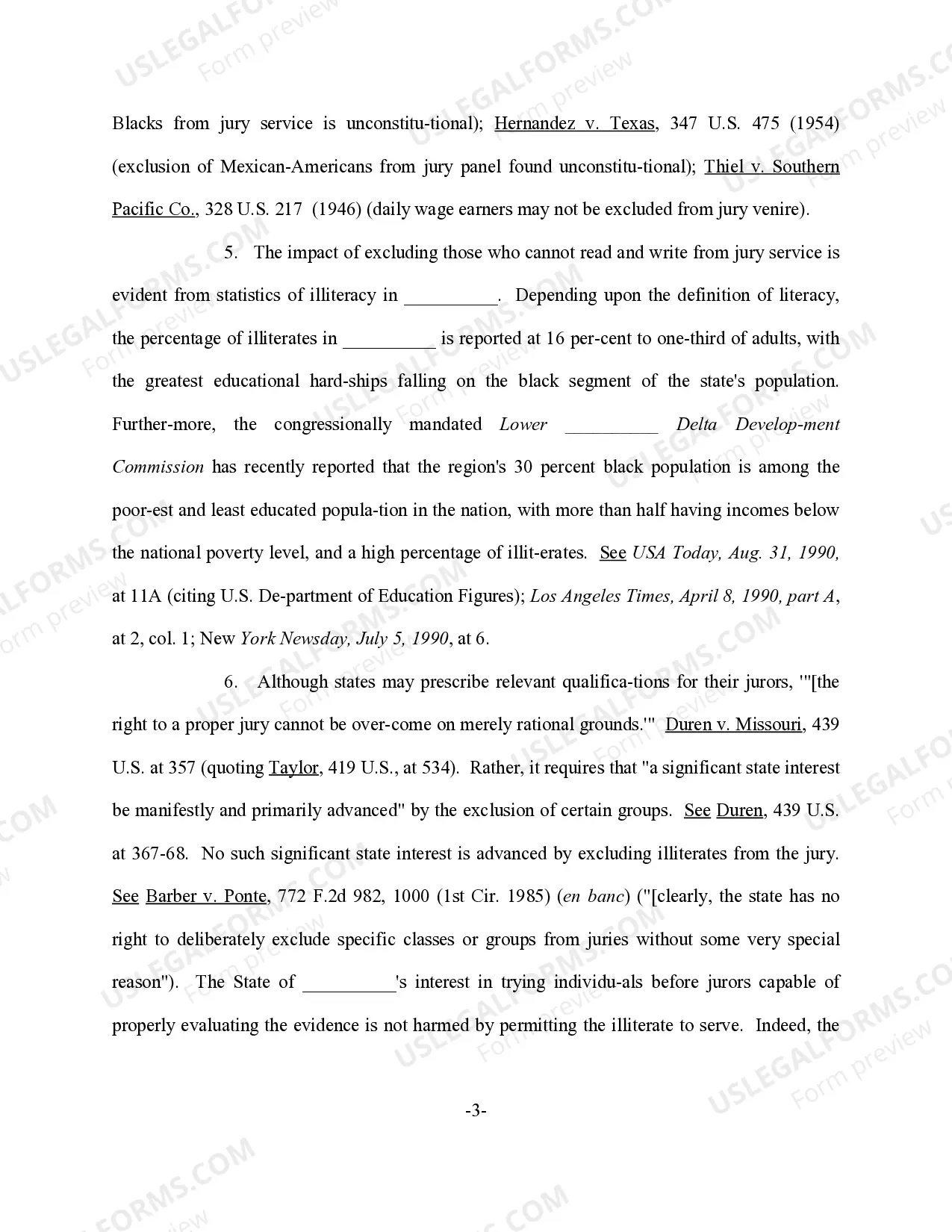
Puerto Rico Motion to Declare Unconstitutional the Discriminatory Exclusion of Illiterates from the Jury
Description
Get your form ready online
Our built-in tools help you complete, sign, share, and store your documents in one place.
Make edits, fill in missing information, and update formatting in US Legal Forms—just like you would in MS Word.
Download a copy, print it, send it by email, or mail it via USPS—whatever works best for your next step.
Sign and collect signatures with our SignNow integration. Send to multiple recipients, set reminders, and more. Go Premium to unlock E-Sign.
If this form requires notarization, complete it online through a secure video call—no need to meet a notary in person or wait for an appointment.
We protect your documents and personal data by following strict security and privacy standards.

Make edits, fill in missing information, and update formatting in US Legal Forms—just like you would in MS Word.

Download a copy, print it, send it by email, or mail it via USPS—whatever works best for your next step.

Sign and collect signatures with our SignNow integration. Send to multiple recipients, set reminders, and more. Go Premium to unlock E-Sign.

If this form requires notarization, complete it online through a secure video call—no need to meet a notary in person or wait for an appointment.

We protect your documents and personal data by following strict security and privacy standards.
Looking for another form?


How to fill out Motion To Declare Unconstitutional The Discriminatory Exclusion Of Illiterates From The Jury?
US Legal Forms - one of the most prominent collections of legal documents in the United States - provides a variety of legal form templates that you can download or print.
By using the website, you can discover numerous forms for business and personal needs, organized by categories, states, or keywords. You can find the latest versions of forms such as the Puerto Rico Motion to Declare Unconstitutional the Discriminatory Exclusion of Illiterates from the Jury in moments.
If you already have a subscription, Log In and download Puerto Rico Motion to Declare Unconstitutional the Discriminatory Exclusion of Illiterates from the Jury from your US Legal Forms library. The Download button will appear on each document you view. You can access all previously saved forms in the My documents section of your account.
Process the transaction. Use your Visa or Mastercard or PayPal account to complete the transaction. Choose the format and download the form to your device.
Make adjustments. Fill out, modify, print, and sign the saved Puerto Rico Motion to Declare Unconstitutional the Discriminatory Exclusion of Illiterates from the Jury. Each format you added to your account has no expiration date and is yours indefinitely. So, if you wish to download or print another version, just go to the My documents section and click on the form you need. Access the Puerto Rico Motion to Declare Unconstitutional the Discriminatory Exclusion of Illiterates from the Jury with US Legal Forms, one of the most comprehensive collections of legal document templates. Utilize thousands of professional and state-specific templates that meet your business or personal needs and requirements.
- If you want to use US Legal Forms for the first time, here are simple steps to get started.
- Ensure you have selected the correct form for your city/region.
- Click the Review button to examine the form’s content.
- Check the form details to confirm you have selected the right form.
- If the form doesn’t meet your requirements, use the Search field at the top of the screen to find the one that does.
- If you are satisfied with the form, confirm your choice by clicking the Purchase now button.
- Then, select the payment plan you prefer and provide your credentials to register for an account.
Form popularity
FAQ
As Puerto Rico is under United States sovereignty, U.S. federal law applies in the territory, and cases of a federal nature are heard in the United States District Court for the District of Puerto Rico.
The justices ruled 8-1 in favor of President Joe Biden's administration, reversing a lower court's ruling that a 1972 decision by Congress to exclude Puerto Rico from the Supplemental Security Income (SSI) program violated a U.S. Constitution requirement that laws apply equally to everyone.
Sixth Amendment protections do not apply to unincorporated territories of the United States.
For instance, in contrast to U.S. states, Puerto Rico residents cannot vote in U.S. presidential elections nor can they elect their own senators and representatives to the U.S. Congress. On the other hand, in contrast to U.S. states, only some residents of Puerto Rico are subject to federal income taxes.
As such, the American citizenship of Puerto Ricans can be taken away by the U.S. Congress unilaterally. Puerto Ricans are also covered by a group of "fundamental civil rights" but, since Puerto Rico is not a state, Puerto Ricans are not covered by the full American Bill of Rights.
The U.S. Supreme Court ruled 8-1 that residents of Puerto Rico are ineligible for a federal welfare program. The U.S. Supreme Court ruled Thursday that Congress may continue to exclude Puerto Rican residents from a federal safety net program that provides direct payments to poor, disabled, and blind American citizens.
Constitutional Provisions belonging to the United States,? a phrase interpreted to give Congress broad authority over nonstate entities such as Puerto Rico. Like all of its legislative powers, however, Congress's territorial authority is bound by the other provisions of the Constitution, including the Fifth Amendment.