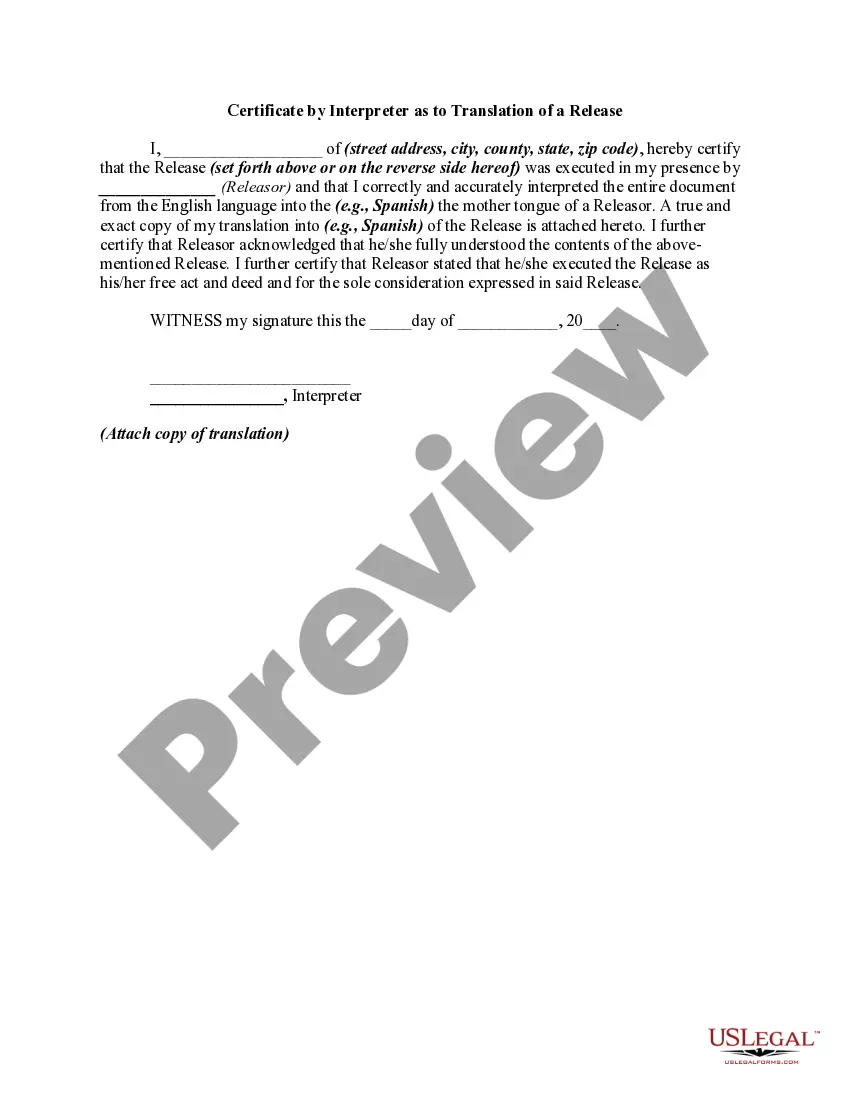
Pennsylvania Certificate by Interpreter as to Translation of a Release
Description
How to fill out Certificate By Interpreter As To Translation Of A Release?
Selecting the appropriate legal document template can be a challenge. Of course, there are numerous formats available online, but how can you find the legal form you require? Utilize the US Legal Forms website. The platform offers a vast array of templates, including the Pennsylvania Certificate by Interpreter regarding Translation of a Release, which can be utilized for both business and personal purposes. All documents are verified by professionals and comply with federal and state regulations.
If you are already registered, Log In to your account and click the Obtain button to locate the Pennsylvania Certificate by Interpreter regarding Translation of a Release. Use your account to search through the legal documents you may have purchased previously. Visit the My documents section of your account to retrieve another copy of the document you need.
If you are a new user of US Legal Forms, here are straightforward instructions you should follow: First, ensure you have selected the correct form for your region/state. You can review the form using the Review button and check the form description to confirm it is suitable for your requirements. If the form does not meet your needs, utilize the Search field to find the appropriate form. Once you are confident that the form is suitable, click the Buy now button to obtain the form. Choose the pricing plan you prefer and enter the necessary information. Create your account and complete the transaction using your PayPal account or credit card. Select the file format and download the legal document template to your device. Complete, modify, print, and sign the obtained Pennsylvania Certificate by Interpreter regarding Translation of a Release.
- US Legal Forms is the largest repository of legal documents that you will find various document formats.
- Utilize the service to obtain professionally crafted paperwork that adhere to state regulations.
Form popularity
FAQ
To become a certified court interpreter, you'll need to take Oral Proficiency Exams, the English-Only Written Exam, and the Bilingual Oral Interpreting Exam.
What are the certification requirements? Program registration. Orientation workshop. Written examination. Oral proficiency examination. Pass a background check. Agree to uphold the interpreter rules of conduct and professional responsibility and follow program policies and regulations. Be at least 18 years of age.
Interpreters should never interject their own words, phrases, or expressions. They should convey the emotional emphasis of the speaker without reenacting or mimicking the speaker's emotions or dramatic gestures.
A certified interpreter is an interpreter who has passed a valid and reliable certification exam administered by an independent entity. It's important to keep in mind that many individuals may complete certificate programs in interpreting as well, but that does not mean they are certified.
Limitations Inconsistent availability. May experience conflict of duties between the roles for which they were hired and the ad hoc interpreter duties. May create resentment in staff member or co-workers. May be unfamiliar with specialized vocabulary. Usually untrained.
Minimum Qualifications to Become an Interpreter Demonstrate bilingualism and literacy through language proficiency testing. Hold a certificate for professional interpreter training (at least 40 hours of training).
Interpreters mediate languages orally while translators work with written material. When it comes to language skills, translators need to have solid reading comprehension, transfer, and target language production skills.
It takes at least four years to become an interpreter. Many programs offer prerequisite courses or a certificate program to teach these basic skills if needed.
Interpreters often face challenges such as difficulty hearing the speaker clearly, dealing with hasty speakers, navigating cultural differences, and interpreting idioms accurately.
A professional interpreter should never: faithfully; ? complete forms for you or your client; and ? change the content and meaning of the source message. Interpreting accurately does not mean interpreting word-for-word, because sometimes there might not be an appropriate word or term in the target language.