Pennsylvania Affidavit of Service by Certified Mail and Regular Mail
What this document covers
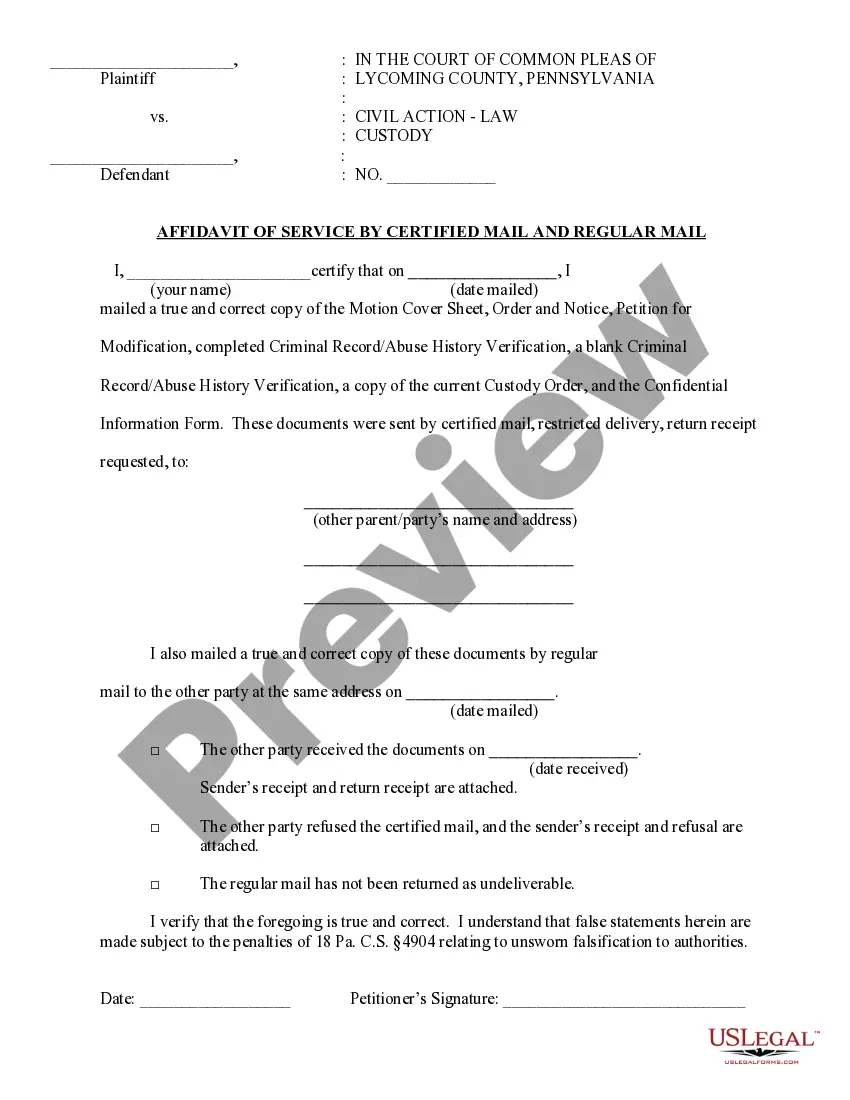
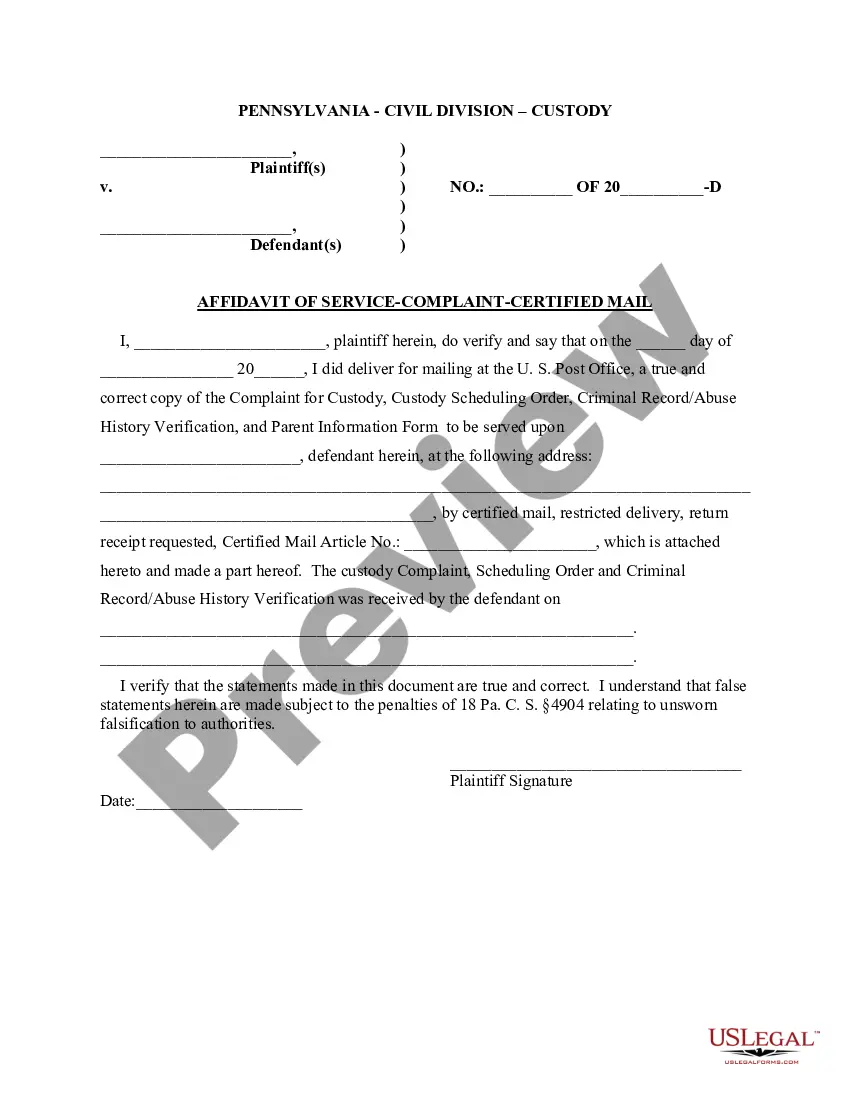
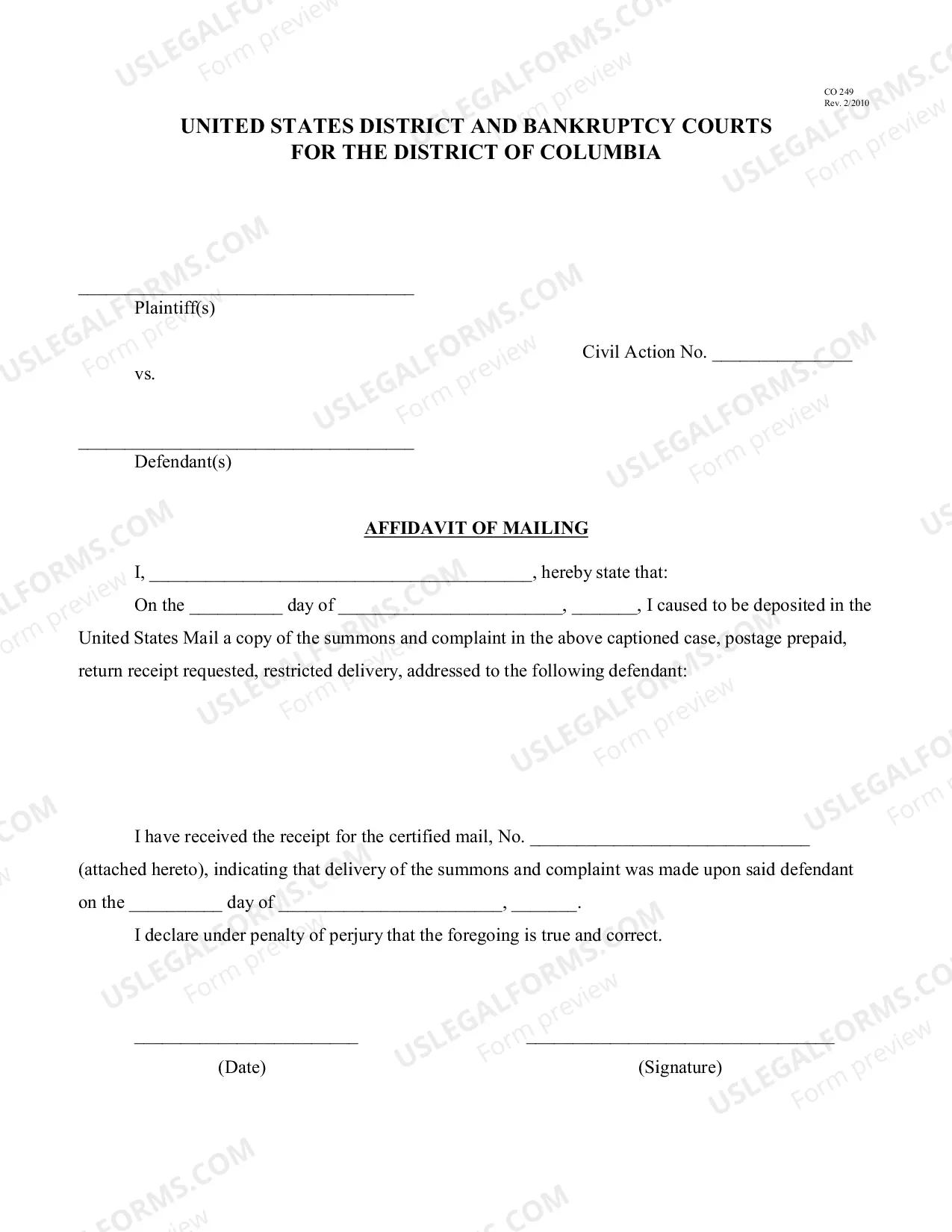
The Affidavit of Service by Certified Mail and Regular Mail is a legal document that certifies the delivery of important documents to an individual via both certified mail and regular mail. This form ensures that the recipient has been properly informed of legal actions, such as custody modifications, without requiring personal delivery. Using this affidavit is crucial for maintaining a clear record of service, which can be vital in custody disputes and other legal matters.
What’s included in this form
- Identification of the plaintiff and defendant.
- Details of the documents sent, including a Motion Cover Sheet and Custody Order.
- Confirmation of the mailing method using certified mail with return receipt.
- Option to indicate if the other party received the documents or refused delivery.
- Certification by the sender regarding the truthfulness of the information provided.
When to use this document
This form is necessary when you need to prove that legal documents have been delivered to an involved party, particularly in custody and family law cases. Use this affidavit to document the service of critical legal notices when personal delivery is not possible or practical. It is particularly useful if you suspect that the other party may deny receipt of the documents.
Who can use this document
This affidavit is intended for individuals engaged in legal proceedings related to custody or other civil matters in which proper notification is essential. Users typically include:
- Petitioners seeking to modify custody arrangements.
- Individuals responding to legal documents requiring notification.
- Attorneys representing clients in custody disputes.
How to prepare this document
- Enter your name and the date when the documents were mailed.
- List the names and addresses of the involved parties and the documents sent.
- Indicate whether the documents were received or refused, including the relevant dates.
- Attach the sender's receipt and return receipt as proof of service.
- Sign and date the affidavit, certifying its accuracy.
Is notarization required?
This form does not typically require notarization unless specified by local law. Ensure you check your jurisdiction's requirements to confirm.
Get your form ready online
Our built-in tools help you complete, sign, share, and store your documents in one place.
Make edits, fill in missing information, and update formatting in US Legal Forms—just like you would in MS Word.
Download a copy, print it, send it by email, or mail it via USPS—whatever works best for your next step.
Sign and collect signatures with our SignNow integration. Send to multiple recipients, set reminders, and more. Go Premium to unlock E-Sign.
If this form requires notarization, complete it online through a secure video call—no need to meet a notary in person or wait for an appointment.
We protect your documents and personal data by following strict security and privacy standards.

Make edits, fill in missing information, and update formatting in US Legal Forms—just like you would in MS Word.

Download a copy, print it, send it by email, or mail it via USPS—whatever works best for your next step.

Sign and collect signatures with our SignNow integration. Send to multiple recipients, set reminders, and more. Go Premium to unlock E-Sign.

If this form requires notarization, complete it online through a secure video call—no need to meet a notary in person or wait for an appointment.

We protect your documents and personal data by following strict security and privacy standards.
Avoid these common issues
- Failing to provide complete names and addresses of the parties involved.
- Not attaching the necessary receipts to verify mailing.
- Inaccurate or missing dates of mailing or receipt.
- Not ensuring the form is signed before submission.
Benefits of completing this form online
- Convenience of immediate downloading and filling out the form at your own pace.
- Editable fields allow for easy customization to fit individual case details.
- Reliability of professionally drafted content, ensuring compliance with legal standards.
Looking for another form?
Form popularity
FAQ
How to apply Choose the right forms. Family Law Act.Complete an affidavit or statement for each order you request.File the forms with a court clerk.Serve your application or claim.If you are filing an application, complete an Affidavit of Service for each applicant and respondent.Attend court.
The Affidavit of Service must be completed by the person who actually served the documents and must be sworn or affirmed before a Commissioner for Oaths, Justice of the Peace, or Notary Public, ensuring that all the required exhibits are attached to the Affidavit of Service.
If it is difficult or impossible to personally serve them, the court may allow you to serve in some other way such as: Recorded Mail (registered mail) to post the notice on their front door. through some other person who is in contact with them such as a co-worker or friend.
How to Fill Out Affidavit of Service PDFRun - YouTube YouTube Start of suggested clip End of suggested clip Done name of the recipient of the service. Address where it is served and the county. And state forMoreDone name of the recipient of the service. Address where it is served and the county. And state for item 7 enter the required. Information indicated below for item 8 mark the appropriate.
I, Name of document server, of Name of city/town, Alberta, SWEAR/AFFIRM THAT: I have personal knowledge of the following information, except where I state that it is based on information from another person, in which case, I believe that information to be true.
Affidavits consist of written statements, perhaps with documents attached as exhibits. The person signing the affidavit must swear (or affirm) to the truth of its contents. If properly sworn, filed and served on opposing parties, a court can accept the contents as evidence.