Pennsylvania Affidavit of Service- Complaint- Certified Mail
Overview of this form
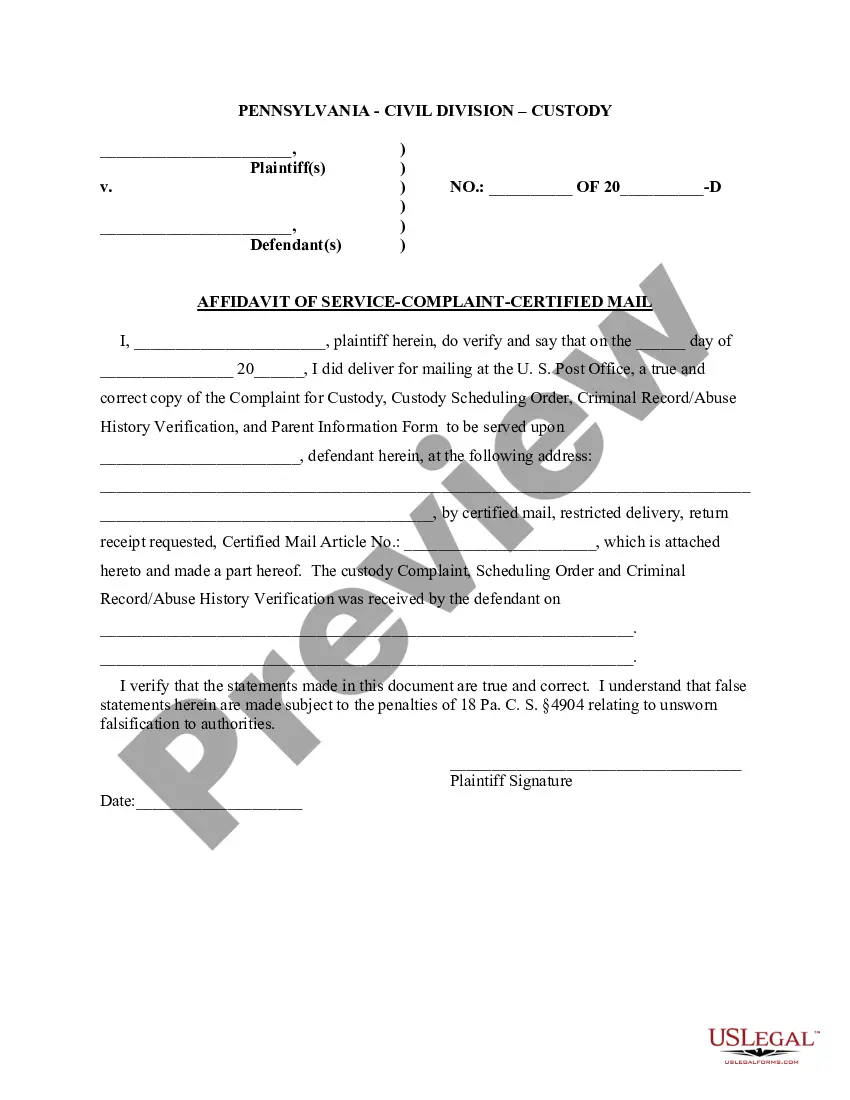
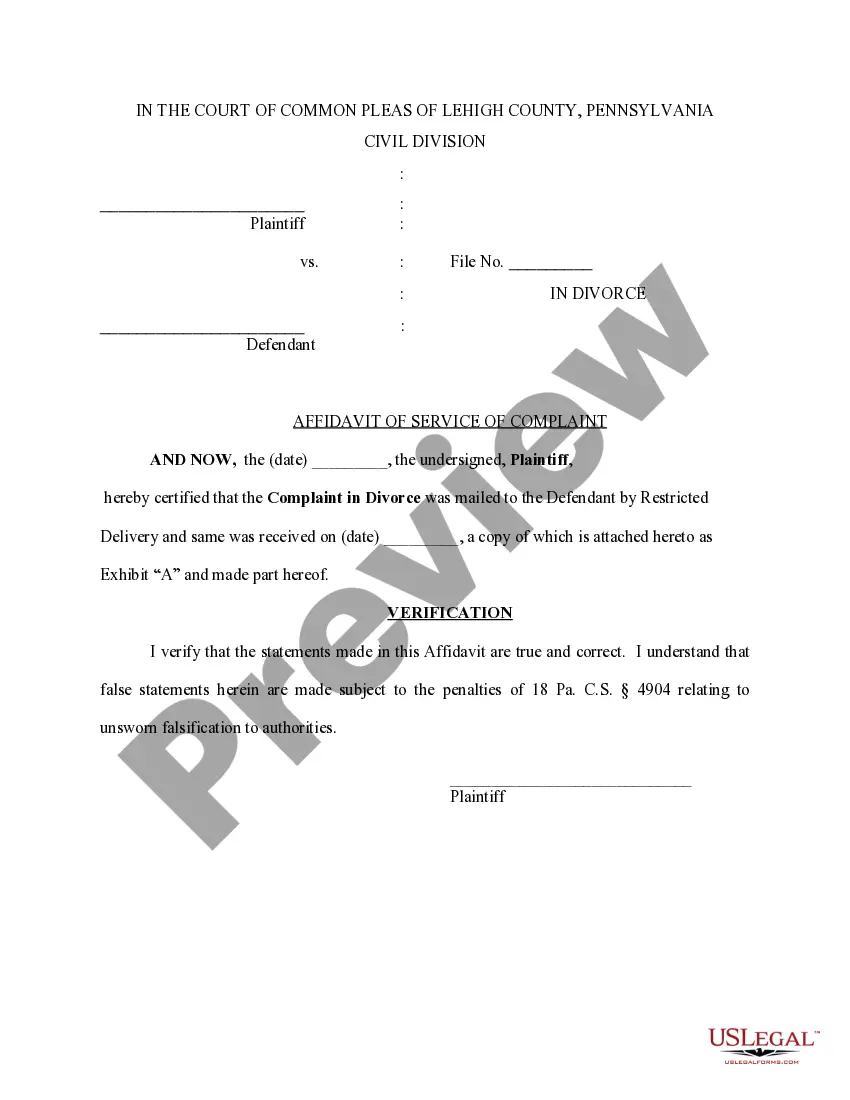
The Affidavit of Service - Complaint - Certified Mail is a legal document certifying that a plaintiff has successfully served a complaint to a defendant via certified mail. This form is specifically used in civil actions, particularly in cases of breach of contract. It is crucial as it serves as proof to the court that the defendant has been notified of the proceedings against them, which differs from other forms of service such as personal delivery or service by a process server.
Key parts of this document
- Identification of the plaintiff and defendant.
- Docket number of the civil case.
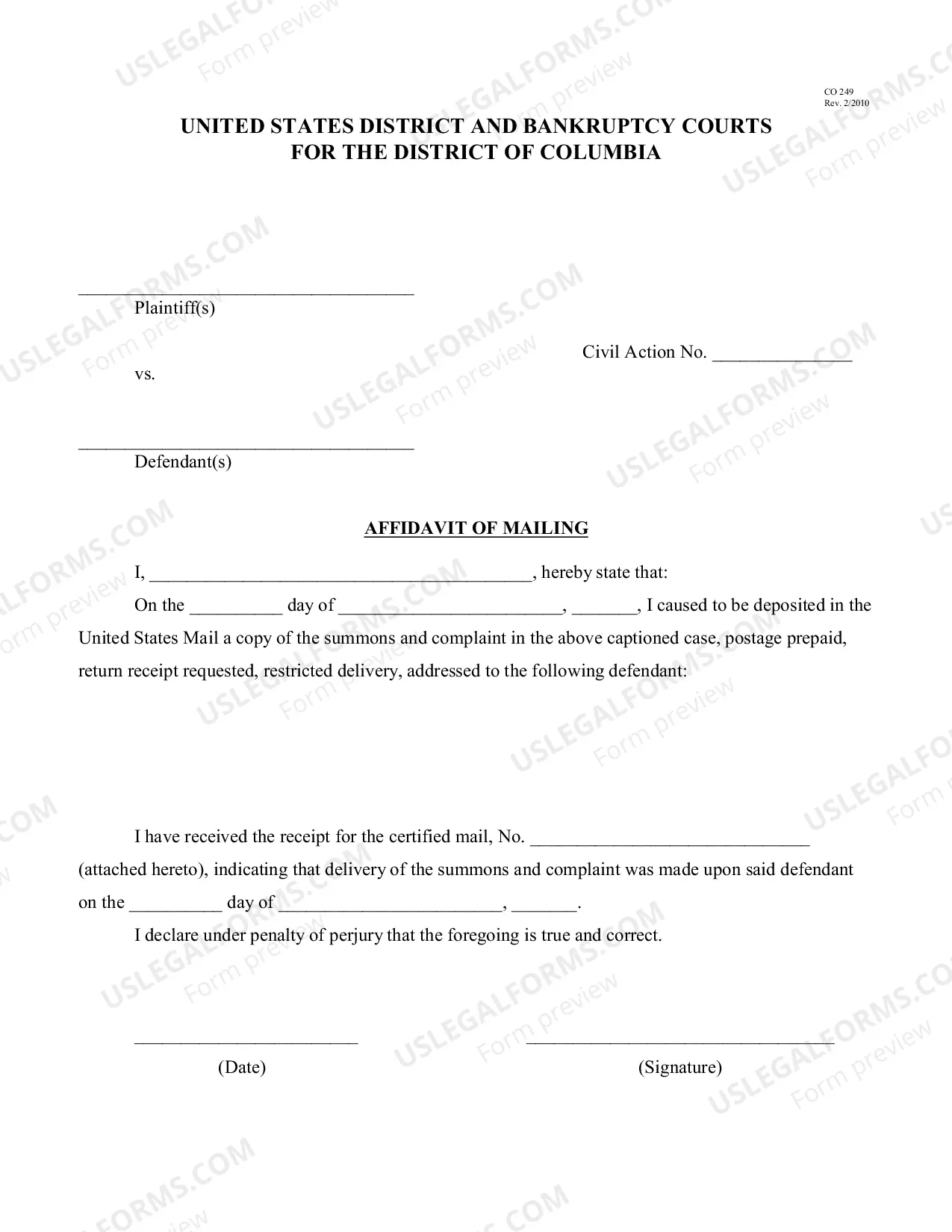
- Date of mailing the complaint via certified mail.
- Method of service including the certified mail article number.
- Signature of the plaintiff affirming the truth of the statements made.
Common use cases
This form should be used when a plaintiff needs to provide legal notice to a defendant regarding a complaint filed in court. It is particularly relevant in cases where the plaintiff has already filed a custody complaint and must prove that the defendant has been properly notified through certified mail. Utilizing this form helps ensure that proper legal protocol is followed to avoid delays in court proceedings.
Who should use this form
This form is intended for:
- Individuals acting as plaintiffs in civil court cases.
- People filing custody complaints against a defendant.
- Legal representatives of plaintiffs in civil actions.
How to complete this form
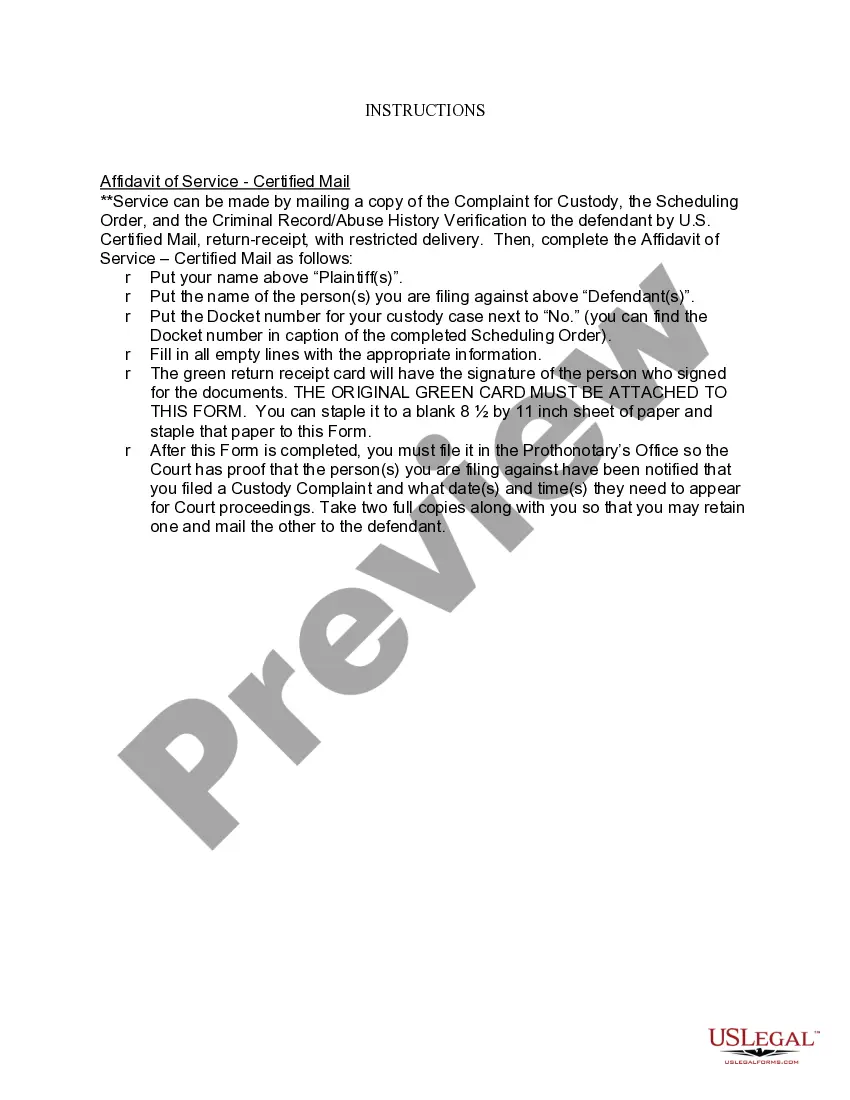
- Write your name as the plaintiff at the top of the form.
- Enter the defendant's name where indicated.
- Insert the docket number for your case next to 'NO.'
- Provide the date you mailed the complaint and the recipient's address.
- Attach the original green return receipt card to the completed form.
- File the completed affidavit in the Prothonotary's Office.
Notarization guidance
This form does not typically require notarization unless specified by local law. Ensure you check your jurisdiction's specific requirements to confirm.
Get your form ready online
Our built-in tools help you complete, sign, share, and store your documents in one place.
Make edits, fill in missing information, and update formatting in US Legal Forms—just like you would in MS Word.
Download a copy, print it, send it by email, or mail it via USPS—whatever works best for your next step.
Sign and collect signatures with our SignNow integration. Send to multiple recipients, set reminders, and more. Go Premium to unlock E-Sign.
If this form requires notarization, complete it online through a secure video call—no need to meet a notary in person or wait for an appointment.
We protect your documents and personal data by following strict security and privacy standards.

Make edits, fill in missing information, and update formatting in US Legal Forms—just like you would in MS Word.

Download a copy, print it, send it by email, or mail it via USPS—whatever works best for your next step.

Sign and collect signatures with our SignNow integration. Send to multiple recipients, set reminders, and more. Go Premium to unlock E-Sign.

If this form requires notarization, complete it online through a secure video call—no need to meet a notary in person or wait for an appointment.

We protect your documents and personal data by following strict security and privacy standards.
Typical mistakes to avoid
- Failing to attach the green return receipt card.
- Not filling in the docket number correctly.
- Signing the affidavit without dating it.
- Providing an incorrect address for the defendant.
Benefits of completing this form online
- Convenient access to legal documents from anywhere.
- Easy to complete and edit before printing.
- Reliable templates that comply with legal standards.
What to keep in mind
- The Affidavit of Service - Complaint - Certified Mail provides proof of legal notification to a defendant.
- It is essential for compliance in legal proceedings.
- Carefully follow the instructions to avoid common errors.
Looking for another form?
Form popularity
FAQ
The court order, accompanied by the complaint, should be sent by certified mail to the Department of State, return receipt requested. The statutory fee is $70.00 for each defendant to be served. You may reach the bureau by telephone by calling (717) 787-1057.
Code § 1021.76a - Entry of default judgment. (a) The Board, on motion of the plaintiff, may enter default judgment against the defendant for failure to file within the required time an answer to a complaint that contains a notice to defend.
Rule 1037. Judgment Upon Default or Admission. Assessment of Damages. (a) If an action is not commenced by a complaint, the prothonotary, upon praecipe praecipe of the defendant, shall enter a rule upon the plaintiff to file a complaint.
(a) Answers to complaints shall be filed with the Board within 30 days after the date of service of the complaint, unless for cause the Board, with or without motion, prescribes a different time. An answer will not be required in less than 10 days after date of service.
Rule 1037. Judgment Upon Default or Admission. Assessment of Damages. (a) If an action is not commenced by a complaint, the prothonotary, upon praecipe praecipe of the defendant, shall enter a rule upon the plaintiff to file a complaint.
Case law has imposed three requirements for opening a judgment by default: a petition timely filed, a reasonable explanation or legitimate excuse for the inactivity or delay and a showing of a meritorious defense.
Code § 237.5 - Form of Notice of Praecipe to Enter Judgment by Default. YOU ARE IN DEFAULT BECAUSE YOU HAVE FAILED TO ENTER A WRITTEN APPEARANCE PERSONALLY OR BY ATTORNEY AND FILE IN WRITING WITH THE COURT YOUR DEFENSES OR OBJECTIONS TO THE CLAIMS SET FORTH AGAINST YOU.
Pennsylvania judgments are valid for 5 years. Judgments can be revived every 5 years and should be revived if a creditor is attempting to actively collect on the debt. Judgments also act as a lien against real property for up to 20 years or longer if properly revived.