Possesing Contraband in Prison
What is this form?
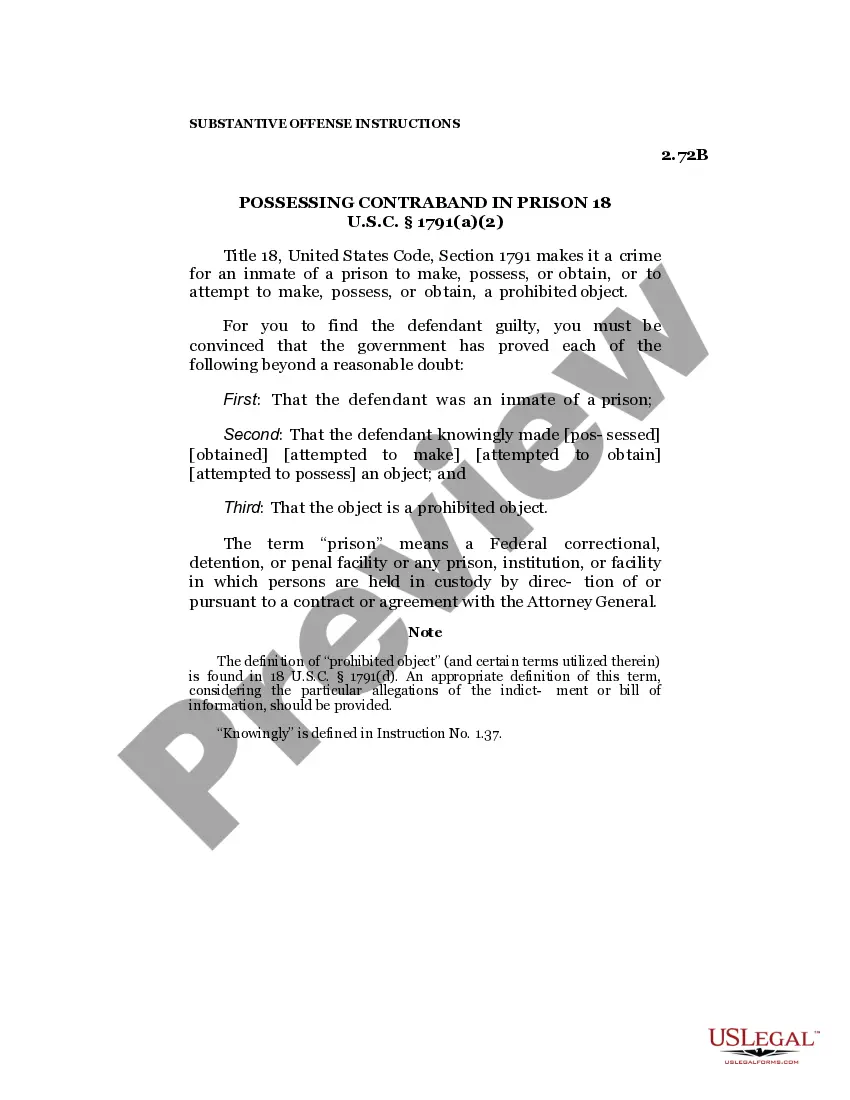
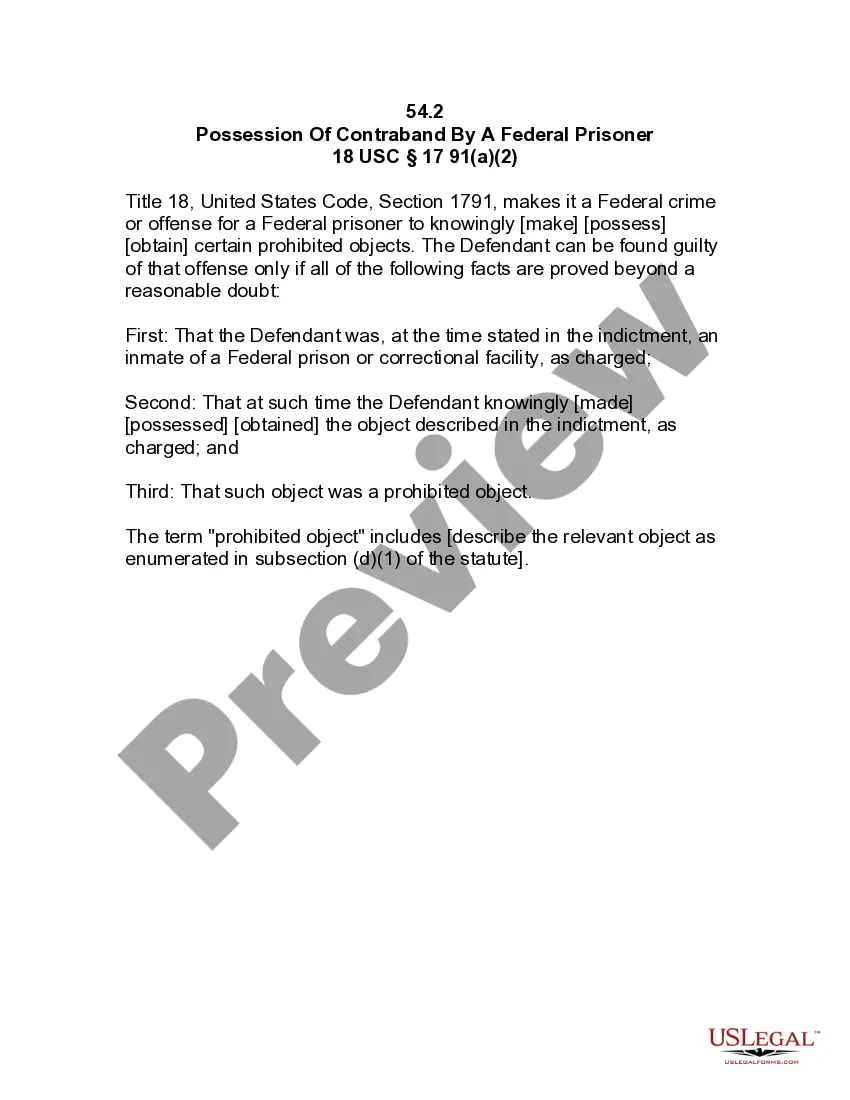
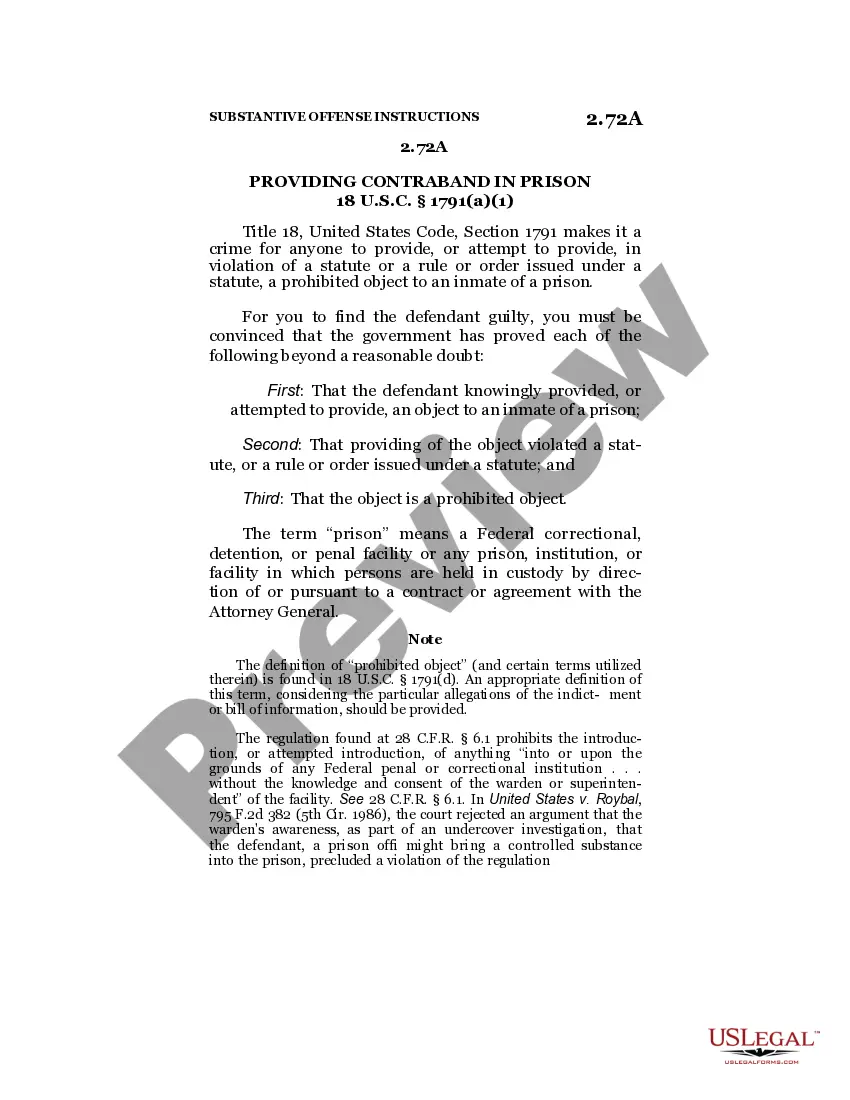
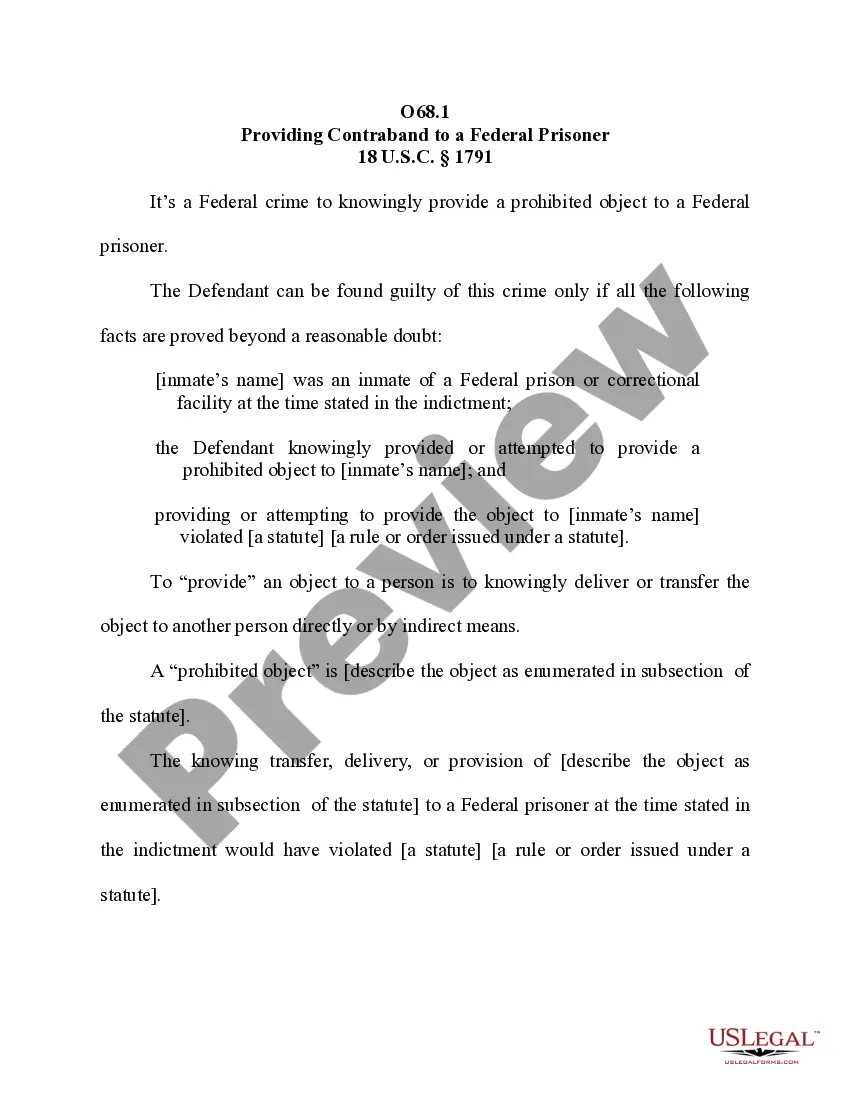
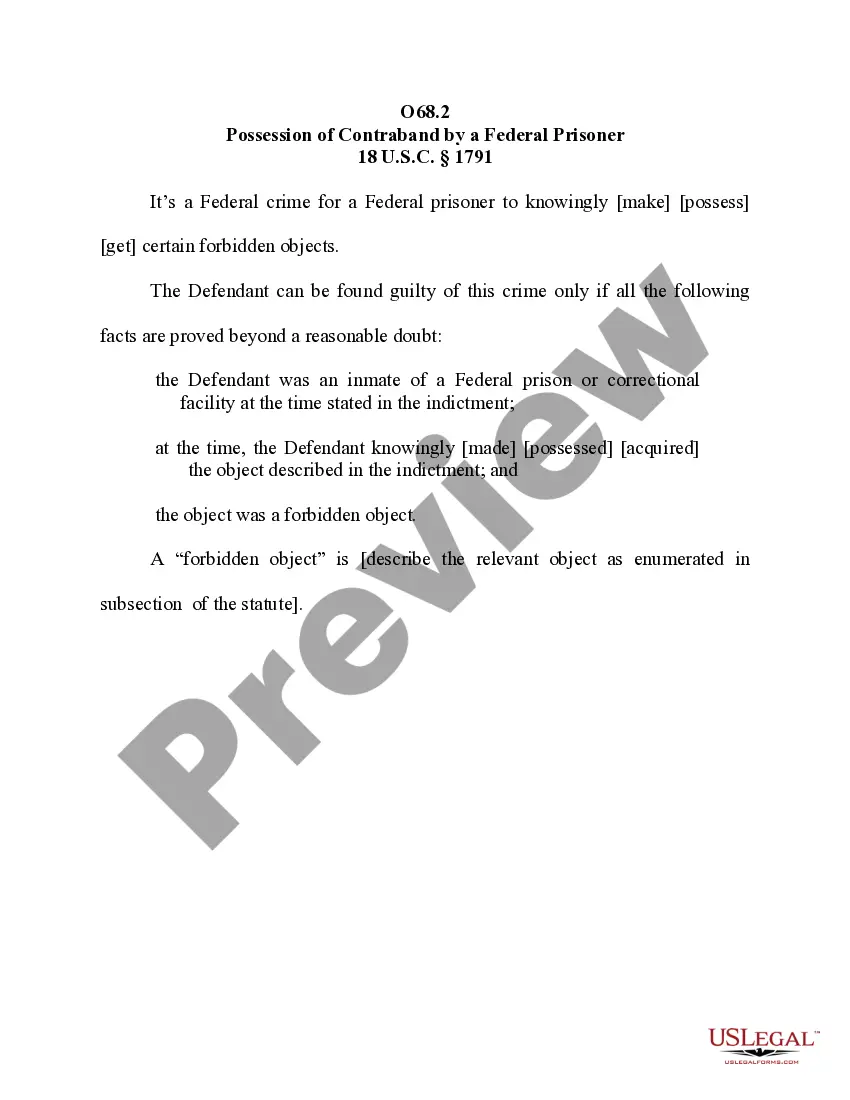
The "Possessing Contraband in Prison" form is a legal document that addresses the offense of possessing prohibited items while incarcerated. It outlines the essential elements required to establish guilt under Title 18, United States Code, Section 1791. This form is crucial for legal proceedings involving inmates facing charges related to contraband possession, setting it apart from general legal forms concerning unlawful possession that may not specifically address prison settings.
Main sections of this form
- Definition of the offense, including the meaning of "contraband" and "prison."
- Elements that must be proven to establish guilt, such as being a prison inmate.
- Clarification of what constitutes a "prohibited object."
- Instructions regarding the burden of proof required in these cases.
When this form is needed
This form is necessary when an inmate is charged with possessing contraband while in a correctional facility. It serves as both a defense tool for the accused and a guide for legal representatives preparing a case related to contraband laws. Situations where this form may be used include defense strategies during a trial or in pre-trial assessments.
Who needs this form
- Inmates facing charges related to contraband possession.
- Defense attorneys representing clients accused of this offense.
- Legal aid organizations assisting incarcerated individuals.
Instructions for completing this form
- Identify the defendant's status as an inmate.
- Establish the specific prohibited object involved in the case.
- Detail any evidence showing that the inmate knowingly possessed the object.
- Outline the circumstances surrounding the alleged offense.
- Provide any necessary legal arguments or defenses relevant to the situation.
Notarization guidance
This form does not typically require notarization to be legally valid. However, some jurisdictions or document types may still require it. US Legal Forms provides secure online notarization powered by Notarize, available 24/7 for added convenience.
Get your form ready online
Our built-in tools help you complete, sign, share, and store your documents in one place.
Make edits, fill in missing information, and update formatting in US Legal Forms—just like you would in MS Word.
Download a copy, print it, send it by email, or mail it via USPS—whatever works best for your next step.
Sign and collect signatures with our SignNow integration. Send to multiple recipients, set reminders, and more. Go Premium to unlock E-Sign.
If this form requires notarization, complete it online through a secure video call—no need to meet a notary in person or wait for an appointment.
We protect your documents and personal data by following strict security and privacy standards.

Make edits, fill in missing information, and update formatting in US Legal Forms—just like you would in MS Word.

Download a copy, print it, send it by email, or mail it via USPS—whatever works best for your next step.

Sign and collect signatures with our SignNow integration. Send to multiple recipients, set reminders, and more. Go Premium to unlock E-Sign.

If this form requires notarization, complete it online through a secure video call—no need to meet a notary in person or wait for an appointment.

We protect your documents and personal data by following strict security and privacy standards.
Mistakes to watch out for
- Failing to clearly define what constitutes contraband in the context of the case.
- Not providing sufficient evidence to show knowledge of possession.
- Overlooking specific state laws that could affect the case.
Benefits of using this form online
- Convenience of completing the form from any location.
- Editability to adjust details as needed before final submission.
- Access to templates that ensure compliance with legal standards.
Legal use & context
- This form is designed to support legal defenses against contraband possession charges under federal law.
- Understanding the definitions and statutes involved is crucial for accurate legal representation.
Summary of main points
- Possessing contraband in prison is a serious offense under federal law.
- Understanding the specific components of the law is essential for effective legal defense.
- This form can aid in structuring the defense and ensuring compliance with legal requirements.
Looking for another form?
Form popularity
FAQ
The effects of contraband on prison staff and the inmate population can be devastating. Weapons are used on other inmates and prison staff. Inmates die from bad drugs and overdoses. Rival prison drug kingpins and gangs fight for position, killing each other for power and money.
In addition, excessive accumulation of otherwise permissible items, such as items from the commissary, newspapers, toiletries, or food, is considered contraband.
Crimes Code based Contraband As such, if you are convicted or plead guilty to it, there is a maximum sentence of 10 years in jail and a maximum fine of $25,000.
A lawyer who brings contraband to an inmate not only commits a serious Felony Criminal offense, but also a serious ethical and moral lapse in judgment. Simply put, Introduction of Contraband is when a person knowingly brings a prohibited item into a jail or prison.
Contraband refers to items that are illegal to trade, carry, produce, or otherwise have in one's possession. Contraband may be goods that are illegal to import or export and are attempted to be smuggled into a country, or items that are banned from a facility. Contraband items are subject to seizure by officials.
Contraband in prisons includes alcohol, communication devices, drugs, drug paraphernalia, tattoo equipment, weapons and other items. Items that are prohibited may include everyday and seemingly innocent items that while not illegal, may be used inappropriately by prisoners.
Hard contraband includes any item that: 1) Is inherently dangerous, including but not limited to weapons (knives, Contraband 1 Page 2 guns, "zip-guns," ammunition, explosives, flammable liquids, brass knuckles, poison, etc.) 2) Is a tool or device that could be used to escape (rope, bolt cutters, keys, etc.)
Contraband in correctional facilities includes illegal items, such as drugs and weapons, or items prohibited in the area being monitored, such as cell phones. Prison staff needs to be able to detect and confiscate contraband quickly to prevent drug abuse, violence and the commission of further crimes.