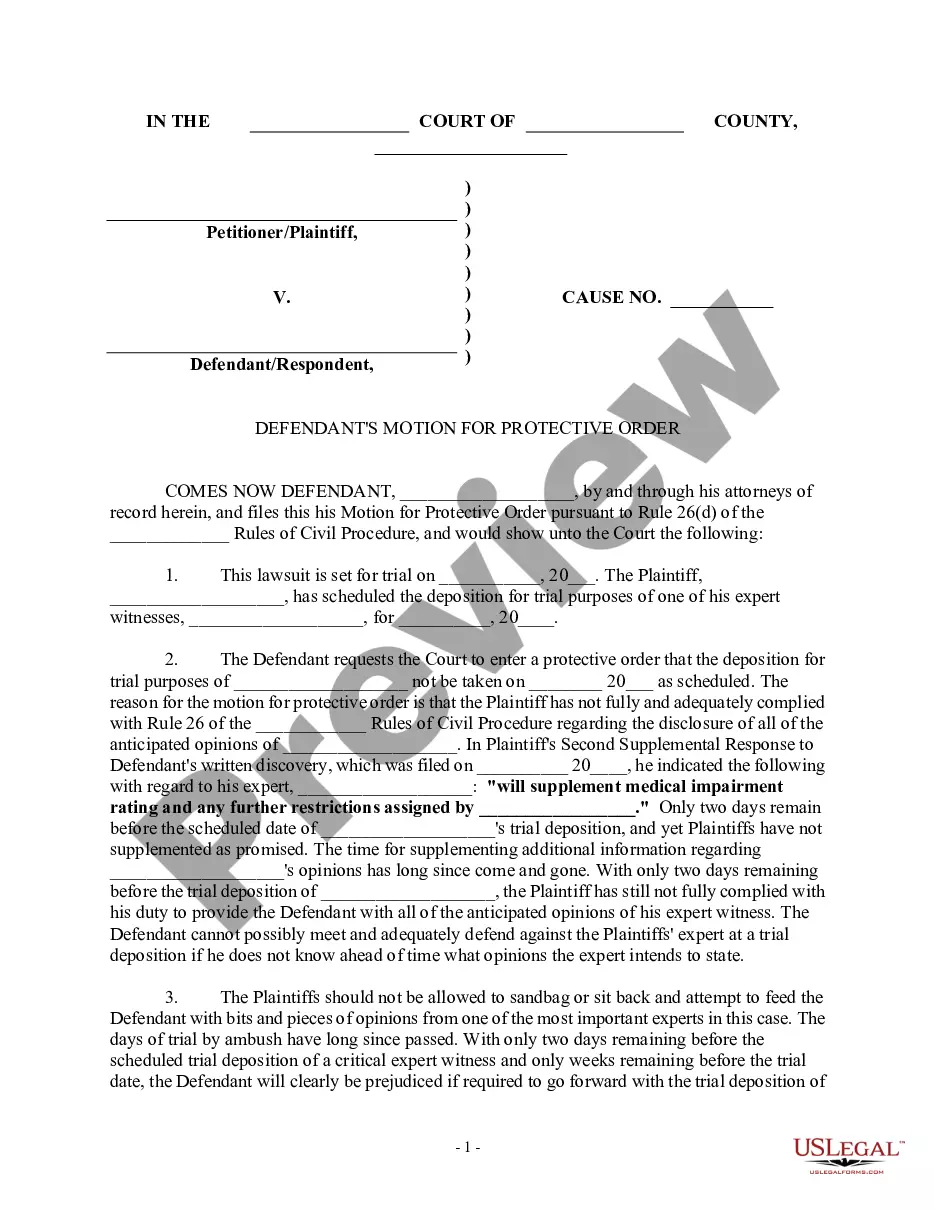
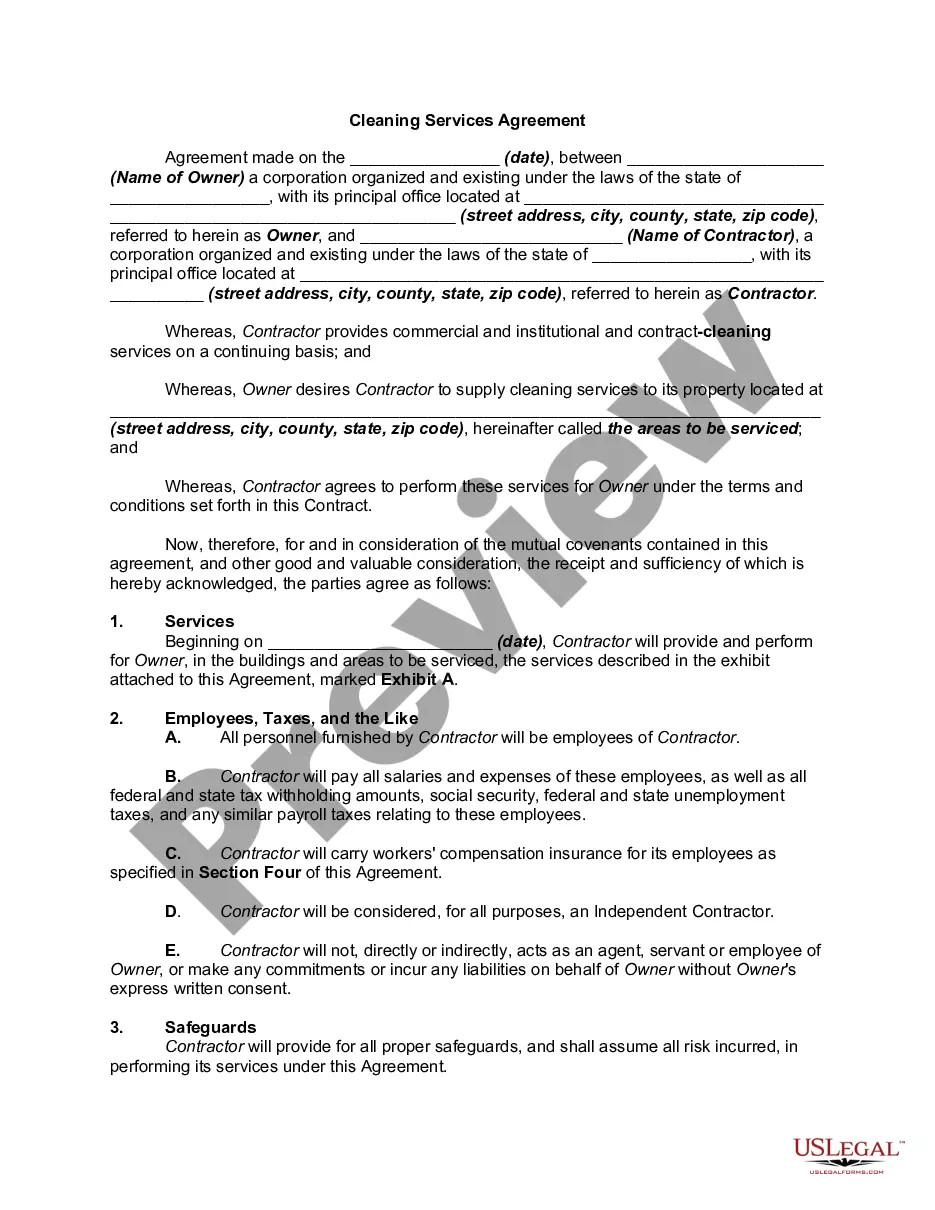
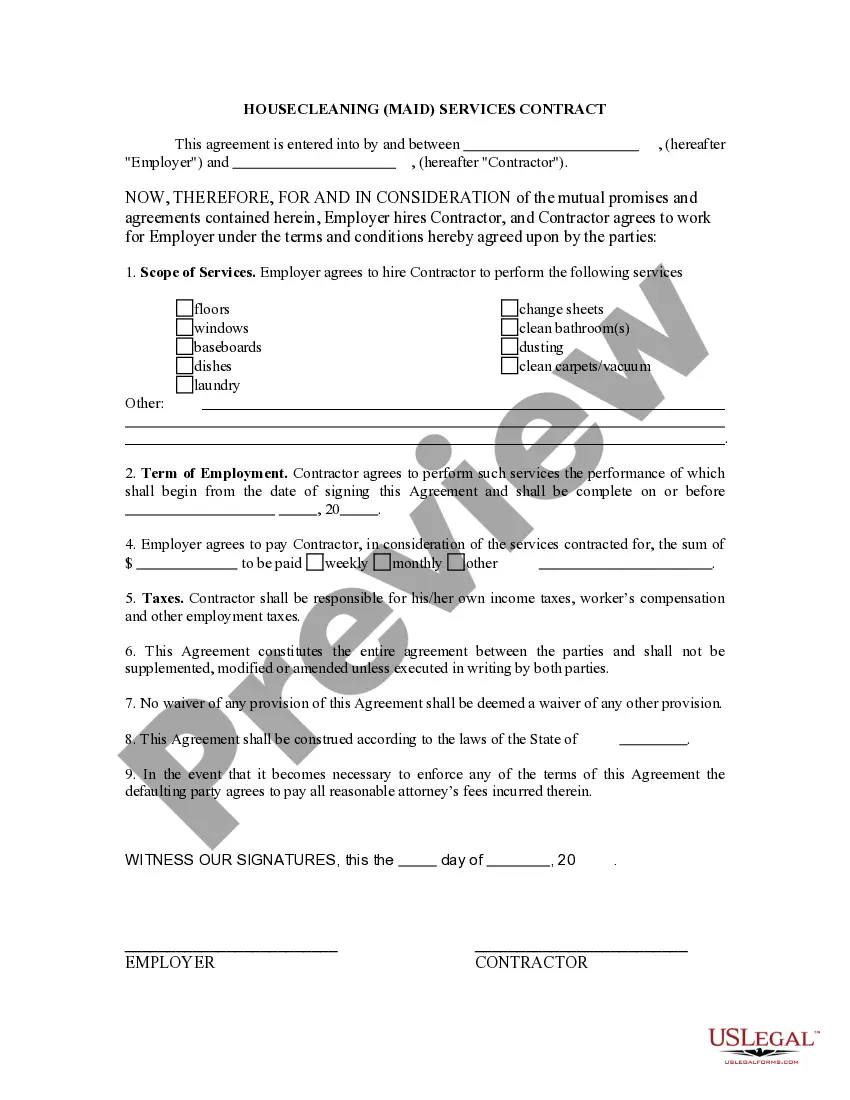
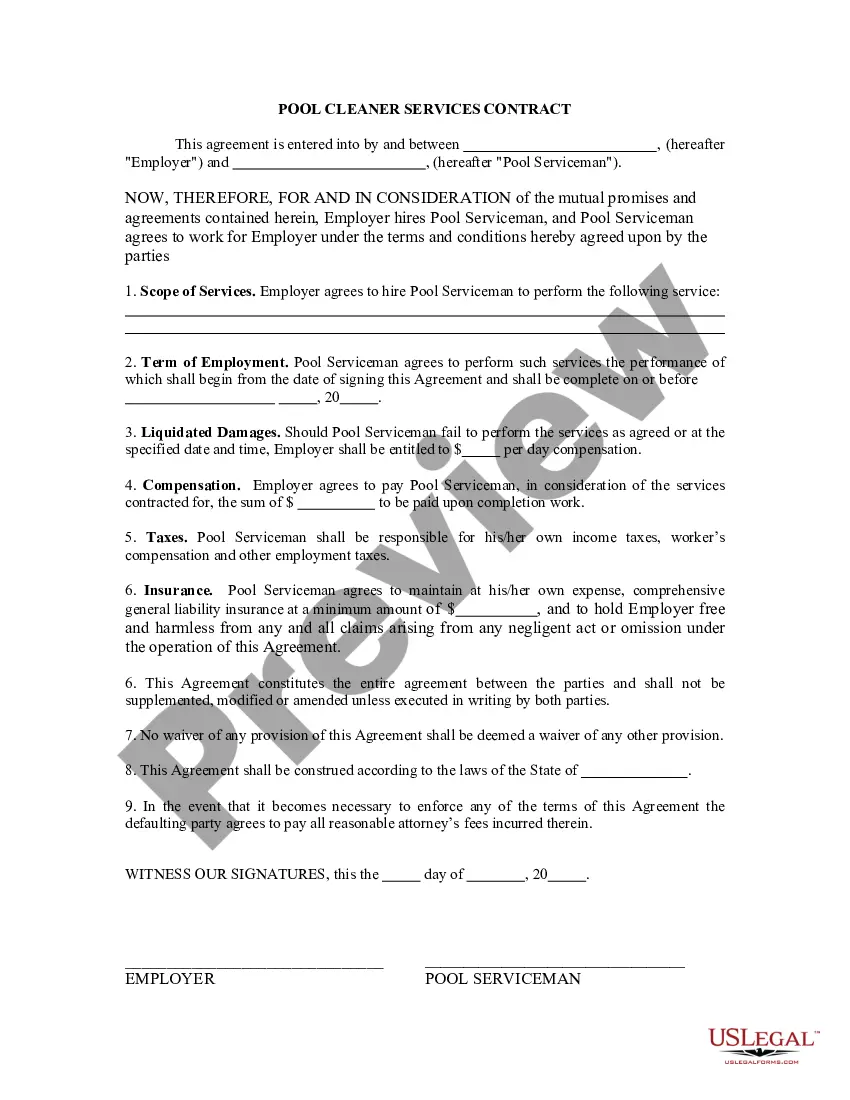
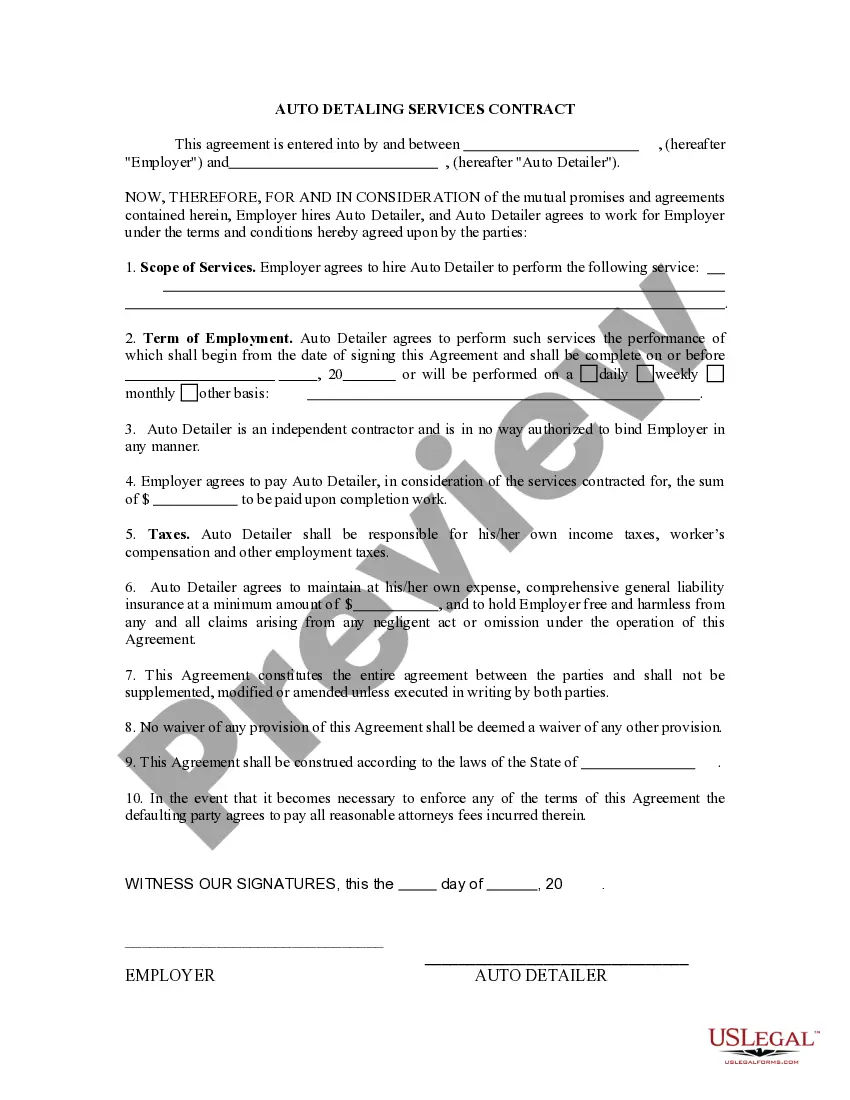
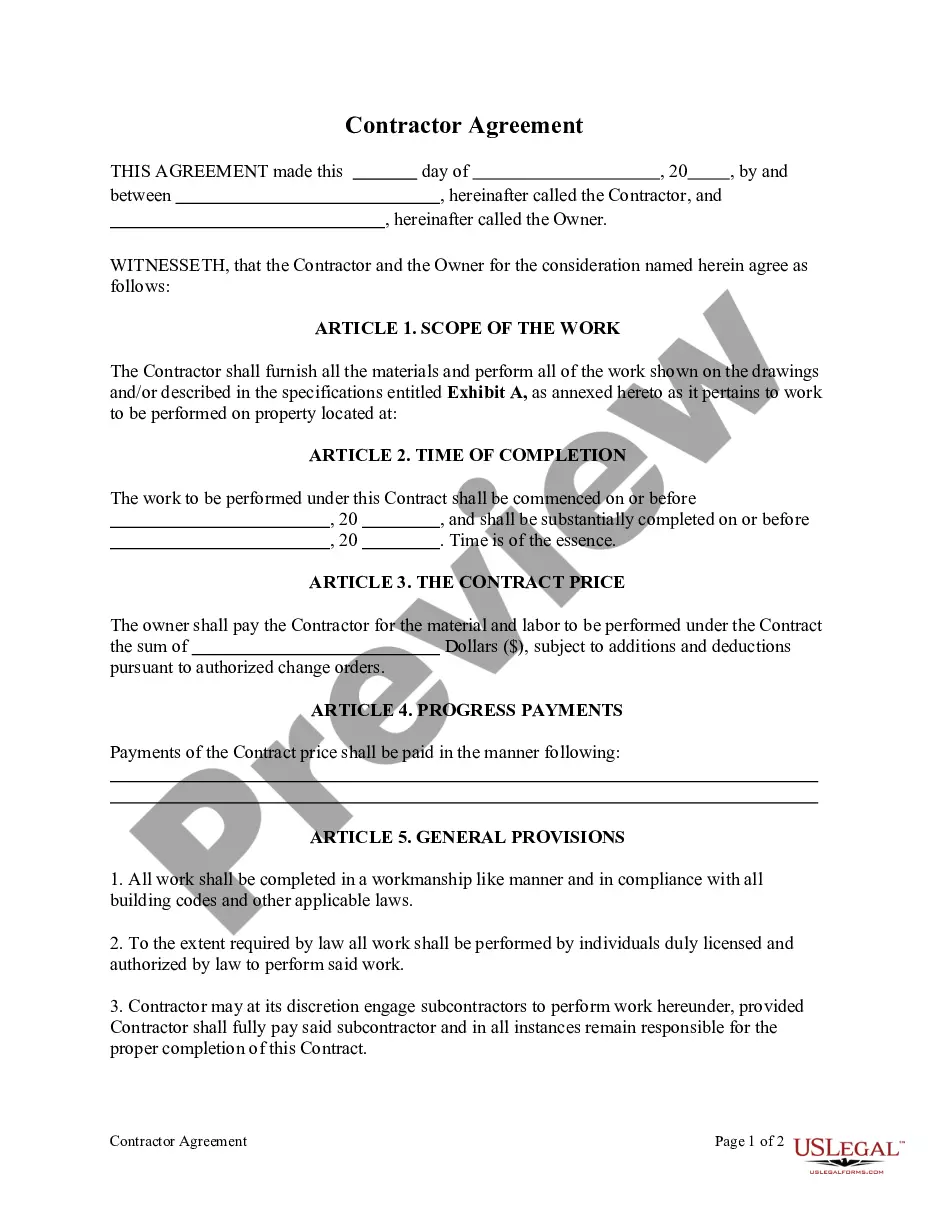
Employer hires a window washer as an independent contractor to perform window washing services as agreed to in the contract.
Oregon Self-Employed Window Washer Services Contract
State:
Multi-State
Control #:
US-INDC-213
Format:
Word;
Rich Text
Instant download
Description
Free preview

Get your form ready online
Our built-in tools help you complete, sign, share, and store your documents in one place.
Built-in online Word editor
Make edits, fill in missing information, and update formatting in US Legal Forms—just like you would in MS Word.
Export easily
Download a copy, print it, send it by email, or mail it via USPS—whatever works best for your next step.
E-sign your document
Sign and collect signatures with our SignNow integration. Send to multiple recipients, set reminders, and more. Go Premium to unlock E-Sign.
Notarize online 24/7
If this form requires notarization, complete it online through a secure video call—no need to meet a notary in person or wait for an appointment.
Store your document securely
We protect your documents and personal data by following strict security and privacy standards.

Make edits, fill in missing information, and update formatting in US Legal Forms—just like you would in MS Word.

Download a copy, print it, send it by email, or mail it via USPS—whatever works best for your next step.

Sign and collect signatures with our SignNow integration. Send to multiple recipients, set reminders, and more. Go Premium to unlock E-Sign.

If this form requires notarization, complete it online through a secure video call—no need to meet a notary in person or wait for an appointment.

We protect your documents and personal data by following strict security and privacy standards.
Looking for another form?







How to fill out Self-Employed Window Washer Services Contract?
US Legal Forms - one of the most important collections of legal documents in the United States - offers a variety of legal document templates that you can download or print. By using the website, you can access thousands of templates for business and personal purposes, organized by categories, states, or keywords. You can find the most recent versions of documents like the Oregon Self-Employed Window Washer Services Contract in just seconds.
If you already have a membership, Log In and retrieve the Oregon Self-Employed Window Washer Services Contract from the US Legal Forms library. The Download option will appear on every document you view. You have access to all previously saved documents within the My documents section of your account.
If you are using US Legal Forms for the first time, here are some simple steps to get started: Ensure you have selected the correct document for your city/region. Click the Review button to examine the document's details. Check the document summary to confirm you have picked the correct one. If the document does not suit your needs, utilize the Search bar at the top of the screen to find one that does. If you are satisfied with the document, confirm your choice by clicking the Purchase now button. Then, select the pricing plan you prefer and provide your credentials to register for the account. Complete the transaction. Use your credit card or PayPal account to finalize the transaction. Choose the format and download the document to your device. Make changes. Fill out, edit, print, and sign the saved Oregon Self-Employed Window Washer Services Contract.
- Every template you add to your account has no expiration date and is yours forever.
- So, if you wish to download or print another copy, simply visit the My documents section and click on the document you need.
- Access the Oregon Self-Employed Window Washer Services Contract with US Legal Forms, the largest collection of legal document templates.
- Utilize thousands of professional and state-specific templates that fulfill your business or personal requirements and needs.
- Find the right legal forms easily and efficiently.
- Get started with your legal documentation today.
Form popularity
FAQ
employed window cleaner can earn a variable income, depending on factors such as location, clientele, and services offered. On average, many window cleaners report earnings ranging from $25 to $75 per hour. Establishing an Oregon SelfEmployed Window Washer Services Contract can help dictate your rates and secure longterm clients, thereby enhancing your earning potential. Keep in mind that business growth often leads to increased revenue.
In Oregon, window washers might not need a specific license, but it's essential to check local regulations. Depending on your business model and services offered, you may need to secure a business license and comply with safety regulations. Having an Oregon Self-Employed Window Washer Services Contract in place not only protects you but also provides clarity in terms of compliance and service expectations. Always research local laws to ensure you operate legally.
Yes, window cleaning can be a profitable business, especially with a well-defined Oregon Self-Employed Window Washer Services Contract. This type of service often requires low startup costs and has a steady demand. By establishing a solid client base and maintaining high service quality, many window washers increase their earnings over time. Additionally, offering bundled services can further enhance profitability.
Creating a contract for cleaning services, such as an Oregon Self-Employed Window Washer Services Contract, starts with defining the scope of work. Include details like payment terms, service frequency, and conditions for termination. It's also essential to outline any liability and responsibilities to protect both parties. For a straightforward template, consider using services like uSlegalforms to simplify the process.
Projects that do not require a license from the CCB include gutter cleaning, power & pressure washing, debris clean up (yard or construction site), and handyman work on projects with a contract value of $1,000 or less.
You have to pass the state exam, obtain the right insurance and bond, and attend classroom education. You can apply to the CCB for your license after that. You have to finish 16 hours of classroom training in construction and contracting laws and regulations that apply in Oregon.
There is no 'handyman license' in Oregon. However, there are limitations on the jobs you can perform without a contractor's license. To qualify for the exemption, a handyman contractor can only perform work that is casual, minor, or inconsequential.
(1) Residential General Contractor. A licensee holding this endorsement may bid or perform work involving an unlimited number of unrelated building trades or crafts on residential or small commercial structures. (2) Residential Specialty Contractor.
Projects that do not require a license from the CCB include gutter cleaning, power & pressure washing, debris clean up (yard or construction site), and handyman work on projects with a contract value of $1,000 or less.
The threshold for performing certain work without a contractor license increased from $500 to $1,000. To qualify for the exemption, a contractor must perform work that is casual, minor or inconsequential. This means that the work cannot: Be structural in nature.