Affidavit by Victim for Dismissal
Overview of this form
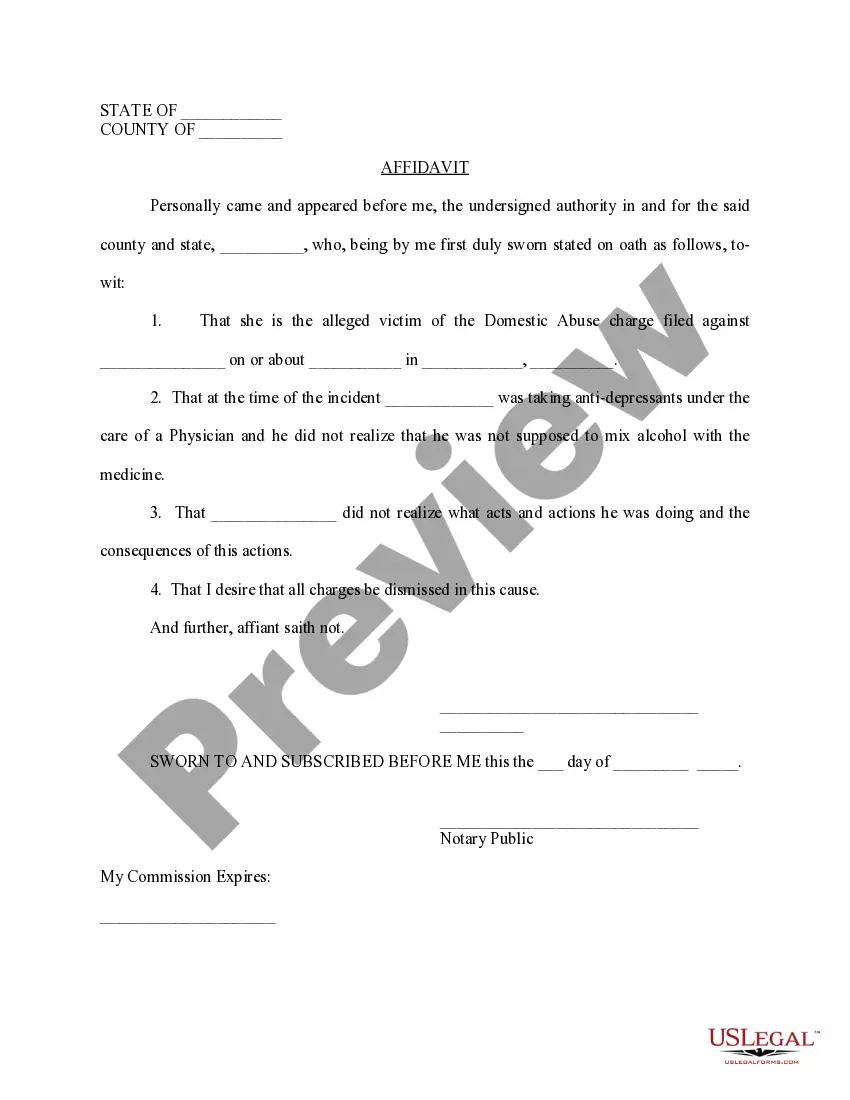
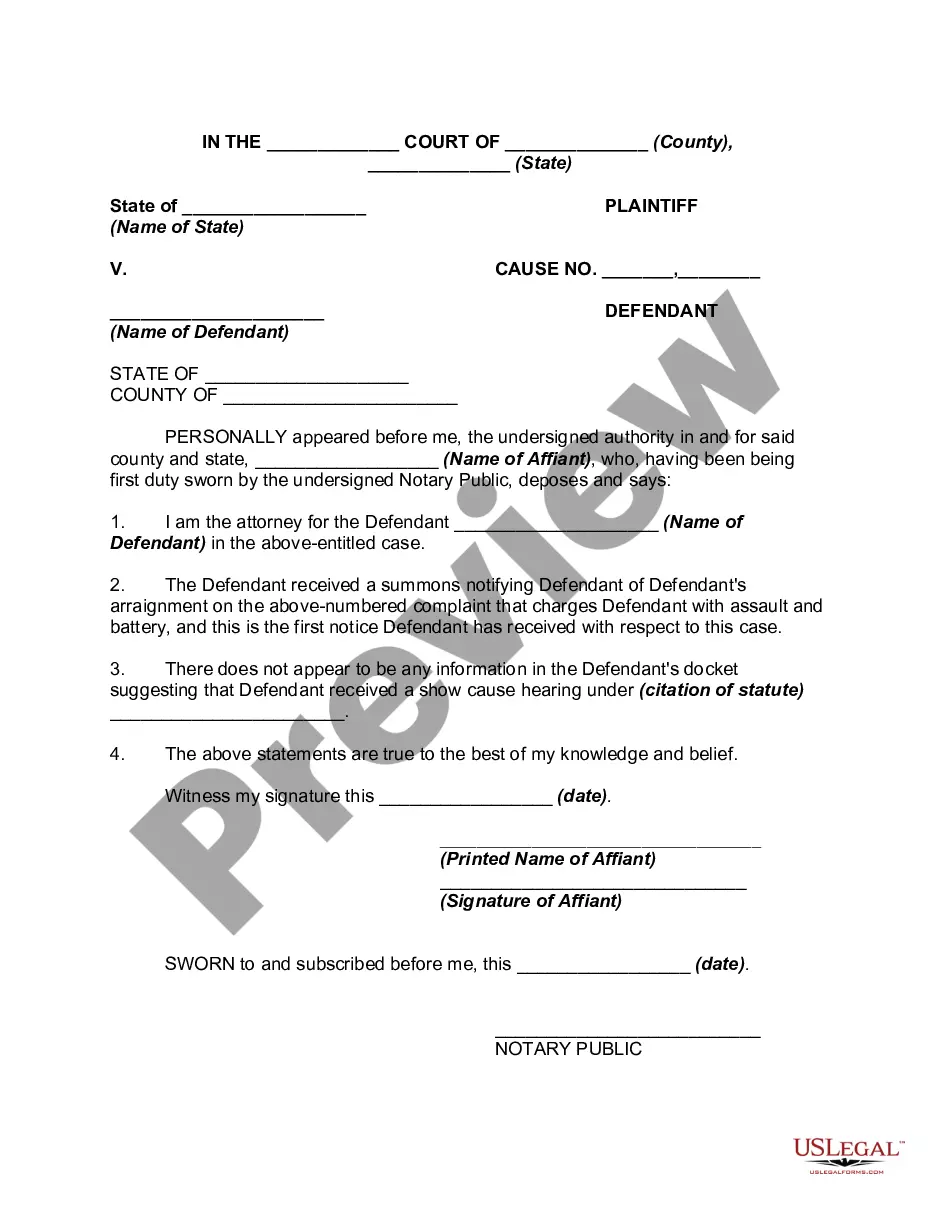
The Affidavit by Victim for Dismissal is a legal document that enables an alleged victim of domestic abuse to request the dismissal of charges against the accused. It asserts that the accused was unaware of their harmful actions due to the influence of medication, specifically indicating that they mixed it with alcohol unwittingly. This form is essential for individuals seeking to resolve legal challenges related to domestic abuse allegations without further court intervention.
What’s included in this form
- Identification of the victim and accused, including names and the nature of the charges.
- Details of the incident, including circumstances surrounding the actions of the accused.
- Affidavit statement confirming the victim's desire for dismissal of charges.
- Signature of the victim and a notary public verifying the affidavit.
Common use cases
This form is used when an alleged victim of domestic abuse believes that the accused was not fully aware of their actions due to the effects of medication and alcohol. It is typically applicable when the victim wishes to formally express their intent to dismiss the case, suggesting that the circumstances of the incident do not warrant legal consequences.
Who should use this form
This form is intended for:
- Individuals who are alleged victims in domestic abuse cases.
- Parties seeking to dismiss charges against an accused individual due to mitigating circumstances.
- Individuals who wish to provide a sworn statement regarding the incident in question.
Completing this form step by step
- Identify the parties involved by filling in the names of the victim and the accused.
- Specify the date and location of the alleged incident.
- Document the circumstances of the incident, highlighting the medication and alcohol involved.
- Clearly state your desire for the dismissal of charges.
- Sign the affidavit in the presence of a notary public.
Does this document require notarization?
Notarization is required for this form to take effect. Our online notarization service, powered by Notarize, lets you verify and sign documents remotely through an encrypted video session, available 24/7.
Get your form ready online
Our built-in tools help you complete, sign, share, and store your documents in one place.
Make edits, fill in missing information, and update formatting in US Legal Forms—just like you would in MS Word.
Download a copy, print it, send it by email, or mail it via USPS—whatever works best for your next step.
Sign and collect signatures with our SignNow integration. Send to multiple recipients, set reminders, and more. Go Premium to unlock E-Sign.
If this form requires notarization, complete it online through a secure video call—no need to meet a notary in person or wait for an appointment.
We protect your documents and personal data by following strict security and privacy standards.

Make edits, fill in missing information, and update formatting in US Legal Forms—just like you would in MS Word.

Download a copy, print it, send it by email, or mail it via USPS—whatever works best for your next step.

Sign and collect signatures with our SignNow integration. Send to multiple recipients, set reminders, and more. Go Premium to unlock E-Sign.

If this form requires notarization, complete it online through a secure video call—no need to meet a notary in person or wait for an appointment.

We protect your documents and personal data by following strict security and privacy standards.
Common mistakes
- Failing to include all necessary information, such as dates and specific details of the incident.
- Not obtaining notarization, which may be required for the affidavit to be legally binding.
- Using vague language that does not clearly express the request for dismissal.
Advantages of online completion
- Convenient access to legal forms from anywhere without time constraints.
- Editability allows for easy adjustments based on individual circumstances.
- Reliability of forms drafted by licensed attorneys, ensuring legal compliance.
Looking for another form?
Form popularity
FAQ
If you withdraw your statement, the case might still go to court if the police think they have enough evidence to prosecute the suspect. If you want to withdraw your statement because you're worried about giving evidence, you should tell the police how you feel.
Alex Watts : You can not retract because the statement is true. A retraction is where you say you made everything up. What you can do is provide a statement saying that you no longer support the prosecution. However in domestic violence cases the matter will still proceed - very rarely do the Police drop a case.
In the sentence, the person writing the statement must state that he or she is stating that the information is accurate. (Example: I, Jane Doe, solemnly swear that the contents of this document are true and correct, and that I agree to abide by the terms in this affidavit.)
Title the affidavit. First, you'll need to title your affidavit. Craft a statement of identity. The very next section of your affidavit is what's known as a statement of identity. Write a statement of truth. State the facts. Reiterate your statement of truth. Sign and notarize.
But people should know that, even if a statement gets recanted: a prosecutor can still file criminal charges against a defendant, and. if a person recants a statement because it was false or a lie, that person could face criminal consequences.
The State of Texas does not mandate a formal procedure for the filing of an affidavit of non-prosecution. Instead, the prosecutor's office might offer a generic form that communicates an assault victim's wish to have a criminal case dismissed or the request not to testify against the defendant at an upcoming trial.
First, it is possible for the victim to recant their testimony. This is done when they want to change what they told police officers or want to withdraw the statement completely. Second, the victim recanting their statement or even refusing to testify in court isn't going to get the case dropped.
Once a 911 call is placed, there is no turning back Even if the alleged victim of domestic violence recants the allegations that you committed domestic violence, it will not matter to the prosecutor. The prosecutor's office could still file misdemeanor or felony criminal charges against you.
Try to directly persuade a prosecutor that a charge should be dropped, cast doubt on an accuser, highlight conflicting evidence, and. provide a reality check on the potential success of brining a charge.