Oregon Defendants Answer
About this form
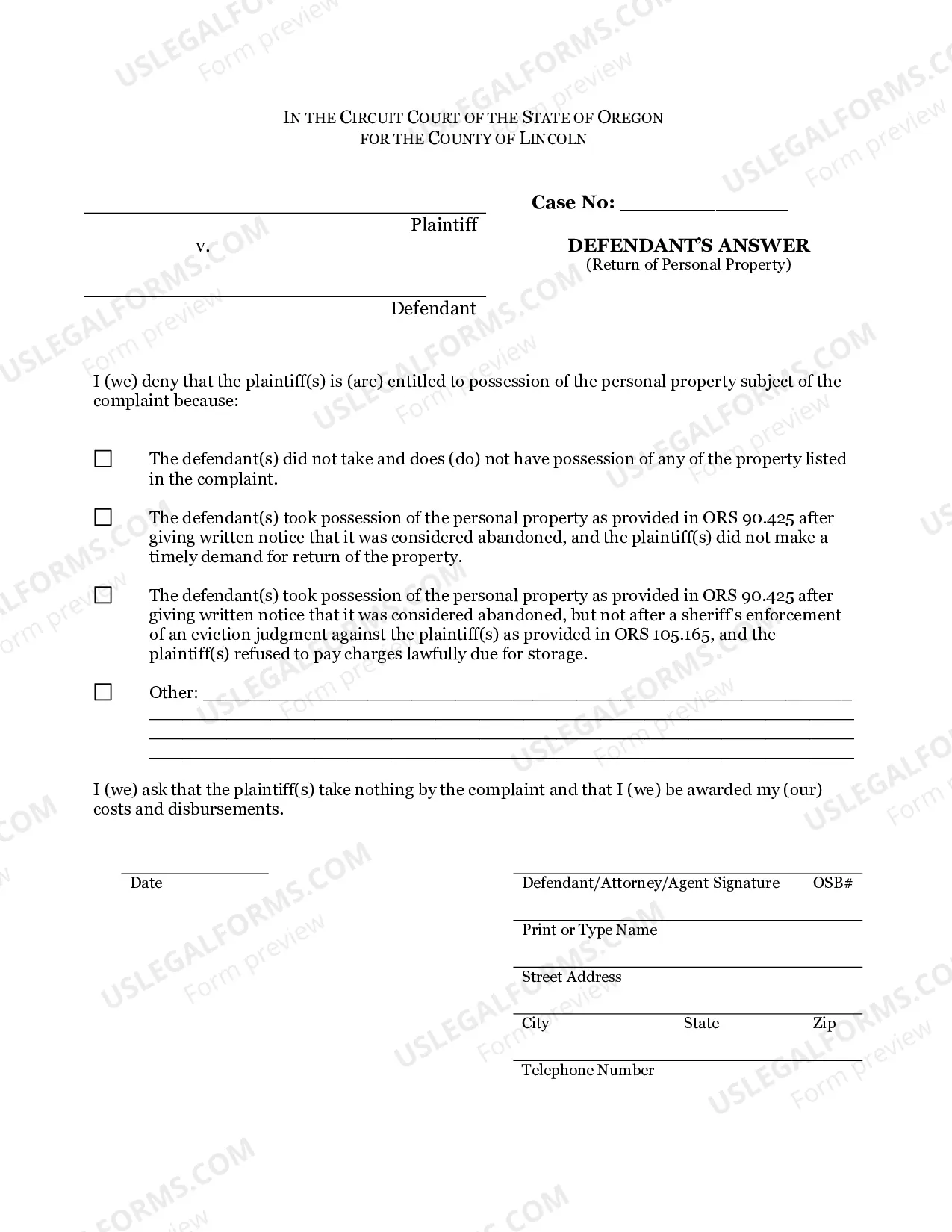
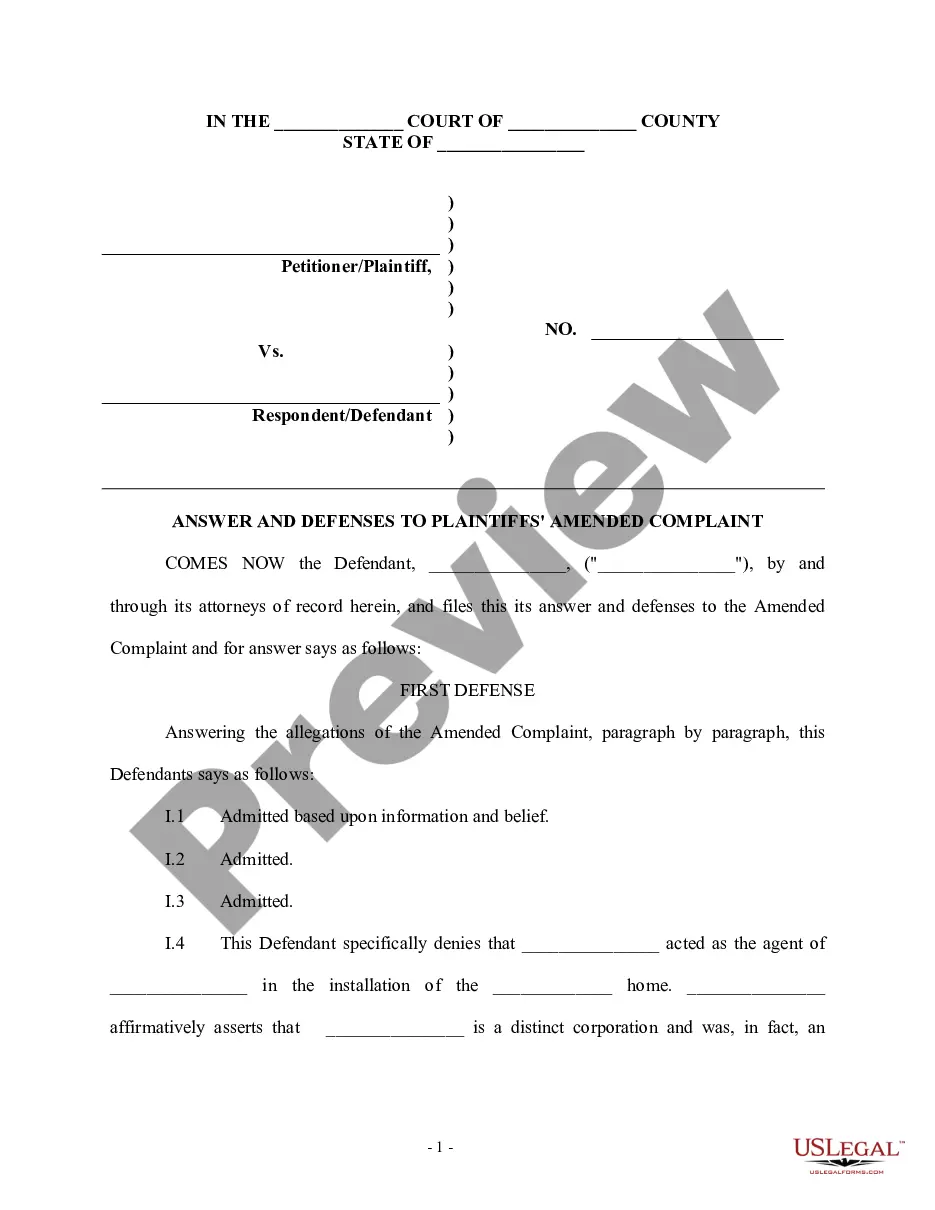
The Defendant's Answer form is a legal document used in response to a plaintiff's complaint regarding the possession of personal property. This form allows the defendant to assert their rights and defenses against the claims made by the plaintiff. It differs from other legal forms, such as a counterclaim, because it addresses the specific issue of possession and the conditions that justify the defendant's stance on ownership or retention of the property in question.
Key components of this form
- Case information: Includes fields for the case number and parties involved.
- Response to complaint: Details the defendant's denial of the plaintiff's claims regarding property possession.
- Legal grounds: Enumerates specific reasons for denying the plaintiff's entitlement, referencing relevant Oregon statutes.
- Request for costs: Allows the defendant to request reimbursement for costs incurred related to the complaint.
- Signature block: Contains spaces for the defendantâs or their attorneyâs signature and contact information.
Common use cases
This form is typically used in cases where a plaintiff has filed a complaint seeking possession of personal property, and the defendant wishes to assert their right to keep the property. Scenarios may include disputes over rental property, claims for stolen items, or cases involving property considered abandoned. If the defendant believes they have legally acquired the property or the plaintiff's claim is unfounded, this form is essential for communicating their defense to the court.
Who can use this document
- Individuals or entities named as defendants in a possession lawsuit.
- Landlords responding to claims from former tenants regarding personal property left behind.
- Anyone who believes they have a legal right to retain property allegedly owned by another party.
- Legal representatives of defendants looking to present their clients' arguments in court.
How to prepare this document
- Identify the parties involved by entering the names of the plaintiff and defendant, along with the case number.
- Clearly state your denial of the plaintiff's claims, citing your reasons for retaining possession of the property.
- If applicable, reference the Oregon statutes justifying your defense.
- Include a request for costs and disbursements if you seek reimbursement from the plaintiff.
- Sign the form and provide your contact details, including a phone number and address.
Is notarization required?
This form does not typically require notarization unless specified by local law. However, it is advisable to check local jurisdiction rules to confirm any additional requirements.
Get your form ready online
Our built-in tools help you complete, sign, share, and store your documents in one place.
Make edits, fill in missing information, and update formatting in US Legal Forms—just like you would in MS Word.
Download a copy, print it, send it by email, or mail it via USPS—whatever works best for your next step.
Sign and collect signatures with our SignNow integration. Send to multiple recipients, set reminders, and more. Go Premium to unlock E-Sign.
If this form requires notarization, complete it online through a secure video call—no need to meet a notary in person or wait for an appointment.
We protect your documents and personal data by following strict security and privacy standards.

Make edits, fill in missing information, and update formatting in US Legal Forms—just like you would in MS Word.

Download a copy, print it, send it by email, or mail it via USPS—whatever works best for your next step.

Sign and collect signatures with our SignNow integration. Send to multiple recipients, set reminders, and more. Go Premium to unlock E-Sign.

If this form requires notarization, complete it online through a secure video call—no need to meet a notary in person or wait for an appointment.

We protect your documents and personal data by following strict security and privacy standards.
Common mistakes to avoid
- Failing to provide a case number or accurate party names, which can lead to dismissal of the response.
- Not clearly stating the defense or legal grounds for the denial, which may weaken your position.
- Omitting the signature or providing incomplete contact information.
- Not filing the form by the court's deadline, leading to default judgment against the defendant.
Benefits of using this form online
- Convenience of immediate access without needing to visit a legal office.
- Editability allows users to customize the form according to their specific case needs.
- Reliable templates drafted by licensed attorneys ensure compliance with legal standards.
- Instant download capability for quick submission to the court.
Legal use & context
- This form is legally recognized in Oregon for responding to personal property claims.
- It provides a structured method for defendants to assert their rights legally.
- Properly completing this form can help prevent default judgments in property possession cases.
Quick recap
- The Defendants Answer form is vital for legally contesting property possession claims.
- Proper completion ensures the defendant's arguments are formally recognized in court.
- Utilizing this form can result in cost recovery and protection of personal property rights.
Looking for another form?

Form popularity
FAQ
The defendant's response to a complaint is called the answer. The answer contains the defendant's version of the events leading to the lawsuit and may be based on the contents of the complaint. The filing of the answer is one option that the defendant has in deciding how to respond to the complaint.
Summons shall be served, either within or without this state, in any manner reasonably calculated, under all the circumstances, to apprise the defendant of the existence and pendency of the action and to afford a reasonable opportunity to appear and defend.
Not more than 30 days after motion is filed and served; the court shall issue a decision within 10 days after the hearing. If no decision is issued within 10 days, the motion shall be considered denied.
Clerical mistakes in judgments, orders, or other parts of the record and errors therein arising from oversight or omission may be corrected by the court at any time on its own motion or on the motion of any party and after such notice to all parties who have appeared, if any, as the court orders.
In law, an answer refers to a defendant's first formal written statement to a plaintiff's initial petition or complaint. This opening written statement will admit or deny the allegations, or demand more information about the claims of wrongdoing.
ORCP 21 D Motion to Make More definite and certain: Use ORCP 21 D to ?require the pleading to be made definite and certain by amendment when the allegations of a pleading are so indefinite or uncertain that the precise nature of the charge, defense, or reply is not apparent.? See Stewart v.
In Oregon, a party must respond to a summons and complaint within 30 days from the date of service (Or. R. Civ. P.
A party may make one motion to dismiss for lack of jurisdiction over the person or insufficiency of summons or process or insufficiency of service of summons or process without consolidation of defenses required by this section.