Oregon Alternative Form of Service
What this document covers
The Alternative Form of Service is a legal document designed for individuals involved in domestic litigation in Oregon, specifically for cases like divorce, custody, or visitation. This form allows a person to request the court's permission to utilize alternative methods of service when traditional service methods are unsuccessful. It differs from standard service forms by focusing on situations where the other party cannot be readily located or served using conventional means.
Form components explained
- Affidavit in Support of Motion for Alternative Form of Service: This document establishes the need for alternative service methods.
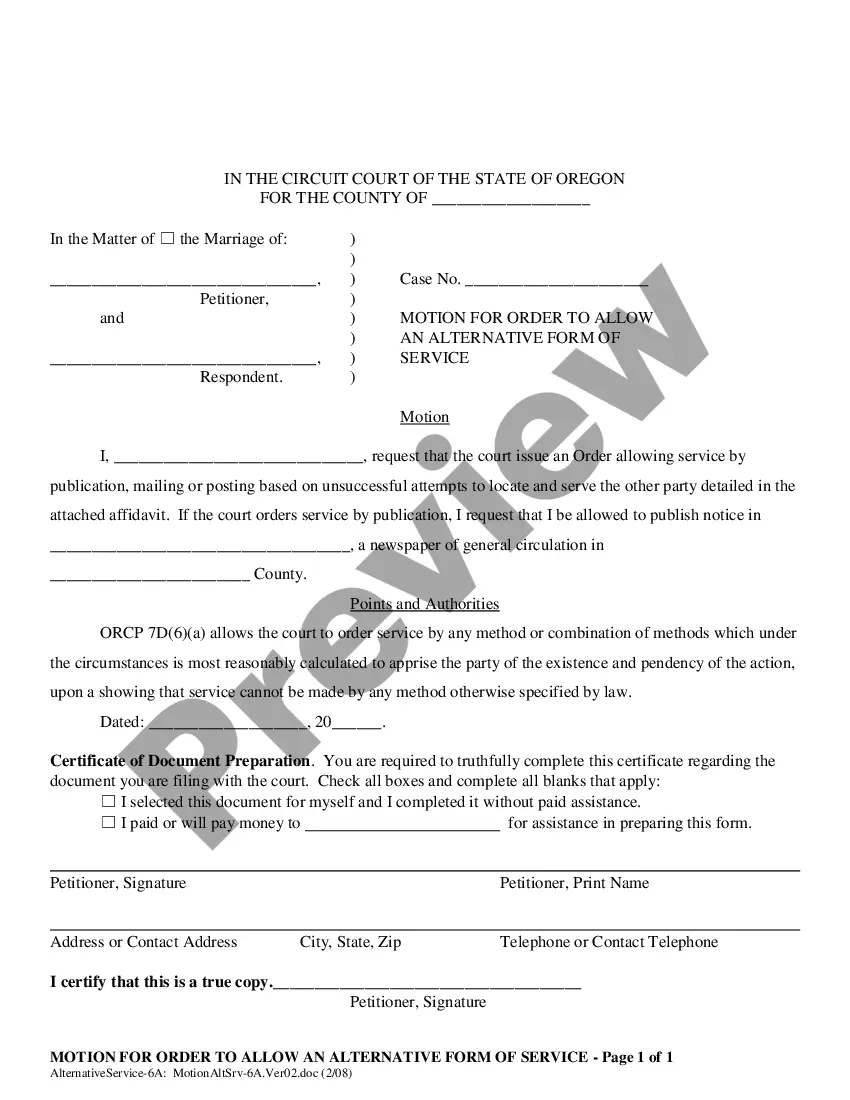
- Motion for Order to Allow Alternative Form of Service: The formal request to the court outlining your proposed service method.
- Order Allowing Alternative Form of Service: This court order specifies which alternative service method has been approved.
- Certificate of Document Preparation: Confirms that the forms were prepared properly.
When to use this form
You should use the Alternative Form of Service when you have initiated a court action for divorce, custody, or visitation, and you cannot complete service using traditional methods. This situation may arise if you are unable to locate the other party despite reasonable efforts or if they are evading service.
Who should use this form
- Individuals involved in domestic litigation in Oregon.
- Those who have attempted to serve the opposing party through standard methods without success.
- Persons seeking to comply with legal requirements to notify the other party of court actions.
Instructions for completing this form
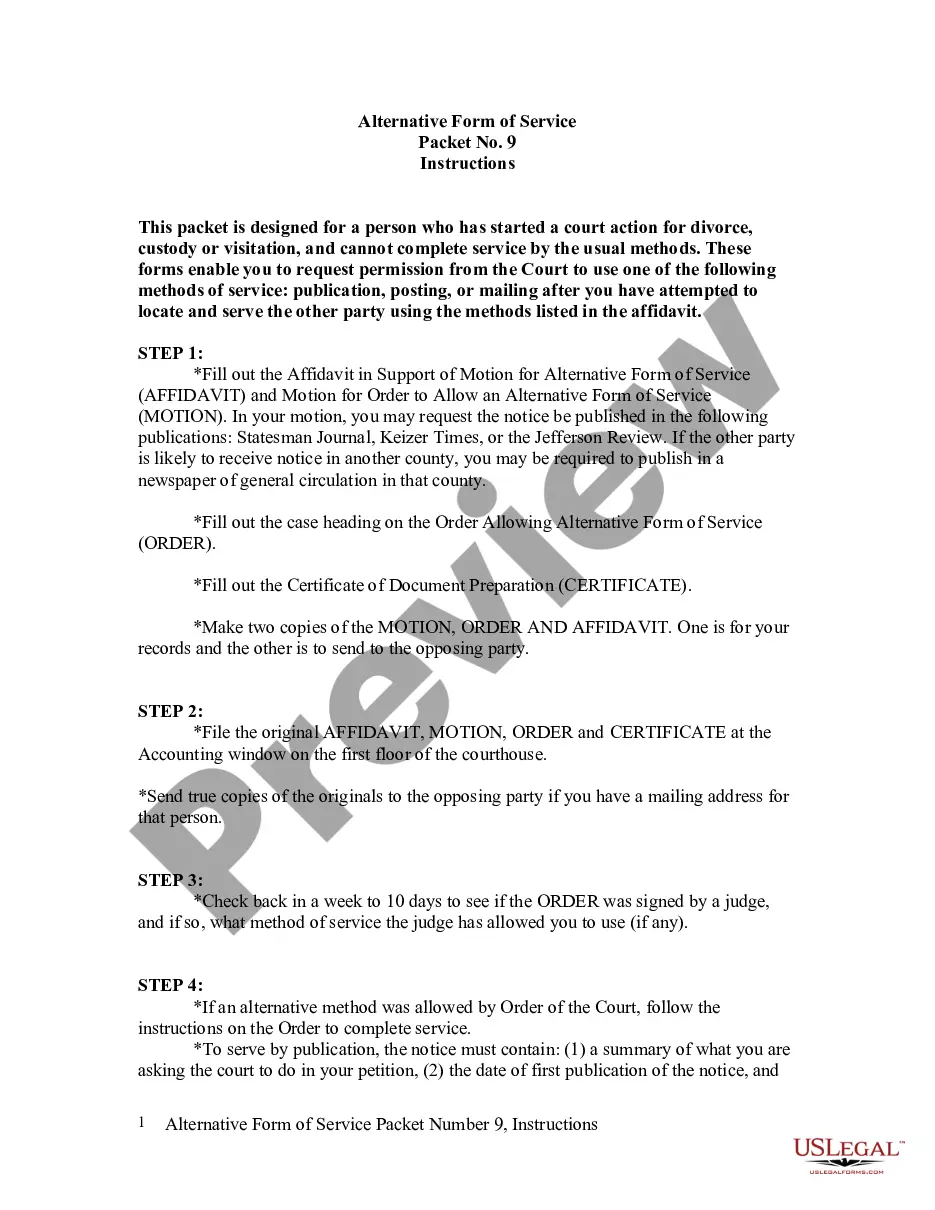
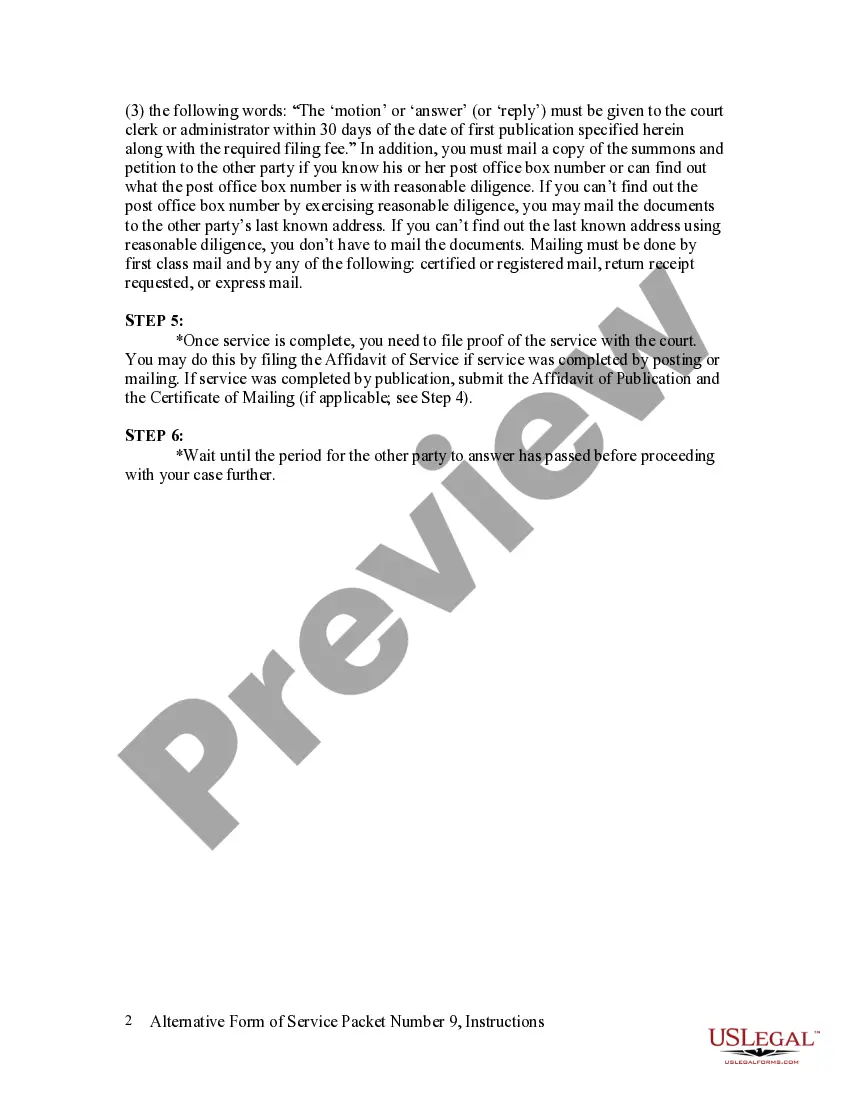
- Fill out the Affidavit and Motion detailing your attempts to locate the other party.
- Specify your preferred method of service publication and complete the necessary case heading on the Order.
- File the original documents at the courthouse and send true copies to the opposing party if an address is available.
- Monitor the status of your Motion in court after one week to ten days for any updates.
- If approved, follow the court's instructions on completing the alternative service method.
- Once served, file proof of service with the court using the appropriate affidavit forms.
Notarization guidance
In most cases, this form does not require notarization. However, some jurisdictions or signing circumstances might. US Legal Forms offers online notarization powered by Notarize, accessible 24/7 for a quick, remote process.
Get your form ready online
Our built-in tools help you complete, sign, share, and store your documents in one place.
Make edits, fill in missing information, and update formatting in US Legal Forms—just like you would in MS Word.
Download a copy, print it, send it by email, or mail it via USPS—whatever works best for your next step.
Sign and collect signatures with our SignNow integration. Send to multiple recipients, set reminders, and more. Go Premium to unlock E-Sign.
If this form requires notarization, complete it online through a secure video call—no need to meet a notary in person or wait for an appointment.
We protect your documents and personal data by following strict security and privacy standards.

Make edits, fill in missing information, and update formatting in US Legal Forms—just like you would in MS Word.

Download a copy, print it, send it by email, or mail it via USPS—whatever works best for your next step.

Sign and collect signatures with our SignNow integration. Send to multiple recipients, set reminders, and more. Go Premium to unlock E-Sign.

If this form requires notarization, complete it online through a secure video call—no need to meet a notary in person or wait for an appointment.

We protect your documents and personal data by following strict security and privacy standards.
Mistakes to watch out for
- Failing to properly fill out the Affidavit or Motion can lead to delays.
- Not keeping copies of filed documents for personal records.
- Neglecting to check back with the court on the status of the Order.
Benefits of completing this form online
- Convenience of completing the forms at your own pace from home.
- Editable templates that allow for easy customization to meet specific needs.
- Access to forms drafted by licensed attorneys, ensuring legal compliance.
Looking for another form?


Form popularity
FAQ
If the other party is willing to accept service, the filing party may simply mail or hand-deliver a copy of the Summons, petition/complaint, and other documents to the Defendant / Respondent, along with a form called an Acceptance of Service. In family law matters, the Acceptance of Service form is available on the
On average on-boarding takes 3-5 days which includes filling out paperwork, taking our process server orientation course and submitting a background check.
In the majority of states, you can serve papers by sending them to the defendant via certified mail with a return receipt requested. In some states, service by certified (or registered) mail is one among several ways you may serve papers.
Tell the server to: Give the papers to a responsible adult where the Defendant lives, or to someone in charge where the Defendant works. Say, These are court papers. Then, mail (first-class) a copy of the papers to the Defendant at the same address where s/he left the papers.
In the majority of states, you can serve papers by sending them to the defendant via certified mail with a return receipt requested. In some states, service by certified (or registered) mail is one among several ways you may serve papers.
A license or professional registration is not required to become a process server in Oregon. Any individual, age eighteen or older, who is not a party to the case, may serve civil process. There's no government-imposed barrier of entry if you want to work as a process server or start your own business.
As already indicated, the general answer is no, they don't have to say anything. In the US, you can be sued under state or federal law, so you should check the rules of civil procedure in your state. The Federal Rules do not require the service agent to say anything.
When the party that has to be served lives out of state, papers can usually be served by sending a copy of the paperwork to be served to that party by first-class mail, postage prepaid, and return receipt requested. The person who mails the papers must be at least 18 and NOT a party to the case.
The person serving the document by hand must identify the person being served and provide a copy of the document to the person served. If the person to be served refuses to take a copy of the document, the person serving it may put it down in the presence of the person to be served and tell the person what it is.