Addendum To Apartment Lease regarding Mold
Overview of this form
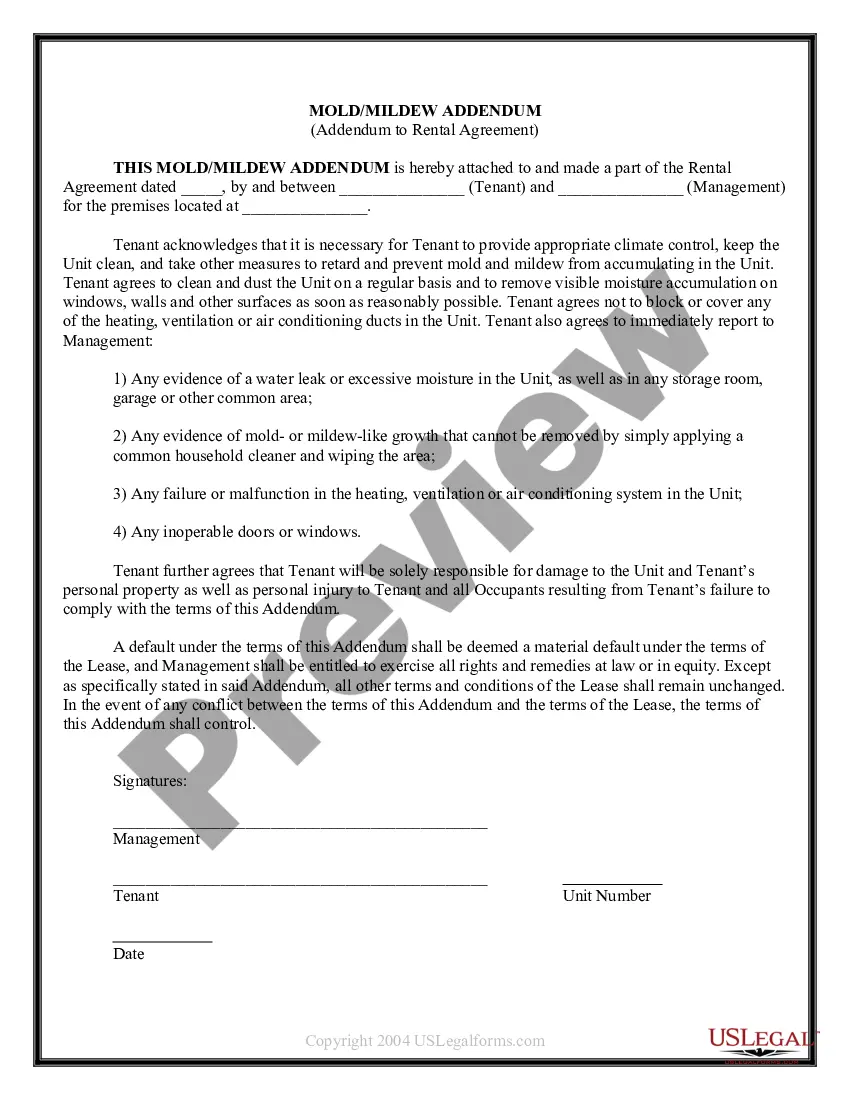
The Addendum to Apartment Lease regarding Mold is a legal document that supplements a rental agreement by specifically addressing the responsibilities and obligations related to mold and mildew management within the rental unit. This addendum outlines the requirements for tenants to maintain a clean environment and report any issues that could lead to mold growth, differentiating it from standard rental agreements that may not provide specific mold-related provisions.
Main sections of this form
- Acknowledgment of the tenant's responsibility for climate control and cleanliness to prevent mold accumulation.
- Requirements for reporting water leaks, moisture issues, and signs of mold or mildew growth.
- Obligations concerning the maintenance of heating, ventilation, and air conditioning systems.
- Consequences of failing to comply with the terms of the addendum, including possible material default.
- Confirmation that the addendum is part of the original rental agreement and specifies which terms take precedence in case of conflict.
When to use this form
This addendum should be used when a landlord and tenant want to clearly define their respective responsibilities regarding mold management in the rental unit. It is especially useful when issues related to mold have arisen or when a landlord wants to prevent potential problems related to mold and mildew growth in their property. Tenants may also request this addendum to ensure protections are in place regarding mold-related concerns.
Intended users of this form
- Landlords who wish to include specific mold-related responsibilities in their rental agreements.
- Tenants who want to clarify their duties regarding mold prevention and management.
- Property management companies that need a standardized addendum for their rental agreements.
Steps to complete this form
- Identify the parties involved, including the tenant and management or landlord.
- Enter the date of the original rental agreement and the address of the rental property.
- Review the terminology and obligations to ensure understanding of responsibilities regarding mold management.
- Sign and date the addendum to officially integrate it into the rental agreement.
- Provide a copy to all parties for their records.
Notarization guidance
In most cases, this form does not require notarization. However, some jurisdictions or signing circumstances might. US Legal Forms offers online notarization powered by Notarize, accessible 24/7 for a quick, remote process.
Get your form ready online
Our built-in tools help you complete, sign, share, and store your documents in one place.
Make edits, fill in missing information, and update formatting in US Legal Forms—just like you would in MS Word.
Download a copy, print it, send it by email, or mail it via USPS—whatever works best for your next step.
Sign and collect signatures with our SignNow integration. Send to multiple recipients, set reminders, and more. Go Premium to unlock E-Sign.
If this form requires notarization, complete it online through a secure video call—no need to meet a notary in person or wait for an appointment.
We protect your documents and personal data by following strict security and privacy standards.

Make edits, fill in missing information, and update formatting in US Legal Forms—just like you would in MS Word.

Download a copy, print it, send it by email, or mail it via USPS—whatever works best for your next step.

Sign and collect signatures with our SignNow integration. Send to multiple recipients, set reminders, and more. Go Premium to unlock E-Sign.

If this form requires notarization, complete it online through a secure video call—no need to meet a notary in person or wait for an appointment.

We protect your documents and personal data by following strict security and privacy standards.
Mistakes to watch out for
- Failing to review the addendum thoroughly before signing it.
- Not clearly defining who is responsible for addressing specific mold issues.
- Ignoring state-specific regulations that may affect mold management responsibilities.
- Not keeping copies of the signed addendum for both tenants and management.
Why use this form online
- Convenience of immediate access and download from any device.
- Editable format allows you to customize terms specific to your situation.
- Reliability, as the forms are drafted by licensed attorneys ensuring legal compliance.
Legal use & context
- The addendum serves as a binding agreement that outlines tenant responsibilities regarding mold.
- Failure to comply with the terms may result in penalties, including liability for damages.
- This document complements the rental lease but takes precedence in mold-related issues.
Quick recap
- The addendum specifically addresses tenant responsibilities regarding mold prevention.
- It protects both landlords and tenants by clearly defining reporting obligations and consequences.
- Ensure proper completion of the form to enforce its terms effectively.
Looking for another form?
Form popularity
FAQ
If there is mold in your apartment, you need to notify your landlord immediately. You might also consider asking your landlord to bring in a professional mold inspector. Mold usually grows in difficult to see places, like behind walls or appliances, and the professionals will have equipment to detect it.
As a landlord, it's both your legal responsibility and a duty of care to your tenants to make sure your property is free of damp and mould. To do this properly, you need an expert to diagnose the problem and then, ideally, secure a fix that also has a quality warranty.
Mold, Mildew, and Water Leaks Not all water leaks amount to a major issue or immediately make a property uninhabitable.This falls into the category of environmental hazards, which can also include exposure to lead paint dust (common in older properties) or asbestos insulation.
Document any signs of mold or damage. Contact your landlord and make them aware of the issues in writing, ask them to have a mold inspection performed. If they refuse contact your local health department for information regarding local mold-related rules and regulations.
The landlord is legally responsible for removing the mold and reimbursing you for any additional costs you have sustained. Even if you don't suffer any injuries, a landlord's failure to maintain a mold-free environment violates the implied warranty of habitability.
So far as ending the contract is concerned, have a look at your tenancy agreement and see if there is a break clause which will allow you to end it early. If not, you will only be able to end the tenancy early if the landlord agrees.
Legally, you're not allowed to repair and deduct, withhold rent, or break your lease if you caused the mold problem. Make sure to promptly report spills and leaks to your landlord, and, if you do notice mold anywhere in your apartment, let your landlord know in writing before it becomes a more serious issue.