Oregon Acceptance of Service regarding Motions, Orders, etc.
Overview of this form
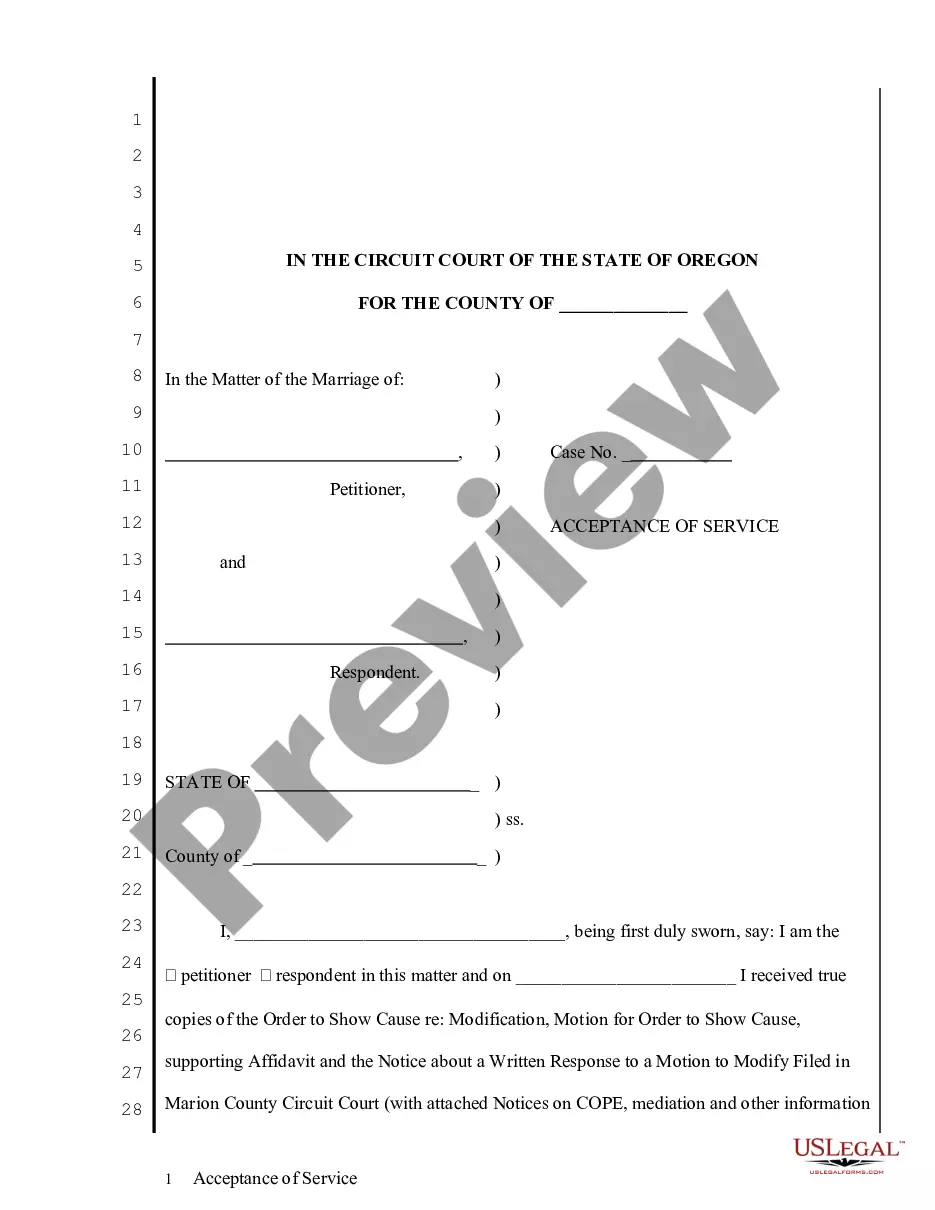
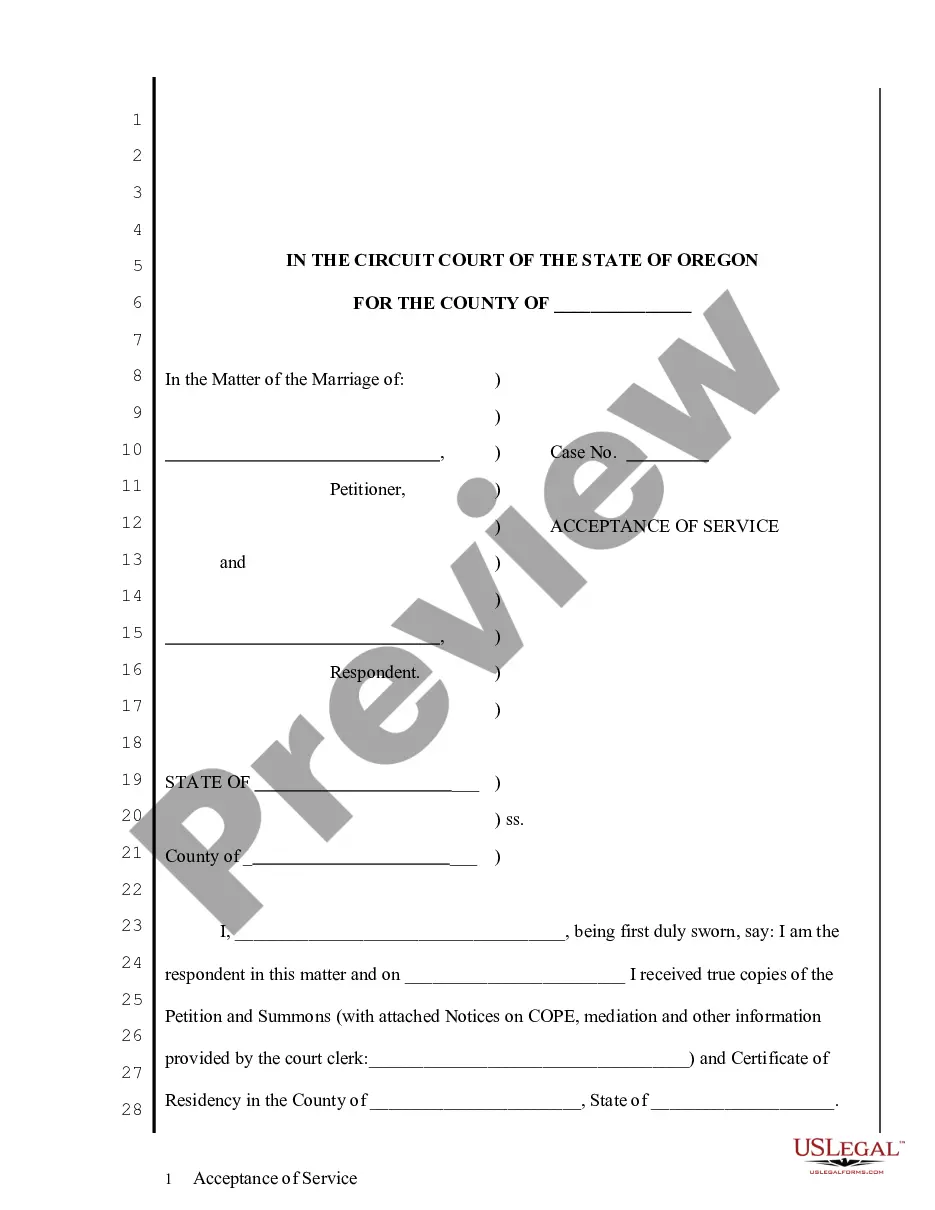
The Acceptance of Service regarding Motions, Orders, etc. is a legal document used in domestic litigation, specifically in Oregon. This form confirms that a party has received copies of relevant court documents such as orders and motions. It serves as an acknowledgment of the receipt of important legal paperwork, differentiating it from other forms that may deal with different legal matters or processes.
Main sections of this form
- Title and identification of the case
- Statement of the party's receipt of court documents
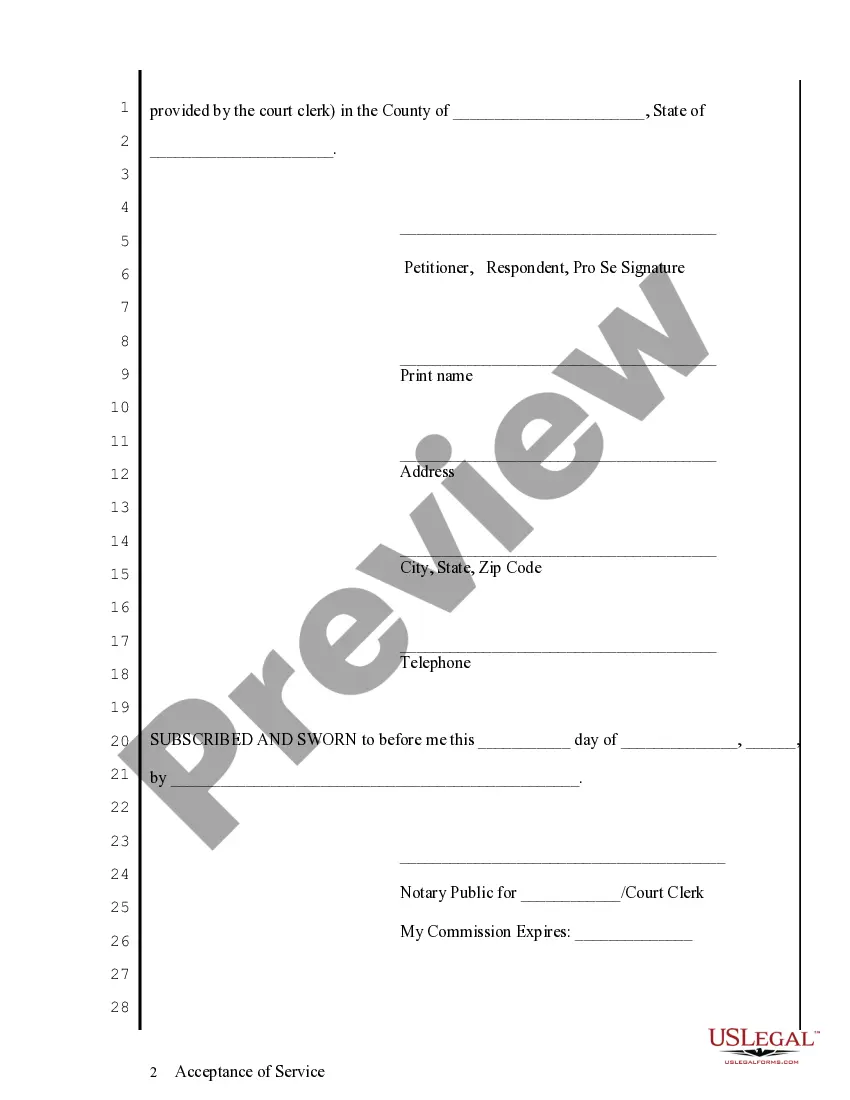
- Signatures of the petitioner or respondent
- Notary public acknowledgment
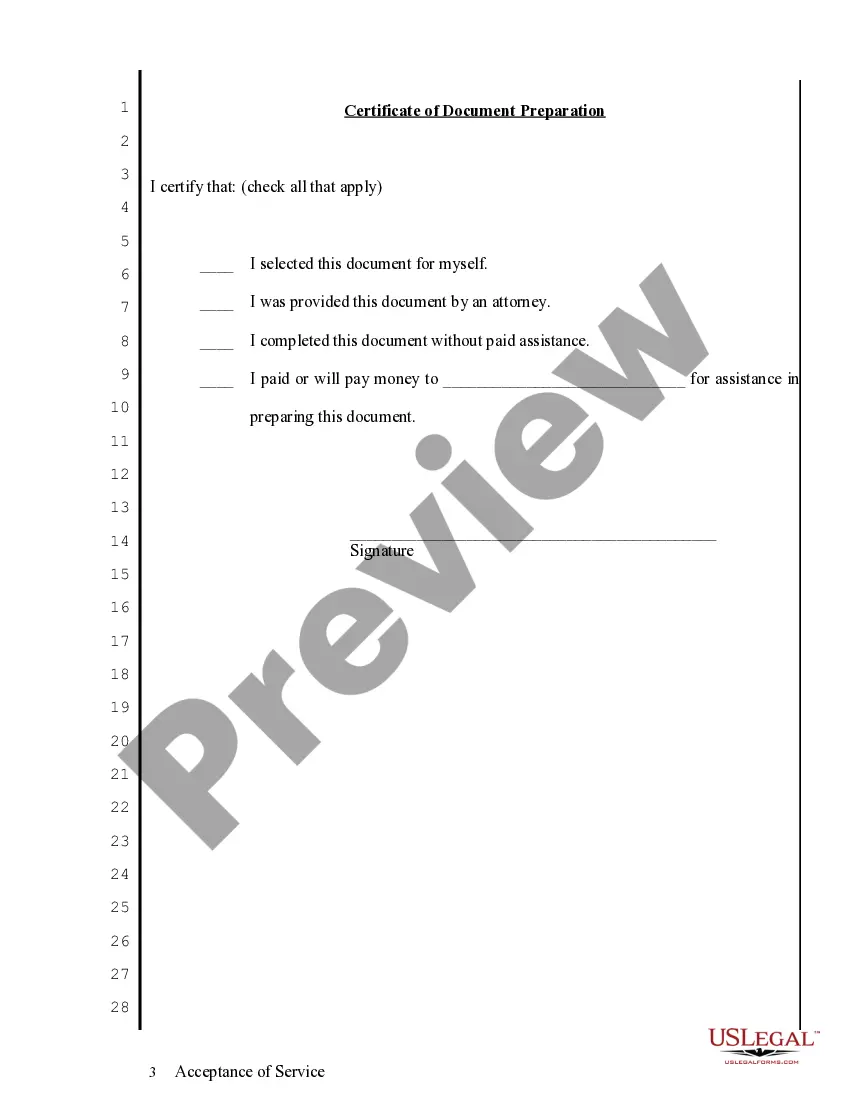
- Certificate of document preparation
When this form is needed
This form is essential when a party involved in a domestic litigation case, such as a divorce or custody dispute, has received court documents like a Motion for Order to Show Cause. It ensures that the court is made aware that all parties have received necessary notifications and are informed about ongoing legal actions.
Who needs this form
- Petitioners or respondents in a domestic litigation case
- Individuals required to acknowledge receipt of court documents
- Any party looking to formalize their acceptance of service in court proceedings
How to prepare this document
- Identify all parties involved in the case by entering their names in the appropriate sections.
- Record the date you received the court documents.
- Provide your signature and print your name, address, and contact information.
- Have the form notarized if required.
- Complete the certificate of document preparation section as applicable.
Does this form need to be notarized?
Notarization is required for this form to take effect. Our online notarization service, powered by Notarize, lets you verify and sign documents remotely through an encrypted video session, available 24/7.
Get your form ready online
Our built-in tools help you complete, sign, share, and store your documents in one place.
Make edits, fill in missing information, and update formatting in US Legal Forms—just like you would in MS Word.
Download a copy, print it, send it by email, or mail it via USPS—whatever works best for your next step.
Sign and collect signatures with our SignNow integration. Send to multiple recipients, set reminders, and more. Go Premium to unlock E-Sign.
If this form requires notarization, complete it online through a secure video call—no need to meet a notary in person or wait for an appointment.
We protect your documents and personal data by following strict security and privacy standards.

Make edits, fill in missing information, and update formatting in US Legal Forms—just like you would in MS Word.

Download a copy, print it, send it by email, or mail it via USPS—whatever works best for your next step.

Sign and collect signatures with our SignNow integration. Send to multiple recipients, set reminders, and more. Go Premium to unlock E-Sign.

If this form requires notarization, complete it online through a secure video call—no need to meet a notary in person or wait for an appointment.

We protect your documents and personal data by following strict security and privacy standards.
Common mistakes
- Failing to sign the form before submitting it.
- Not providing the correct case number or names as recorded in court documents.
- Overlooking the notarization requirement, if applicable.
Benefits of completing this form online
- Instant access to downloadable forms tailored for Oregon legal requirements.
- Edit and customize the form conveniently using a digital platform.
- Ensured accuracy with templates drafted by licensed attorneys.
Looking for another form?
Form popularity
FAQ
Motion to Dismiss an attempt to get the judge to dismiss a charge or the case. Motion to Suppress an attempt to keep certain statements or evidence from being introduced as evidence. Motion for Change of Venue may be made for various reasons including pre-trial publicity.
Motions are not pleadings but are requests for the judge to make a legal ruling. Some of the most common pre-trial motions include: Motion to Discover. A motion by which one party seeks to gain information from the adverse party.
A motion is a written request made to the court, asking the judge to issue an order. The motion must be supported by evidence.
During a civil case, most of your interactions with the judge will be the result of you or the other side filing a written motion. A motion is a written request to the judge that asks for a ruling on some issue in the case.
After you complete your motion, you must file it with the court.You must then serve (mail) a copy of your filed motion (including all exhibits and the date, time, and place of hearing) to all other parties in the case. If a party is represented by an attorney, mail the motion directly to the attorney's office.
Generally speaking, a MOTION, is a request made to the Court to take some specified action or to compell a party to take some specified action, whereas an ORDER is the decree or decision of the Court.
Each judge has her/his own habits and it's difficult to speak to the speed of a judge outside of my personal experience. But as a general rule, you can expect a decision in this type of matter in anywhere from 2 weeks to 3 months.
A motion is the standard way to seek certain forms of relief from a court. An Order to Show Cause is often a quicker way to seek the same relief. It usually has some provision which directs you to do something or to refrain from doing something...
A hearing for the purpose of asking a judge to issue a ruling or order. The motion is typically filed by one side and a notice is sent to the opposing attorney who responds in writing.