Oregon Notice to Respondent - Elder Abuse Prevention Act
Understanding this form
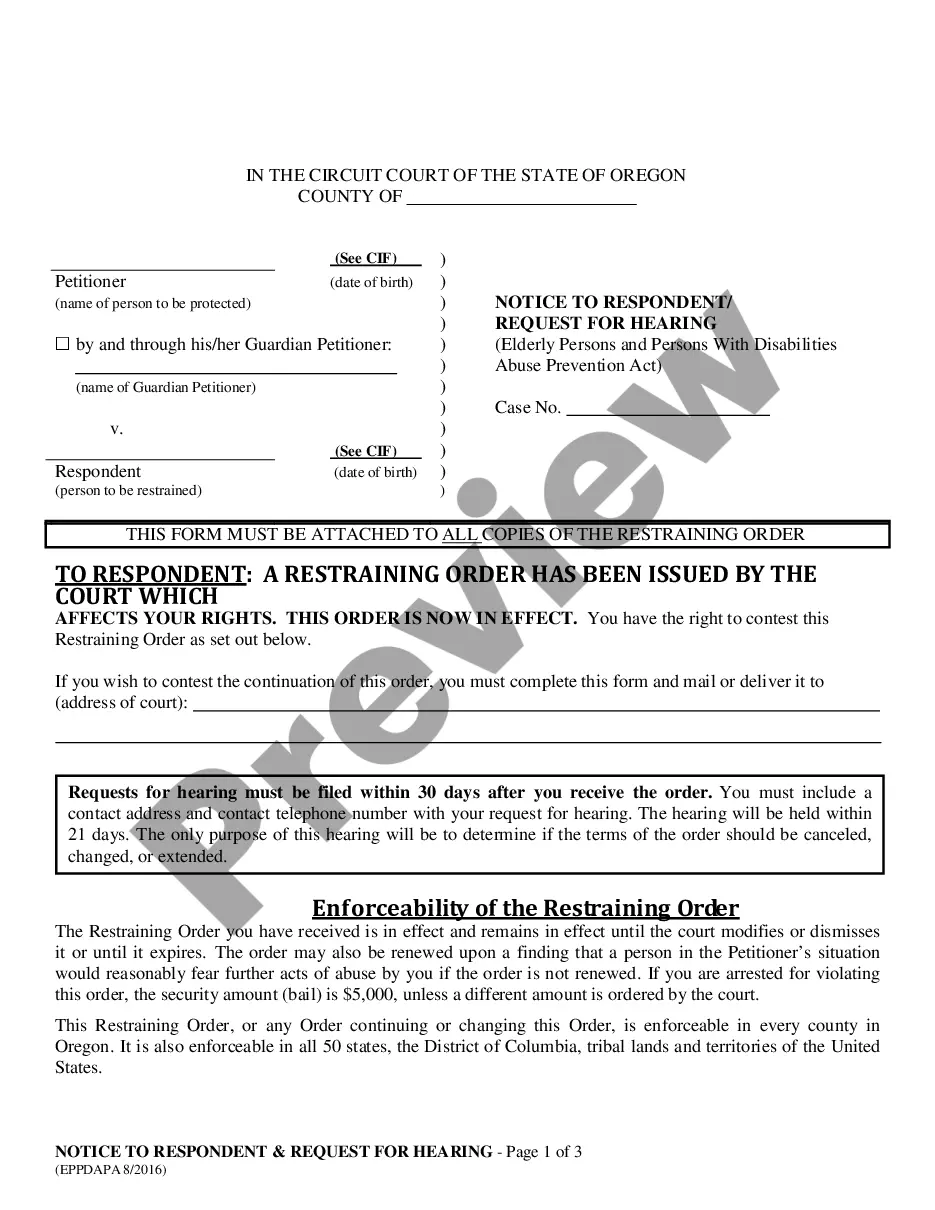
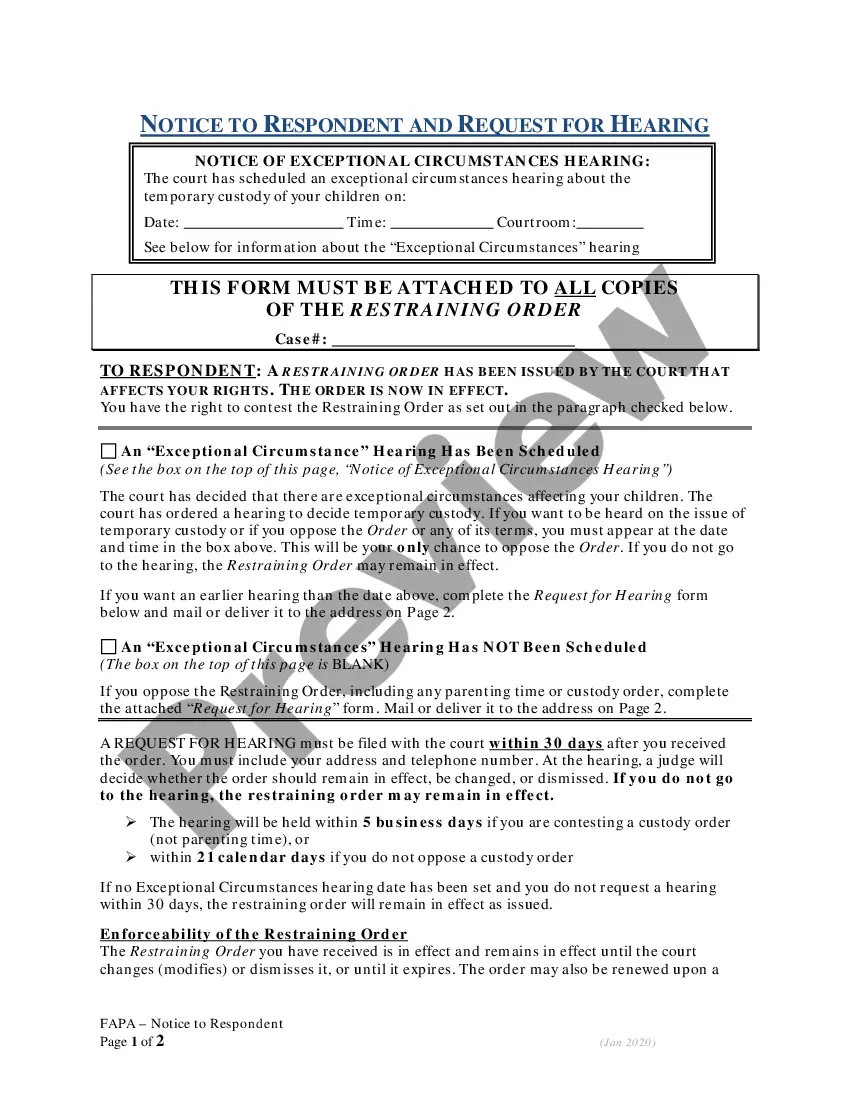
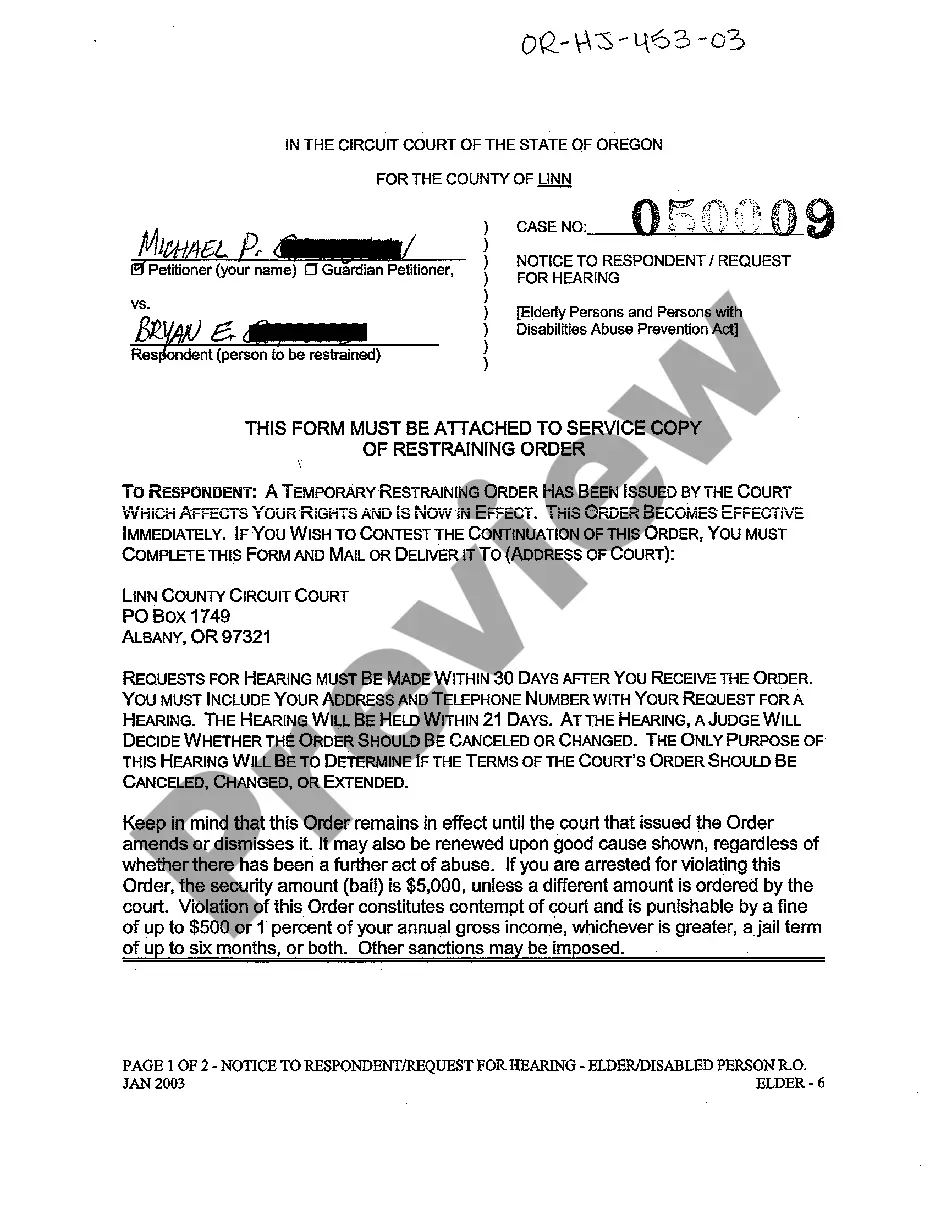
The Notice to Respondent - Elder Abuse Prevention Act is a legal document used in Oregon that notifies an individual (the respondent) about a restraining order issued due to allegations of elder abuse. This form serves as a critical component in domestic abuse litigation, providing the respondent with essential information regarding their rights and options to contest the order. The form emphasizes the legal implications of the restraining order and outlines the procedures for requesting a hearing.
Key components of this form
- Notifies the respondent of the restraining order and its immediate effect on their rights.
- Provides details on how to contest the restraining order, including the requirement to submit a request for a hearing.
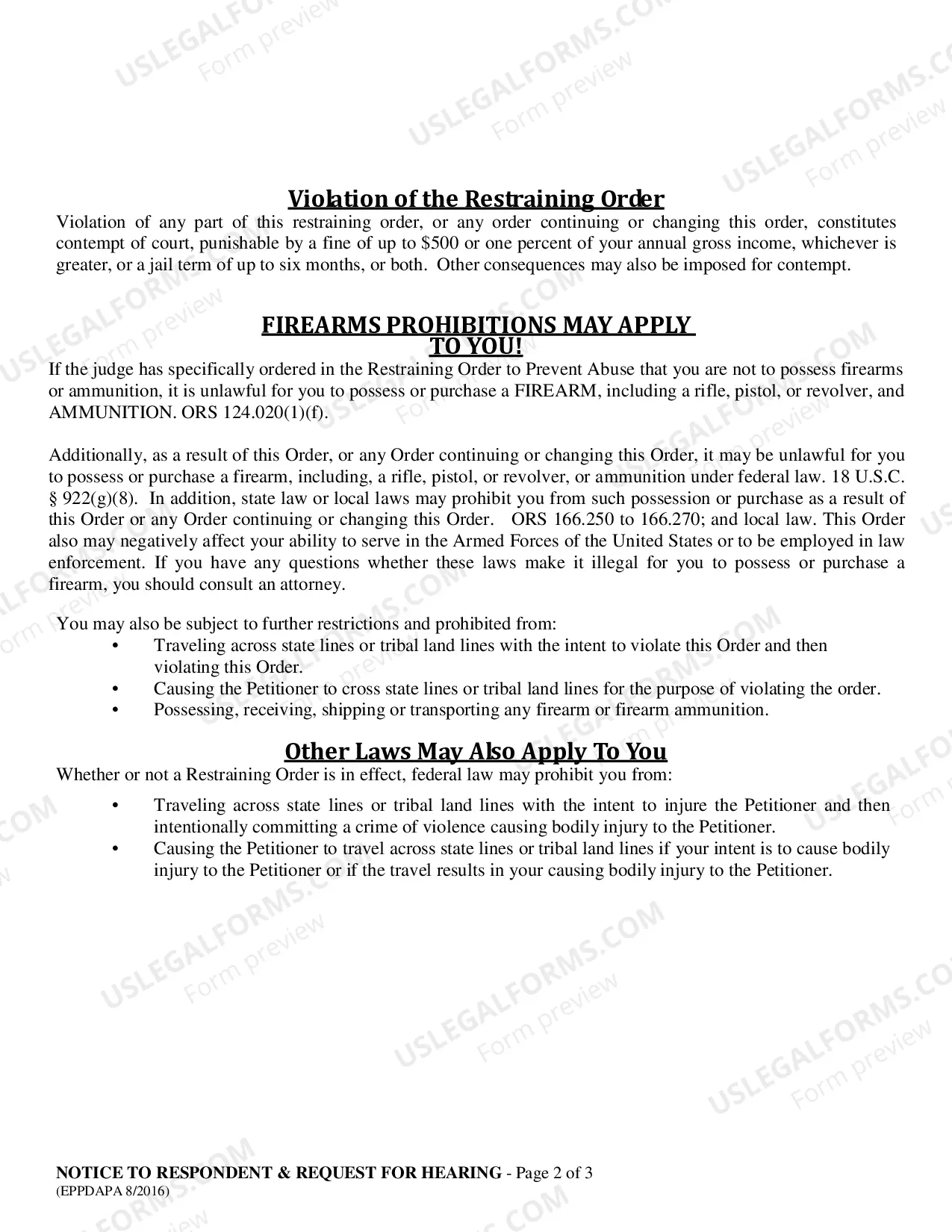
- Specifies the consequences of violating the restraining order, including potential fines and incarceration.
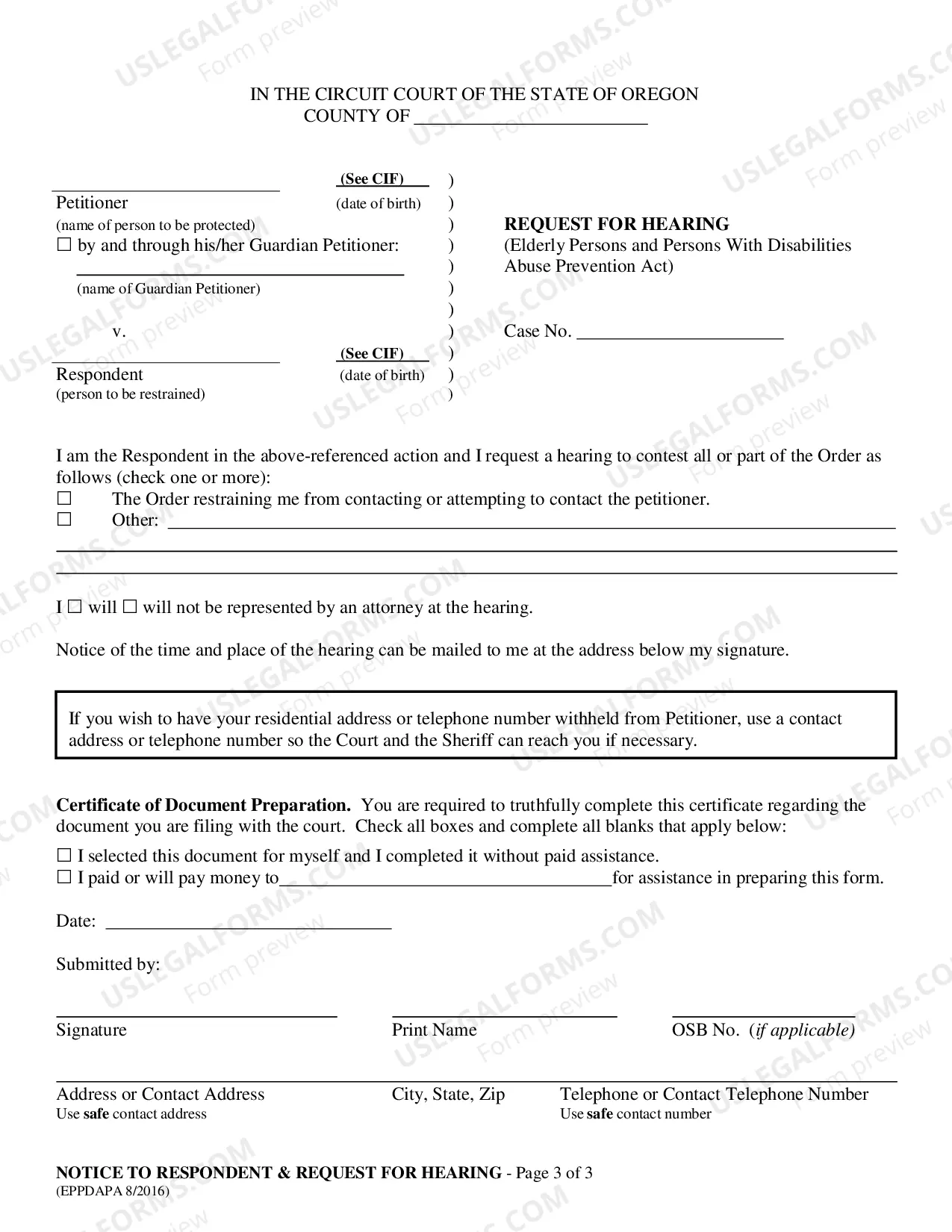
- Includes a request for a hearing section where the respondent can specify which aspects of the order they wish to contest.
- Contains a certificate of document preparation that affirms how the form was completed.

Situations where this form applies
This form should be used when a restraining order has been issued against you in accordance with the Elder Abuse Prevention Act in Oregon. It is essential when you wish to formally contest the restraining order in court, whether to challenge its terms or to seek its cancellation. The form must be filed within thirty days of receiving the order to ensure your right to a hearing is preserved.
Who can use this document
- Individuals who have received a restraining order under the Elder Abuse Prevention Act in Oregon.
- Respondents who intend to contest the restraining order and require a formal hearing.
- Guardians of elderly individuals who have been subjected to abuse and are involved in the legal proceedings.
Instructions for completing this form
- Identify the parties involved, including the petitioner and respondent, along with their respective dates of birth.
- Fill in the case number assigned by the court to ensure correct identification of the legal action.
- Specify which sections of the restraining order you wish to contest by checking the relevant boxes.
- Provide your contact information in the designated section to receive notifications regarding the hearing.
- Complete the certificate of document preparation, indicating how you obtained assistance with the form.
Does this form need to be notarized?
This form does not typically require notarization unless specified by local law. It is important to check with the court or legal authority for any specific requirements pertaining to your case.
Get your form ready online
Our built-in tools help you complete, sign, share, and store your documents in one place.
Make edits, fill in missing information, and update formatting in US Legal Forms—just like you would in MS Word.
Download a copy, print it, send it by email, or mail it via USPS—whatever works best for your next step.
Sign and collect signatures with our SignNow integration. Send to multiple recipients, set reminders, and more. Go Premium to unlock E-Sign.
If this form requires notarization, complete it online through a secure video call—no need to meet a notary in person or wait for an appointment.
We protect your documents and personal data by following strict security and privacy standards.

Make edits, fill in missing information, and update formatting in US Legal Forms—just like you would in MS Word.

Download a copy, print it, send it by email, or mail it via USPS—whatever works best for your next step.

Sign and collect signatures with our SignNow integration. Send to multiple recipients, set reminders, and more. Go Premium to unlock E-Sign.

If this form requires notarization, complete it online through a secure video call—no need to meet a notary in person or wait for an appointment.

We protect your documents and personal data by following strict security and privacy standards.
Typical mistakes to avoid
- Failing to file the request for a hearing within the 30-day deadline.
- Omitting essential personal information such as the case number or contact details.
- Not checking the appropriate boxes to specify which parts of the restraining order are being contested.
- Neglecting to complete the certificate of document preparation correctly.
Why use this form online
- Convenience of accessing the form anytime and anywhere with an internet connection.
- Editability that allows you to fill out the form at your own pace.
- Reliability of using a template that has been drafted and vetted by licensed attorneys.
Looking for another form?


Form popularity
FAQ
A violation of a restraining order will often result in arrest, and is a criminal offense.If there is a restraining order against you, but the person who filed the order repeatedly tries to have contact with you, you may go to court to ask the judge to vacate the restraining order.
The laws on restraining orders and no-contact agreements vary by state, but the main idea is that no-contact agreements exist to punish someone who has already caused harm and to prevent further harm, whereas restraining orders exist to prevent someone from causing harm in the first place.
Each restraining order has its own terms as to how far away a defendant must stay from the complaintant. Typically it is 50 or 100 feet. If you become aware that your ex is within that protection zone, it is up to you to remove...
It should be noted that upon conviction for domestic violence the court can make a no-contact order a condition of probation. This means that the defendant will continue to be precluded from having contact with the victim as long as they are on probation, usually up to one year.
You are at least 18 years old. If you are younger, then you may seek a restraining order (1) if you are or you were married to the abuser, and/or (2) you have been in a sexual relationship with the abuser, and (3) the person who abused you is at least 18 years old.
A restraining order lasts for 1 year from the date the judge signed it, unless it is dismissed or cancelled by the court. Orders can be renewed for 1 year at a time, if the judge believes you are likely still in danger. To renew the order, you must file paperwork before the order ends.
Even if the restraining order goes on your record, it likely won't affect your current or future employment. Most employers who conduct background checks only check for the most serious crimes. It costs more to search for every possible crime a person might have committed.
Stay Away Provision: Ordering the abuser to stay at least a certain number of yards or feet away from the victim, his or her home, job, school, and car. The stay-away distance can vary by state, judge or the lethality of the situation, but is often at least 100 yards or 300 feet.
A restraining order is a court order to protect your physical safety. It can tell the other person (the respondent) to move. The order can also specify locations where the respondent cannot go. The Petition includes other things that you can ask for if you think they will help you stay safe.