Ohio Fiduciary Acceptance - Executor - Administrator
What this document covers
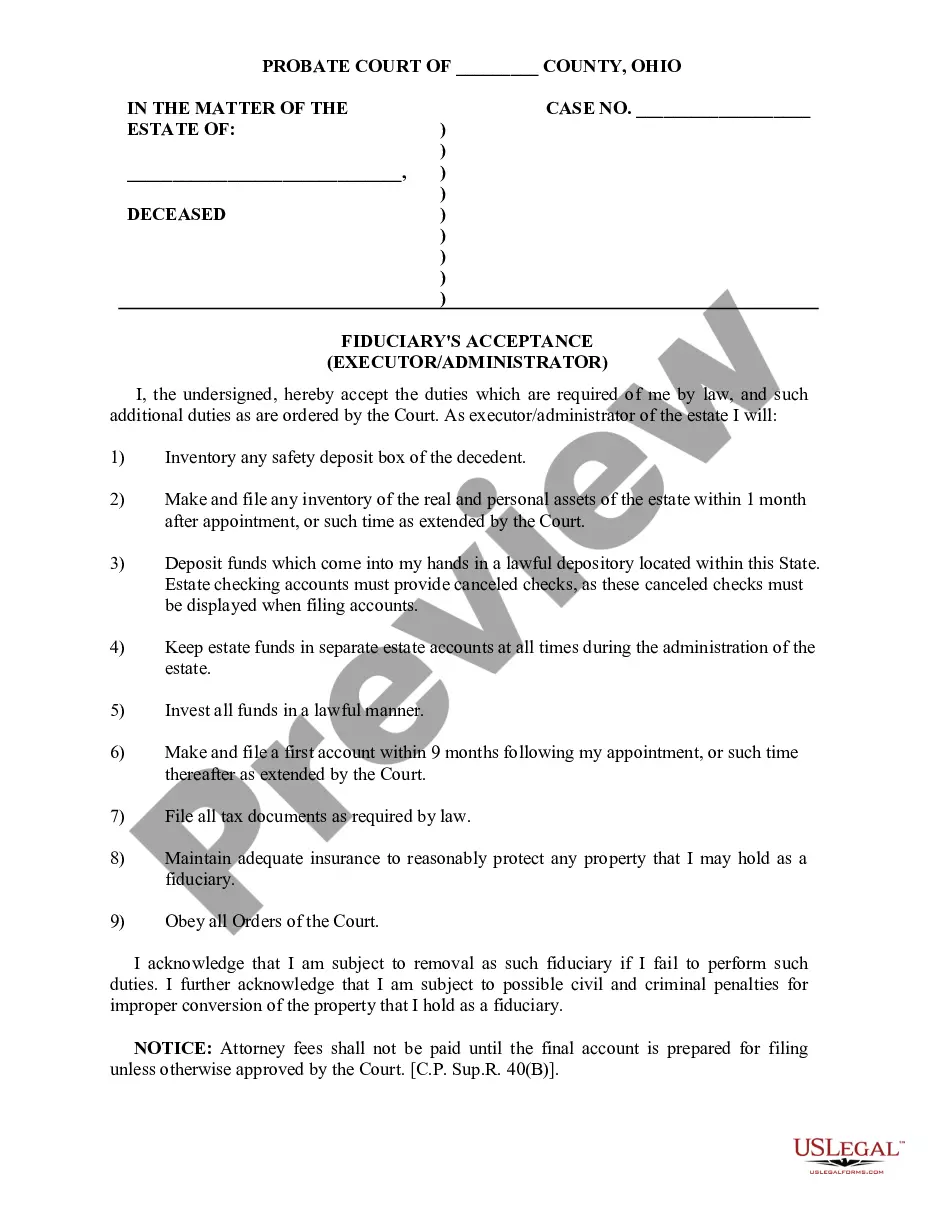
The Fiduciary Acceptance - Executor/Administrator form is a legal document used in Ohio to formally accept the responsibilities associated with administering a decedent's estate. This form outlines the duties expected of an executor or administrator, such as handling estate assets, filing tax documents, and maintaining court compliance. It is important to note that this form is specific to executor duties, distinguishing it from other fiduciary forms with different roles or responsibilities.
Form components explained
- Identification of the estate and case number.
- Acceptance of duties as executor or administrator.
- Inventory requirements for decedent's assets.
- Management of estate funds and accounts.
- Filing timelines for inventory and first account.
- Obligations regarding tax documents and court orders.

When to use this form
This form should be used when a person has been appointed as the executor or administrator of a decedent's estate in Ohio. It is necessary to complete this form upon receiving letters of appointment from the probate court to officially accept the role and responsibilities, ensuring compliance with state laws during the estate administration process.
Who this form is for
- Individuals appointed as executors in a will.
- Administrators assigned by the court for intestate estates (where there is no will).
- Lawyers or legal representatives assisting clients with estate administration.
How to complete this form
- Enter the decedent's name and estate case number at the top of the form.
- Read through the list of duties and confirm your understanding of the responsibilities.
- Provide your signature and date to acknowledge acceptance of the executor or administrator role.
- Make copies of the completed document for your records and any necessary court submissions.
- File the original form with the probate court as required.
Notarization guidance
Notarization is not commonly needed for this form. However, certain documents or local rules may make it necessary. Our notarization service, powered by Notarize, allows you to finalize it securely online anytime, day or night.
Get your form ready online
Our built-in tools help you complete, sign, share, and store your documents in one place.
Make edits, fill in missing information, and update formatting in US Legal Forms—just like you would in MS Word.
Download a copy, print it, send it by email, or mail it via USPS—whatever works best for your next step.
Sign and collect signatures with our SignNow integration. Send to multiple recipients, set reminders, and more. Go Premium to unlock E-Sign.
If this form requires notarization, complete it online through a secure video call—no need to meet a notary in person or wait for an appointment.
We protect your documents and personal data by following strict security and privacy standards.

Make edits, fill in missing information, and update formatting in US Legal Forms—just like you would in MS Word.

Download a copy, print it, send it by email, or mail it via USPS—whatever works best for your next step.

Sign and collect signatures with our SignNow integration. Send to multiple recipients, set reminders, and more. Go Premium to unlock E-Sign.

If this form requires notarization, complete it online through a secure video call—no need to meet a notary in person or wait for an appointment.

We protect your documents and personal data by following strict security and privacy standards.
Common mistakes
- Failing to file the form by court-imposed deadlines.
- Not maintaining separate accounts for estate funds.
- Overlooking inventory requirements for estate assets.
Benefits of using this form online
- Instant access to the form in multiple formats, including Word and Rich Text.
- Convenient editing options to tailor the form to specific needs.
- Downloadable format allows for easy printing and filing.
What to keep in mind
- The Fiduciary Acceptance - Executor/Administrator form is essential for formally accepting executor duties in Ohio.
- Completing this form is a critical step in the estate administration process.
- Ensure compliance with timelines and inventory requirements to avoid potential legal issues.
Looking for another form?
Form popularity
FAQ
The successor trustee does not have to live in the same state as you do.But for transfers of property such as securities and bank accounts, it usually won't make much difference where the successor trustee lives.
A backdoor way to modifying an irrevocable trust might be through a change in the situs of the trust's administration. Some trust instruments permit the trustee to move the situs of the trust to another jurisdiction and then adopt the laws of that new jurisdiction for purposes of trust administration.
No. Trust does not need to be filed in California. Trusts are private documents and usually there are compelling reasons not to file the trust.
If your will and revocable trusts were properly executed in accordance with the laws of one state, they are usually valid in other states.Your heirs might need to rely on the laws of another state to establish the validity of your will and trusts, and opinions from attorneys in two separate states may be required.
Out-of-State Trustees The successor trustee does not have to live in the same state as you do.But for transfers of property such as securities and bank accounts, it usually won't make much difference where the successor trustee lives.
Situs is the state that the trust originated and whose laws will govern the trust.In general, for tax purposes, trust situs is determined by the combined jurisdictions that have the legal authority to tax a trust or trustees.
A revocable living trust isn't subject to the same kind of rules as a will; it should be valid in any state, no matter where you signed it.If you acquire real estate in your new state, you'll probably want to hold it in the trust, so that it doesn't have to go through probate at your death.
A revocable living trust isn't subject to the same kind of rules as a will; it should be valid in any state, no matter where you signed it.If you acquire real estate in your new state, you'll probably want to hold it in the trust, so that it doesn't have to go through probate at your death.
If your will and revocable trusts were properly executed in accordance with the laws of one state, they are usually valid in other states.Your heirs might need to rely on the laws of another state to establish the validity of your will and trusts, and opinions from attorneys in two separate states may be required.