Ohio Entry Setting Hearing on Inventory
What this document covers
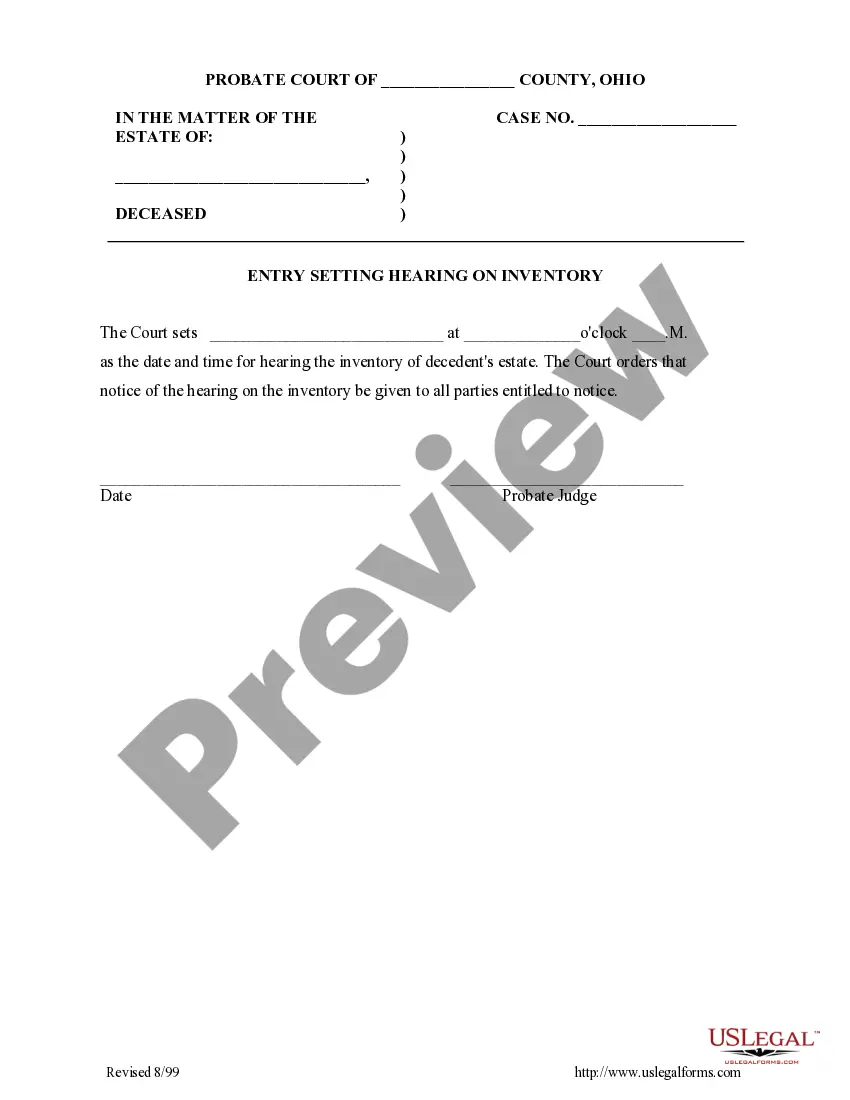
The Entry Setting Hearing on Inventory is a legal document used in Ohio to schedule a court hearing regarding the inventory of a deceased person's estate. This form is crucial in the probate process as it ensures that the estate's assets are accounted for and properly managed. Unlike other probate forms, this specific entry focuses on setting a hearing date, rather than detailing the inventory itself.
Key parts of this document
- The name of the Probate Court and the county.
- The title of the document, indicating it sets a hearing on the inventory.
- The case number associated with the estate.
- The scheduled date and time for the inventory hearing.
- Requirements for providing notice to interested parties.
- The signature of the Probate Judge along with the date.
When to use this document
This form should be used when an executor or administrator of an estate needs to formally schedule a hearing to present the inventory of the deceased's assets. It is typically utilized after the initial filing of the probate case and when all relevant parties need to be notified about the upcoming hearing.
Who should use this form
This form is intended for:
- Executors or administrators managing the estate of a deceased individual.
- Legal representatives involved in the probate process.
- Heirs and beneficiaries of the estate who want to participate in the inventory hearing.
Instructions for completing this form
- Identify the Probate Court and county where the estate is being handled.
- Fill in the names involved in the case, including the deceased's name.
- Enter the case number pertaining to the probate proceedings.
- Specify the date and time for the hearing on the inventory.
- Include a statement about notifying all parties entitled to receive notice.
- Sign the document and date it, following the Probate Judge's requirements.
Notarization requirements for this form
Notarization is generally not required for this form. However, certain states or situations might demand it. You can complete notarization online through US Legal Forms, powered by Notarize, using a verified video call available anytime.
Get your form ready online
Our built-in tools help you complete, sign, share, and store your documents in one place.
Make edits, fill in missing information, and update formatting in US Legal Forms—just like you would in MS Word.
Download a copy, print it, send it by email, or mail it via USPS—whatever works best for your next step.
Sign and collect signatures with our SignNow integration. Send to multiple recipients, set reminders, and more. Go Premium to unlock E-Sign.
If this form requires notarization, complete it online through a secure video call—no need to meet a notary in person or wait for an appointment.
We protect your documents and personal data by following strict security and privacy standards.

Make edits, fill in missing information, and update formatting in US Legal Forms—just like you would in MS Word.

Download a copy, print it, send it by email, or mail it via USPS—whatever works best for your next step.

Sign and collect signatures with our SignNow integration. Send to multiple recipients, set reminders, and more. Go Premium to unlock E-Sign.

If this form requires notarization, complete it online through a secure video call—no need to meet a notary in person or wait for an appointment.

We protect your documents and personal data by following strict security and privacy standards.
Common mistakes
- Failing to include the correct case number.
- Not specifying the proper date and time for the hearing.
- Neglecting to notify all interested parties as required.
- Omitting the signature of the Probate Judge or the date.
Advantages of online completion
- Convenience of downloading from anywhere at any time.
- Editable formats allow customization to fit specific needs.
- Reliability of templates drafted by licensed attorneys.
Looking for another form?
Form popularity
FAQ
At hearings, the court relies on written declarations and your arguments. Hearings can determine temporary, agreed, or some procedural matters. The trial is where you give evidence and arguments for the judge to use in making a final decision.
Understand Your State's Child-Custody Laws. Stockbyte / Getty Images. Understand the Better-Parent Standard. Morsa Images / Getty Images. Bring the Right Documents to Court. Learn Proper Courtroom Etiquette. Know What to Expect During the Hearing. Dress Appropriately.
A motion is where one of you asks the court to do something. A hearing is where you go before the judge and...
What Is Your Financial Status? What Type of Custody Arrangement Are You Seeking? How Is Communication With the Other Parent? Do You Have Any Existing Arrangements?
A journal entry is a record of the business transactions in the accounting books of a business. A properly documented journal entry consists of the correct date, amounts to be debited and credited, description of the transaction and a unique reference number. A journal entry is the first step in the accounting cycle.
It is a request for the court to settle a proposed court order. Discuss this with your attorney. If you dont have an attorney, sounds like this would be the time to hire one asap. This communication does not create an attorney/client relationship and is not legal advice.
The court will almost always get the final say on custody and visitation.To do that, the court will look at factors like the parents' respective mental and physical health, the child's choice, the parent's wishes, and which parent can provide the most stable and healthy environment for the child.
Standard Journal Entries are used to record entries that contain the same general ledger account numbers, but will use different amounts each time they are entered.
A journal entry is a document usually prepared by lawyers for the judge to sign which correctly document and spell out the fact finding and the order of the court coming out of a hearing before the court.