Townsite Deed of Alaska Native
Understanding this form
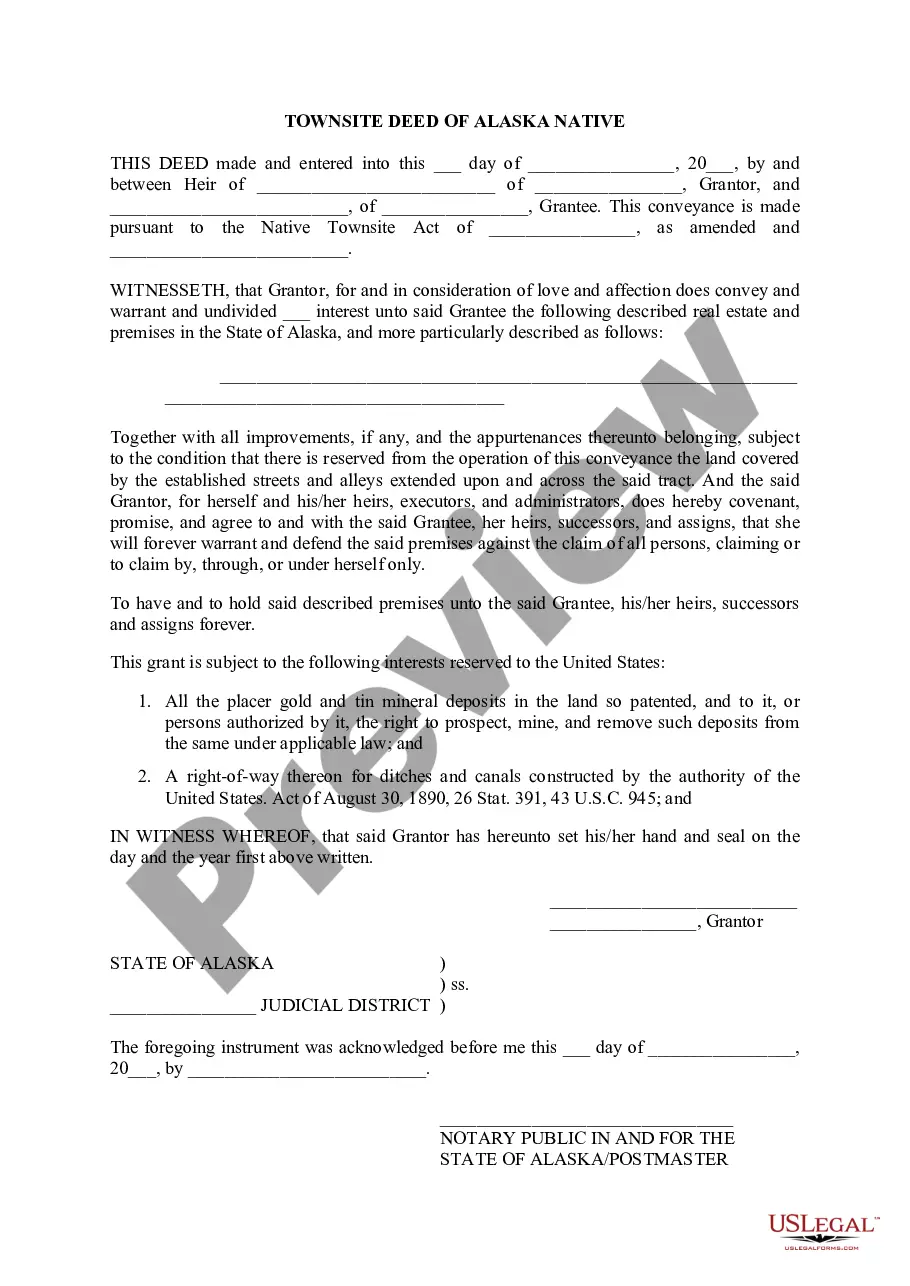
The Townsite Deed of Alaska Native is a legal document used to convey an undivided interest in real estate located in Alaska, specifically pursuant to the Native Townsite Act. Unlike standard property deeds, this form is tailored for conveying land ownership among Native Alaskan heirs, making it unique in its application and requirements.
What’s included in this form
- Identification of the Grantor and Grantee with their addresses.
- Details of the real estate being conveyed, including location and legal description.
- Provisions regarding the reservation of certain rights and interests for the United States.
- Signature and acknowledgment by the Grantor, along with a notarization requirement.
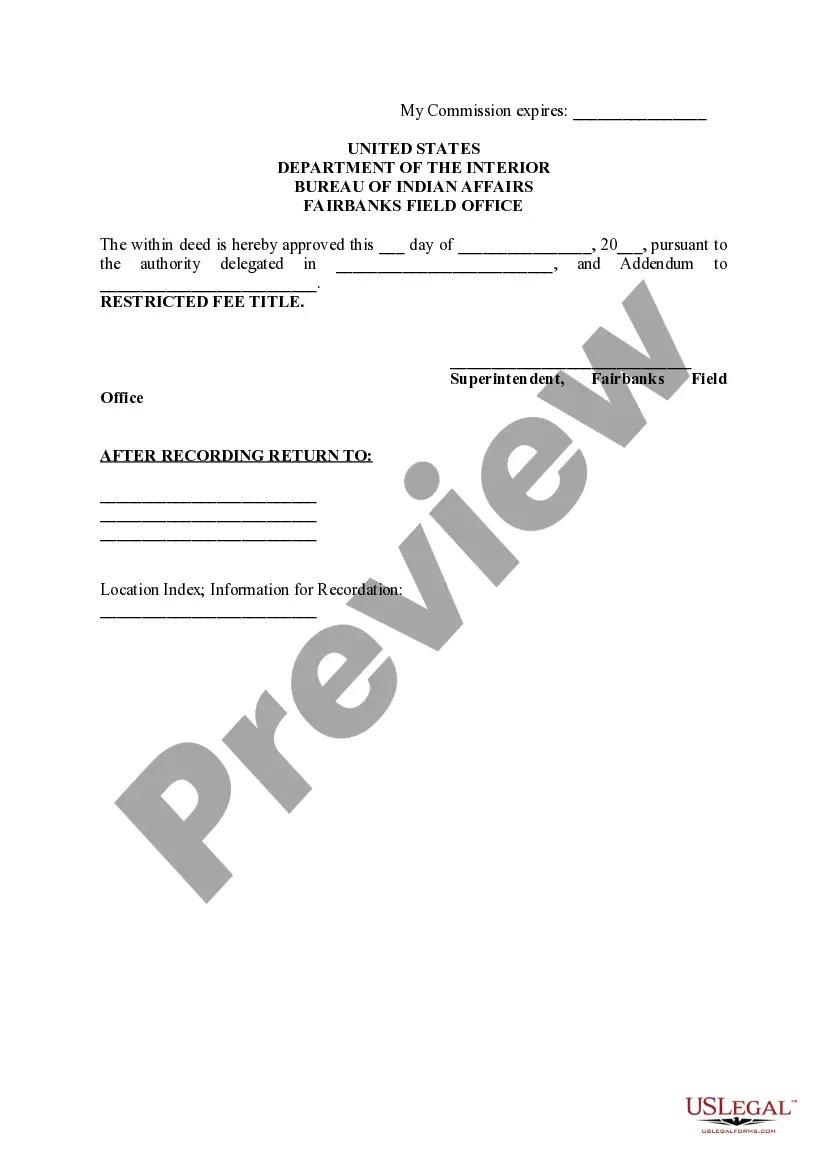
- Approval clause from the U.S. Department of the Interior, Bureau of Indian Affairs.

Common use cases
This form should be used when an heir wishes to transfer their undivided interest in a native townsite property to another party. It is essential in situations where familial property rights are being established, conveyed, or clarified among Native Alaskan communities.
Who needs this form
- Heirs of Native Alaskans holding property interests in designated townsites.
- Individuals or entities looking to acquire property within Native Alaskan lands.
- Legal representatives handling estate matters for Native Alaskan families.
How to prepare this document
- Identify and write the names and addresses of the Grantor and Grantee.
- Specify the date of the deed and enter the required legal description of the property.
- Fill in the undivided interest being transferred.
- Ensure the Grantor signs the deed and includes their notary acknowledgment.
- Submit the completed form to the appropriate governmental office for recording.
Notarization guidance
Yes, this form must be notarized to be legally valid. The notarization confirms the identity of the Grantor and the voluntary nature of the signing. US Legal Forms offers convenient online notarization services via secure video calls, ensuring a streamlined process without the need for in-person visits.
Get your form ready online
Our built-in tools help you complete, sign, share, and store your documents in one place.
Make edits, fill in missing information, and update formatting in US Legal Forms—just like you would in MS Word.
Download a copy, print it, send it by email, or mail it via USPS—whatever works best for your next step.
Sign and collect signatures with our SignNow integration. Send to multiple recipients, set reminders, and more. Go Premium to unlock E-Sign.
If this form requires notarization, complete it online through a secure video call—no need to meet a notary in person or wait for an appointment.
We protect your documents and personal data by following strict security and privacy standards.

Make edits, fill in missing information, and update formatting in US Legal Forms—just like you would in MS Word.

Download a copy, print it, send it by email, or mail it via USPS—whatever works best for your next step.

Sign and collect signatures with our SignNow integration. Send to multiple recipients, set reminders, and more. Go Premium to unlock E-Sign.

If this form requires notarization, complete it online through a secure video call—no need to meet a notary in person or wait for an appointment.

We protect your documents and personal data by following strict security and privacy standards.
Avoid these common issues
- Failing to accurately describe the property can lead to complications in title transfer.
- Not obtaining the required notarization prior to submitting the deed.
- Leaving out necessary signatures or dates, which may invalidate the deed.
Benefits of completing this form online
- Convenience of downloading and completing the form from anywhere.
- Editability allows you to ensure all details are correct before submission.
- Access to reliable forms drafted by licensed attorneys for increased legal reliability.
Looking for another form?

Form popularity
FAQ
The Alaska Native Claims Settlement Act of 1971 (ANCSA) was a new approach by Congress to federal Indian policy. ANCSA extinguished aboriginal land title in Alaska.The federal government also compensated the newly formed Alaska Native corporations a total of $962.5 million for land lost in the settlement agreement.
The fight over who owned the land in Alaska was finally settled after two hundred years.How has this one piece of legislation forever changed the state of Alaska? When President Nixon signed ANCSA into law, it finally settled who would own most of Alaska.
In 1971, the Alaska Native Claims Settlement Act was signed into law by President Nixon. It abrogated Native claims to aboriginal lands except those that are the subject of the law. In return, Natives received up to 44 million acres (180,000 km2) of land and were paid $963 million.
Changes to Village Corporations under Alaska Native Claims Settlement Act (ANCSA) are effective for tax years beginning after December 31, 2016. Payments made from the sharing of natural resource revenue were paid directly to the ANC, and taxed at the corporate level.
Since the passage of ANCSA, various industries have been strengthened in Alaska, creating jobs in both the private and public sectors. By creating Alaska Native-owned, for-profit corporations, ANCSA also brought additional economic diversity to the state that has benefited, either directly or indirectly, all Alaskans.
Alaska Natives increasingly prefer to be known by the names they use in their own languages, such as Inupiaq or Yupik. "Inuit" is now the current term in Alaska and across the Arctic, and "Eskimo" is fading from use. The Inuit Circumpolar Council prefers the term "Inuit" but some other organizations use "Eskimo".
ANCSA extinguished all the Indian reservations in Alaska, with the exception of Metlakatla. Tribes that had their reservations extinguished had the option of keeping their former reservation land, both surface and subsurface ownership.
Natives were able to choose tens of thousands of acres of land rich with timber while Doyon used mineral analysis to attract businesses. The state of Alaska to date has been granted approximately 85% or 90 million acres (360,000 km2) of the land claims it has made under ANCSA.
Alaska Native people can be citizens of the United States, the State of Alaska, and also of one or more tribes. In other words, citizens of the three sovereigns in the United States: United States sovereign, State of Alaska sovereign, and Tribal sovereign.