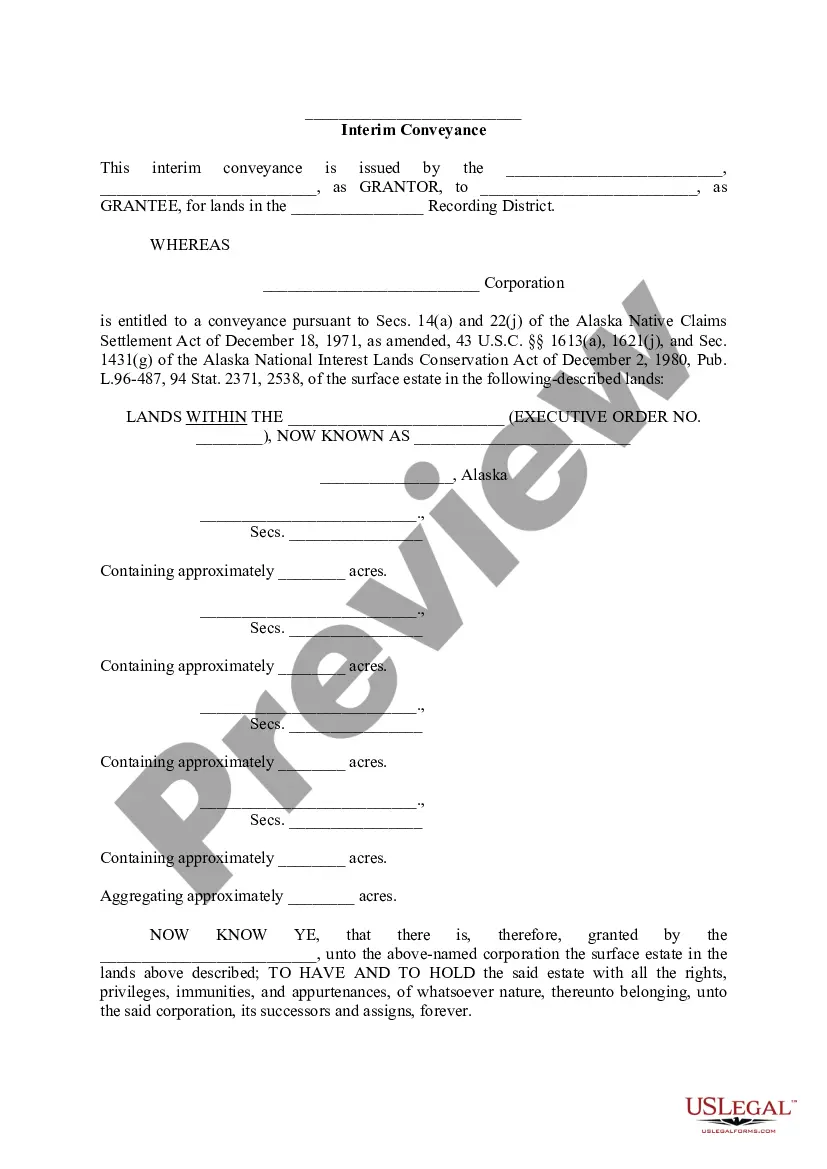
Interim Conveyance Pursuant to Alaska Native Claims Settlement Act of December 18, 1971
Understanding this form
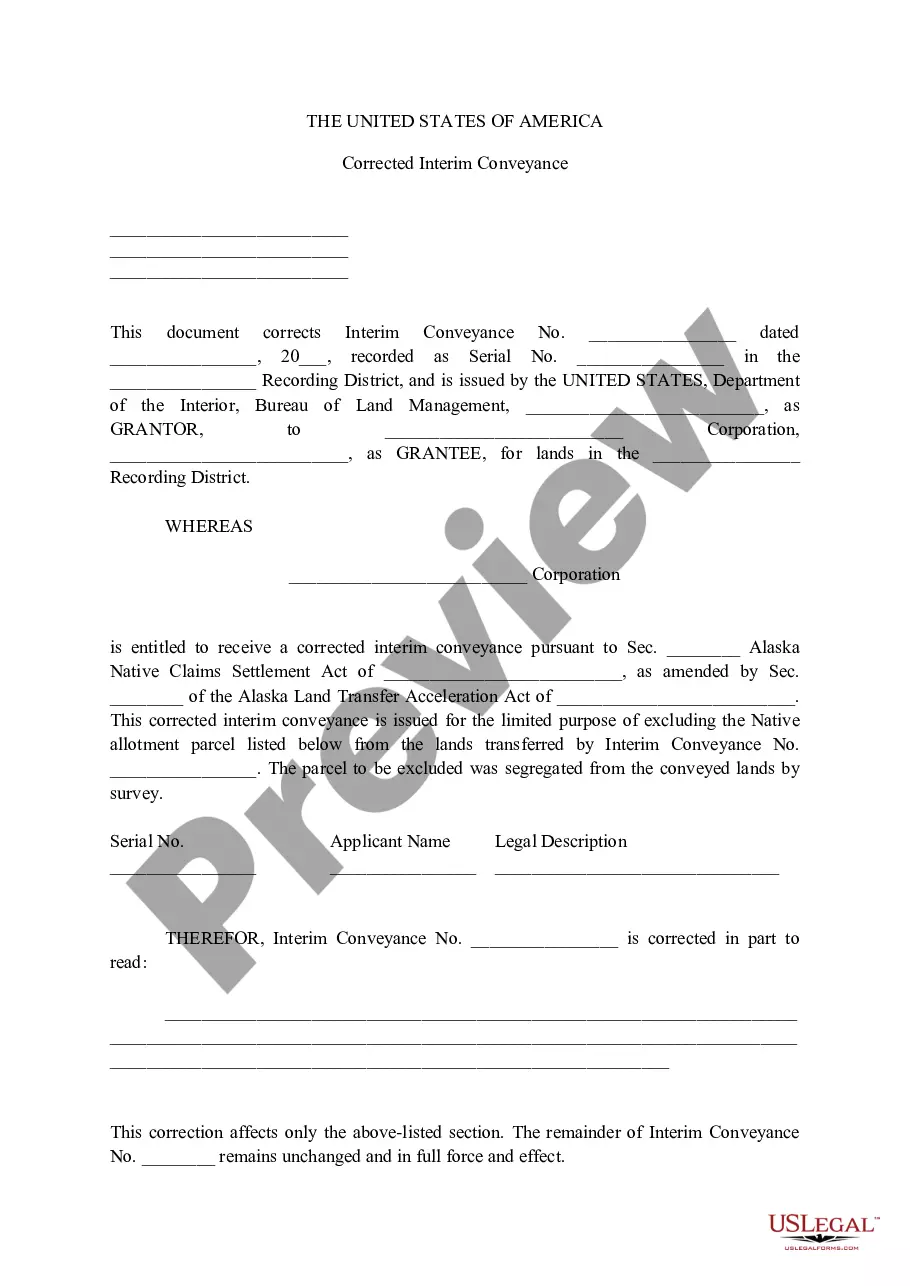
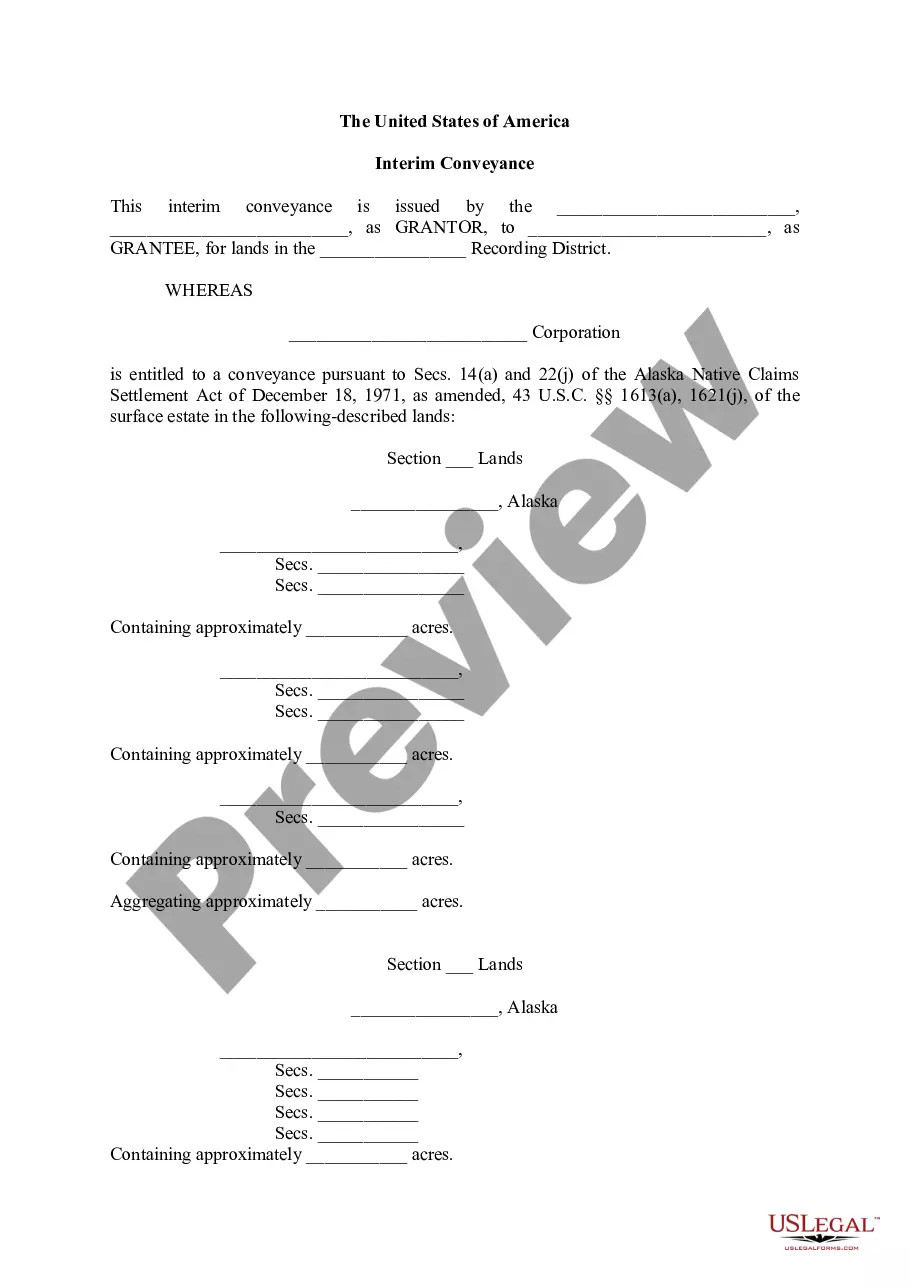
The Interim Conveyance Pursuant to Alaska Native Claims Settlement Act of December 18, 1971 is a legal document that grants temporary use of land and property before they are developed for their final intended purpose. This form serves as a crucial tool for entities entitled to land under the Alaska Native Claims Settlement Act, providing a clear framework for interim land use and ensuring compliance with relevant regulations. Unlike other real estate forms, this interim conveyance specifically focuses on lands designated for Alaska Native corporations, addressing unique requirements set forth in federal law.
Key parts of this document
- Identification of grantor and grantee along with their roles.
- Description of the lands being conveyed, including acreage and location.
- Establishes rights and privileges associated with the conveyed land.
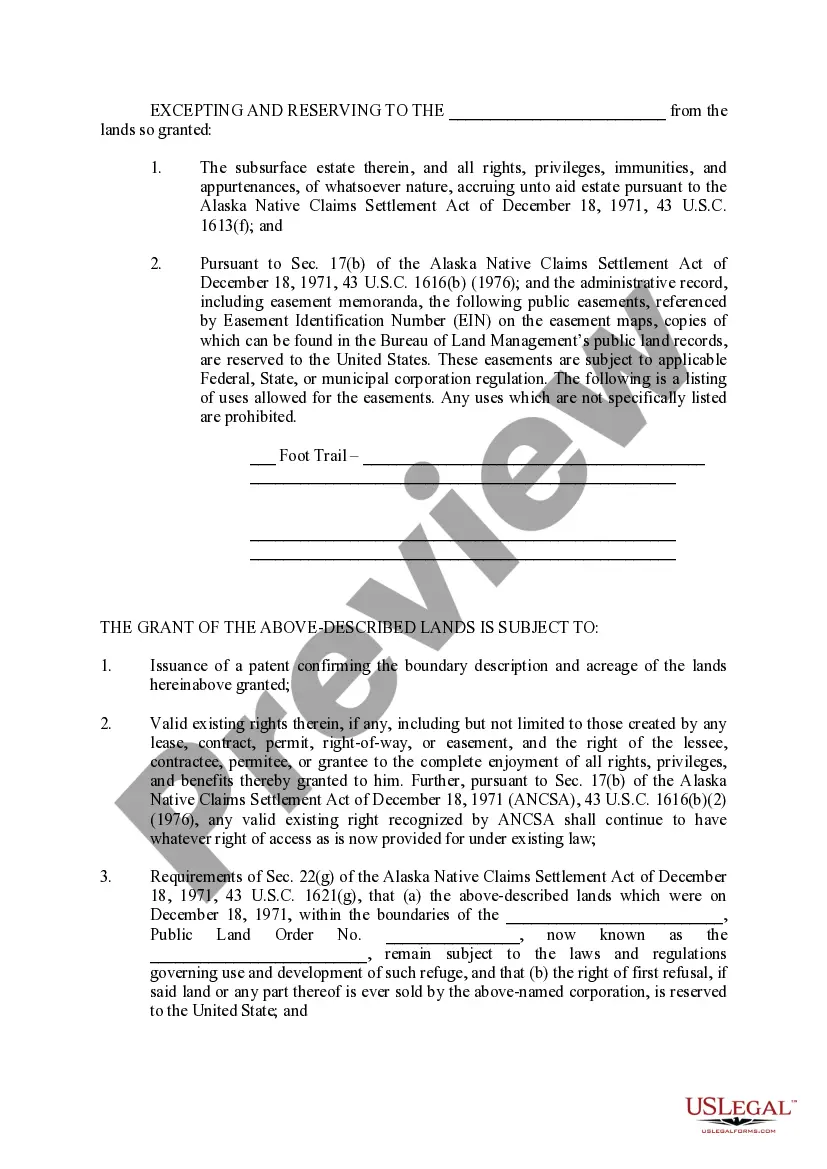
- Outlines reservations, including mineral rights and existing easements.
- Conditions related to the issuance of a patent confirming the land boundaries.
- Notices of compliance with federal laws and regulations governing land use.
Situations where this form applies
This form should be used when an Alaska Native corporation is ready to temporarily convey land before future development. Common scenarios include facilitating construction projects, exploration of natural resources, or other interim land uses that align with the provisions of the Alaska Native Claims Settlement Act. It ensures that the controlling entities have the appropriate legal backing to utilize the land in accordance with federal regulations.
Who this form is for
- Alaska Native corporations seeking to convey land under the provisions of federal law.
- Legal representatives and advisers assisting Alaska Native entities with land transactions.
- Individuals or organizations involved in land developments associated with the interim use of properties.
How to prepare this document
- Identify the grantor and grantee, including their full names and addresses.
- Provide a detailed description of the lands being conveyed, including specific sections and acreages.
- Outline any existing rights, privileges, or reservations associated with the property.
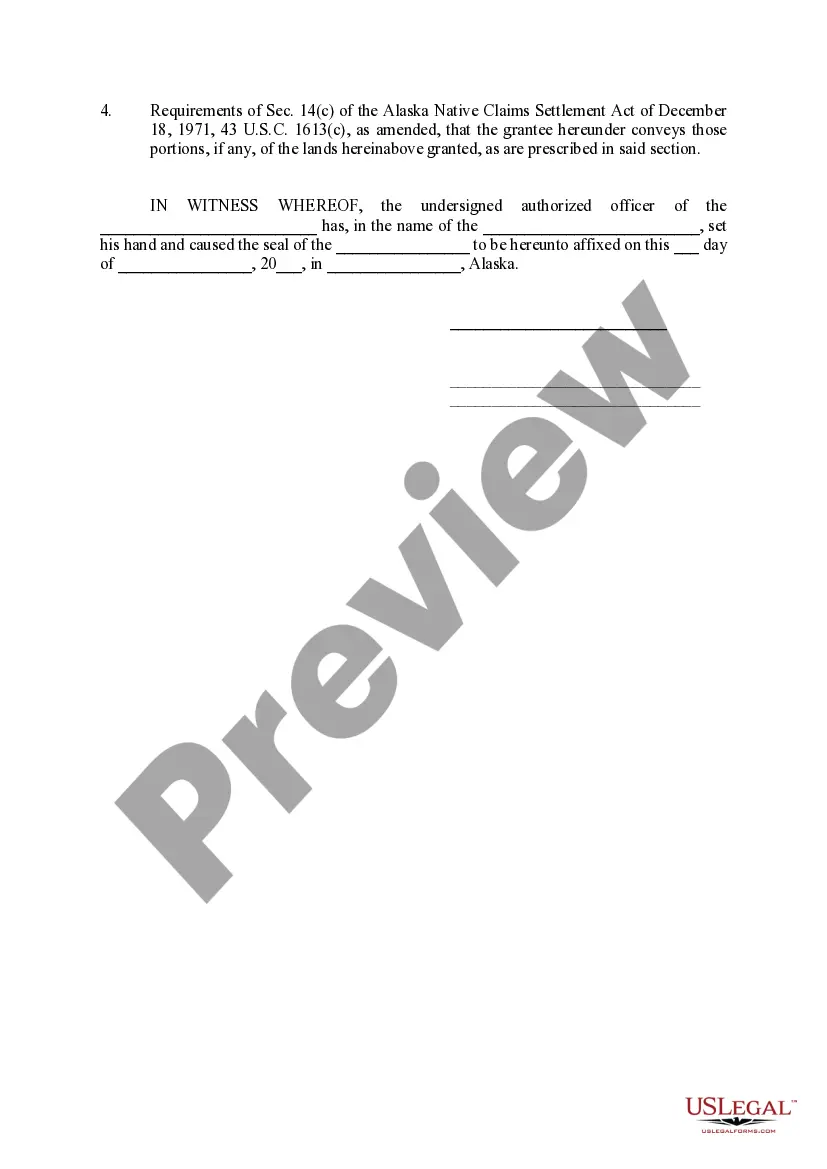
- Enter the necessary dates and signatures to validate the conveyance.
- Submit the completed form to the appropriate recording office as required by local regulations.
Does this form need to be notarized?
This form does not typically require notarization unless specified by local law. However, it is recommended to confirm signatures with a notary for enhanced legal validity in certain transactions.
Get your form ready online
Our built-in tools help you complete, sign, share, and store your documents in one place.
Make edits, fill in missing information, and update formatting in US Legal Forms—just like you would in MS Word.
Download a copy, print it, send it by email, or mail it via USPS—whatever works best for your next step.
Sign and collect signatures with our SignNow integration. Send to multiple recipients, set reminders, and more. Go Premium to unlock E-Sign.
If this form requires notarization, complete it online through a secure video call—no need to meet a notary in person or wait for an appointment.
We protect your documents and personal data by following strict security and privacy standards.

Make edits, fill in missing information, and update formatting in US Legal Forms—just like you would in MS Word.

Download a copy, print it, send it by email, or mail it via USPS—whatever works best for your next step.

Sign and collect signatures with our SignNow integration. Send to multiple recipients, set reminders, and more. Go Premium to unlock E-Sign.

If this form requires notarization, complete it online through a secure video call—no need to meet a notary in person or wait for an appointment.

We protect your documents and personal data by following strict security and privacy standards.
Avoid these common issues
- Failing to provide a complete and accurate legal description of the property.
- Omitting signatures or dates, which can render the conveyance invalid.
- Not clearly identifying existing rights and reservations pertaining to the property.
Why complete this form online
- Convenience of immediate access, allowing for quick completion and filing.
- Editability to ensure information can be accurately corrected before printing.
- Reliability of using professionally drafted forms created by licensed attorneys.
Main things to remember
- The Interim Conveyance is essential for facilitating temporary land use under the Alaska Native Claims Settlement Act.
- Proper completion and adherence to legal requirements ensure the conveyance's validity.
- Understanding the specific obligations and rights associated with the property is crucial for all parties involved.
Looking for another form?


Form popularity
FAQ
Section 17(d)(2) authorizes the Secretary to recommend to Congress the designation of up to 80 million acres of Alaska land for use as national parks, forests, and refuges and for inclusion of some of Alaska's rivers in the Wild and Scenic Rivers System (Figure 210).
In 1971, the Alaska Native Claims Settlement Act was signed into law by President Nixon. It abrogated Native claims to aboriginal lands except those that are the subject of the law. In return, Natives received up to 44 million acres (180,000 km2) of land and were paid $963 million.
Rather than designating reservations held in trust by the United States government, as the majority of tribes in the Lower 48 have, the Alaska Native Claims Settlement Act created 12 regional profit-making Alaska Native corporations and over 200 village, group, and urban corporations to receive what would end up being
On December 18, 1971, Public Law 92-203, the "Alaska Native Claims Settlement Act," was signed into law by President Nixon. Public Law 92-203 was enacted by Congress to settle the claim of Alaska's native Indian Aleut and Eskimo population to aboriginal title to the land on which they have lived for generations.
The fight over who owned the land in Alaska was finally settled after two hundred years.How has this one piece of legislation forever changed the state of Alaska? When President Nixon signed ANCSA into law, it finally settled who would own most of Alaska.
Since the passage of ANCSA, various industries have been strengthened in Alaska, creating jobs in both the private and public sectors. By creating Alaska Native-owned, for-profit corporations, ANCSA also brought additional economic diversity to the state that has benefited, either directly or indirectly, all Alaskans.
Passage of the Act was necessary, because the pipeline could not be built across Alaska until it was determined who owned the land. Congress would settle Native land rights on the basis of how much money and land Alaska Natives needed. ANCSA extinguished aboriginal title to lands in Alaska.
Rather than designating reservations held in trust by the United States government, as the majority of tribes in the Lower 48 have, the Alaska Native Claims Settlement Act created 12 regional profit-making Alaska Native corporations and over 200 village, group, and urban corporations to receive what would end up being