Alaska Tax Deed
What this document covers
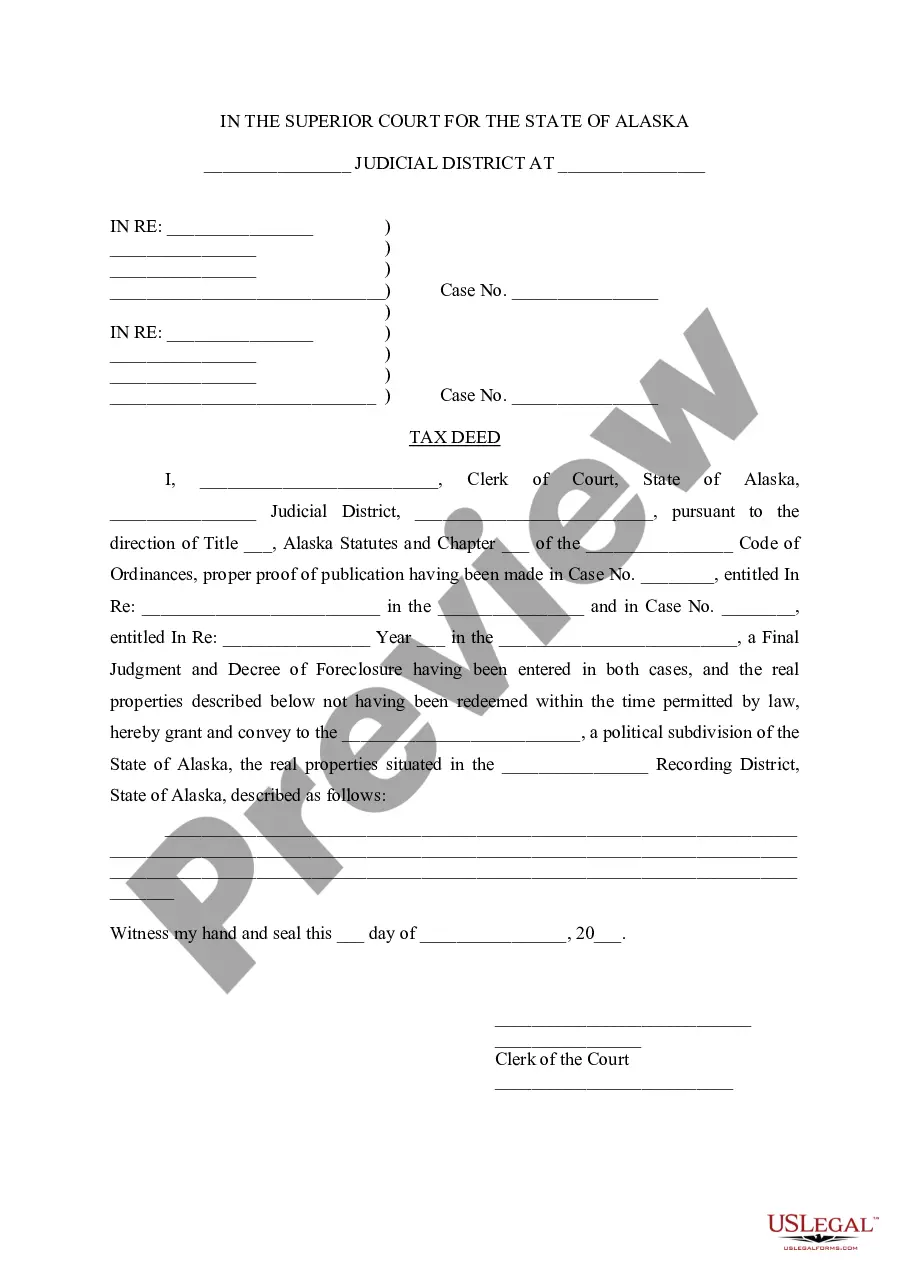
The tax deed is a legal document that transfers ownership of a property to a government entity when the property owner fails to pay property taxes. This form is used when a government agency intends to sell the property to recover unpaid taxes. Unlike other property transfer documents, a tax deed specifically involves properties that have gone through the foreclosure process due to tax delinquency.
Main sections of this form
- Identification of the clerk of court and judicial district.
- Details of the case number pertaining to the tax deed.
- Legal authority cited as per Alaska Statutes and local ordinances.
- Property description including location and legal identification.
- Signature and seal of the clerk of court for validation.
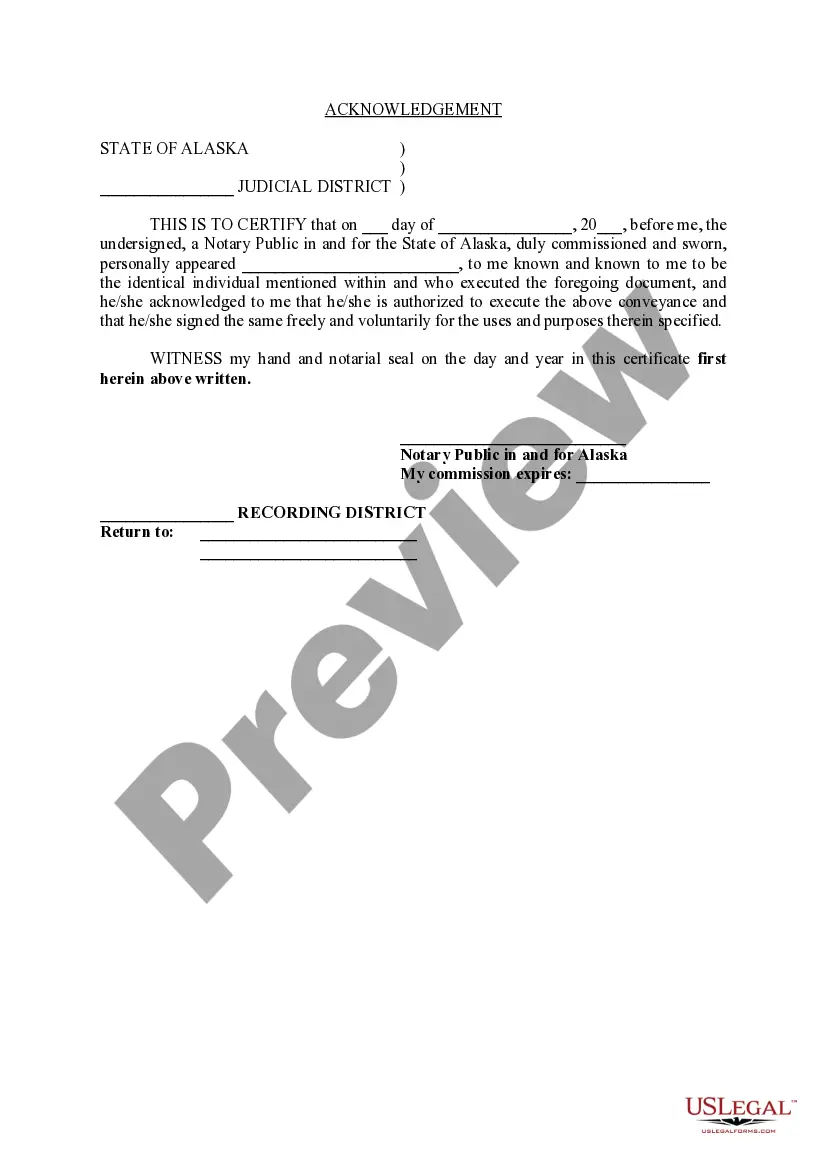
- Notary acknowledgment to confirm the identity of the signer.
When this form is needed
This form should be used when a property owner has failed to pay property taxes, and a government body has initiated a foreclosure process resulting in a tax deed. It is necessary to formalize the transfer of ownership from the private owner to the government, allowing the agency to proceed with the sale of the property to recover the outstanding taxes.
Intended users of this form
- Government agencies handling property tax foreclosures.
- Clerks of court responsible for recording and administering tax deeds.
- Legal representatives assisting government entities in property matters.
Completing this form step by step
- Fill in the clerk of court's name and the applicable judicial district.
- Enter the relevant case numbers for tax deed proceedings.
- Provide the legal authority that allows for the issuance of the tax deed.
- Detail the property description, including its location and boundaries.
- Obtain the clerk's signature and seal on the document.
- Have the deed notarized to confirm its validity.
Does this form need to be notarized?
Yes, this form must be notarized to be legally valid. It is essential to have a notary public witness the signature of the clerk to ensure the document complies with state laws. US Legal Forms offers integrated online notarization, available 24/7, providing a secure video call option with legal equivalence, eliminating the need for travel.
Get your form ready online
Our built-in tools help you complete, sign, share, and store your documents in one place.
Make edits, fill in missing information, and update formatting in US Legal Forms—just like you would in MS Word.
Download a copy, print it, send it by email, or mail it via USPS—whatever works best for your next step.
Sign and collect signatures with our SignNow integration. Send to multiple recipients, set reminders, and more. Go Premium to unlock E-Sign.
If this form requires notarization, complete it online through a secure video call—no need to meet a notary in person or wait for an appointment.
We protect your documents and personal data by following strict security and privacy standards.

Make edits, fill in missing information, and update formatting in US Legal Forms—just like you would in MS Word.

Download a copy, print it, send it by email, or mail it via USPS—whatever works best for your next step.

Sign and collect signatures with our SignNow integration. Send to multiple recipients, set reminders, and more. Go Premium to unlock E-Sign.

If this form requires notarization, complete it online through a secure video call—no need to meet a notary in person or wait for an appointment.

We protect your documents and personal data by following strict security and privacy standards.
Mistakes to watch out for
- Failing to accurately describe the property can lead to disputes.
- Not including the necessary case numbers, which can invalidate the deed.
- Omitting the clerk's signature or seal may render the deed unenforceable.
Why use this form online
- Convenience of downloading the form directly from your device.
- Easy to edit the document to meet your specific needs.
- Reliable templates that comply with legal standards.
Looking for another form?

Form popularity
FAQ
The property at a tax deed sale is usually sold for the amount due in unpaid taxes, plus fees and interest charges.Before being transferred to the winning bidder, the property should be cleared of all mortgages and liens against it.
Tax deed sales must eliminate any community association liens and debts acquired prior to the tax deed. Tax deed sales must reduce any code enforcement liens to hard costs if the tax deed investor timely addresses such liens and underlying issues after purchasing the tax deed.
The Bottom LineTax deed auctions let investors acquire real estate that has been foreclosed because of unpaid taxes. Properties can be purchased at significant discounts to market value, but the complexity and risks of tax deed investing are also significant.
A tax deed grants ownership of a property to a government body when the owner fails to pay the associated property taxes. Tax deeds are sold to the highest bidder at auction for a minimum bid of the outstanding taxes plus interest and the costs associated with the sale.
Once the property is sold at a tax deed sale, the property is conveyed to the new buyer, wiping out most debts or encumbrances, including mortgages, and giving the buyer ownership to the property from the sale date forward.
When homeowners fail to pay their property taxes, some tax jurisdictions choose to hold tax deed home sales to make back the money they are owed. Interested buyers can register to participate as a bidder on these homes in a tax deed auction.
The biggest difference between a tax deed sale and the foreclosure sale has to do with due diligence by the buyer.The buyer is also liable for homeowner or condominium association fees after the tax deed is issued by the Clerk of Court.
In a tax deed sale, the property itself is sold. The sale takes place through an auction, with a minimum bid of the amount of back taxes owed plus interest, as well as costs associated with selling the property. The highest bidder wins the property.