New York Affidavit In Support of Motion for Order Approving Relative as Foster Parent
What this document covers
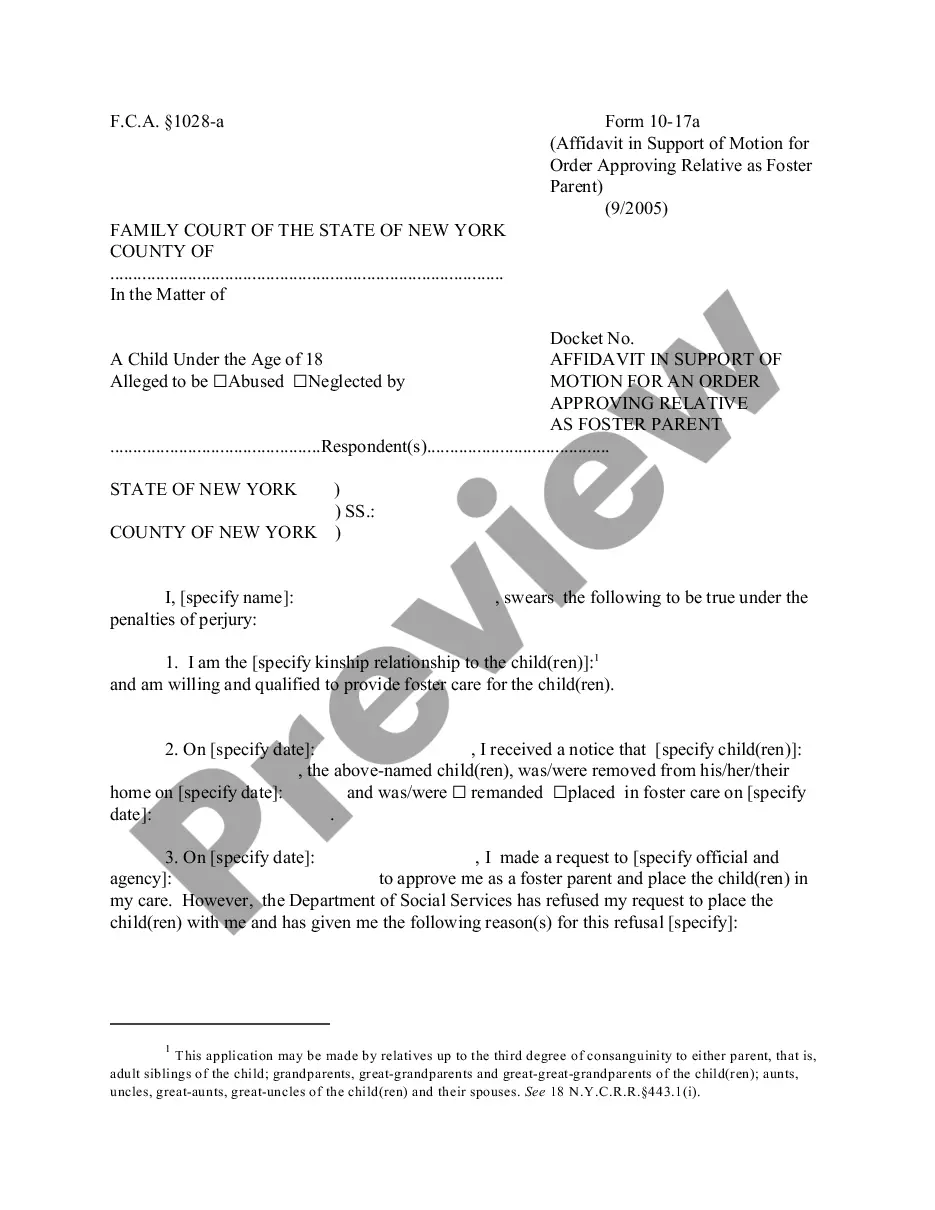
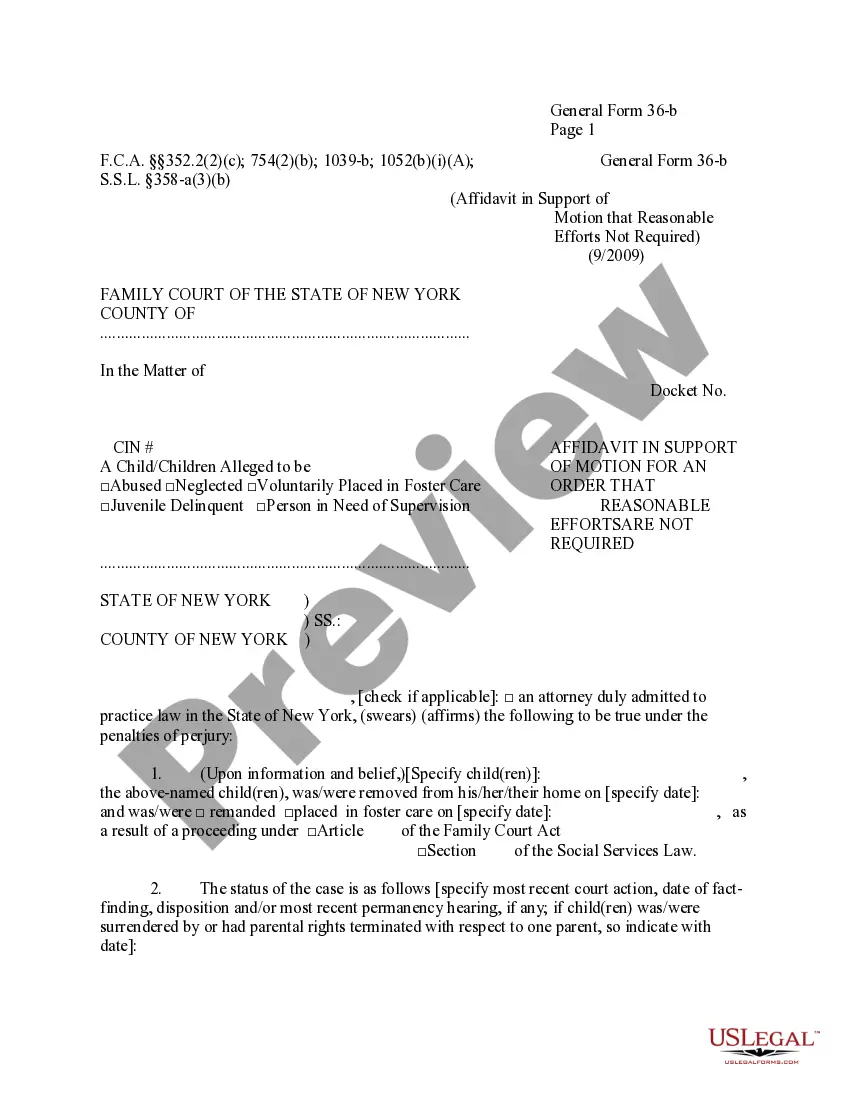
The Affidavit in Support of Motion for Order Approving Relative as Foster Parent is an official New York Family Court document that allows relatives of a child to formally request approval to serve as their foster parent. This affidavit is specifically tailored for individuals related to the child up to the third degree of consanguinity. It differs from other foster care forms by focusing on relatives seeking to care for a child that has been removed from their home due to abuse or neglect allegations.
Key parts of this document
- Affiant's Relationship: The form requires the caregiver to specify their relationship to the child.
- Notice of Removal: The affiant must detail the circumstances surrounding the child's removal from their home.
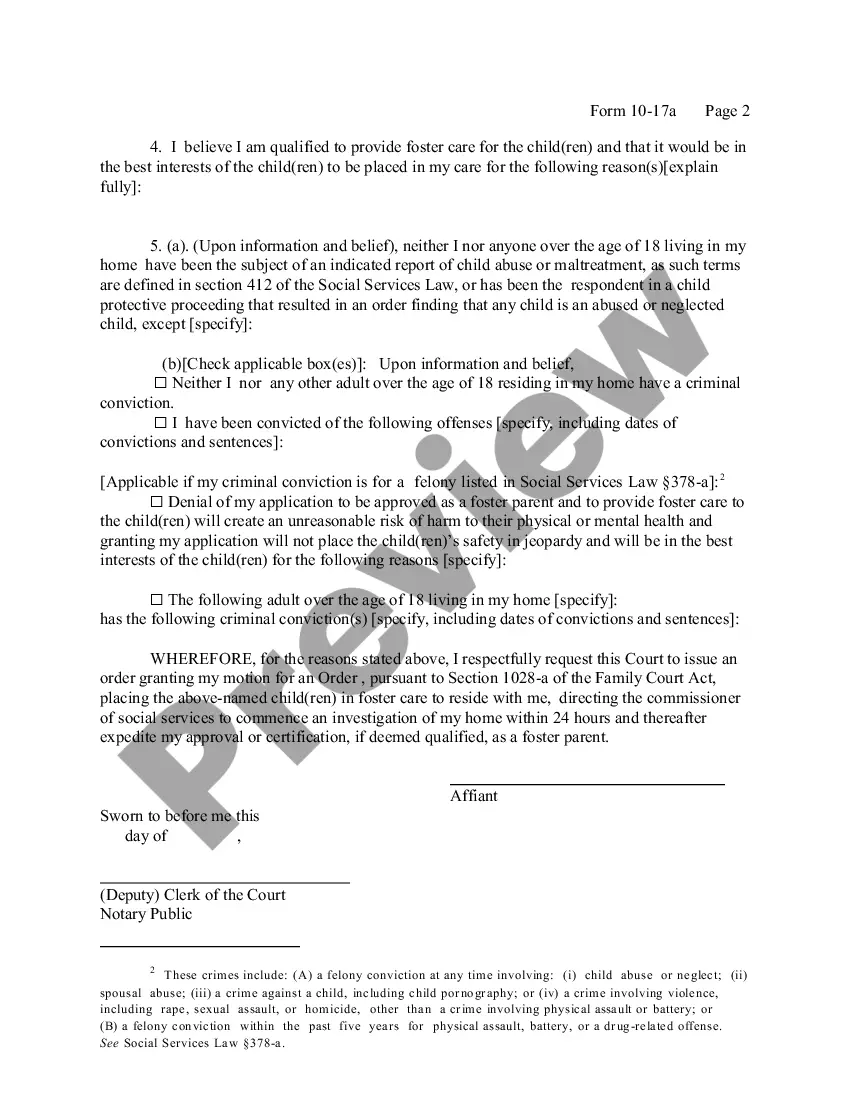
- Request Details: The form includes a section where the requester can explain their qualifications and why placement in their care is in the child's best interest.
- Criminal Background Disclosures: It asks for information regarding any criminal history of the affiant or adult residents in the home.
- Request for Investigation: The form concludes with a request for the court to mandate a social services investigation of the home.
When to use this document
This affidavit is used when a relative wishes to step forward as a potential foster caregiver for a child under the age of eighteen who has been placed in the foster system following allegations of abuse or neglect. It is appropriate in situations where the biological parents cannot provide a safe environment, and a relative believes they can offer a better living situation for the child.
Who this form is for
- Individuals related to the child (such as siblings, grandparents, aunts, uncles) up to the third degree.
- Relatives interested in becoming foster parents for children who have been removed due to abuse or neglect.
- Caregivers willing and qualified to provide a stable and supportive home for the child.
Completing this form step by step
- Identify the parties: Enter your name and relationship to the child at the top of the form.
- Document the child's circumstances: Specify the details of the child's removal, including dates and reasons.
- Describe your qualifications: Clearly state why you believe you are capable of providing foster care for the child.
- Disclose criminal history: Answer all questions regarding any criminal convictions for you or other adults in your household.
- Provide a signature: Sign and date the form in the presence of a notary public to affirm the information is true.
Does this form need to be notarized?
Yes, this form must be notarized to be legally valid. You can take advantage of US Legal Forms' integrated online notarization service, which provides secure video calls with notaries available twenty-four hours a day, ensuring you don't have to travel to a physical location.
Get your form ready online
Our built-in tools help you complete, sign, share, and store your documents in one place.
Make edits, fill in missing information, and update formatting in US Legal Forms—just like you would in MS Word.
Download a copy, print it, send it by email, or mail it via USPS—whatever works best for your next step.
Sign and collect signatures with our SignNow integration. Send to multiple recipients, set reminders, and more. Go Premium to unlock E-Sign.
If this form requires notarization, complete it online through a secure video call—no need to meet a notary in person or wait for an appointment.
We protect your documents and personal data by following strict security and privacy standards.

Make edits, fill in missing information, and update formatting in US Legal Forms—just like you would in MS Word.

Download a copy, print it, send it by email, or mail it via USPS—whatever works best for your next step.

Sign and collect signatures with our SignNow integration. Send to multiple recipients, set reminders, and more. Go Premium to unlock E-Sign.

If this form requires notarization, complete it online through a secure video call—no need to meet a notary in person or wait for an appointment.

We protect your documents and personal data by following strict security and privacy standards.
Typical mistakes to avoid
- Failing to properly identify the relationship to the child, potentially affecting the application.
- Not including significant details regarding the child's removal or the reasons for the request.
- Overlooking the requirement to disclose all relevant criminal history information.
- Not signing the document in front of a notary public, making it legally invalid.
Benefits of using this form online
- Convenient access to legal forms anywhere and anytime, saving you travel time.
- Edit and customize the form easily according to your specific circumstances.
- Reliable templates drafted by licensed attorneys to ensure compliance with legal standards.
Key takeaways
- The affidavit is crucial for relatives seeking to become foster parents for children in a vulnerable state.
- Accurate documentation and disclosure are essential for the approval process.
- Ensure notarization is completed to validate the form legally.
Looking for another form?
Form popularity
FAQ
However, when a person is awaiting trial, writing a letter to the judge will not help. At best, the letter will go unread by the judge, and will be of no help. In a worst-case scenario, the letter will end up being used by the prosecution as evidence against that person.
A motion is a written request or proposal to the court to obtain an asked-for order, ruling, or direction.Courts usually have specific requirements for filing a motion, so either consult your attorney or look up the local court rules to understand what you will need as you move forward.
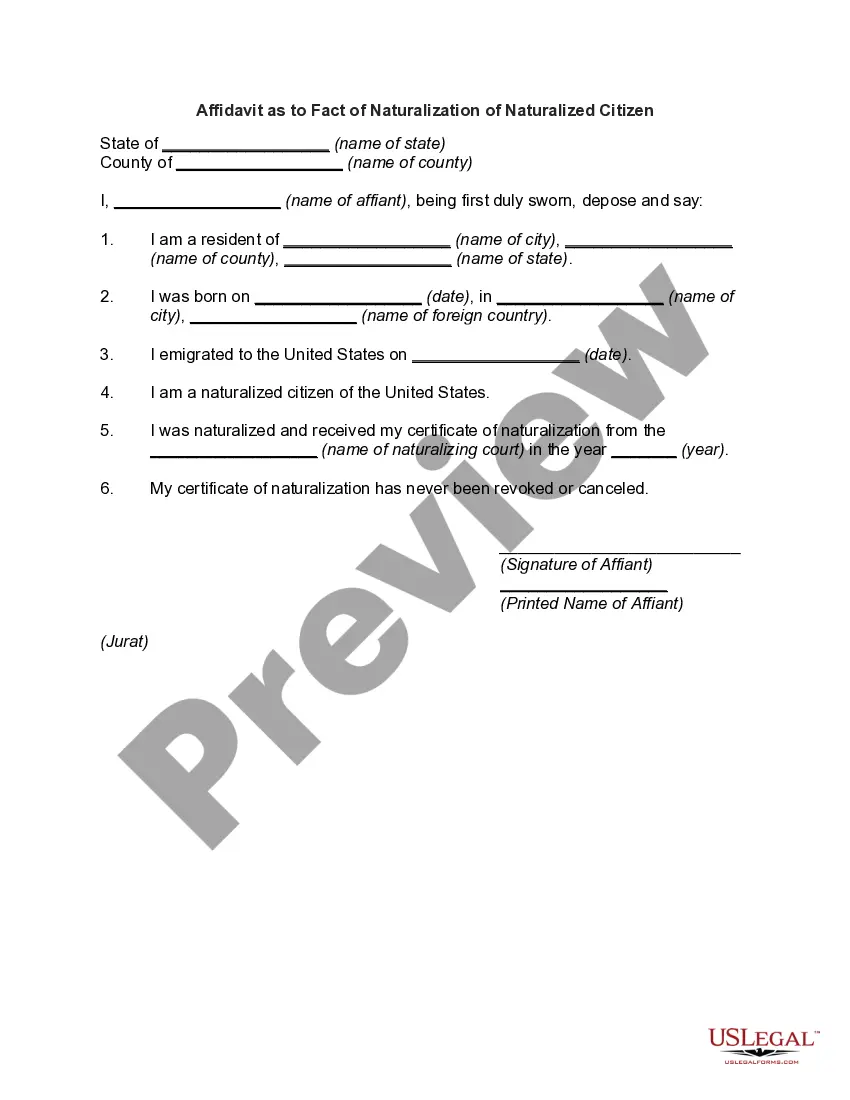
In the sentence, the person writing the statement must state that he or she is stating that the information is accurate. (Example: I, Jane Doe, solemnly swear that the contents of this document are true and correct, and that I agree to abide by the terms in this affidavit.)
Although affidavits are considered legal documents, anyone can draft one. As long as it is signed, witnessed, and notarized correctly, it will be valid. That means that you do not have to use a lawyer to create an affidavit.
Ask the court for a motion date. Identify and fill out your motion forms. Serve and file your motion forms. Confirm that you will attend the motion. Go to your motion hearing. Receive the judge's decision.
You can't write to the judge. You can hire your own attorney to make your case to the court.
Examples Of Motion Our daily activities, like walking, running, closing the door, etc. involve motion.The flow of air in and out of our lungs is also an example of motion. The automobiles that carry passengers from the place of pick up to the destination possess motion.
You write your motion. You file your motion with the court clerk. The court clerk inserts the date and time your motion will be heard by the judge. You serve (mail) your motion to the other side.
General format - each motion generally consists of a case caption, a title that briefly identifies the relief sought, a series of numbered paragraphs that explains -- in a logical way -- why you are entitled to that relief, a prayer for relief, a signature block, a certification that a copy of the motion was sent to
I ____ (Applicant Name as per id proof), residing at _______(Address as per address proof) do solemnly affirm and stated as under: I am _____ and my name _______, appearing on the enclosed ID proof, is single name. My father's name is ________________.