New York Quitclaim Deed from Three Individuals to a Limited Liability Company
What is this form?
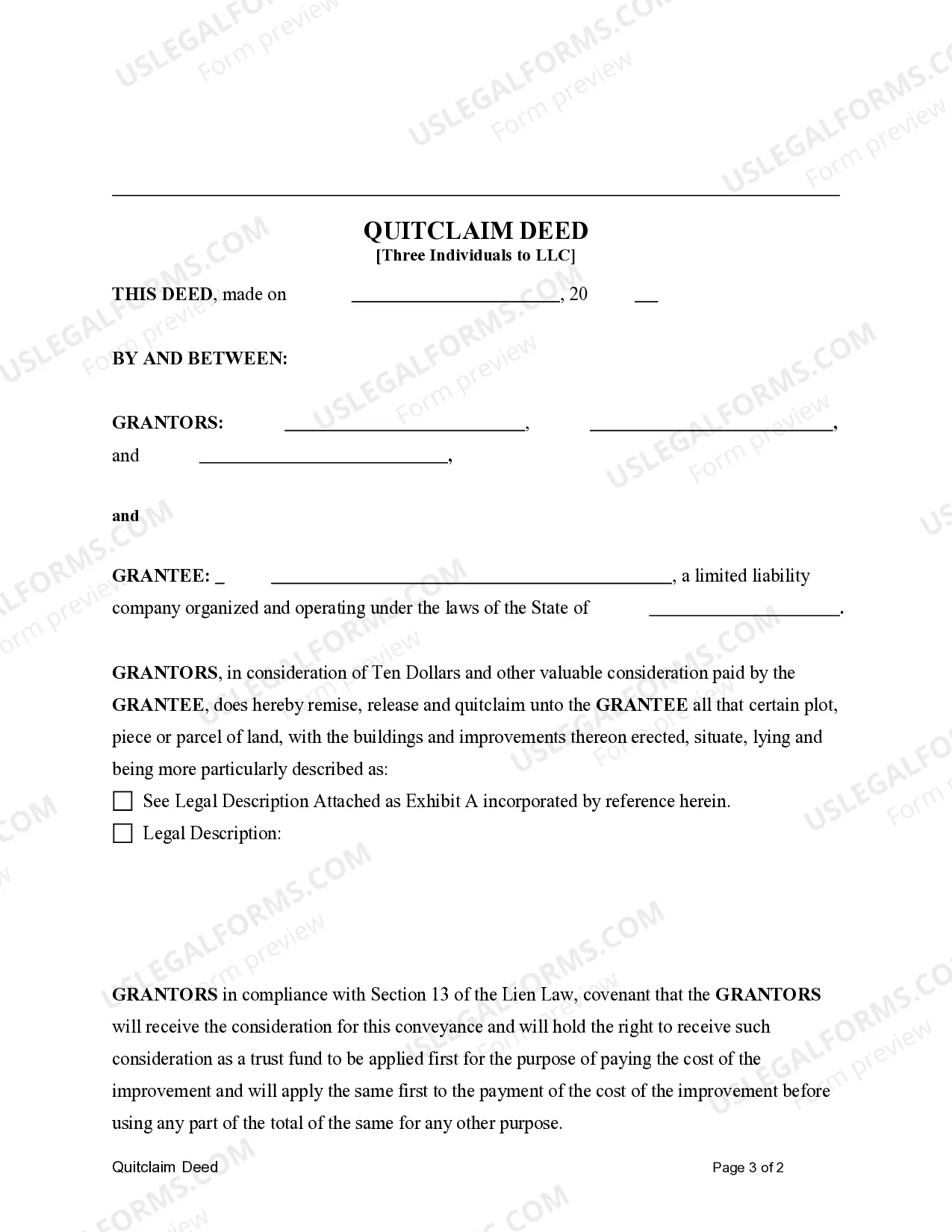
This form is a Quitclaim Deed specifically designed for transferring property ownership from three individuals (Grantors) to a limited liability company (Grantee). A quitclaim deed is a legal document that conveys any interest the Grantors have in the property without making any warranties about the title. This means that the Grantee assumes the title as-is, without guarantees of ownership. This form differs from other types of deeds, like warranty deeds, which offer more legal protection to the buyer.
Form components explained
- Names and addresses of all Grantors involved in the property transfer.
- Identification of the Grantee as a limited liability company.
- A detailed legal description of the property being conveyed.
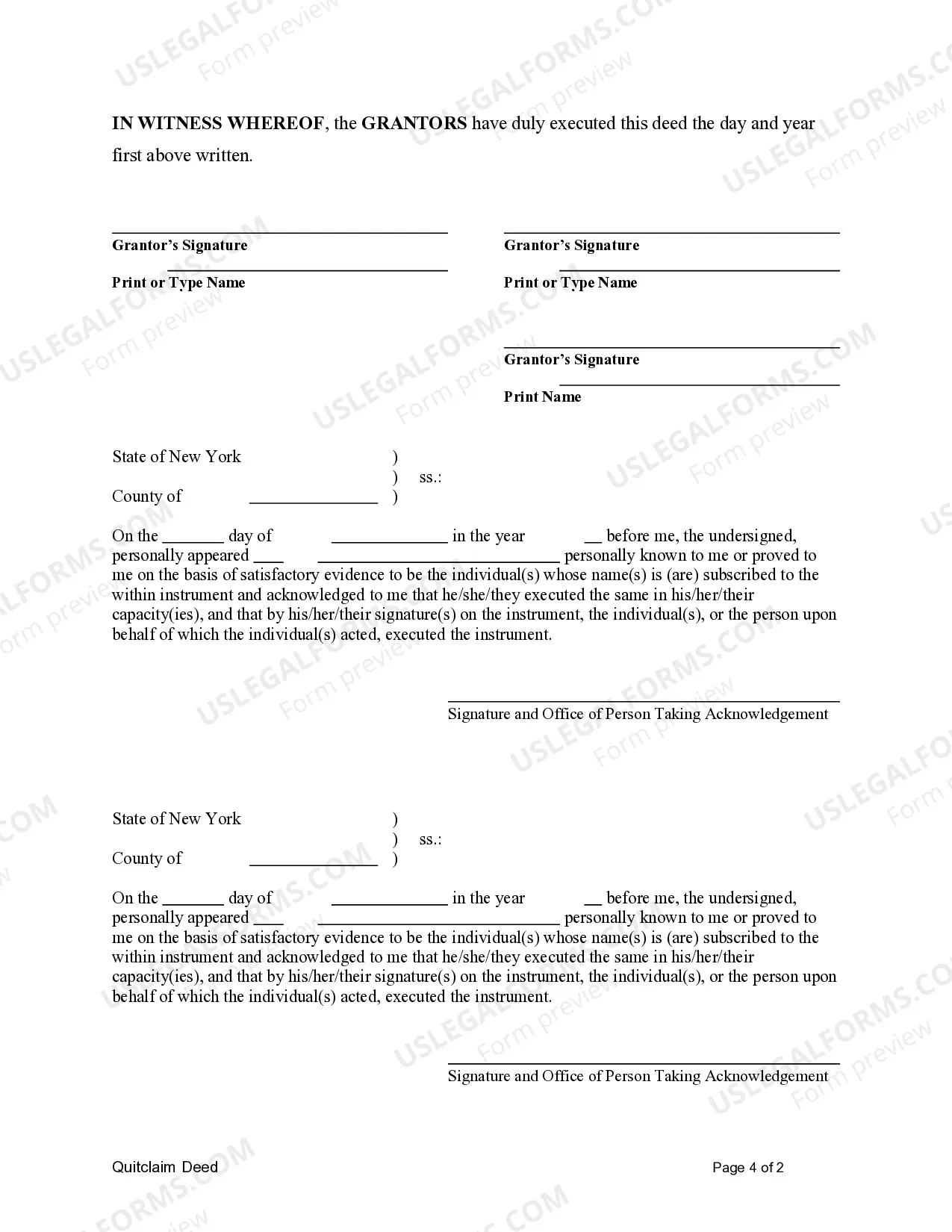
- Signatures of all Grantors, along with their acknowledgment by a notary or official.
- Date of execution, indicating when the deed was signed.


Common use cases
This Quitclaim Deed should be used when three individuals wish to transfer their interests in a piece of property to a limited liability company. Common situations include the transfer of property owned jointly among family members or business partners to a newly formed LLC, or to streamline property management under a single entity. It is particularly useful when the Grantors do not require the legal assurances typically found in other forms of deeds.
Who can use this document
- Individuals who currently hold title to a property and wish to transfer ownership to a limited liability company.
- Property owners looking to simplify their property management structure.
- Business partners or family members intending to consolidate property under a legal entity.
How to complete this form
- Identify and list the names and addresses of all Grantors.
- Clearly specify the limited liability company as the Grantee.
- Attach a detailed legal description of the property, which is typically found in the propertyâs title deed or tax records.
- Have all Grantors sign the document in the presence of a notary public.
- Date the form at the time of signing.
Does this form need to be notarized?
This form does not typically require notarization unless specified by local law. However, having it notarized can provide additional legal credibility and is often recommended to validate the signatures of the Grantors.
Get your form ready online
Our built-in tools help you complete, sign, share, and store your documents in one place.
Make edits, fill in missing information, and update formatting in US Legal Forms—just like you would in MS Word.
Download a copy, print it, send it by email, or mail it via USPS—whatever works best for your next step.
Sign and collect signatures with our SignNow integration. Send to multiple recipients, set reminders, and more. Go Premium to unlock E-Sign.
If this form requires notarization, complete it online through a secure video call—no need to meet a notary in person or wait for an appointment.
We protect your documents and personal data by following strict security and privacy standards.

Make edits, fill in missing information, and update formatting in US Legal Forms—just like you would in MS Word.

Download a copy, print it, send it by email, or mail it via USPS—whatever works best for your next step.

Sign and collect signatures with our SignNow integration. Send to multiple recipients, set reminders, and more. Go Premium to unlock E-Sign.

If this form requires notarization, complete it online through a secure video call—no need to meet a notary in person or wait for an appointment.

We protect your documents and personal data by following strict security and privacy standards.
Mistakes to watch out for
- Failing to include a complete legal description of the property.
- Not having all Grantors sign the deed.
- Neglecting to get the document notarized, if required by local laws.
- Using outdated templates which may not comply with current state laws.
Benefits of using this form online
- Downloadable and editable format makes it easy to complete at your convenience.
- Access to attorney-drafted templates ensures compliance with legal standards.
- Easy printing options allow for physical copies to be created for signatures and filing.
Looking for another form?

Form popularity
FAQ
But you might be wondering if an owner can transfer a deed to another person without a real estate lawyer. The answer is yes. Parties to a transaction are always free to prepare their own deeds.A quitclaim deed, for example, is far simpler than a warranty deed.
Fill in the deed form. Print it out. Have the grantor(s) sign and get the signature(s) notarized. Complete a transfer tax form, Form TP-584. Complete and print out Form RP-5217 (or, if you are in New York City, Form RP-5217NYC).
Fill in the deed form. Print it out. Have the grantor(s) sign and get the signature(s) notarized. Complete a transfer tax form, Form TP-584. Complete and print out Form RP-5217 (or, if you are in New York City, Form RP-5217NYC).
For a quitclaim deed to be valid, it has to be recorded at the county recorder's office in the county where the property is located. If you're using an attorney, paralegal or title company to handle the transaction for you, they will take care of this.
First, so long as you own the property you purchased, you are obligated to pay its property taxes. One way to get a warranty deed to the property you acquired via a foreclosure where you got a quit claim deed for it is to simply deed the property to yourself or a trust that you created as a grant (warranty) deed.
To use a Quitclaim Deed to add someone to a property deed or title, you would need to create a Quitclaim Deed and list all of the current owners in the grantor section. In the grantee section, you would list all of the current owners as well as the person you would like to add.
An unrecorded quit claim deed is still valid.Failure to record a deed could render transfer or mortgaging of the property impossible and create numerous legal difficulties. The purpose of the recording a quit claim deed is to give notice to the world that there has been a change in ownership.
A person who signs a quitclaim deed to transfer property they do not own results in no title at all being transferred since there is no actual ownership interest. The quitclaim deed only transfers the type of title you own.
Fees to File a Quitclaim Deed in New York As of 2018, the basic fee for filing a quitclaim deed of residential or farm property is $125, while the fee for all other property is $250. These fees are for the RP-5217 form.