New Mexico New Resident Guide
Overview of this form
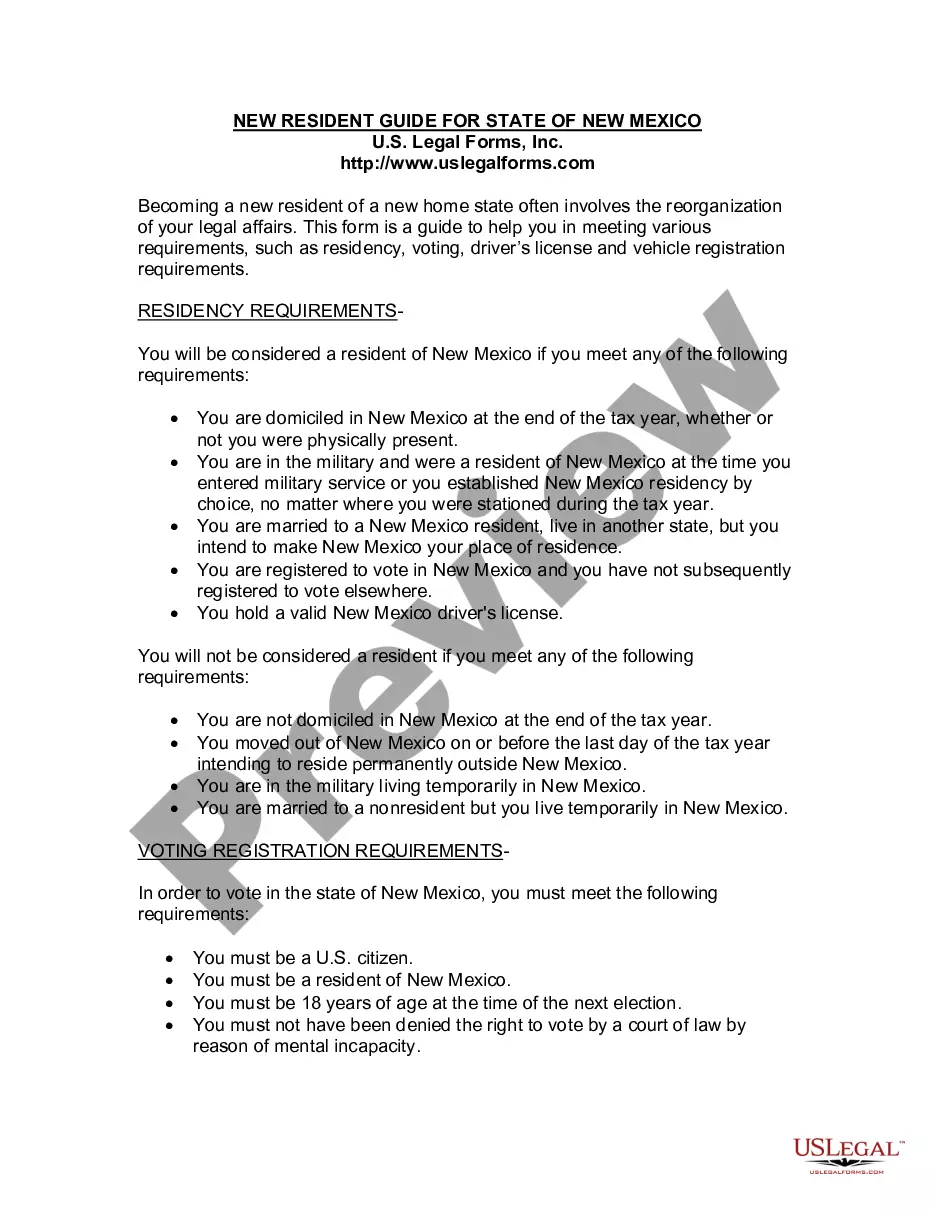
The New Resident Guide is a comprehensive informational resource designed to assist individuals transitioning into a new state. This form outlines essential state requirements related to residency, voter registration, driver's licenses, and vehicle title and registration. Unlike other legal forms, the New Resident Guide is focused specifically on the needs of those relocating, providing a clear roadmap to navigate the bureaucratic process effectively.
Key components of this form
- Residency requirements detailing how to establish legal residence.
- Voting registration criteria including age and residency stipulations.
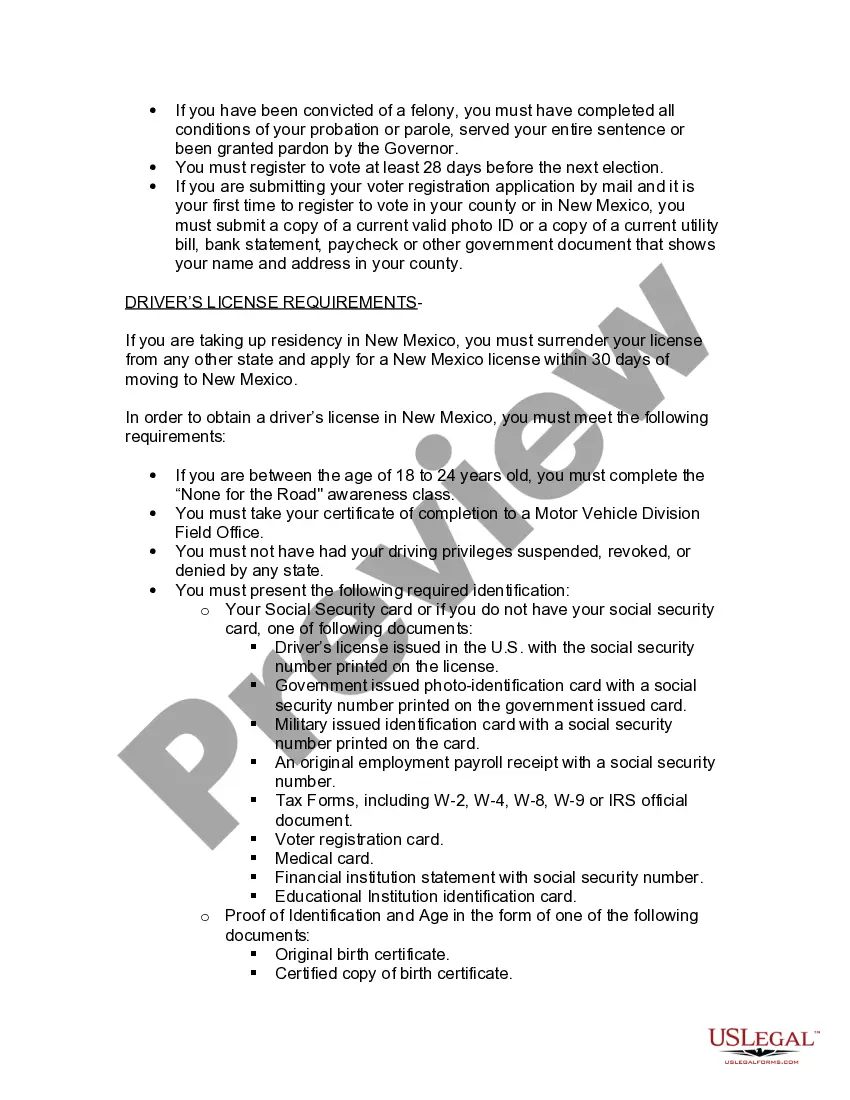
- Driver's license application guidelines for new residents.
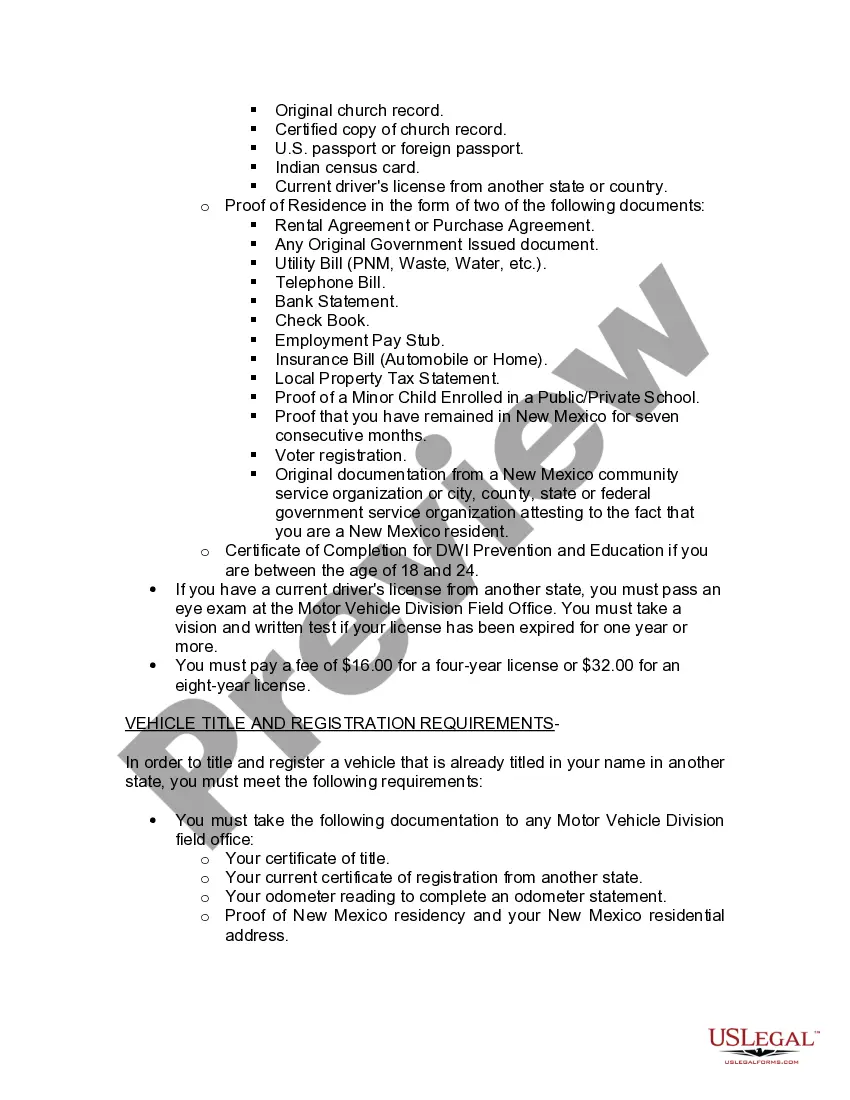
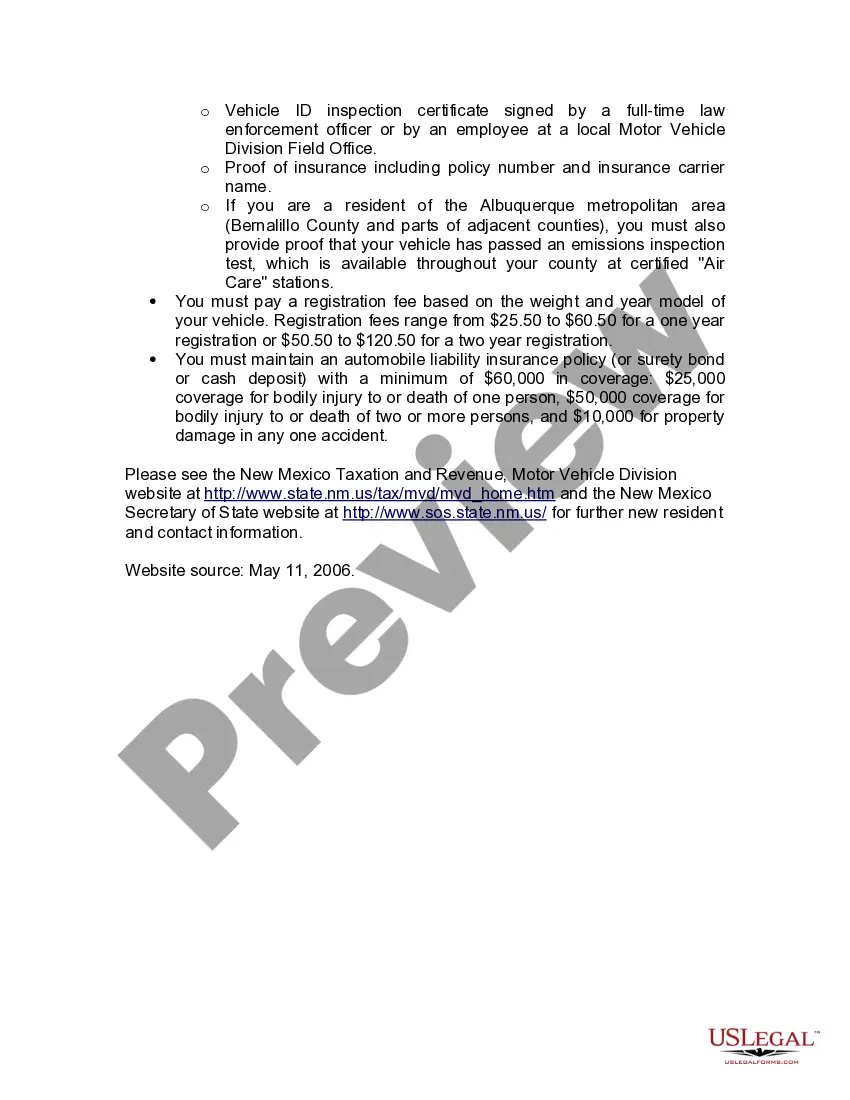
- Vehicle title and registration requirements for transferring vehicles from another state.
- Identification documents required to obtain a New Mexico driver's license.
Situations where this form applies
This form is essential for new residents who are relocating to New Mexico. You should use this guide when you need to understand and comply with the state's regulations regarding residency, voting, driving privileges, and registering your vehicle. It is particularly helpful when adjusting your legal residency status and ensuring you meet all necessary local requirements.
Who this form is for
- Individuals or families moving to New Mexico from another state.
- New residents needing to register to vote in New Mexico.
- Persons applying for a New Mexico driver's license after relocating.
- Anyone who has recently moved and needs to register their vehicle in New Mexico.
How to prepare this document
- Review the residency requirements to determine your eligibility.
- Gather the necessary identification documents for voter registration and driver's license application.
- Complete the voter registration form and submit it by the required deadline.
- Visit a Motor Vehicle Division Field Office to apply for a New Mexico driver's license and register your vehicle.
- Ensure you have proof of residency and vehicle insurance when proceeding with registration.
Does this form need to be notarized?
This form does not typically require notarization to be legally valid. However, some jurisdictions or document types may still require it. US Legal Forms provides secure online notarization powered by Notarize, available 24/7 for added convenience.
Get your form ready online
Our built-in tools help you complete, sign, share, and store your documents in one place.
Make edits, fill in missing information, and update formatting in US Legal Forms—just like you would in MS Word.
Download a copy, print it, send it by email, or mail it via USPS—whatever works best for your next step.
Sign and collect signatures with our SignNow integration. Send to multiple recipients, set reminders, and more. Go Premium to unlock E-Sign.
If this form requires notarization, complete it online through a secure video call—no need to meet a notary in person or wait for an appointment.
We protect your documents and personal data by following strict security and privacy standards.

Make edits, fill in missing information, and update formatting in US Legal Forms—just like you would in MS Word.

Download a copy, print it, send it by email, or mail it via USPS—whatever works best for your next step.

Sign and collect signatures with our SignNow integration. Send to multiple recipients, set reminders, and more. Go Premium to unlock E-Sign.

If this form requires notarization, complete it online through a secure video call—no need to meet a notary in person or wait for an appointment.

We protect your documents and personal data by following strict security and privacy standards.
Mistakes to watch out for
- Not providing adequate proof of residency when applying for a driver's license.
- Failing to register to vote by the 28-day deadline before an election.
- Overlooking the specific identification requirements for obtaining a new driver's license.
- Not bringing the correct documentation for vehicle registration, such as out-of-state title and registration.
Advantages of online completion
- Immediate access to the latest requirements for new residents in New Mexico.
- Easy customization and download of the form for personal use.
- Streamlined process that allows you to complete and file forms at your convenience.
- Reliable information drafted by licensed attorneys to ensure accuracy.
Legal use & context
- This guide serves as an informative tool to help new residents comply with state laws.
- Utilizing this form may help avoid legal issues related to residency verification and voting eligibility.
Summary of main points
- The New Resident Guide simplifies understanding the legal requirements for residency in New Mexico.
- It assists with the processes of voter registration, obtaining a driver's license, and vehicle registration.
- Ensuring all documents are complete will help facilitate a smooth transition to becoming a New Mexico resident.
Looking for another form?
Form popularity
FAQ
Find a new place to live in the new state. Establish domicile. Change your mailing address and forward your mail. Change your address with utility providers. Change IRS address. Register to vote. Get a new driver's license. File taxes in your new state.
1. Physical presence. You must be continuously physically present in California for more than one year (366 days) immediately prior to the residence determination date of the term for which you request resident status.
Roads and Traffic- New Mexico has pretty bad roads and it is on the list for states with pretty poor condition on rural roads.Crime Rate- New Mexico is not safe place for living. As research shows that the percentage of violent crimes per 1,000 residents is 7.83%, while the national one is only 4%.
A person must physically reside in New Mexico for the twelve consecutive months immediately preceding the term for which the resident classification is requested. Only persons who are financially independent may establish residency apart from parents or guardians.
U.S. citizenship or U.S. permanent residency. The 12-Month Consecutive Presence Requirement: You must physically reside in New Mexico for the 12 months immediately preceding the term in which you request resident classification.
How do you establish New Mexico residency for tuition purposes? The 12-Month Consecutive Presence Requirement: You must physically reside in New Mexico for the 12 months immediately preceding the term in which you request resident classification.
The documents we require include: Your current, unexpired driver's license from your previous home state. Proof of identification number (you can use your social security card) Two proofs of your current New Mexico address (you can use a utility bill or rental agreement)
A New Mexico Resident is an individual who is domiciled in New Mexico or physically present in the state for 185 days or more (no matter where domiciled).A Nonresident is an individual that is not domiciled in New Mexico for any part of the year and did not spend 185 days or more in New Mexico.