New Mexico Subcontractor's Notice to Subcontractor or Materialman - Individual
Understanding this form
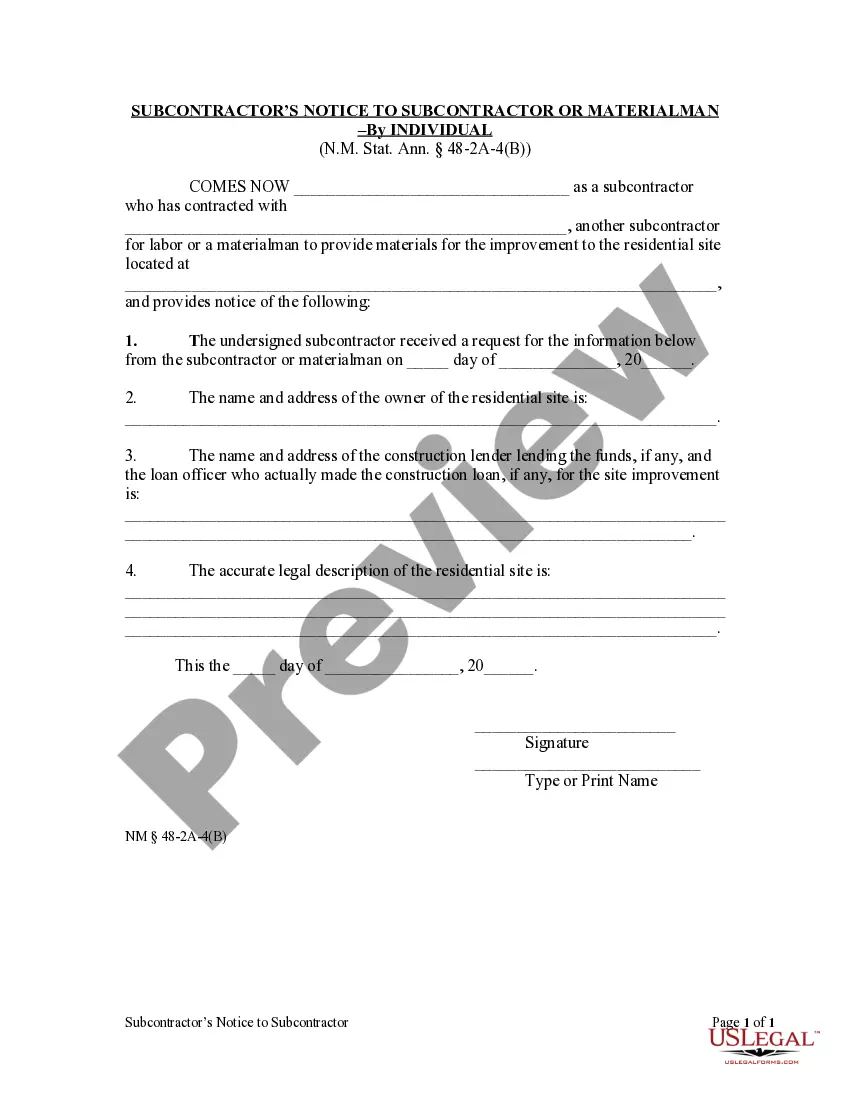
The Subcontractor's Notice to Subcontractor or Materialman form is a legal document specifically designed for individual subcontractors. This form serves to formally notify another subcontractor or materialman regarding the request for information related to labor or materials provided for a residential site improvement. It is distinct from other construction-related forms as it focuses on the communication between subcontractors, ensuring all parties are informed of the project details, owner, and lender information pertinent to the construction work.
Key components of this form
- Information about the subcontractor providing the notice.
- Details of the subcontractor or materialman involved in the contract.
- Date of the request for information received.
- Name and address of the residential site owner.
- Name and address of the construction lender and loan officer, if applicable.
- Legal description of the residential site.

Common use cases
This form should be used when an individual subcontractor has received a request for information from another subcontractor or materialman regarding a project related to residential site improvements. It serves to document and communicate necessary project details, ensuring that all parties are aligned and aware of their responsibilities and obligations under the contract.
Who can use this document
- Individual subcontractors working on residential construction projects.
- Subcontractors who are required to communicate project details to other subcontractors or material suppliers.
- Contractors who need to document the exchange of information for legal or project management purposes.
How to complete this form
- Identify the parties involved, including your information and that of the subcontractor or materialman.
- Specify the date you received the request for information.
- Enter the name and address of the owner of the residential site.
- Include the details of the construction lender, if applicable, including the loan officer's information.
- Provide the accurate legal description of the residential site.
- Sign and date the form to confirm its validity.
Notarization guidance
In most cases, this form does not require notarization. However, some jurisdictions or signing circumstances might. US Legal Forms offers online notarization powered by Notarize, accessible 24/7 for a quick, remote process.
Get your form ready online
Our built-in tools help you complete, sign, share, and store your documents in one place.
Make edits, fill in missing information, and update formatting in US Legal Forms—just like you would in MS Word.
Download a copy, print it, send it by email, or mail it via USPS—whatever works best for your next step.
Sign and collect signatures with our SignNow integration. Send to multiple recipients, set reminders, and more. Go Premium to unlock E-Sign.
If this form requires notarization, complete it online through a secure video call—no need to meet a notary in person or wait for an appointment.
We protect your documents and personal data by following strict security and privacy standards.

Make edits, fill in missing information, and update formatting in US Legal Forms—just like you would in MS Word.

Download a copy, print it, send it by email, or mail it via USPS—whatever works best for your next step.

Sign and collect signatures with our SignNow integration. Send to multiple recipients, set reminders, and more. Go Premium to unlock E-Sign.

If this form requires notarization, complete it online through a secure video call—no need to meet a notary in person or wait for an appointment.

We protect your documents and personal data by following strict security and privacy standards.
Common mistakes
- Failing to accurately enter the date of the request.
- Omitting the legal description of the property.
- Not providing complete contact information for the construction lender, if applicable.
- Submitting the form without proper identification of all parties involved.
Benefits of completing this form online
- Easy access to a professionally drafted legal document.
- Ability to fill out the form at your convenience, saving time.
- Editability allows for customization to meet specific project needs.
- Downloadable format ensures you have a copy readily available for your records.
Legal use & context
- This form is an important tool for subcontractors to establish clear communication with other parties involved in residential improvement projects.
- It serves as a legally recognized document, which can be used as evidence if disputes arise concerning construction agreements.
- Completing this form accurately can help prevent payment disputes or other issues related to subcontracting work.
What to keep in mind
- The Subcontractor's Notice to Subcontractor or Materialman is essential for maintaining clear communication in residential construction.
- Understanding how to properly fill out this form can significantly enhance project documentation and compliance.
- Always verify state-specific requirements to ensure the form meets legal standards.
Looking for another form?

Form popularity
FAQ
A lien is essentially a claim for repayment of a debt. In the construction context, a lien is of considerable importance because it offers considerable power to a subcontractor to seek payment from an owner through the property itself for a debt owed to the subcontractor by a general contractor or other third party.
The simplest way to prevent liens and ensure that subcontractors and suppliers are paid is to pay with joint checks. This is when both parties endorse the check. Compare the contractor's materials or labor bill to the schedule of payments in your contract and the Preliminary Notices.
What Is a Mechanics' (Construction) Lien? When a contractor files a mechanics' (construction) lien on your home, the lien makes your home into what's called security for an outstanding debt, which the contractor claims is due and unpaid for services or materials.
Formalize a defense for disputing the amount of the lien. Gather supporting documentation for your rebuttal, depending on the type of lien. Contact the agent representing the creditor to dispute the amount of the claim. Negotiate a payment settlement with the creditor if you cannot pay the amount you owe in full.
Legally, an unpaid contractor, subcontractor or supplier can file a lien (sometimes called a mechanic's lien) that could eventually force the sale of your home in place of compensation.Conversely, if the contractor who worked on your project does not pay for materials, a supplier could place a lien on your property.
Legally, an unpaid contractor, subcontractor or supplier can file a lien (sometimes called a mechanic's lien) that could eventually force the sale of your home in place of compensation.Conversely, if the contractor who worked on your project does not pay for materials, a supplier could place a lien on your property.
Negotiate with the contractor who placed the lien (the "lienor" to remove it. Obtain a lien bond to discharge the lien, or. File a lawsuit to vacate the lien.
New Mexico mechanics liens are perfected by filing the claim in the county clerk's office where the property is physically located. If the property is situated in more than one county, the claim should be filed in the clerk's office of all counties it is located in.