New Mexico Final Decree of Divorce
What this document covers
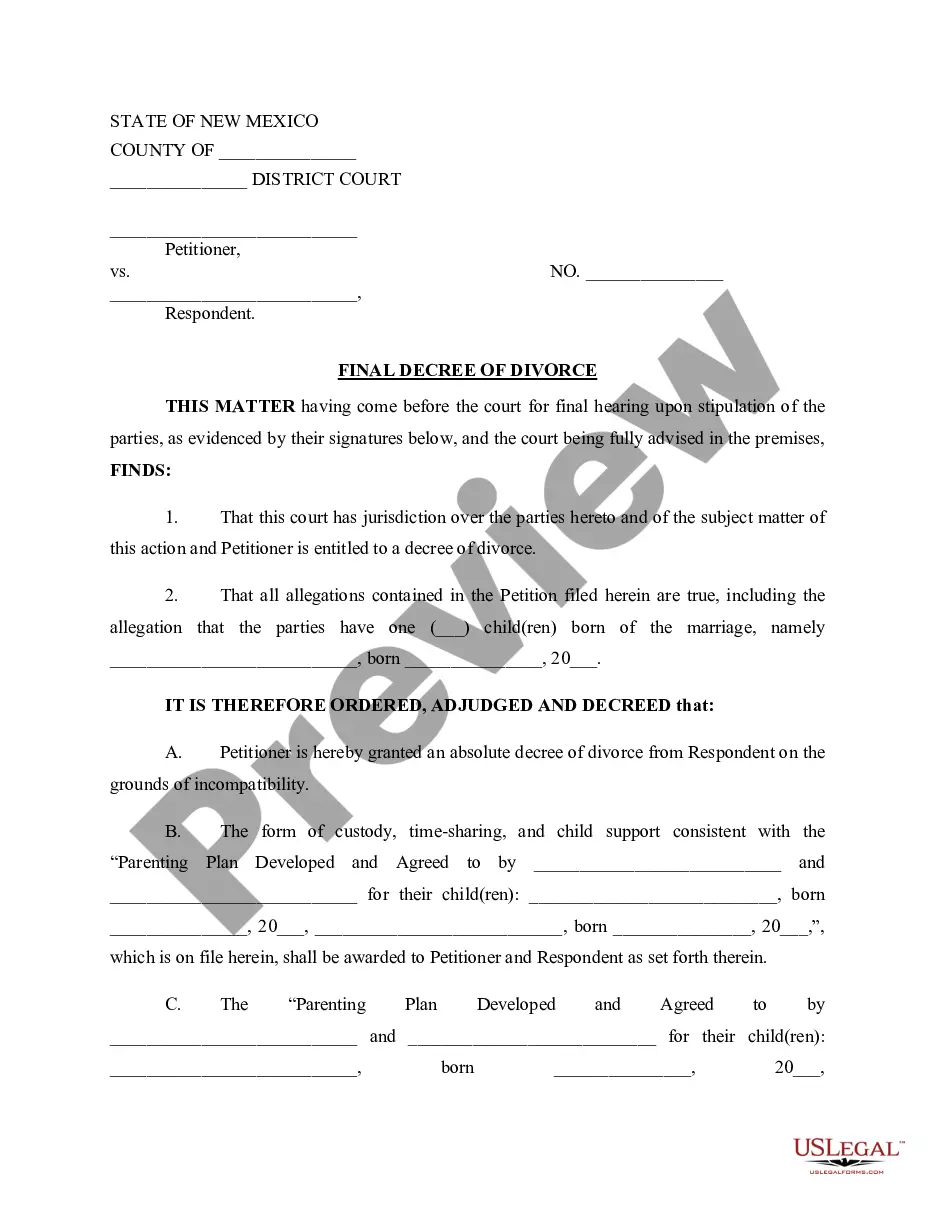
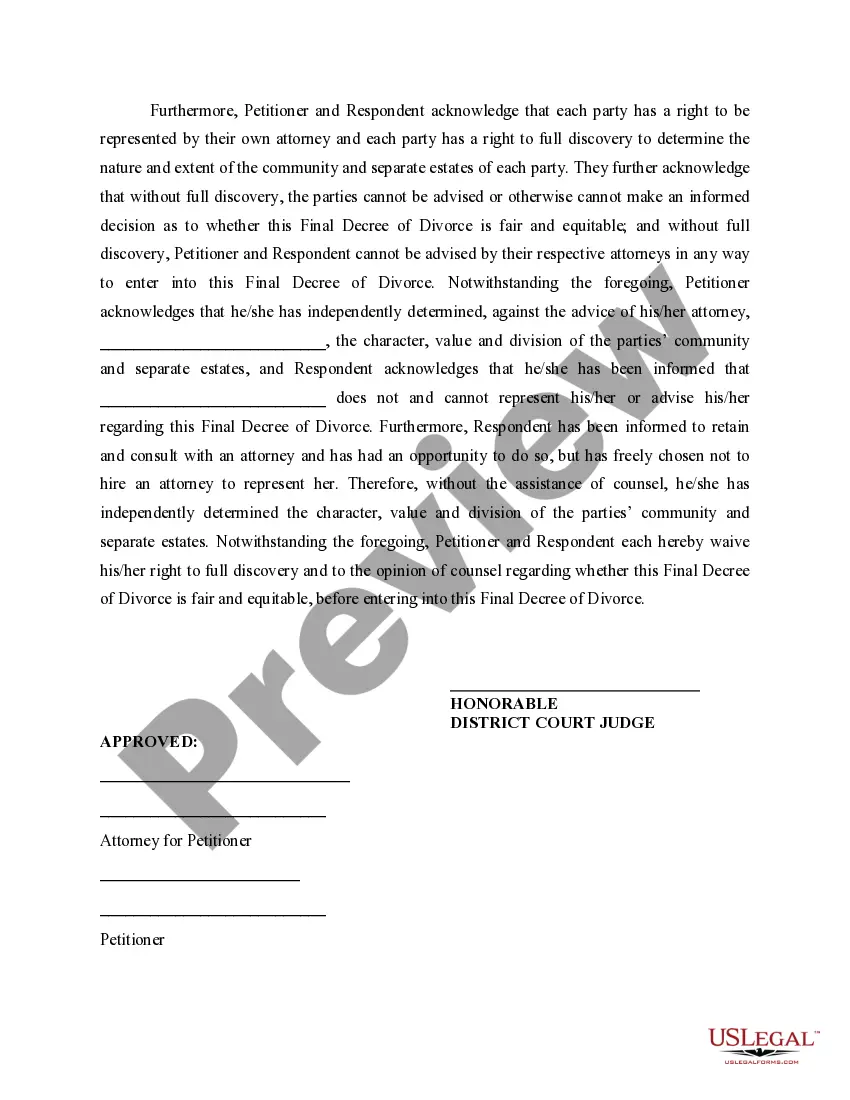
The Final Decree of Divorce is a legal document issued by a district court that officially ends a marriage. It includes rulings on critical issues such as property division, child custody, and support obligations, ensuring that both parties adhere to the terms agreed upon in their divorce settlement. This form serves as the final step in the divorce process, distinguishing it from other documents like the divorce petition or temporary orders, which may only address preliminary matters.
What’s included in this form
- The court's jurisdiction to grant the divorce.
- Acknowledgment of any children born of the marriage.
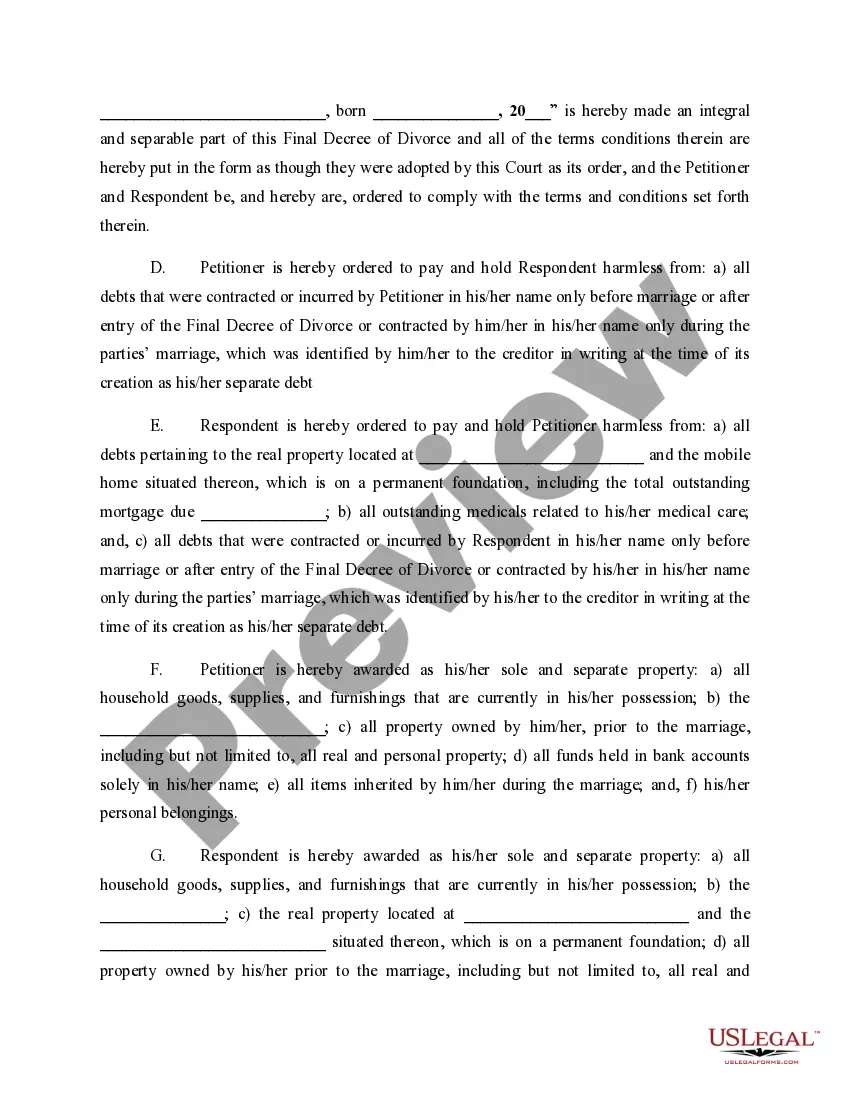
- Terms of custody and child support based on an agreed Parenting Plan.
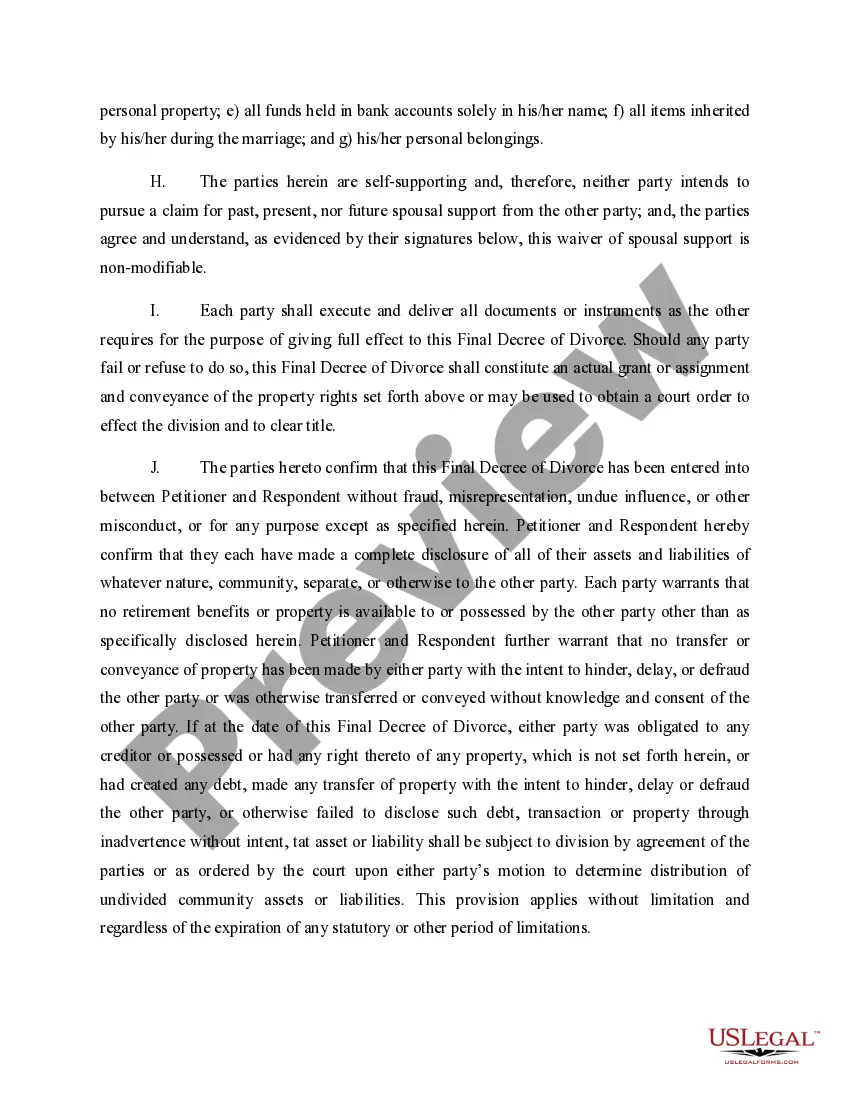
- Division of debts and responsibilities between the parties.
- Distribution of property to each party.
- Waiver of spousal support claims.

Common use cases
This form should be used when both parties in a divorce have reached an agreement on the terms of the divorce, including aspects such as asset division, child custody, and support payments. It is typically utilized after the court has completed hearings on the matter, signifying that all issues have been resolved amicably, and both parties seek a formalized conclusion to their marriage.
Who can use this document
- Individuals who have filed for divorce and have come to a mutual agreement with their spouse.
- Couples seeking to finalize their divorce without needing to specify contested issues in court.
- Parties involved in a divorce with minor children who have established a Parenting Plan.
- People wanting to document the legal termination of their marriage in a legally binding way.
Instructions for completing this form
- Identify the parties involved in the divorce and fill in their names in the designated sections.
- Specify the number of children from the marriage and provide their names and birthdates.
- Detail the custody arrangements as well as the terms of any child support and Parenting Plan.
- Assign the division of property and debts clearly, citing specific items and responsibilities for each party.
- Ensure both parties review and sign the document in front of a notary public to validate the form.
Does this form need to be notarized?
Yes, this form must be notarized to be legally valid. US Legal Forms provides integrated online notarization services, allowing you to complete the notarization process securely through a video call, available 24/7, without the need for travel.
Get your form ready online
Our built-in tools help you complete, sign, share, and store your documents in one place.
Make edits, fill in missing information, and update formatting in US Legal Forms—just like you would in MS Word.
Download a copy, print it, send it by email, or mail it via USPS—whatever works best for your next step.
Sign and collect signatures with our SignNow integration. Send to multiple recipients, set reminders, and more. Go Premium to unlock E-Sign.
If this form requires notarization, complete it online through a secure video call—no need to meet a notary in person or wait for an appointment.
We protect your documents and personal data by following strict security and privacy standards.

Make edits, fill in missing information, and update formatting in US Legal Forms—just like you would in MS Word.

Download a copy, print it, send it by email, or mail it via USPS—whatever works best for your next step.

Sign and collect signatures with our SignNow integration. Send to multiple recipients, set reminders, and more. Go Premium to unlock E-Sign.

If this form requires notarization, complete it online through a secure video call—no need to meet a notary in person or wait for an appointment.

We protect your documents and personal data by following strict security and privacy standards.
Common mistakes to avoid
- Failing to accurately fill in all required information, such as names or property details.
- Not having the form notarized, leading to potential validation issues.
- Overlooking the inclusion of all children in the custody agreement.
- Assuming verbal agreements cover all terms without documenting them in the form.
Why use this form online
- Convenience of downloading the form anytime without the need for in-person appointments.
- Editability allows you to customize the form to fit your unique situation effortlessly.
- Access to guidance throughout the form-filling process ensures accuracy and completeness.
- Cost-effectiveness compared to hiring legal services for minor divorce issues.
Key takeaways
- The Final Decree of Divorce finalizes the legal end of a marriage.
- This form covers crucial aspects such as child custody, property division, and debt responsibilities.
- Correctly completing and notarizing this form is essential for legal validity.
- The form is tailored for use in New Mexico, reflecting state-specific rules.
Looking for another form?


Form popularity
FAQ
A divorce decree is a court document that is a final judgment from divorce court. It contains information about your case including spousal support, child support, custody, visitation, property division, and other information.
How long does a divorce take in New Mexico? Once the divorce paperwork has been filed in court, it usually takes 30 to 90 days for a divorce to be final. The start to finish time of the divorce may vary depending on the caseload of the court and the availability of judges to sign the final Decree of Dissolution.
Copies of divorce decrees are available from the district court where the court order was filed. For further information about these services, please contact the appropriate county clerk or district court.
Divorce records in New Mexico are regarded as public records.
Most courthouses have a public records computer terminal. You can search by your name or the name of your spouse. Check them carefully and get the right file. Ask the court clerk's office for help. The counter clerk can look records up for you and confirm whether a divorce has been filed.
The court will give you a proof of written judgement that lets you know that your divorce is final. You can request a copy of this judgement from the court in your jurisdiction contact the courthouse or visit its website to see what its specific procedures are.
Assuming the divorce is being transmitted now, it will need to be reviewed. If everything is in order, your divorce decree should be processed in about 2-3 months.
Since New Mexico is a "Community Property" state, all marital property will be divided in a 50-50 fashion according to the court unless agreed to otherwise by the divorcing spouses. This means that everything that is considered "up for grabs" in the dissolution of marriage will be distributed equally to each spouse.
The court will give you a proof of written judgement that lets you know that your divorce is final. You can request a copy of this judgement from the court in your jurisdiction contact the courthouse or visit its website to see what its specific procedures are.