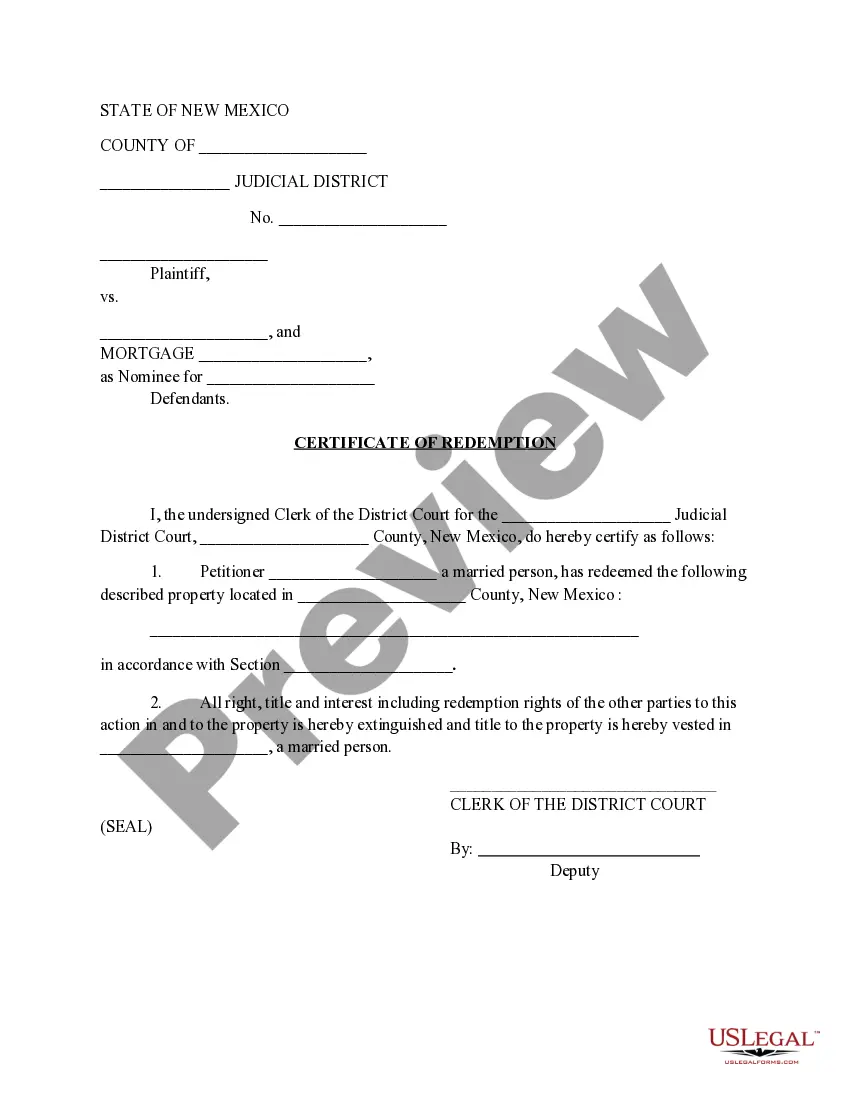
New Mexico Certificate of Redemption
Overview of this form
A Certificate of Redemption is a legal document that certifies that a borrower facing foreclosure has paid off all outstanding taxes and fines. This form allows the borrower to regain ownership of the property after foreclosure but before the property is sold at auction. It is essential for individuals who want to restore their rights to a property that may have been on the verge of being taken away due to unpaid debts.
Form components explained
- Identification of the petitioner and the property involved.
- Certification by the Clerk of the District Court.
- Statement of redemption, including the property description.
- Details about extinguishing any competing claims or interests.
- Signature of the Clerk and court seal, confirming the documentâs validity.
When to use this document
This form should be used in situations where a borrower has resolved outstanding financial obligations tied to a property facing foreclosure. If a borrower has paid all relevant taxes and fines and wishes to reclaim their rights to the property before an auction occurs, this certificate is necessary to formalize that redemption.
Who should use this form
This form is designed for individuals who meet the following criteria:
- Individuals who have faced foreclosure due to unpaid taxes or fines.
- Borrowers who have cleared their debts related to the property.
- Property owners in New Mexico seeking to retain ownership before an auction.
Steps to complete this form
- Identify all parties involved in the foreclosure case, including the plaintiff and defendants.
- Clearly describe the property that has been redeemed by the borrower.
- State the payments made to cover all outstanding debts.
- Include the appropriate legal citation referencing the New Mexico law.
- Ensure the Clerk of the District Court signs and seals the document for validation.
Does this document require notarization?
This form does not typically require notarization unless specified by local law. However, it is essential to confirm with local regulations to ensure compliance when submitting the Certificate of Redemption.
Get your form ready online
Our built-in tools help you complete, sign, share, and store your documents in one place.
Make edits, fill in missing information, and update formatting in US Legal Forms—just like you would in MS Word.
Download a copy, print it, send it by email, or mail it via USPS—whatever works best for your next step.
Sign and collect signatures with our SignNow integration. Send to multiple recipients, set reminders, and more. Go Premium to unlock E-Sign.
If this form requires notarization, complete it online through a secure video call—no need to meet a notary in person or wait for an appointment.
We protect your documents and personal data by following strict security and privacy standards.

Make edits, fill in missing information, and update formatting in US Legal Forms—just like you would in MS Word.

Download a copy, print it, send it by email, or mail it via USPS—whatever works best for your next step.

Sign and collect signatures with our SignNow integration. Send to multiple recipients, set reminders, and more. Go Premium to unlock E-Sign.

If this form requires notarization, complete it online through a secure video call—no need to meet a notary in person or wait for an appointment.

We protect your documents and personal data by following strict security and privacy standards.
Typical mistakes to avoid
- Not including the correct legal description of the property.
- Failing to have the form properly signed and sealed by the Clerk.
- Omitting necessary payments or failing to document them adequately.
- Incorrectly identifying the parties involved in the foreclosure.
Benefits of using this form online
- Easy access to professionally drafted legal documents.
- Ability to edit and customize the form to meet specific needs.
- Convenient download and printing options for immediate use.
- Guidance provided to ensure proper completion.
Looking for another form?
Form popularity
FAQ
State Statutory Redemption Laws The redemption period in states that allow it ranges from just 30 days to as high as two years. Many states reduce the redemption period if the property has been abandoned, while borrowers may waive their redemption rights in many states.
Learn about the right of redemption. A "redemption period" is a specific amount of time given to borrowers in foreclosure during which they can pay to redeem their property.pay off the total debt, including the principal balance, plus costs and interest, before the sale to stop the foreclosure, or.
The Redemption Period occurs approximately 30 days after a domain has reached its expiration date. For 30 days after the expiration date the domain will be available for renewal during a grace period. After the 30 day grace period, the domain will enter a hold period known as the Redemption Period for another 30 days.
Nonjudicial foreclosures are allowed in New Mexico if the loan contract is a deed of trust. In a nonjudicial foreclosure, the bank must record a notice of sale in the county records at least 90 days before the sale date.
This is called reinstatement of the loan. During the 21-day period after the Notice of Sale is recorded, any person or institution (like a bank) with an interest in your home has the right to redeem the home up until the nonjudicial foreclosure sale/auction. This means that they must pay the entire loan in full.
During the redemption period, you or your tenant may continue to live in the property and are not required to make any mortgage payments. You also have the right to sell the property to another person or re-purchase the property.
When available, the redemption period generally ranges from thirty days to a year. In most states that provide a post-sale redemption period, specific factors often change the redemption period's length. For example: The redemption period might vary depending on whether the foreclosure is judicial or nonjudicial.
You may want to pay off your mortgage before the end of your term to sell your property or remortgage to a better deal elsewhere. Paying off your loan early in this way is called 'redeeming' your mortgage.
Redemption is a period after your home has already been sold at a foreclosure sale when you can still reclaim your home. You will need to pay the outstanding mortgage balance and all costs incurred during the foreclosure process. Many states have some type of redemption period.