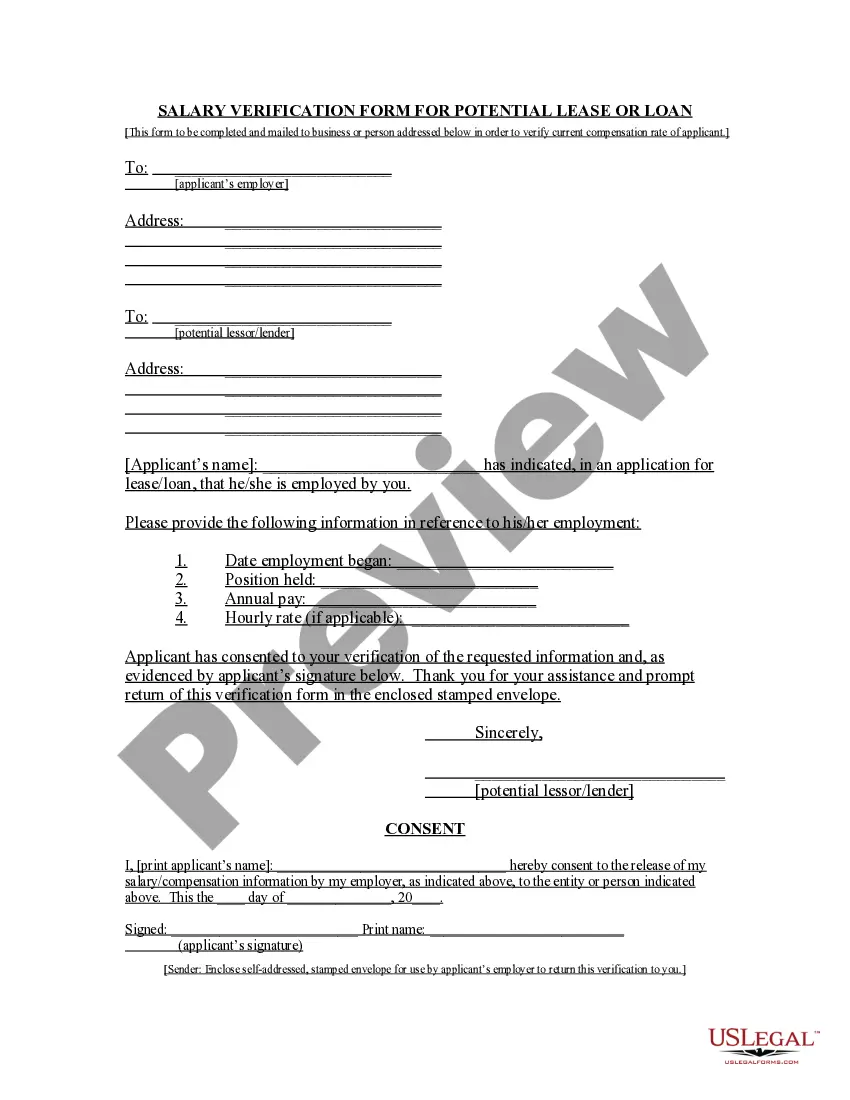
New Jersey Salary Verification form for Potential Lease
Understanding this form
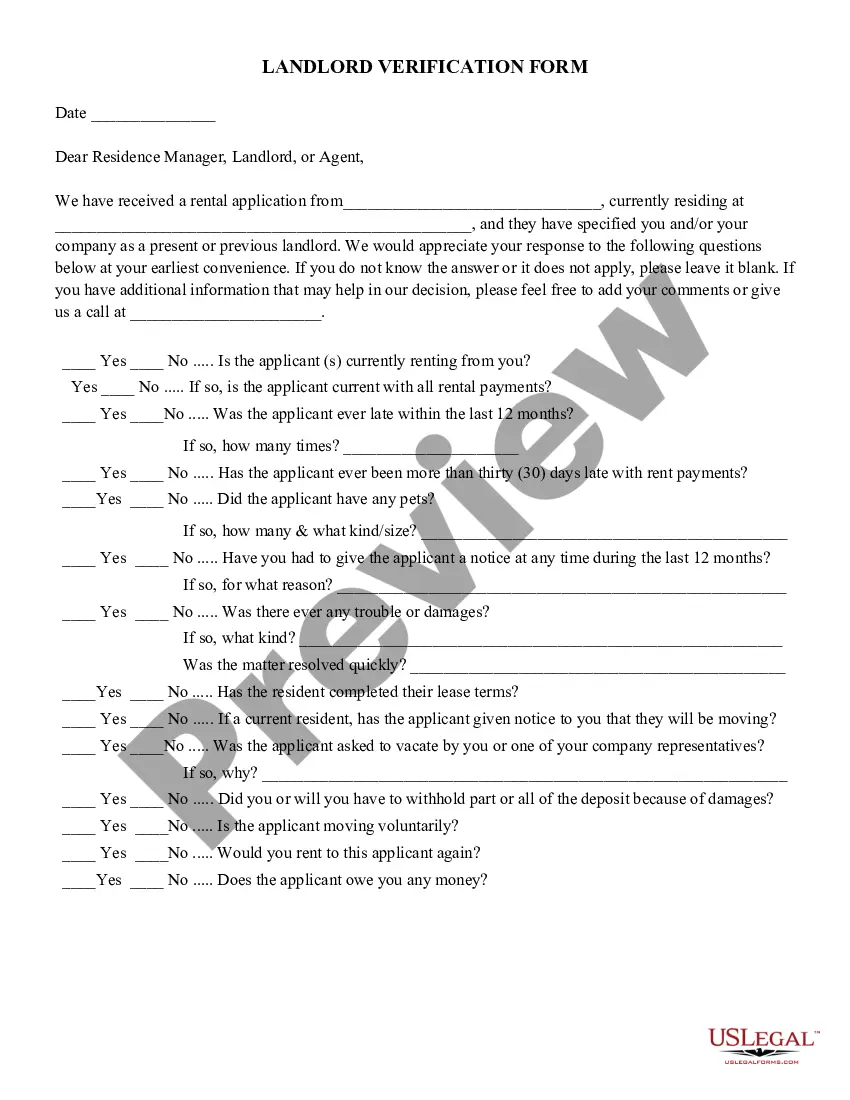
The Salary Verification form for Potential Lease is a legal document designed for landlords to confirm the income of potential tenants. This form is sent to the applicant's employer to verify the income stated in the lease application. It ensures the accuracy of financial information, which is crucial for making informed leasing decisions. This form is distinct from other rental forms, like the Application for Residential Lease, as it focuses specifically on income verification.
Key components of this form
- Applicant's employer details for income verification.
- Employment start date to establish tenure.
- Current job title to validate position.
- Annual salary and hourly wage details for accurate compensation assessment.
- Applicant's consent for the employer to disclose information.
- Self-addressed stamped envelope for easy return by the employer.

Common use cases
This form is ideal for landlords or property management professionals who need to verify the income of a prospective tenant as part of the leasing process. It is typically utilized when the tenant provides income information that needs official confirmation from their employer. Using this form can help prevent potential issues related to income misrepresentation.
Who can use this document
This form is intended for:
- Landlords seeking to verify a tenantâs income.
- Property managers responsible for tenant screening.
- Real estate professionals assisting landlords in the leasing process.
- Potential tenants who wish to ensure their income details are accurately conveyed to landlords.
Steps to complete this form
- Fill in the name and contact details of the applicant's employer.
- Indicate the date when the applicant started their employment.
- Specify the applicantâs current position or job title.
- Enter the applicant's annual salary and hourly wage if applicable.
- Obtain the applicantâs signature for consent to release information.
- Include a self-addressed stamped envelope for the employer's reply.
Is notarization required?
This form does not typically require notarization unless specified by local law.
Get your form ready online
Our built-in tools help you complete, sign, share, and store your documents in one place.
Make edits, fill in missing information, and update formatting in US Legal Forms—just like you would in MS Word.
Download a copy, print it, send it by email, or mail it via USPS—whatever works best for your next step.
Sign and collect signatures with our SignNow integration. Send to multiple recipients, set reminders, and more. Go Premium to unlock E-Sign.
If this form requires notarization, complete it online through a secure video call—no need to meet a notary in person or wait for an appointment.
We protect your documents and personal data by following strict security and privacy standards.

Make edits, fill in missing information, and update formatting in US Legal Forms—just like you would in MS Word.

Download a copy, print it, send it by email, or mail it via USPS—whatever works best for your next step.

Sign and collect signatures with our SignNow integration. Send to multiple recipients, set reminders, and more. Go Premium to unlock E-Sign.

If this form requires notarization, complete it online through a secure video call—no need to meet a notary in person or wait for an appointment.

We protect your documents and personal data by following strict security and privacy standards.
Common mistakes to avoid
- Failing to obtain the tenant's signature for consent.
- Not providing complete employer contact details, which may lead to delays.
- Leaving out specific salary details, which can cause confusion.
- Omitting the self-addressed stamped envelope, increasing the chance of non-response.
Why complete this form online
- Easy access and instant downloads from US Legal Forms.
- Editability to customize the form based on specific scenarios.
- Reliability of professionally drafted templates by licensed attorneys.
Main things to remember
Key Takeaways
- The Salary Verification form is essential for verifying an applicant's income.
- It should be sent directly to the applicant's employer for accurate income confirmation.
- Ensure all sections of the form are complete to avoid delays in the rental application process.
- Convenience and reliability are enhanced when using the form online.
Looking for another form?
Form popularity
FAQ
Muse Career Coach, Theresa Merrill, advises people to be honest about their current or past salary. Misrepresenting anything about your work history in an interview or on an application is unethical, and therefore unadvisable.
Background checks will show you if the candidate is providing the correct salary history for their previous employment.
Pay stubs are the best proof of income, but landlords also should collect at least one other proof of income document and compare the two. You can verify income manually by requesting documents that show proof of income through a tenant screening company.
In the initial screening interview, the recruiter should ask, What salary range are you expecting for this position? If your candidate states a number that's within your budget, your reply should be, That's within our range. Then move on to discussing aspects of the job and the interview process.
No, the California Labor Code prohibits an employer from seeking salary history information about an applicant for employment. Salary history information includes both your rate of compensation and information about other benefits.You can voluntarily disclose salary history information to a potential employer.
State-wide. California's ban prohibits private and public employers from seeking a candidate's pay history. Even if an employer already has that information or an applicant volunteers it, it still can't be used in determining a new hire's pay.
Can a new employer check your previous salary? Theoretically, a new employer could always calculate your previous salary from the P45 you give to them.Even so, it's a widely accepted truth of the industry that many people inflate their salaries when applying for jobs.
What to Put for Desired Salary on Job Applications. The best way to answer desired salary or salary expectations on a job application is to leave the field blank or write 'Negotiable' rather than providing a number. If the application won't accept non-numerical text, then enter 999, or 000.
What does the New Jersey salary history ban do? The law forbids employers from screening job applicants based on their previous wage, salary, or benefits or from requiring that an applicant's salary history satisfies a minimum or maximum criteria.