Nebraska Real Estate Retention Agreement
About this form
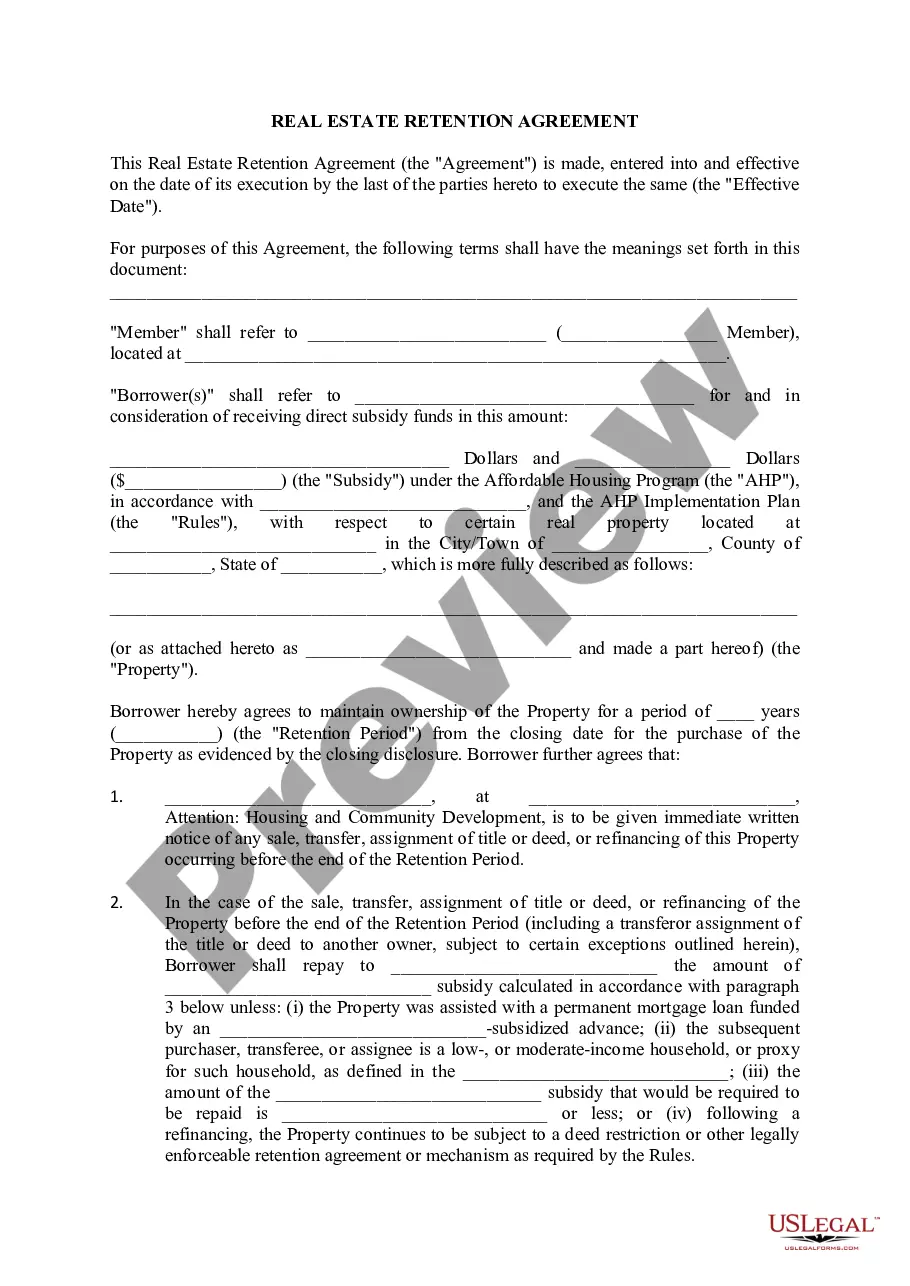
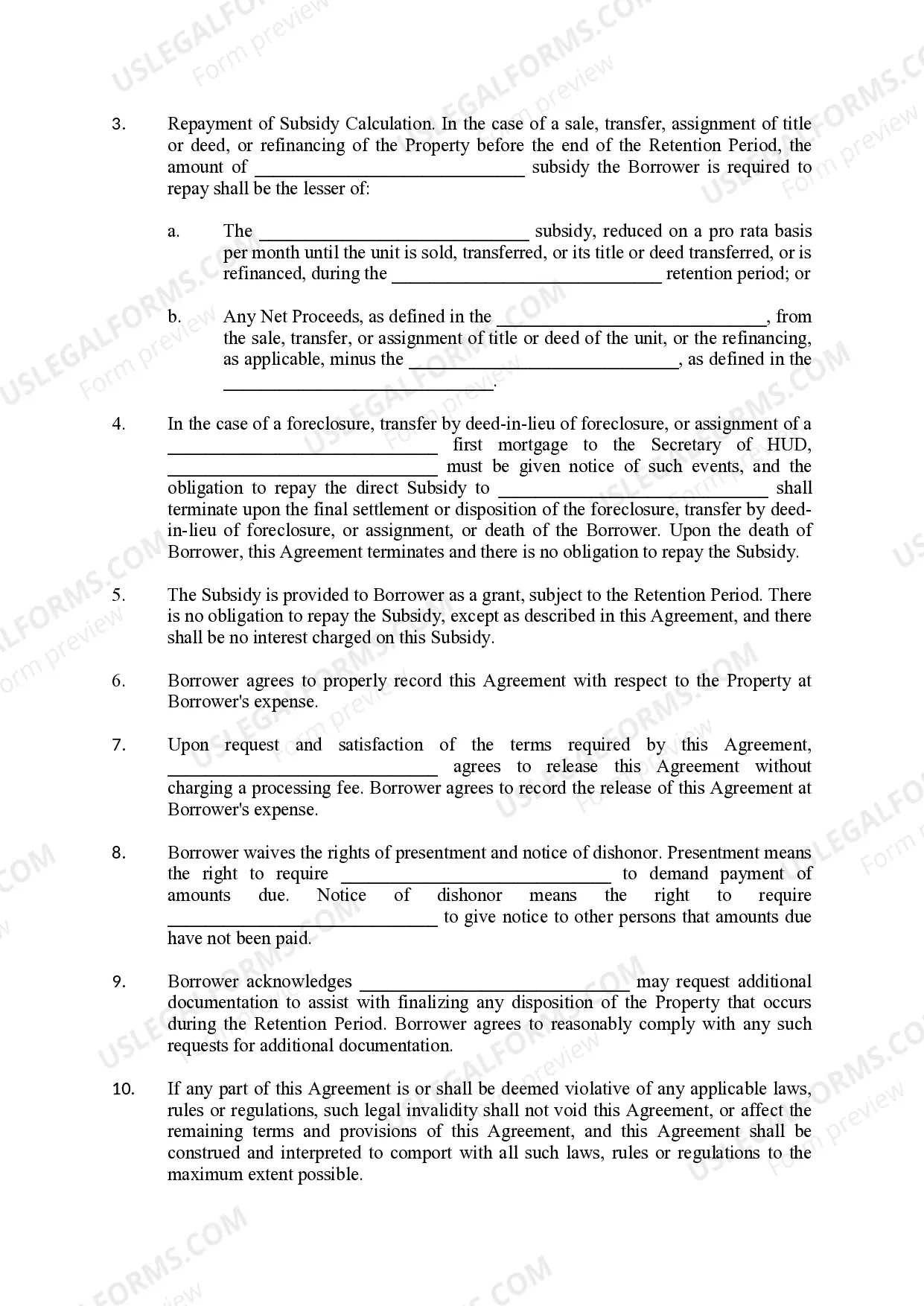
The Real Estate Retention Agreement is a legal document that establishes a commitment for a borrower under the Affordable Housing Program to maintain ownership of a property for a specified retention period. This agreement outlines the borrowerâs responsibilities and the conditions under which subsidies may need to be repaid should the property be sold or refinanced before the end of this period. Unlike other real estate agreements, this form specifically ties retention of ownership to financial assistance received, ensuring compliance with program rules.
Key parts of this document
- Definition of the parties involved: Includes provisions regarding the member and the borrower.
- Subsidy amount details: Specifies the total financial assistance received under the Affordable Housing Program.
- Retention period: Outlines the required timeframe for maintaining ownership of the property.
- Notification obligations: Requires the borrower to inform relevant authorities of any changes in property ownership or financing.
- Repayment conditions: Describes how and when the subsidy must be repaid in case of early sale or refinancing.
- Documentation requirements: Mandates proper filing and recording of the agreement and its release when appropriate.
When to use this document
This form should be used when a borrower receives financial assistance under the Affordable Housing Program and needs to agree to conditions regarding the ownership of the property. It is essential for borrowers who want to ensure compliance with program retention requirements and avoid potential penalties related to early sale or refinancing of the property.
Intended users of this form
- Borrowers who receive funds from the Affordable Housing Program.
- Individuals or entities purchasing property with the understanding that they must maintain ownership for a designated period.
- Real estate agents and attorneys representing borrowers involved in affordable housing transactions.
Steps to complete this form
- Identify the parties: Clearly state the names of the member and borrower involved in the agreement.
- Specify the property: Provide a detailed description of the property covered by this agreement.
- Enter the subsidy amount: Write in the total financial assistance received under the program.
- Define the retention period: Indicate the number of years for which the borrower agrees to retain ownership.
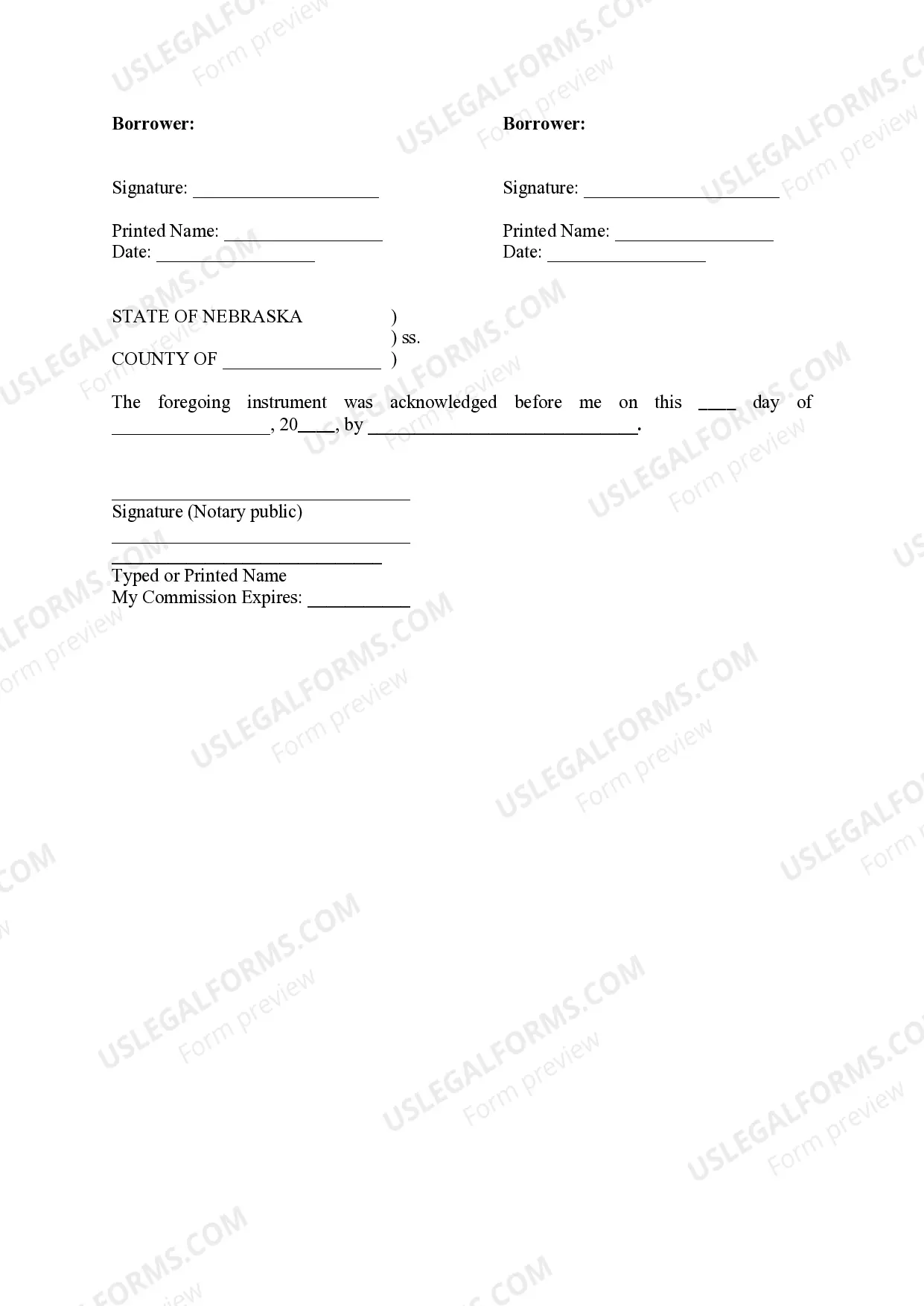
- Sign and date the document: Ensure all parties sign and date the agreement for validation.
Notarization requirements for this form
This form does not typically require notarization unless specified by local law. It is recommended, however, that both parties review the legal requirements in their jurisdiction to ensure compliance.
Get your form ready online
Our built-in tools help you complete, sign, share, and store your documents in one place.
Make edits, fill in missing information, and update formatting in US Legal Forms—just like you would in MS Word.
Download a copy, print it, send it by email, or mail it via USPS—whatever works best for your next step.
Sign and collect signatures with our SignNow integration. Send to multiple recipients, set reminders, and more. Go Premium to unlock E-Sign.
If this form requires notarization, complete it online through a secure video call—no need to meet a notary in person or wait for an appointment.
We protect your documents and personal data by following strict security and privacy standards.

Make edits, fill in missing information, and update formatting in US Legal Forms—just like you would in MS Word.

Download a copy, print it, send it by email, or mail it via USPS—whatever works best for your next step.

Sign and collect signatures with our SignNow integration. Send to multiple recipients, set reminders, and more. Go Premium to unlock E-Sign.

If this form requires notarization, complete it online through a secure video call—no need to meet a notary in person or wait for an appointment.

We protect your documents and personal data by following strict security and privacy standards.
Common mistakes to avoid
- Failing to notify the appropriate authority of a property sale or refinancing.
- Not clearly defining the retention period or subsidy amount.
- Neglecting to sign and date the agreement properly.
Benefits of using this form online
- Convenience: Download and complete the form at your own pace.
- Editability: Customize the template based on your specific needs.
- Reliability: The forms are drafted by licensed attorneys, ensuring legal compliance.
Looking for another form?
Form popularity
FAQ
A failure to deposit the earnest money in the escrow account will likely constitute a breach of the purchase agreement by the buyer.Buyers are forewarned that in this hot real estate market, the failure to pay that promised sum into escrow could result in termination of the contract by the seller.
No, the buyer does not have 3 days to back out. In the State of California in a real estate purchase contract there are a number of contingencies that must be met before the contract moves forward.
Federal law gives borrowers what is known as the "right of rescission." This means that borrowers after signing the closing papers for a home equity loan or refinance have three days to back out of that deal.
Does the Seller Ever Keep the Earnest Money? Yes, the seller has the right to keep the money under certain circumstances. If the buyer decides to cancel the sale without a valid reason or doesn't stick to an agreed timeline, the seller gets to keep the money.
But unlike buyers, sellers can't back out and forfeit their earnest deposit money (usually 1-3 percent of the offer price). If you decide to cancel a deal when the home is already under contract, you can be either legally forced to close anyway or sued for financial damages.
The earnest money can be held in escrow during the contract period by a title company, lawyer, bank, or brokerwhatever is specified in the contract. Most U.S. jurisdictions require that when a buyer timely and properly drops out of a contract, the money be returned within a brief period of time, say, 48 hours.
Generally, these funds are held in an escrow account managed by the buyer's real estate agent or the title company. The deposit is then applied to your closing costs or returned to you at closing. Earnest money funds are usually applied to a loan's closing costs or to the down payment.
There is no automatic three day right to cancel, but most real estate contracts have other "contingencies" such as financing or inspection that would give a buyer a right to cancel for specific reasons.
When a deposit is paid, the real estate agent is required to hold it for 10 days. Vendors often ask agents to release the deposit early to use it as a deposit on another house or to clear some debts etc.