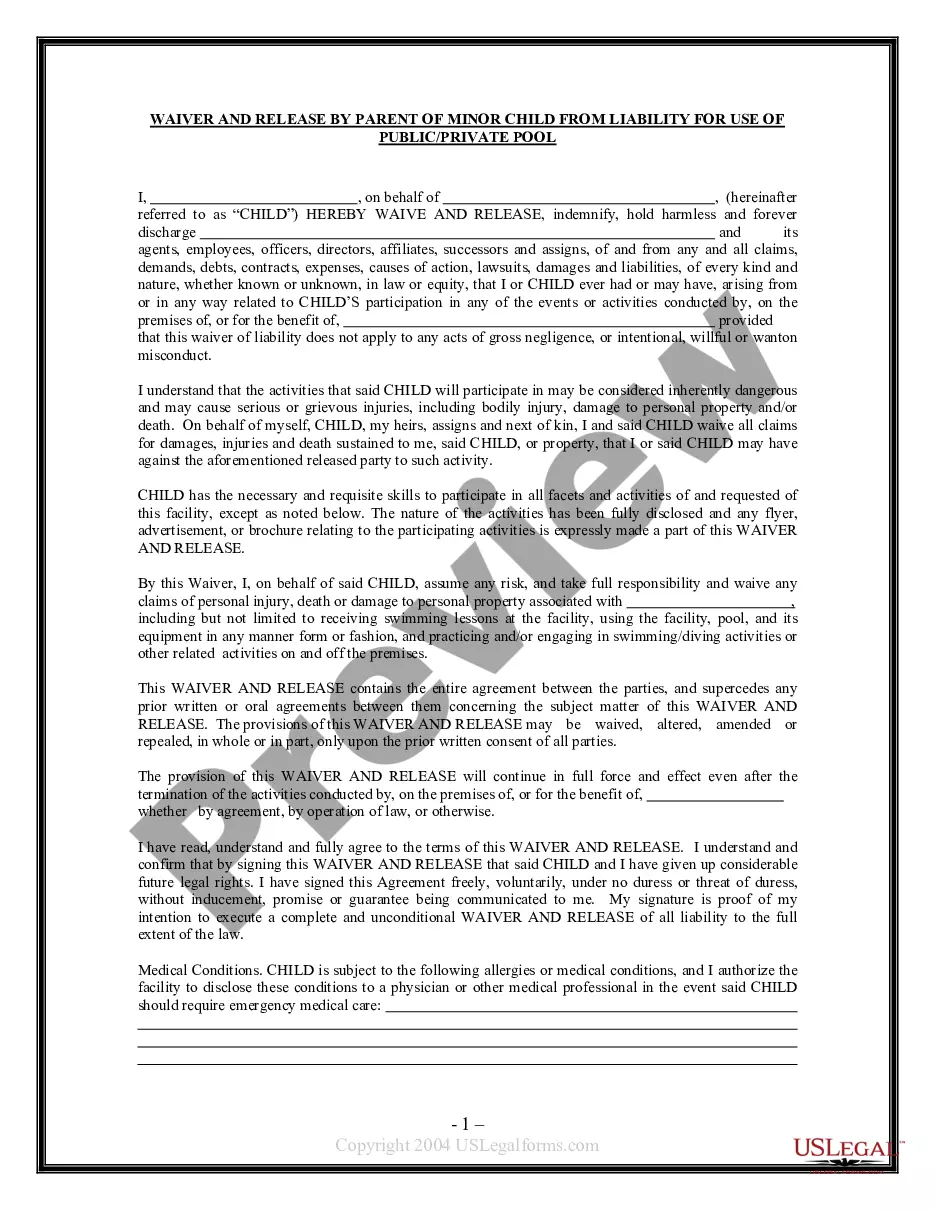
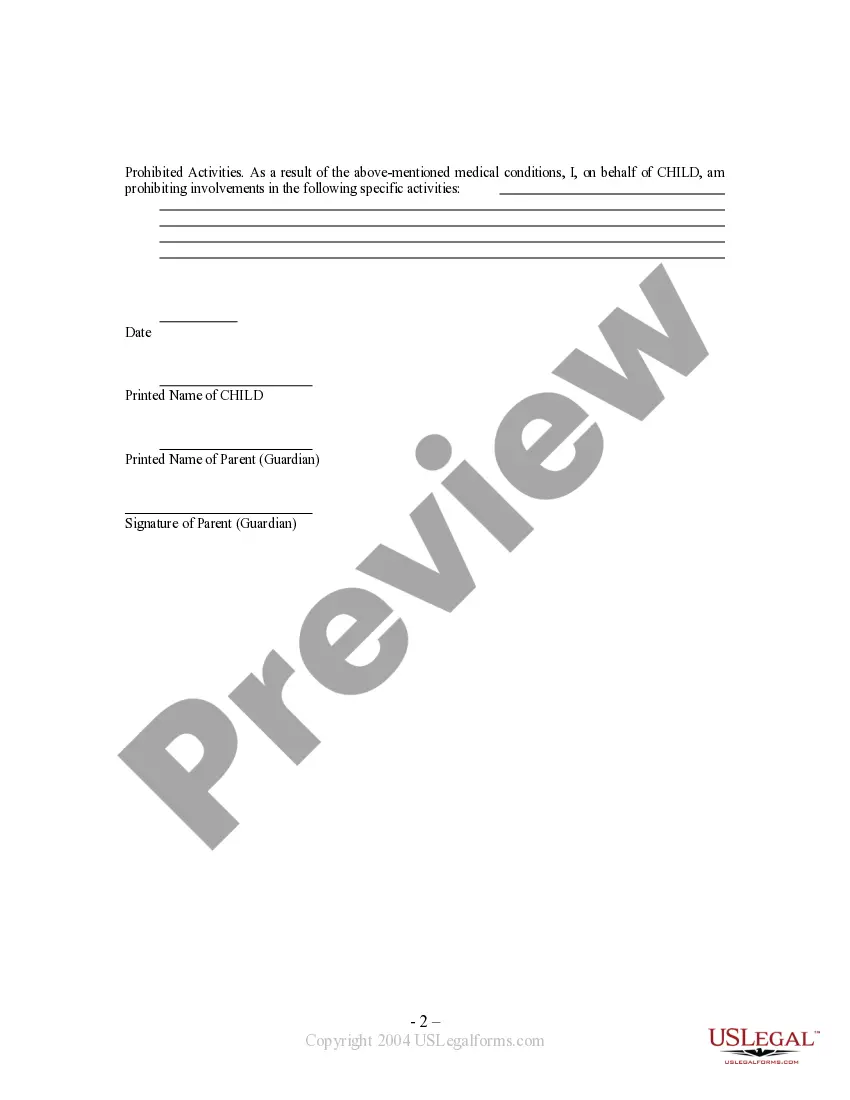
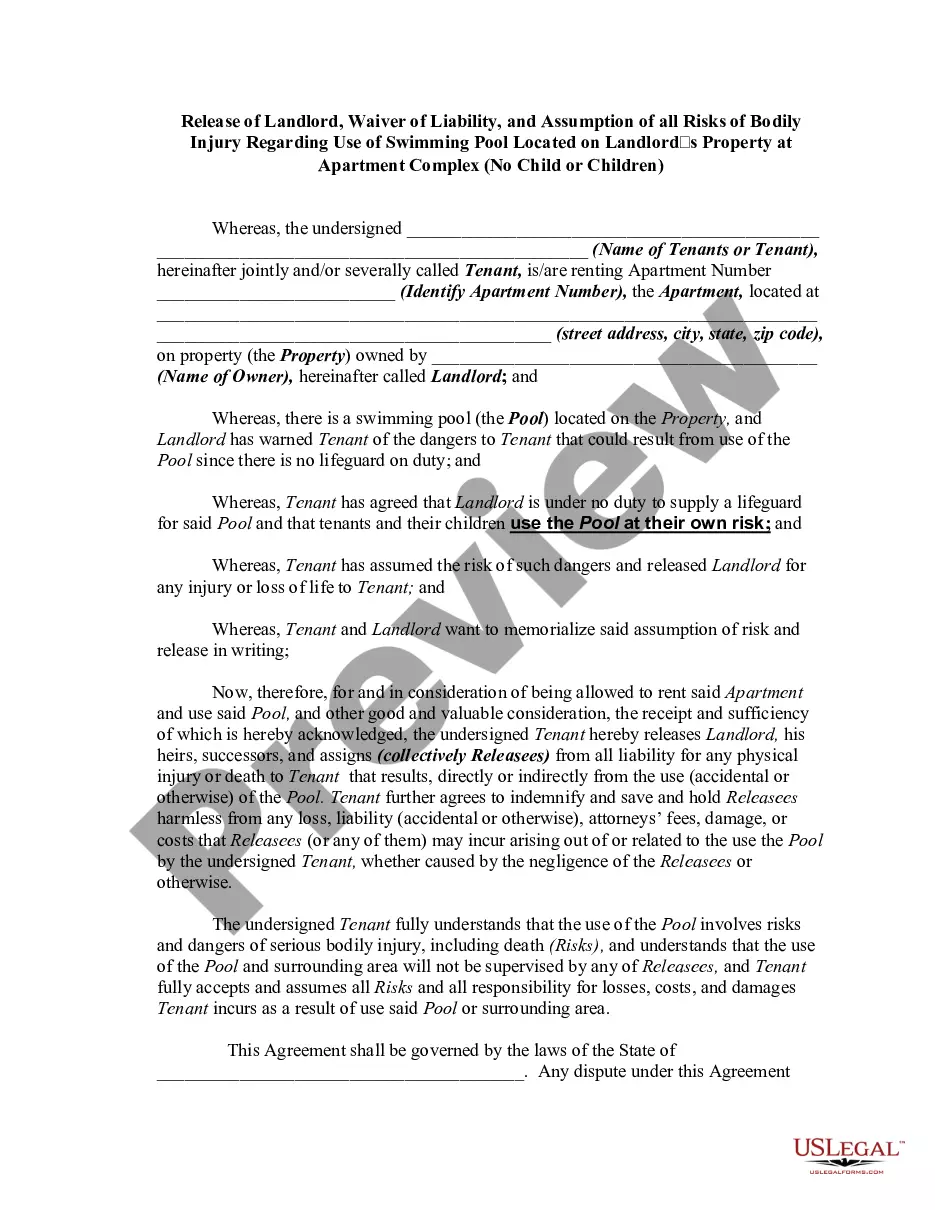
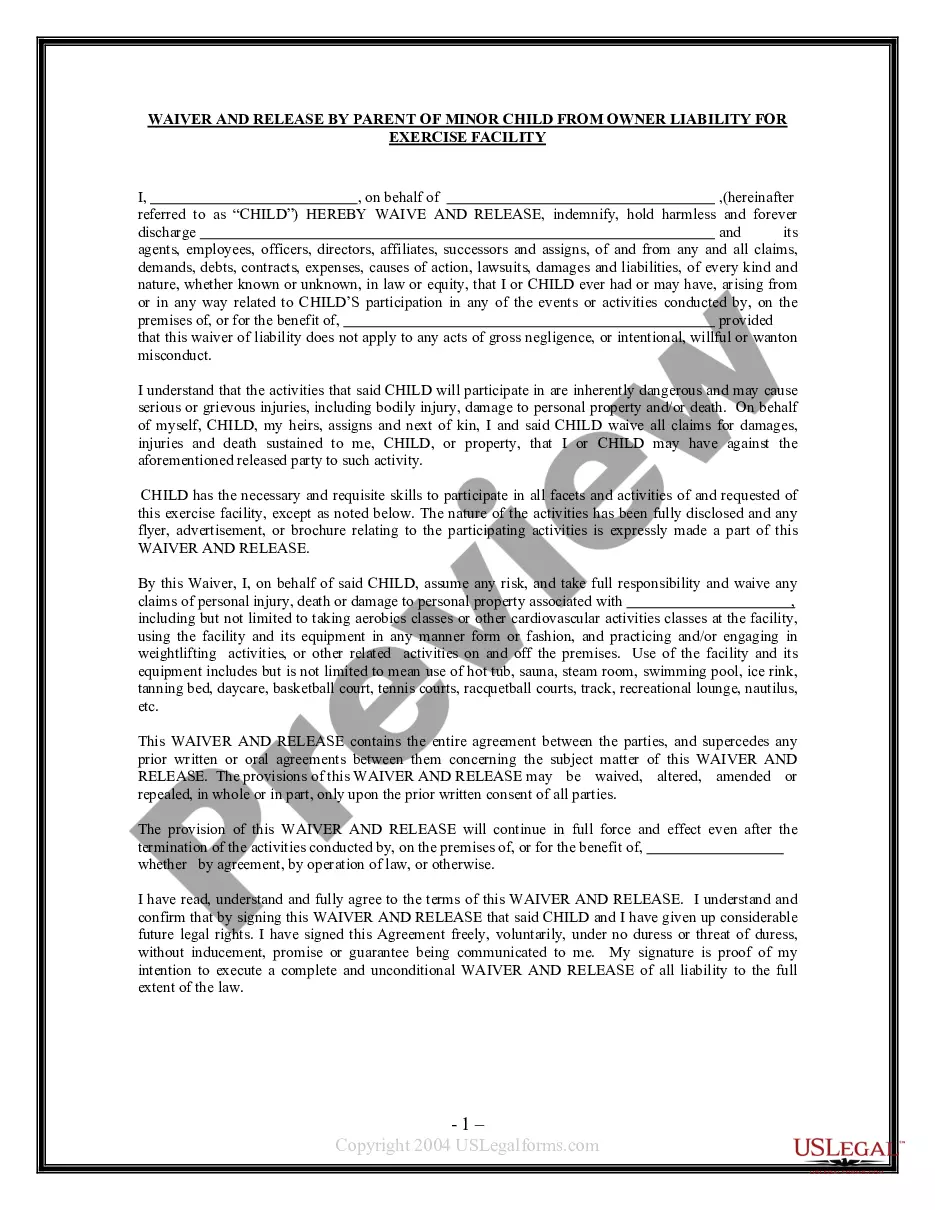
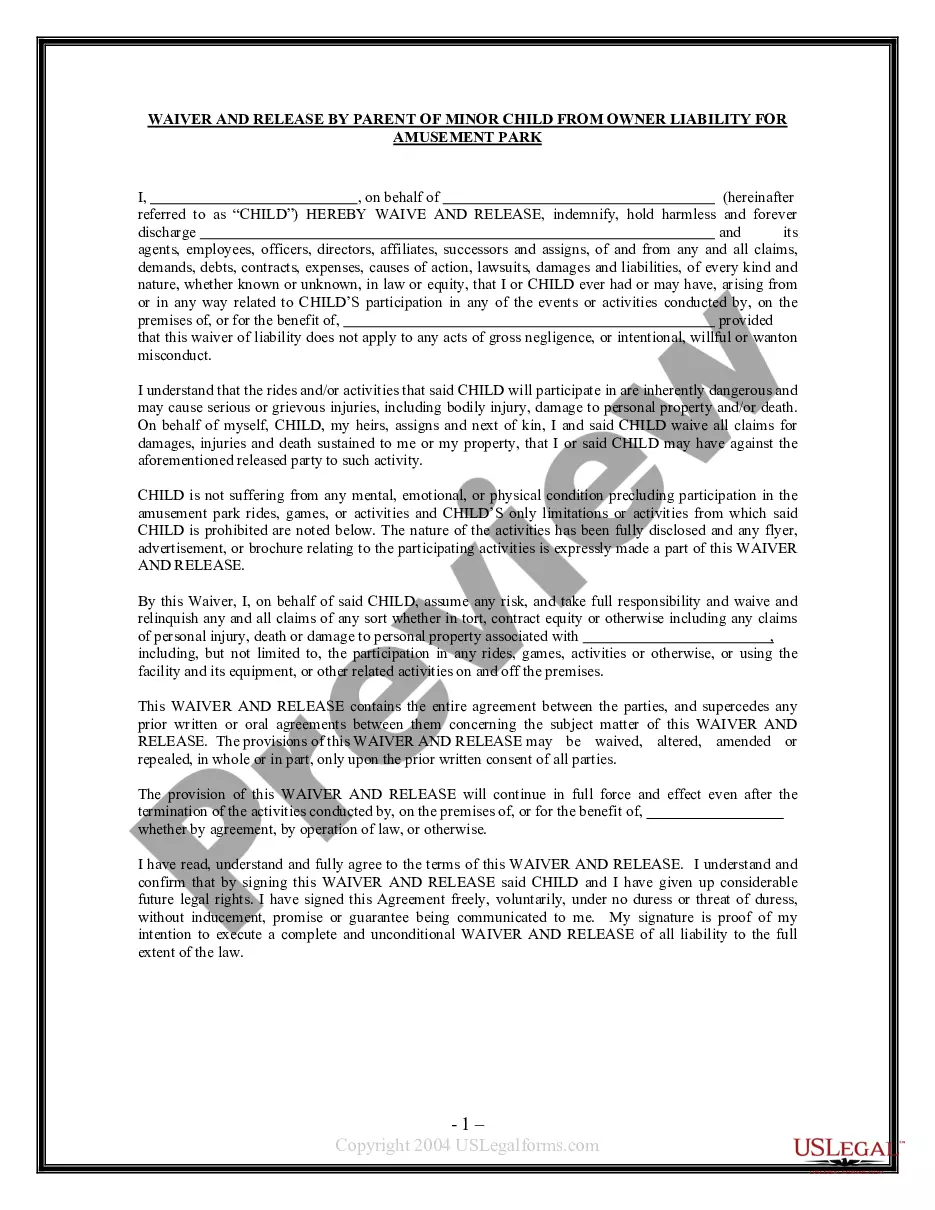
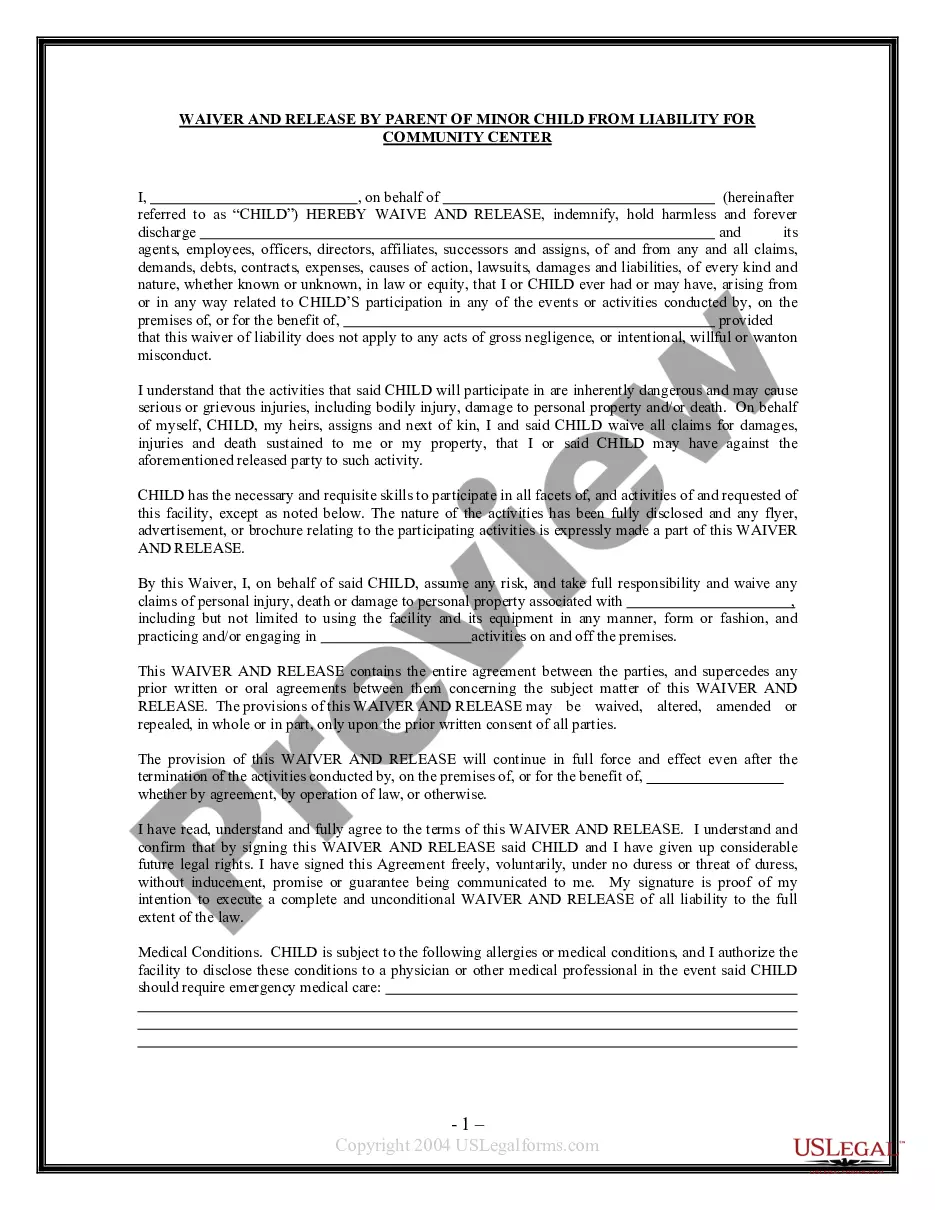
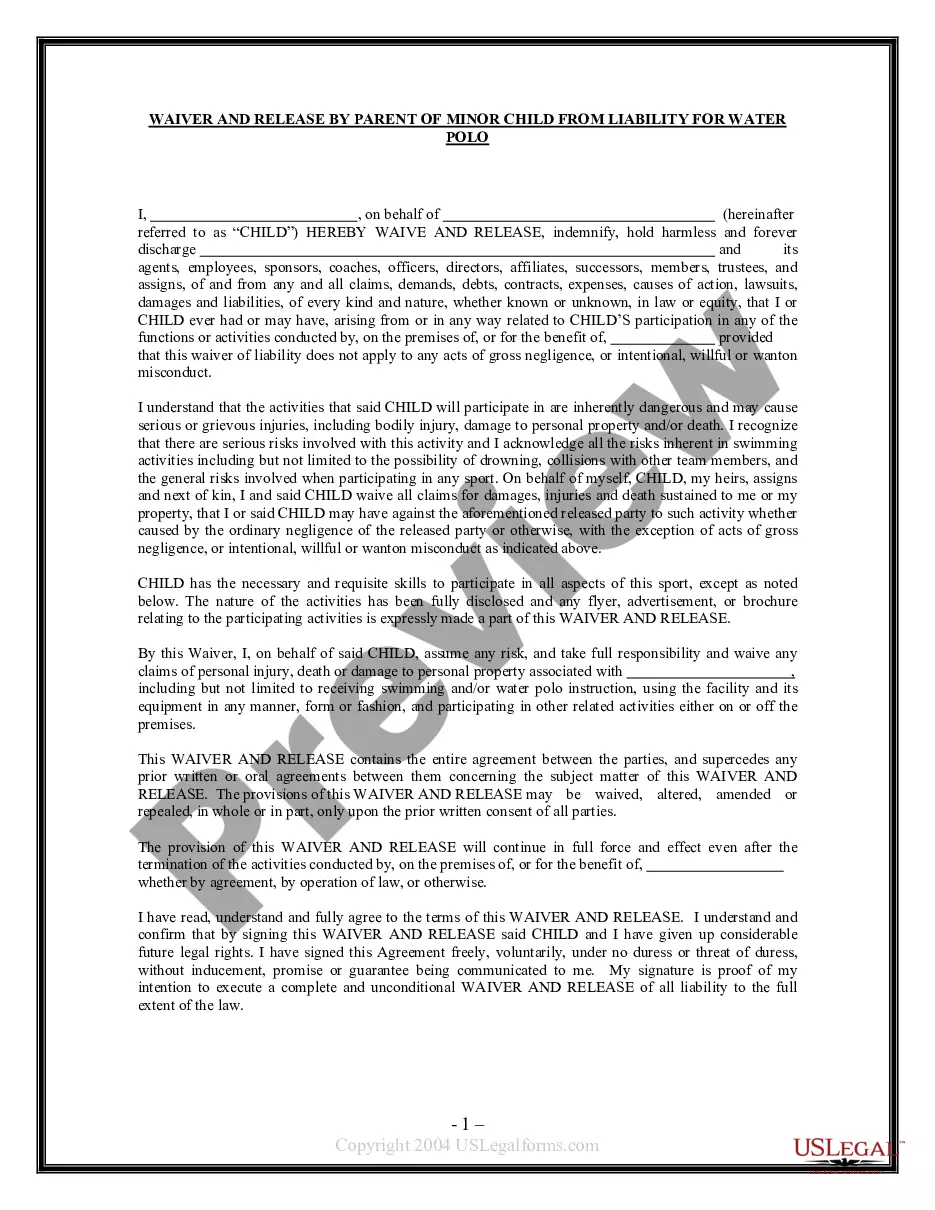
This form allows a parent or guardian to release an Public/Private Pool from liability for injuries which may be incurred by a minor child while on the premises, taking part in activities, etc.
North Dakota Waiver and Release From Liability For Minor Child for Pool
State:
Multi-State
Category:
Control #:
US-WAV-06M
Format:
Word;
Rich Text
88 downloads
Description
Free preview
Get your form ready online
Our built-in tools help you complete, sign, share, and store your documents in one place.
Built-in online Word editor
Make edits, fill in missing information, and update formatting in US Legal Forms—just like you would in MS Word.
Export easily
Download a copy, print it, send it by email, or mail it via USPS—whatever works best for your next step.
E-sign your document
Sign and collect signatures with our SignNow integration. Send to multiple recipients, set reminders, and more. Go Premium to unlock E-Sign.
Notarize online 24/7
If this form requires notarization, complete it online through a secure video call—no need to meet a notary in person or wait for an appointment.
Store your document securely
We protect your documents and personal data by following strict security and privacy standards.

Make edits, fill in missing information, and update formatting in US Legal Forms—just like you would in MS Word.

Download a copy, print it, send it by email, or mail it via USPS—whatever works best for your next step.

Sign and collect signatures with our SignNow integration. Send to multiple recipients, set reminders, and more. Go Premium to unlock E-Sign.

If this form requires notarization, complete it online through a secure video call—no need to meet a notary in person or wait for an appointment.

We protect your documents and personal data by following strict security and privacy standards.
Looking for another form?
How to fill out Waiver And Release From Liability For Minor Child For Pool?
Are you presently in a situation where you require documentation for potential business or personal purposes nearly every day.
There are numerous legal document templates accessible online, but finding versions you can rely on isn't straightforward.
US Legal Forms offers thousands of form templates, such as the North Dakota Waiver and Release From Liability For Minor Child for Pool, that are designed to comply with state and federal regulations.
Use US Legal Forms, one of the most extensive collections of legal forms, to save time and avoid mistakes.
The service offers professionally drafted legal document templates that can be utilized for various purposes. Create an account on US Legal Forms and start making your life a bit easier.
- If you are already familiar with the US Legal Forms website and have an account, simply Log In.
- Subsequently, you can download the North Dakota Waiver and Release From Liability For Minor Child for Pool template.
- If you do not have an account and wish to start using US Legal Forms, follow these steps.
- Find the form you need and ensure it is for the correct city/region.
- Utilize the Preview option to review the document.
- Check the details to confirm that you have selected the appropriate form.
- If the form isn't what you are looking for, use the Search field to find the form that meets your needs and criteria.
- If you obtain the correct form, click Acquire now.
- Select the payment plan you prefer, complete the required details to create your account, and finalize the transaction using your PayPal or credit card.
- Choose a convenient file format and download your version.
- Access all the document templates you have purchased in the My documents menu. You can download an additional copy of the North Dakota Waiver and Release From Liability For Minor Child for Pool at any time, if needed. Just select the necessary form to download or print the document template.
Form popularity
FAQ
Yes, you can write your own liability waiver, but it is essential to ensure it meets legal requirements. The North Dakota Waiver and Release From Liability For Minor Child for Pool should include specific elements like risk acknowledgment, a release of liability clause, and the signatures of both parents and the facility. However, crafting a legally binding waiver can be complex, so using a trusted resource like uslegalforms can simplify the process and ensure you cover all necessary aspects effectively. This helps protect both you and the facility in case of unforeseen incidents.
To write a liability waiver form, start by clearly stating the intent of the document, which is to protect against legal claims. Include essential details such as the names of the parties involved, the specific activities covered, and a clear acknowledgment of risks, especially for the North Dakota Waiver and Release From Liability For Minor Child for Pool. Clearly outline the responsibilities of both the facility and the parents, ensuring the language is easy to understand. For a comprehensive solution, you may consider using platforms like uslegalforms, which provide templates tailored for this purpose.
A parental release of liability form is a document that allows parents to waive the right to sue for injuries their child might incur during activities. In the context of swimming, the North Dakota Waiver and Release From Liability For Minor Child for Pool serves this purpose by ensuring that parents accept the risks involved in pool activities. This form is crucial for facilities as it protects them legally while allowing children to have fun safely. By utilizing this form, parents can facilitate their child's participation without unnecessary worry.
A minor waiver form is a legal document that parents or guardians sign to release a facility or organization from liability for injuries their minor child may sustain while participating in activities, such as swimming. Specifically, the North Dakota Waiver and Release From Liability For Minor Child for Pool is designed to protect pool owners and operators from claims arising from accidents. This form ensures that parents acknowledge the risks associated with swimming and agree not to hold the facility responsible. By using this form, you can enjoy peace of mind knowing both parties understand the legal implications.
Liability waivers are enforceable in California solely to the extent they shift to the customer the risk of ordinary negligence. Under California law, a liability waiver cannot excuse an injury caused by a defendant's gross negligence, recklessness or intentionally wrongful act.
Generally, a liability waiver document is a legally binding agreement that relinquishes the right of one party to pursue legal remedy for injuries accrued on the property, regardless of fault involved.
Ambiguous language or missing information can invalidate a waiver. The waiver contains errors that make it invalid. The language of the waiver must obey relevant state laws. An improperly worded or drafted waiver, as well as one that violates the law or public policy, may not hold up in court.
A waiver is an exculpatory contract. That means it's used to excuse a party from responsibility when the other contracted party is injured by either known or unknown risks in a particular activity. This includes inherent risks and ordinary negligence.
You might think that since you signed a waiver acknowledging the risks of the activity, you have no legal leg to stand on to file a personal injury lawsuit. Waivers can make personal injury lawsuits more complex, but you can still seek damages for injuries that could have and should have been prevented.
So, if an accident happens and injury occurs, is a Waiver effective in protecting the institution from liability and preventing a lawsuit from the injured party? The answer is that, if properly worded and signed, the Waiver is likely valid and will preclude legal claims for injuries.