Jury Instruction - Evidence - Direct and Circumstantial Argument of Counsel
About this form
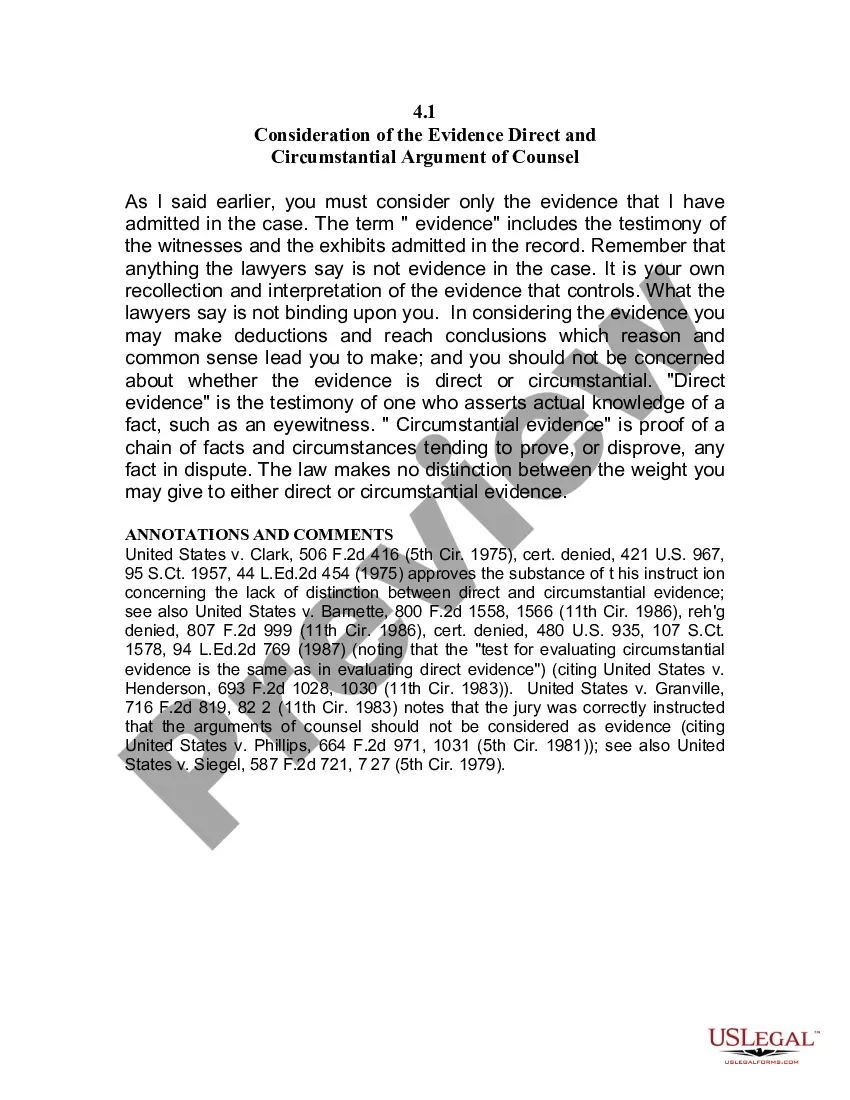
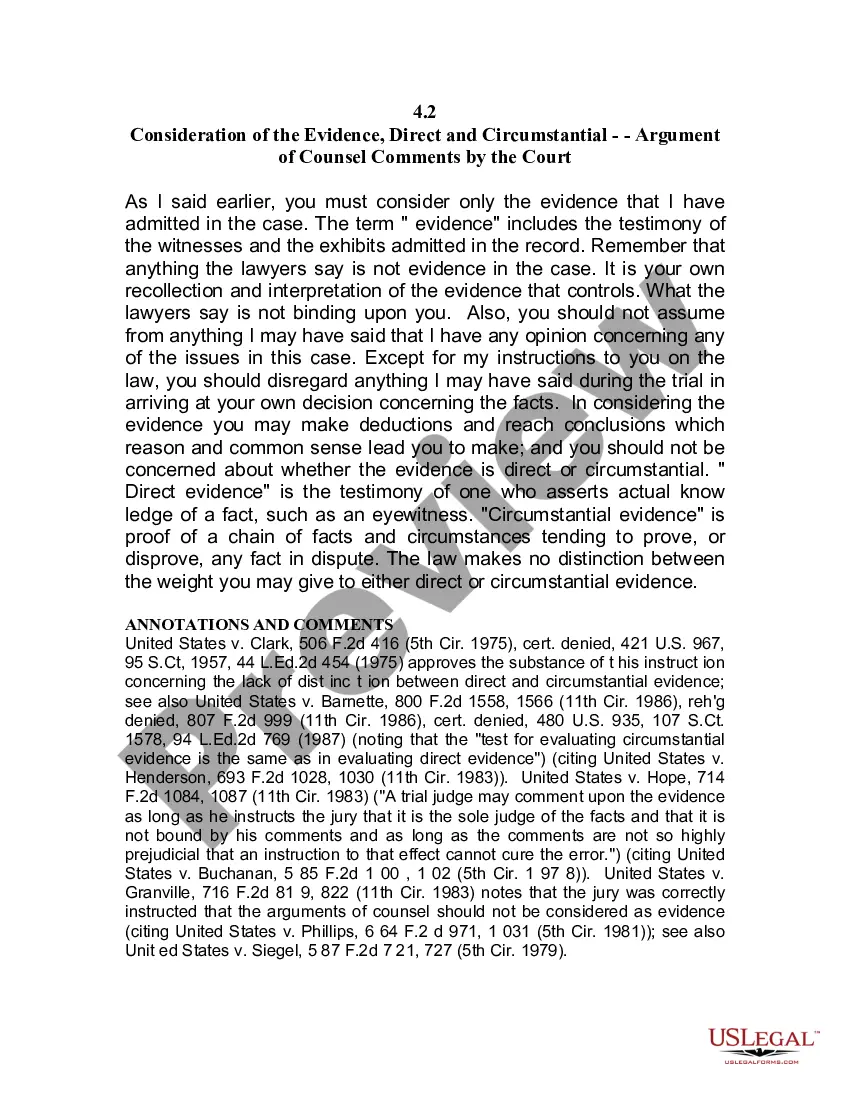
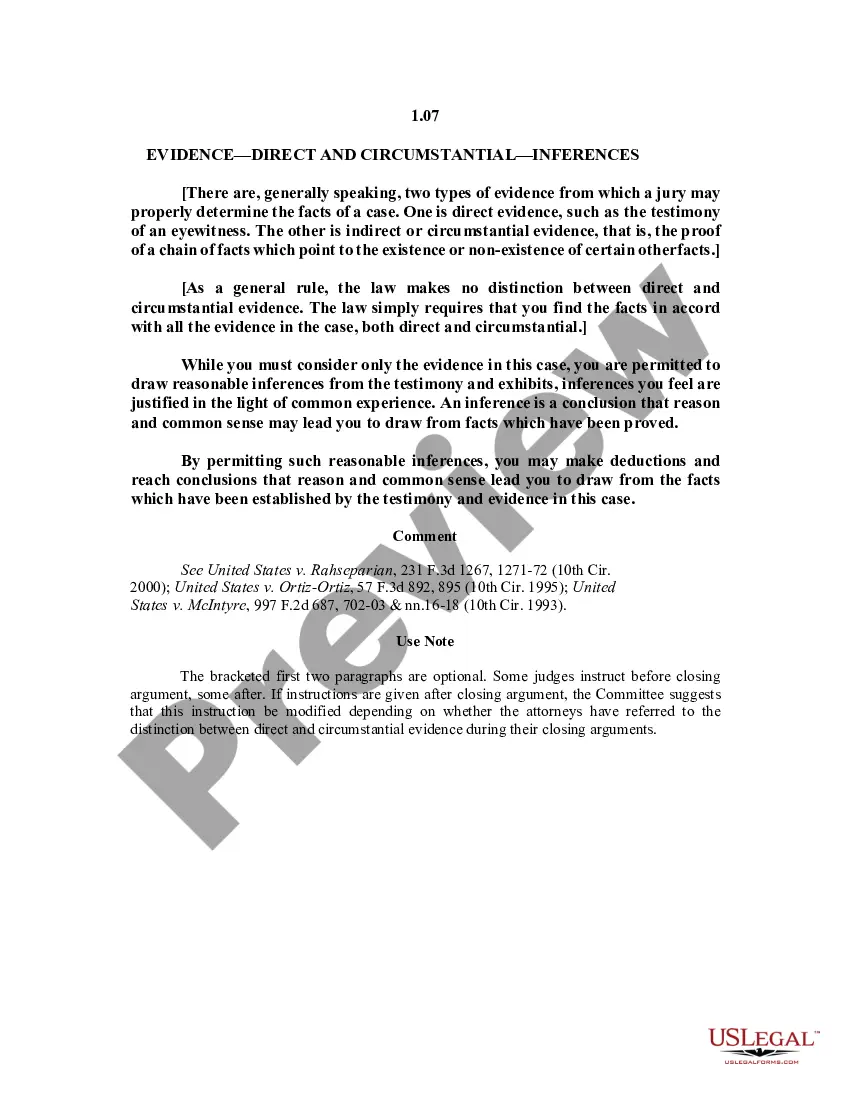
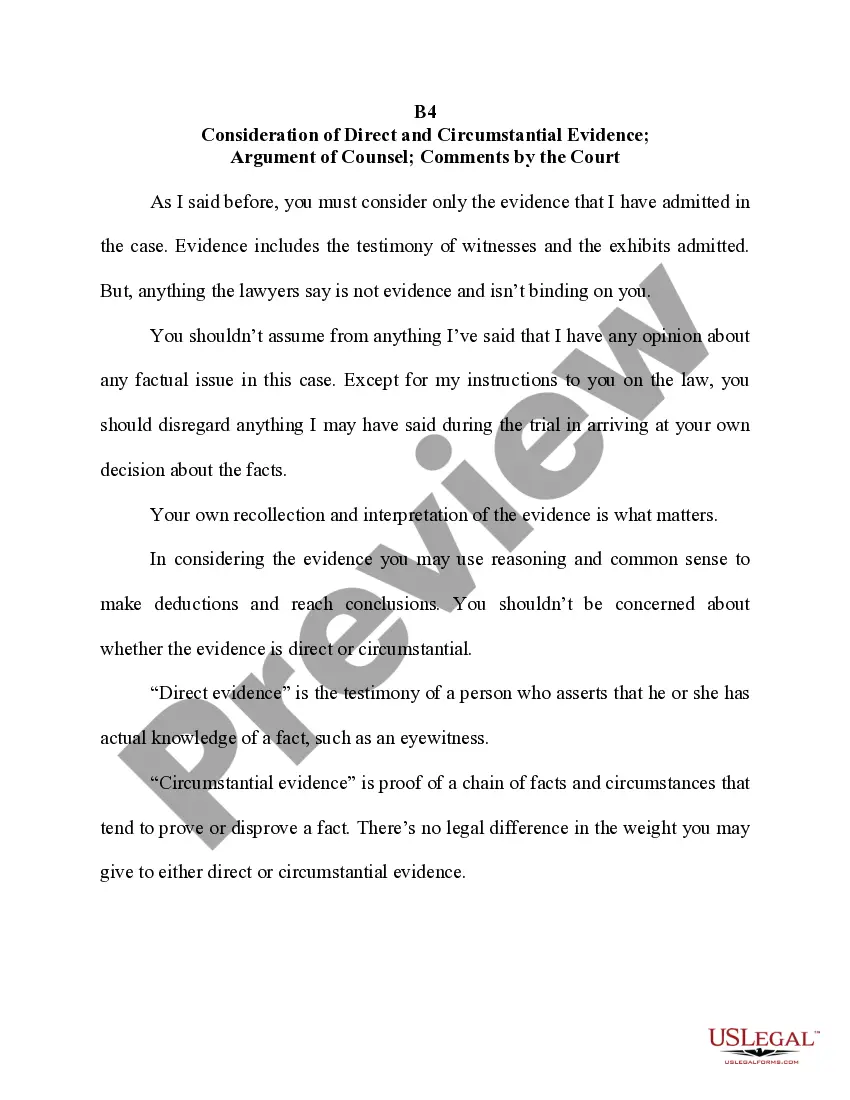
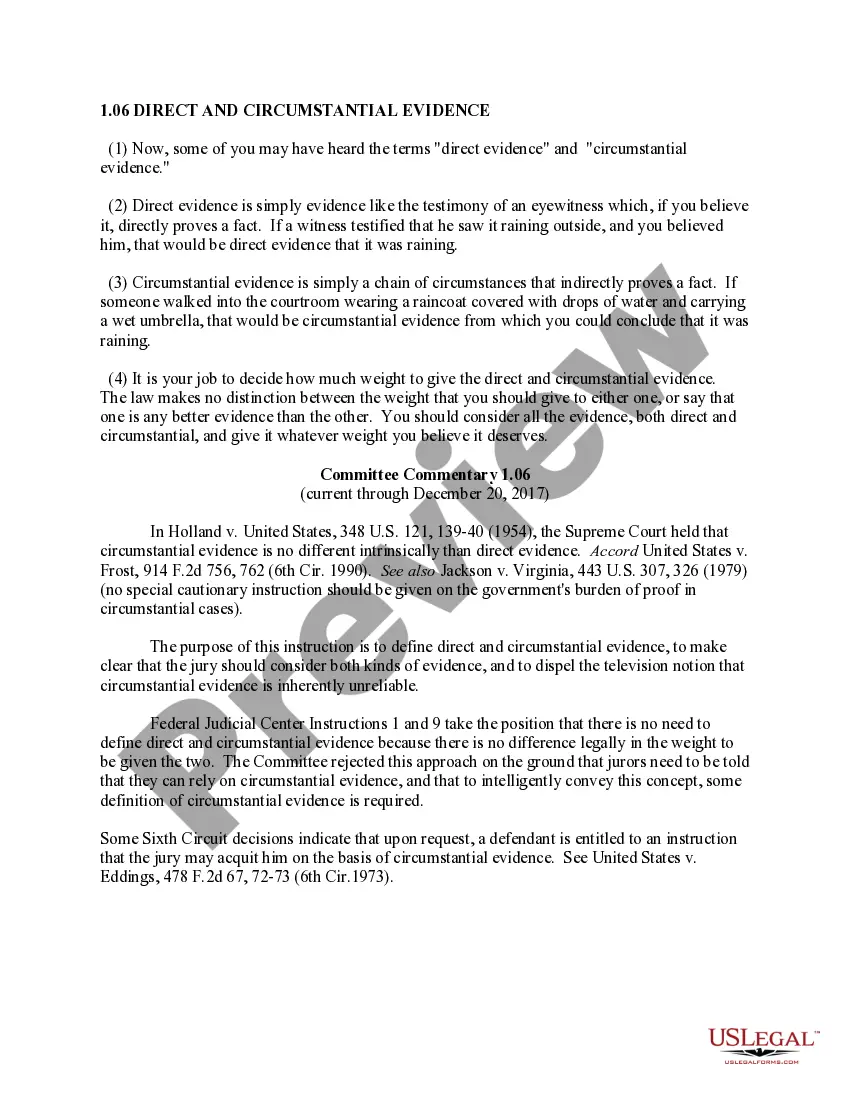
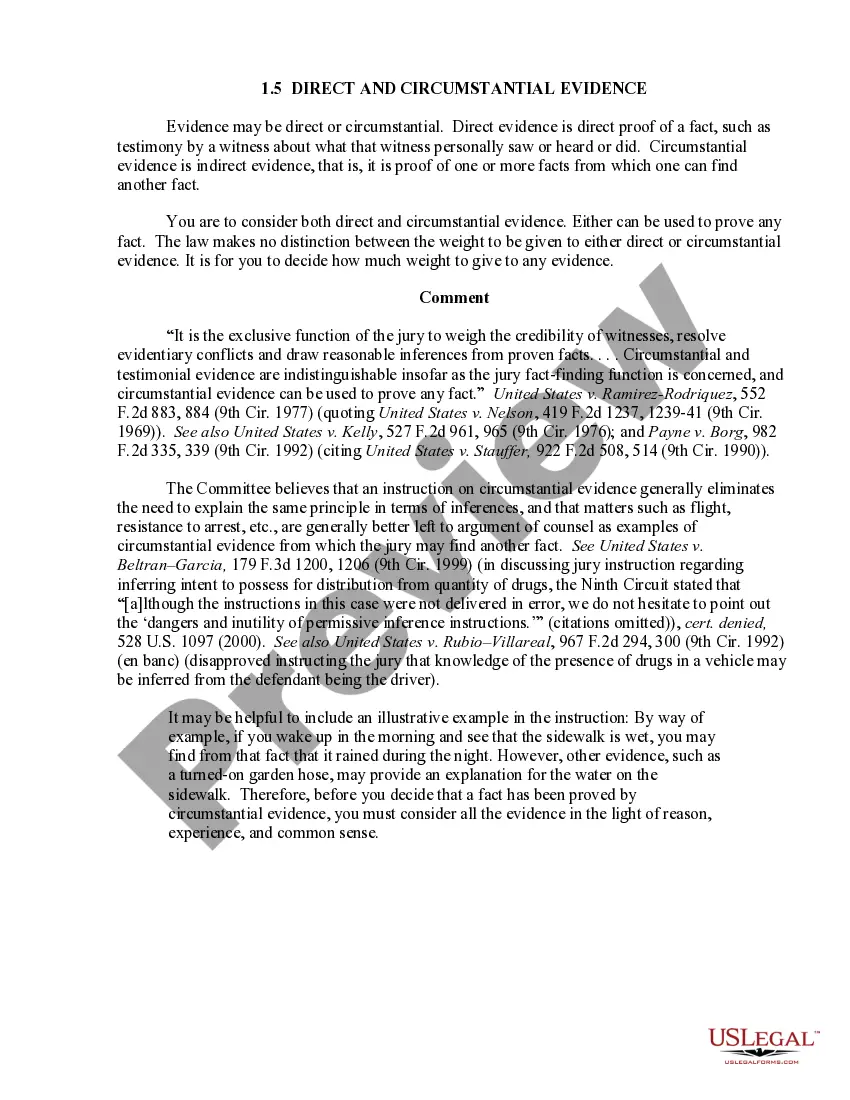
The Jury Instruction form regarding Evidence - Direct and Circumstantial Argument of Counsel provides essential guidance for jury deliberations in legal cases. This form outlines how jurors should evaluate evidence presented in court, emphasizing the importance of their independent recollection and interpretation over what lawyers argue. It distinguishes between direct evidence, such as eyewitness testimony, and circumstantial evidence, which consists of facts that imply conclusions. This form serves as a valuable model and must be tailored to align with the specifics of each case.
Form components explained
- Definition of evidence, including both direct and circumstantial types.
- Instruction on the jurors' duty to rely on admitted evidence only.
- Clarification that arguments made by counsel are not evidence.
- Guidance on making deductions and drawing conclusions based on the evidence.
- References to relevant legal case precedents to support the instructions.
When to use this document
This form should be used during trials where a jury is tasked with determining the facts of a case. It is particularly applicable in situations where differing perspectives on evidence may arise, including criminal and civil cases. This instruction is critical for ensuring jurors understand how to properly assess both types of evidence and maintain focus on the evidence presented rather than on attorneys' arguments.
Who should use this form
Eligible users of this form include:
- Judges presiding over jury trials who need to provide clear instructions to jurors.
- Attorneys involved in cases where jury deliberation and evidence assessment are critical.
- Court clerks responsible for preparing materials for jury instructions.
Completing this form step by step
- Identify the case for which the instructions apply, including case number and title.
- Adapt the sample language to reflect the specific evidence and circumstances of the case.
- Include relevant references to case law that supports the jury instructions given.
- Consider consultation with legal experts to ensure compliance with local regulations.
- Finalize the document for presentation to the jury for their deliberation.
Notarization guidance
This form usually doesn’t need to be notarized. However, local laws or specific transactions may require it. Our online notarization service, powered by Notarize, lets you complete it remotely through a secure video session, available 24/7.
Get your form ready online
Our built-in tools help you complete, sign, share, and store your documents in one place.
Make edits, fill in missing information, and update formatting in US Legal Forms—just like you would in MS Word.
Download a copy, print it, send it by email, or mail it via USPS—whatever works best for your next step.
Sign and collect signatures with our SignNow integration. Send to multiple recipients, set reminders, and more. Go Premium to unlock E-Sign.
If this form requires notarization, complete it online through a secure video call—no need to meet a notary in person or wait for an appointment.
We protect your documents and personal data by following strict security and privacy standards.

Make edits, fill in missing information, and update formatting in US Legal Forms—just like you would in MS Word.

Download a copy, print it, send it by email, or mail it via USPS—whatever works best for your next step.

Sign and collect signatures with our SignNow integration. Send to multiple recipients, set reminders, and more. Go Premium to unlock E-Sign.

If this form requires notarization, complete it online through a secure video call—no need to meet a notary in person or wait for an appointment.

We protect your documents and personal data by following strict security and privacy standards.
Typical mistakes to avoid
- Failing to customize the instructions to fit the specifics of the case.
- Neglecting to reference local legal standards and case law.
- Misunderstanding the difference between direct and circumstantial evidence.
Advantages of online completion
- Immediate access to professionally drafted instructions tailored for jury trials.
- Editability allows for case-specific customization without needing to start from scratch.
- Reliable format ensures compliance with common legal standards across jurisdictions.
Legal use & context
- This form serves as a guideline for proper jury deliberation regarding evidence.
- Instructions should align with state-specific legal norms for jury trials.
- Understanding these instructions is crucial for jurors to arrive at fair verdicts based on evidence.
Looking for another form?

Form popularity
FAQ
Circumstantial evidence usually is that which suggests a fact by implication or inference: the appearance of the scene of a crime, testimony that suggests a connection or link with a crime, physical evidence that suggests criminal activity.
For example, that a suspect is seen running away from a murder scene with a weapon in hand is circumstantial evidence he committed the murder. This contrasts with direct evidence, which directly proves the fact in question. An eyewitness who testifies to seeing the suspect shoot the victim is direct evidence.
Circumstantial evidence is proof of a fact or set of facts from which one could infer the fact in question. For example, that a suspect is seen running away from a murder scene with a weapon in hand is circumstantial evidence he committed the murder.
Evidence is direct when every fact in dispute are communicated by those who has actual knowledge of them by means of the senses.Circumstantial evidence is indirect evidence and requires the use of a logical inference from the facts presented to resolve the issue in dispute.
Evidence that directly links a person to a crime, without the need of any inference (for example, they were seen committing the crime). Compare to circumstantial evidence.
Direct evidence can be a witness testifying about their direct recollection of events. This can include what they saw, what they heard or anything they observed with their senses.Circumstantial evidence is when a witness cannot tell you directly about the fact that is intended to be proved.
Eyewitness testimony that a person was seen fleeing from the scene of a crime; A person's fingerprints found at the scene of the crime alongside other people's fingerprints;
Evidence can be either direct or circumstantial. Direct evidence establishes a fact. Examples of direct evidence are eyewitness statements and confessions. Circumstantial evidence, on the other hand, requires that a judge and/or jury make an indirect judgment, or inference, about what happened.
Security camera footage showing a person breaking into a store and stealing items; An audio recording of a person admitting to committing a crime; Ballistics tests that show a bullet was fired by a specific firearm; Eyewitness testimony that a person saw the defendant commit a crime;