15.01 DEFENSE THEORY INSTRUCTIONS - THREE OPTIONS OVERVIEW
Overview of this form
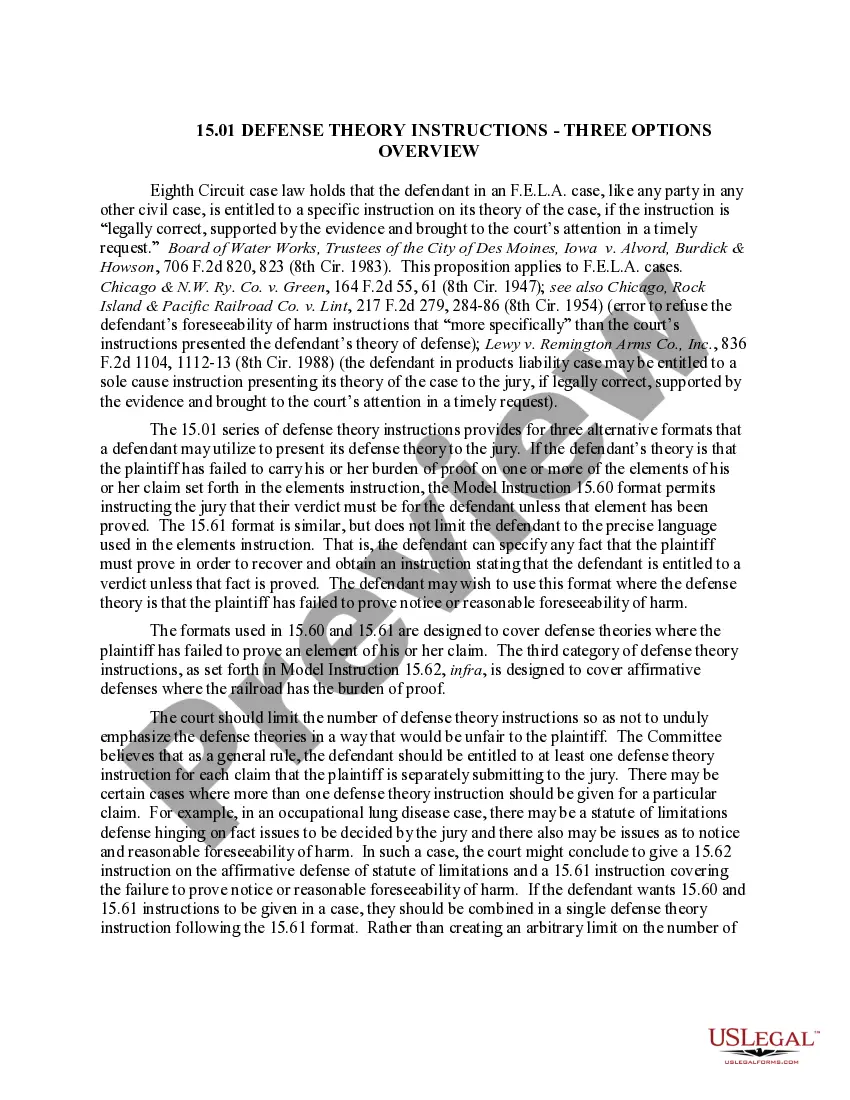
The 15.01 Defense Theory Instructions - Three Options Overview is a legal instruction form intended for use in a Federal Employers' Liability Act (F.E.L.A.) case. This form allows defendants to present their theory of defense regarding a plaintiff's claim. Unlike other forms, this one focuses specifically on providing instructions that are tailored to the evidence presented in the case, ensuring that the jury receives clear guidance on the defendant's arguments.
Form components explained
- 15.60 format: Instruction for the jury that the defendant prevails unless the plaintiff proves specific elements of their claim.
- 15.61 format: Allows specificity while presenting the defendant's required elements that must be proved by the plaintiff.
- 15.62 format: Covers affirmative defenses where the defendant bears the burden of proof.
- Flexibility guidance: Instructions can be combined where multiple defense theories exist.
- Limitations to avoid bias: Guidelines to ensure fairness in presenting defense theories.

Common use cases
This form should be used when a defendant in an F.E.L.A. case needs to provide a structured instruction to the jury concerning their defense theory. Situations include when the plaintiff has failed to prove certain elements of their claim, when there are multiple possible defenses to present, or when specific factual issues need to be highlighted in court.
Who can use this document
This form is intended for use by:
- Defendants in F.E.L.A. cases seeking to establish their defense theories.
- Attorneys representing defendants who need to instruct the jury regarding the elements the plaintiff must prove.
- Legal teams preparing for trial and requiring a structured approach to jury instructions.
How to complete this form
- Review the evidence against the plaintiff's claims.
- Select the appropriate instruction format: 15.60, 15.61, or 15.62.
- Draft the specific language for the jury instruction based on the chosen format.
- Ensure timely submission of the instruction request to the court.
- Prepare to explain the relevance of the chosen instruction during the trial.
Does this document require notarization?
This form does not typically require notarization to be legally valid. However, some jurisdictions or document types may still require it. US Legal Forms provides secure online notarization powered by Notarize, available 24/7 for added convenience.
Get your form ready online
Our built-in tools help you complete, sign, share, and store your documents in one place.
Make edits, fill in missing information, and update formatting in US Legal Forms—just like you would in MS Word.
Download a copy, print it, send it by email, or mail it via USPS—whatever works best for your next step.
Sign and collect signatures with our SignNow integration. Send to multiple recipients, set reminders, and more. Go Premium to unlock E-Sign.
If this form requires notarization, complete it online through a secure video call—no need to meet a notary in person or wait for an appointment.
We protect your documents and personal data by following strict security and privacy standards.

Make edits, fill in missing information, and update formatting in US Legal Forms—just like you would in MS Word.

Download a copy, print it, send it by email, or mail it via USPS—whatever works best for your next step.

Sign and collect signatures with our SignNow integration. Send to multiple recipients, set reminders, and more. Go Premium to unlock E-Sign.

If this form requires notarization, complete it online through a secure video call—no need to meet a notary in person or wait for an appointment.

We protect your documents and personal data by following strict security and privacy standards.
Mistakes to watch out for
- Failing to timely submit the instruction request to the court.
- Using vague language that does not clearly present the defense theory.
- Overlooking the need for specificity in the required elements or factual issues.
- Not considering the flexibility allowed in combining defense theories.
Why complete this form online
- Convenience of accessing legal instructions from anywhere.
- Editability to customize the instructions based on unique case circumstances.
- Reliability assured through templates drafted by licensed attorneys.
Legal use & context
- Provides a structured format for presenting defense theories in court.
- Ensures that defendants are afforded a fair opportunity to present their case.
- Helps prevent potential jury bias through clear and concise instructions.
Key takeaways
- The 15.01 Defense Theory Instructions offer vital frameworks for defendants in F.E.L.A. cases.
- Proper usage of this form is critical for presenting a compelling defense.
- Flexibility in instruction formats allows for tailored approaches based on court requirements.
Looking for another form?


Form popularity
FAQ
Put options should be exercised when they are in the money, meaning that the strike price is higher than the value of the underlying asset. If the price of the underlying is less than the strike price, the option owner can sell the option to earn a profit from it.
Anyone can trade options in their brokerage account, if approved. At Fidelity, this requires completing an options application that asks questions about your financial situation and investing experience, and reading and signing an options agreement.
Example of a Put Option Transaction Each option contract is worth 100 shares, so this gives him the right to sell 100 shares of Ford at $11 before the expiration date. If Max already holds 100 shares of Ford, his broker will sell these shares at the $11 strike price.
A put option buyer makes a profit if the price falls below the strike price before the expiration. The exact amount of profit depends on the difference between the stock price and the option strike price at expiration or when the option position is closed.
Example: Stock X is trading for $20 per share, and a call with a strike price of $20 and expiration in four months is trading at $1. The contract pays a premium of $100, or one contract $1 100 shares represented per contract. The trader buys 100 shares of stock for $2,000 and sells one call to receive $100.
An option is a contract that gives you the right to buy or sell a financial product at an agreed upon price for a specific period of time. Options are available on numerous financial products, including equities, indices, and ETFs.
So if XYZ is trading at $50, Jane can sell a call with a $55 strike price and a put with a $45 strike price. She'll receive the premium payment from both contracts. Neither option buyer will exercise their contracts as long as the stock's price remains between $45 and $55.
Example of a put option By purchasing a put option for $5, you now have the right to sell 100 shares at $100 per share. If the ABC company's stock drops to $80 then you could exercise the option and sell 100 shares at $100 per share resulting in a total profit of $1,500.